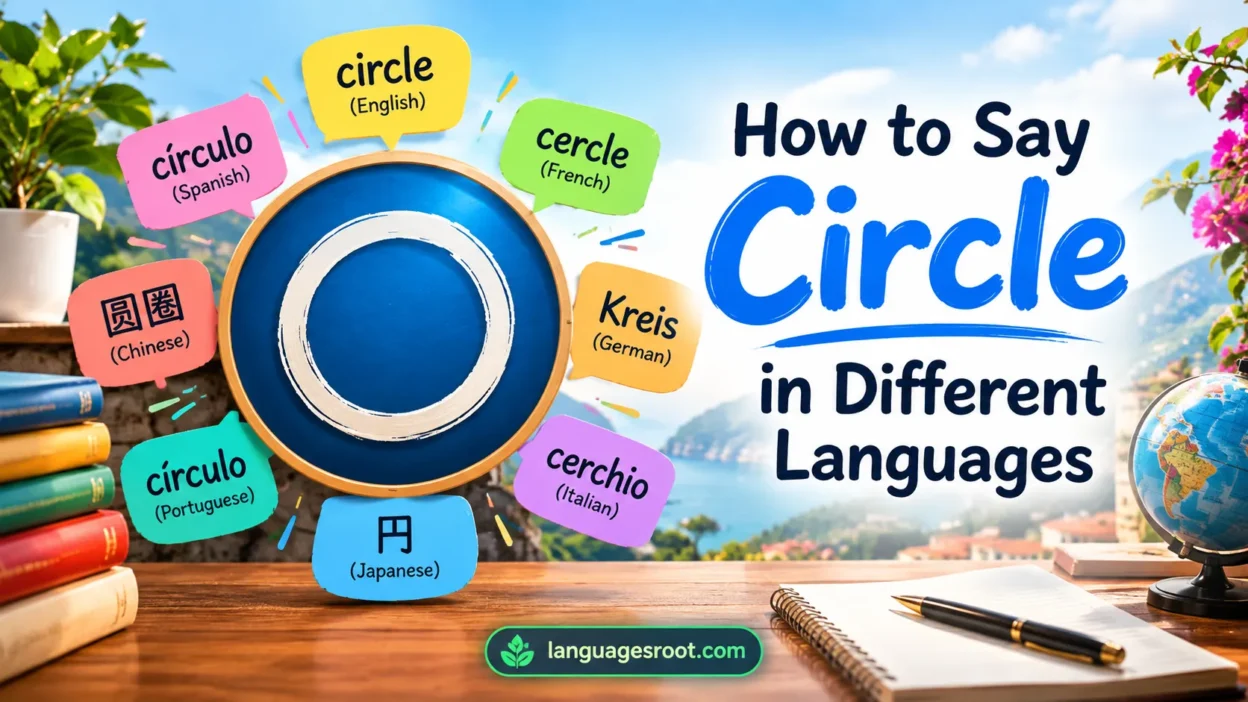
A circle is a geometric shape that appears in mathematics, art, and everyday life. Learning how to say circle in different languages helps you build vocabulary and improve communication skills. Each language has its own word, pronunciation, and cultural context. For example, circle in Spanish is el círculo, while circle in French is le cercle. These simple circle translations make language learning more practical, interesting, and enjoyable.
Whether you are a student, teacher, traveler, or language learner, exploring circle vocabulary can strengthen your language foundation. Moreover, understanding circle pronunciation, meanings, and usage helps you communicate naturally in daily conversations. This guide explores multilingual translations, including circle in Arabic, Vietnamese, and Korean, alongside useful examples. You will also discover how this familiar round shape connects geometry, nature, and different cultures. As a result, learning shape names in different languages becomes an engaging way to explore global languages and improve vocabulary.
Interesting Facts About Circle
- A circle is a two-dimensional shape with a curved boundary.
- Every point on the circumference of a perfect circle is equally distant from its center.
- The distance from the center to the edge is called the radius.
- The distance across a circle through its center is called the diameter.
- The diameter is twice the length of the radius.
- The mathematical constant π, commonly written as pi, is closely connected with circles.
- The circumference of a circle can be calculated using the formula 2πr.
- The area of a circle can be calculated using πr².
- Circles appear naturally in planets, moons, tree rings, bubbles, flowers, and many other objects.
- Wheels use a circular shape because it allows smooth rotational movement.
- The word circle can describe both a physical shape and a social group.
- In some languages, the everyday word for circle and the mathematical term may differ.
- A ring can sometimes be described using a word related to circle, although the exact meaning depends on the language.
- Circles have important symbolic meanings in many cultures, including unity, completeness, eternity, and continuity.
- The circle is one of the most commonly recognized geometric shapes around the world.
How to Say “Circle” in Different Languages
The word circle has interesting equivalents across languages. Some languages use a word specifically meaning a geometric circle, while others have related words that can also describe a ring, round shape, or group.
The tables below include the language, region, translation, pronunciation guidance, related words, and a simple example sentence. Pronunciations are approximate learner-friendly guides rather than formal phonetic transcriptions.
European Languages
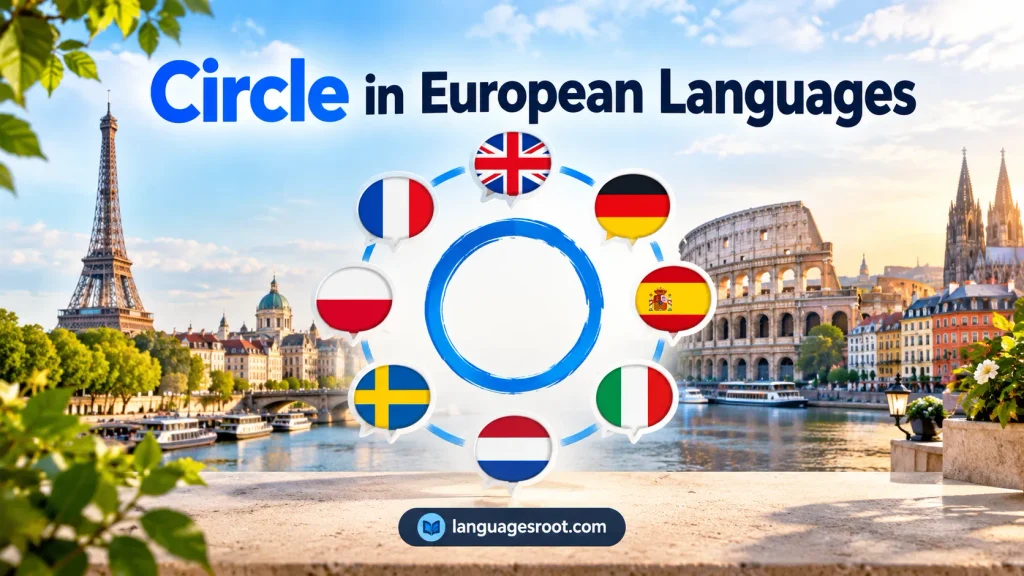
European languages come from several major language families, including Romance, Germanic, Slavic, Celtic, and others. As a result, the word for circle can sound very different from one language to another. Many European languages also have separate terms for geometric circles, rings, circles of people, and circular movements.
| Language | Country/Region | Translation | Pronunciation | Synonyms | Example Sentence |
| 🇺🇸 American English | United States | Circle | SUR-kul | ring, round | Draw a circle on the paper. |
| 🇬🇧 British English | United Kingdom | Circle | SUR-kul | ring, round | Draw a circle around the answer. |
| 🇦🇺 Australian English | Australia | Circle | SUR-kul | ring, round | The children stood in a circle. |
| 🇪🇸 Spanish | Spain, Latin America | Círculo | SEER-koo-loh | aro, circunferencia | Dibuja un círculo. |
| 🇫🇷 French | France | Cercle | SER-kl | rond, anneau | Dessine un cercle. |
| 🇮🇹 Italian | Italy | Cerchio | CHER-kyoh | anello, tondo | Disegna un cerchio. |
| 🇵🇹 Portuguese | Portugal, Brazil | Círculo | SEER-koo-loo | aro, roda | Desenhe um círculo. |
| 🇩🇪 German | Germany, Austria | Kreis | KRYSE | Ring, Rundung | Zeichne einen Kreis. |
| 🇳🇱 Dutch | Netherlands, Belgium | Cirkel | SEER-kel | ring, rond | Teken een cirkel. |
| 🇸🇪 Swedish | Sweden | Cirkel | SEER-kel | ring | Rita en cirkel. |
| 🇳🇴 Norwegian | Norway | Sirkel | SEER-kel | ring | Tegn en sirkel. |
| 🇩🇰 Danish | Denmark | Cirkel | SEER-kel | ring | Tegn en cirkel. |
| 🇫🇮 Finnish | Finland | Ympyrä | UM-puh-rah | kehä | Piirrä ympyrä. |
| 🇮🇸 Icelandic | Iceland | Hringur | HRING-ur | hringlaga form | Teiknaðu hring. |
| 🇵🇱 Polish | Poland | Koło | KOH-woh | okrąg | Narysuj koło. |
| 🇨🇿 Czech | Czech Republic | Kruh | KROOKH | kolečko | Nakresli kruh. |
| 🇸🇰 Slovak | Slovakia | Kruh | KROOKH | krúžok | Nakresli kruh. |
| 🇺🇦 Ukrainian | Ukraine | Коло | KOH-loh | окружність | Намалюй коло. |
| 🇷🇺 Russian | Russia | Круг | KROOK | окружность | Нарисуй круг. |
| 🇧🇬 Bulgarian | Bulgaria | Кръг | KRUG | окръжност | Нарисувай кръг. |
| 🇷🇸 Serbian | Serbia | Круг | KROOG | кружница | Nacrtaj krug. |
| 🇭🇷 Croatian | Croatia | Krug | KROOG | kružnica | Nacrtaj krug. |
| 🇸🇮 Slovenian | Slovenia | Krog | KROHG | krožnica | Nariši krog. |
| 🇸🇰 Slovak | Slovakia | Kruh | KROOKH | krúžok | Nakresli kruh. |
| 🇬🇷 Greek | Greece | Κύκλος | KEE-kloos | δακτύλιος | Σχεδίασε έναν κύκλο. |
| 🇷🇴 Romanian | Romania | Cerc | CHERK | rotund, inel | Desenează un cerc. |
| 🇭🇺 Hungarian | Hungary | Kör | KUR | karika | Rajzolj egy kört. |
| 🇱🇹 Lithuanian | Lithuania | Apskritimas | ap-SKREE-tee-mas | ratas | Nubrėžk apskritimą. |
| 🇱🇻 Latvian | Latvia | Aplis | AH-plis | loks | Uzzīmē apli. |
| 🇪🇪 Estonian | Estonia | Ring | RING | rõngas | Joonista ring. |
| 🇮🇪 Irish | Ireland | Ciorcal | KEER-kul | fáinne | Tarraing ciorcal. |
| 🇽🇰 Albanian | Albania, Kosovo | Rreth | RRETH | unazë | Vizato një rreth. |
| 🇲🇹 Maltese | Malta | Ċirku | CHEER-koo | ċirku | Iġbed ċirku. |
These languages show how one basic geometric idea can have many different linguistic forms. Romance languages often have related words, while Germanic and Slavic languages have their own distinct vocabulary. The examples also demonstrate how the word can be naturally used in everyday instructions.
Also Read: How to Say “Cinder” in Different Languages
Asian Languages
Asia contains thousands of languages and many different writing systems. Words for circle can be written using Latin letters, Chinese characters, Japanese kana and kanji, Korean Hangul, Arabic-derived scripts, and other writing systems. In several Asian languages, the same basic word may be used for a geometric circle or a round shape.
| Language | Country/Region | Translation | Pronunciation | Synonyms | Example Sentence |
| 🇨🇳 Mandarin Chinese | China, Taiwan | 圆 / 圓 | yuán | 圆形 | 画一个圆。 |
| 🇯🇵 Japanese | Japan | 円 / 丸 | en / maru | 円形, 丸い形 | 円を描いてください。 |
| 🇰🇷 Korean | South Korea | 원 | won | 원형 | 원을 그려 주세요. |
| 🇻🇳 Vietnamese | Vietnam | Hình tròn | hing chon | vòng tròn | Hãy vẽ một hình tròn. |
| 🇹🇭 Thai | Thailand | วงกลม | wong-klom | รูปวงกลม | วาดวงกลมหนึ่งวง |
| 🇮🇩 Indonesian | Indonesia | Lingkaran | ling-kah-ran | bulatan | Gambarlah sebuah lingkaran. |
| 🇲🇾 Malay | Malaysia, Brunei | Bulatan | boo-lah-tan | lingkaran | Lukis satu bulatan. |
| 🇵🇭 Filipino | Philippines | Bilog | bee-log | bilugan | Gumuhit ng bilog. |
| 🇮🇳 Hindi | India | वृत्त | vritt | गोल | एक वृत्त बनाइए। |
| 🇧🇩 Bengali | Bangladesh, India | বৃত্ত | brit-to | গোল | একটি বৃত্ত আঁকুন। |
| 🇵🇰 Urdu | Pakistan, India | دائرہ | daa-yeh-rah | حلقہ | ایک دائرہ بنائیں۔ |
| 🇮🇳 Punjabi | India, Pakistan | ਚੱਕਰ / دائرہ | chakkar | ਗੋਲ | ਇੱਕ ਦਾਇਰਾ ਬਣਾਓ۔ |
| 🇮🇳 Marathi | India | वर्तुळ | var-tool | गोल | एक वर्तुळ काढा. |
| 🇮🇳 Gujarati | India | વર્તુળ | var-too-l | ગોળ | એક વર્તુળ દોરો. |
| 🇳🇵 Nepali | Nepal | वृत्त | brit-ta | गोलो | एउटा वृत्त बनाउनुहोस्। |
| 🇱🇰 Sinhala | Sri Lanka | වෘත්තය | vur-tha-ya | රවුම | වෘත්තයක් අඳින්න. |
| 🇮🇷 Persian | Iran | دایره | daa-yeh-reh | حلقه | یک دایره بکشید. |
| 🇦🇫 Pashto | Afghanistan | دایره | daa-yeh-rah | ګرد | یوه دایره رسم کړئ. |
| 🇲🇳 Mongolian | Mongolia | Тойрог | toy-rog | дугуй | Тойрог зур. |
| 🇰🇭 Khmer | Cambodia | រង្វង់ | rong-vong | រង្វង់មូល | គូសរង្វង់មួយ។ |
| 🇱🇦 Lao | Laos | ວົງມົນ | vong-mon | ວົງ | ແຕ້ມວົງມົນ. |
| 🇲🇲 Burmese | Myanmar | စက်ဝိုင်း | set-wine | ဝိုင်း | စက်ဝိုင်းတစ်ခု ဆွဲပါ။ |
| 🇬🇪 Georgian | Georgia | წრე | TSREH | რგოლი | დახატე წრე. |
| 🇦🇲 Armenian | Armenia | Շրջան | shur-chan | օղակ | Շրջան նկարիր։ |
| 🇦🇿 Azerbaijani | Azerbaijan | Dairə | dah-ee-reh | halqa | Bir dairə çək. |
Across Asia, the concept of a circle is often connected with ideas such as roundness, completeness, movement, and repetition. In languages that use different scripts, learning both the written form and pronunciation can make the word easier to remember.
African Languages
Africa is home to extraordinary linguistic diversity, with languages belonging to several major language families. Some African languages are spoken across multiple countries, while others are strongly associated with particular communities. The word for circle may also overlap with terms meaning ring, round shape, or circular object.
| Language | Country/Region | Translation | Pronunciation | Synonyms | Example Sentence |
| 🇸🇦 Arabic | North Africa and beyond | دائرة | daa-ee-rah | حلقة, دائرة مستديرة | ارسم دائرة. |
| 🇪🇹 Amharic | Ethiopia | ክብ | kib | ክብ ቅርጽ | ክብ ሳል። |
| 🇸🇴 Somali | Somalia, Somaliland | Goobo | goo-bo | wareeg | Sawir goobo. |
| 🇰🇪 Swahili | East Africa | Duara | doo-ah-rah | mduara | Chora duara. |
| 🇿🇦 Zulu | South Africa | Isiyingi | ee-see-ying-ee | indilinga | Dweba isiyingi. |
| 🇿🇦 Xhosa | South Africa | Isangqa | ee-sang-kah | isangqa esijikelezayo | Zoba isangqa. |
| 🇿🇦 Afrikaans | South Africa, Namibia | Sirkel | SEER-kel | ring | Teken ‘n sirkel. |
| 🇳🇬 Yoruba | Nigeria, Benin | Yíyíká | yee-yee-kah | àyíká | Ya yíyíká kan. |
| 🇳🇬 Igbo | Nigeria | Okirikiri | oh-kee-ree-kee-ree | gburugburu | See okirikiri. |
| 🇳🇬 Hausa | Nigeria, Niger | Da’ira | dah-ee-rah | zobe | Zana da’ira. |
| 🇲🇬 Malagasy | Madagascar | Faribolana | fah-ree-boh-lah-nah | boribory | Manaova faribolana. |
| 🇷🇼 Kinyarwanda | Rwanda | Uruziga | oo-roo-zee-gah | uruziga | Shushanya uruziga. |
| 🇧🇼 Setswana | Botswana, South Africa | Sedikologo | seh-dee-koh-loh-goh | kgolokwe | Thala sedikologo. |
| 🇱🇸 Sesotho | Lesotho, South Africa | Sedikadikwe | seh-dee-kah-dee-kweh | selikalikoe | Thala sedikadikwe. |
| 🇲🇿 Chichewa | Malawi, Zambia | Bwalo | bwah-loh | bwalo lozungulira | Jambulani bwalo. |
African languages demonstrate the enormous variety of vocabulary used for basic shapes. In multilingual countries, people may know several words for the same object depending on the language they use at home, school, work, or in their community.
Middle Eastern Languages
The Middle East includes languages with long literary and cultural histories. Arabic, Persian, Hebrew, Turkish, Kurdish, and other languages use different writing systems and vocabulary traditions. Circle-related words may describe a geometric circle, a ring, or something that surrounds an area.
| Language | Country/Region | Translation | Pronunciation | Synonyms | Example Sentence |
| 🇸🇦 Arabic | Saudi Arabia, Middle East | دائرة | daa-ee-rah | حلقة | ارسم دائرة. |
| 🇮🇷 Persian | Iran | دایره | daa-yeh-reh | حلقه | یک دایره بکش. |
| 🇮🇱 Hebrew | Israel | מעגל | ma-GAL | עיגול | צייר מעגל. |
| 🇹🇷 Turkish | Turkey | Daire | dah-ee-reh | çember, halka | Bir daire çiz. |
| 🇮🇶 Kurdish | Iraq, Iran, Turkey, Syria | Bazin | bah-zeen | xeleq | Bazinekê bikişîne. |
| 🇦🇿 Azerbaijani | Azerbaijan | Dairə | dah-ee-reh | halqa | Dairə çək. |
| 🇦🇲 Armenian | Armenia | Շրջան | shur-chan | օղակ | Շրջան գծիր։ |
| 🇬🇪 Georgian | Georgia | წრე | TSREH | რგოლი | დახატე წრე. |
| 🇵🇸 Palestinian Arabic | Palestine | دائرة | daa-ee-rah | حلقة | ارسم دائرة. |
| 🇯🇴 Jordanian Arabic | Jordan | دائرة | daa-ee-rah | حلقة | ارسم دائرة. |
The region’s vocabulary also shows why context matters when translating simple words. A word that refers to a geometric circle in one context may refer to a ring, loop, surrounding area, or group in another context.
Additional Languages Around the World
Languages outside the major regional groups add even more variety to the word circle. These examples include languages from Central Asia, the Pacific, the Americas, and other parts of the world. Learning these forms can be especially useful for international students, travelers, teachers, and anyone interested in world languages.
| Language | Country/Region | Translation | Pronunciation | Synonyms | Example Sentence |
| 🇰🇿 Kazakh | Kazakhstan | Шеңбер | sheng-ber | дөңгелек | Шеңбер сыз. |
| 🇺🇿 Uzbek | Uzbekistan | Doira | doh-ee-rah | aylana | Doira chizing. |
| 🇹🇯 Tajik | Tajikistan | Доира | doh-ee-rah | ҳалқа | Доира кашед. |
| 🇹🇲 Turkmen | Turkmenistan | Tegelek | teh-geh-lek | halka | Tegelek çyz. |
| 🇰🇬 Kyrgyz | Kyrgyzstan | Тегерек | teh-geh-rek | айлана | Тегерек тарт. |
| 🇮🇱 Hebrew | Israel | עיגול | ee-GOOL | מעגל | צייר עיגול. |
| 🇪🇸 Catalan | Spain | Cercle | SER-kleh | rodona | Dibuixa un cercle. |
| 🇪🇸 Basque | Spain | Zirkulu | zeer-koo-loo | biribil | Marraztu zirkulu bat. |
| 🇪🇸 Galician | Spain | Círculo | SEER-koo-loh | aro | Debuxa un círculo. |
| 🇧🇷 Portuguese | Brazil | Círculo | SEER-koo-loo | aro | Desenhe um círculo. |
| 🇨🇦 Canadian French | Canada | Cercle | SER-kl | rond | Dessine un cercle. |
| 🇳🇿 Māori | New Zealand | Porowhita | poh-roh-fee-tah | porowhita | Tuhia he porowhita. |
| 🇼🇸 Samoan | Samoa | Li’o | lee-oh | mamao | Tusi se li’o. |
| 🇹🇴 Tongan | Tonga | Fakamamafa | fah-kah-mah-mah-fah | takai | Tohi ha takai. |
| 🇮🇩 Javanese | Indonesia | Bunderan | boon-deh-ran | bunder | Gawe bunderan. |
| 🇮🇩 Sundanese | Indonesia | Buleud | boo-leh-ood | buleud | Jieun buleud. |
| 🇲🇾 Malay | Malaysia | Bulatan | boo-lah-tan | lingkaran | Lukis bulatan. |
| 🇲🇽 Nahuatl | Mexico | Malacachtic | mah-lah-kash-tik | round form | Draw the round shape. |
| 🇵🇪 Quechua | Andes | Muyuri | moo-yoo-ree | muyu | Ruwana muyuri. |
Because some languages have multiple dialects and regional varieties, translations can vary. A word used in one country may sound different or have a slightly different meaning in another region. For formal writing or professional translation, native-speaker review is always useful.
Circle in Different Contexts
The English word circle has several meanings, so choosing the correct translation depends on context.
When talking about geometry, circle usually means a perfectly round two-dimensional shape. For example, a teacher might say, “Draw a circle.” In this situation, the translation should refer specifically to the geometric shape.
Circle can also describe a group of people. For example, “She has a close circle of friends” does not refer to a physical shape. It describes a social group.
The word can also appear as a verb. Someone can circle an answer on a worksheet, meaning they draw a curved line around it. In another context, a person or vehicle can circle an area, meaning they move around it.
There are also expressions such as “full circle,” which means returning to an earlier point or situation. Because of these different meanings, direct word-for-word translation is not always the best approach.
How to Pronounce “Circle” in English
In American, British, and Australian English, circle is generally pronounced with the same basic sound pattern, although individual accents can vary.
The word has two syllables and begins with the sir sound. The final part is lighter and less strongly stressed. When learning English, listening to native speakers can help you understand the natural rhythm better than relying only on spelling.
The spelling can also be confusing for beginners because English pronunciation does not always follow simple letter-by-letter rules. Practicing the word in complete sentences is often more useful than repeating it alone.
Common Synonyms for Circle
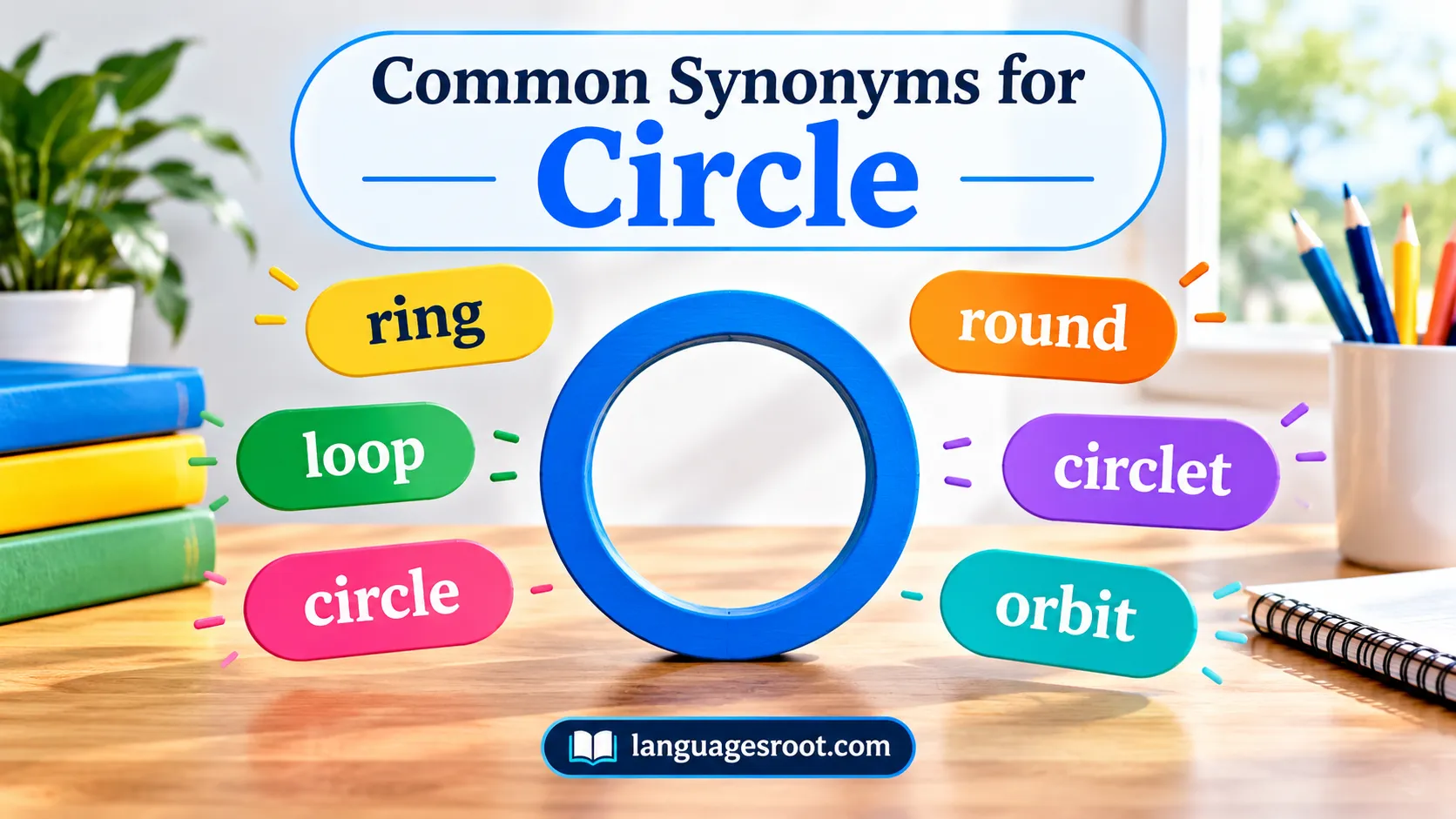
Depending on the context, several English words can be related to circle.
Ring can describe a circular object or band. For example, a wedding ring is circular.
Round can describe something with a circular or curved shape. It is often used as an adjective.
Loop describes a curved shape that returns toward itself.
Disk or disc can describe a flat, circular object.
Orbit describes the curved path of one object around another, although it does not mean exactly the same thing as circle.
Circumference refers specifically to the boundary or distance around a circle in mathematics.
Sphere is related to roundness but describes a three-dimensional object rather than a two-dimensional circle.
Understanding these distinctions can help you choose the right word when speaking or writing.
Why Learn the Word “Circle” in Different Languages?
Learning simple words across languages can be an enjoyable introduction to international communication. You do not need to become fluent in a language before learning useful vocabulary. Even a few words can help you recognize signs, understand educational materials, communicate while traveling, or connect with speakers of another language.
The word circle is particularly useful because shapes appear everywhere. You may encounter the concept in classrooms, maps, instructions, artwork, design, mathematics, construction, technology, and everyday conversations.
Learning vocabulary in several languages can also help you notice connections between languages. Some words may look or sound similar because languages share historical roots, while others may be completely different.
Frequently Asked Questions
How do you say “circle” in different languages?
The word circle has different translations across languages. For example, círculo means circle in Spanish, cercle in French, Kreis in German, and cerchio in Italian. These words are commonly used for the geometric shape.
How do you say “circle” in Arabic, Urdu, and Hindi?
In Arabic, circle is دائرة (dā’irah). In Urdu, it is دائرہ (daaira), while the Hindi mathematical term is वृत्त (vritt). Pronunciation and everyday usage may vary by language and context.
How do you pronounce “circle” in English?
The English word circle has two syllables and is commonly pronounced “SUR-kul.” American, British, and Australian English use a similar basic pronunciation, though accents may differ. Practice saying it in simple sentences to improve your pronunciation.
What is the difference between a circle and a sphere?
A circle is a two-dimensional geometric shape with a curved boundary. A sphere is a three-dimensional object, like a ball. Both are round, but they describe different geometric forms.
Why can the translation of “circle” vary between languages?
Translations can vary because circle has several meanings. It can describe a geometric shape, a social group, or the act of drawing a line around something. Therefore, understanding the context helps you choose the correct translation.
Conclusion
Learning how to say circle in different languages helps you build circle vocabulary and explore language translations from around the world. From círculo in Spanish to le cercle in French and دائرة in Arabic, each translation offers a new way to understand this familiar geometric shape. Moreover, practicing circle pronunciation and exploring its meanings in mathematics, art, and everyday life can improve your language learning and communication skills.