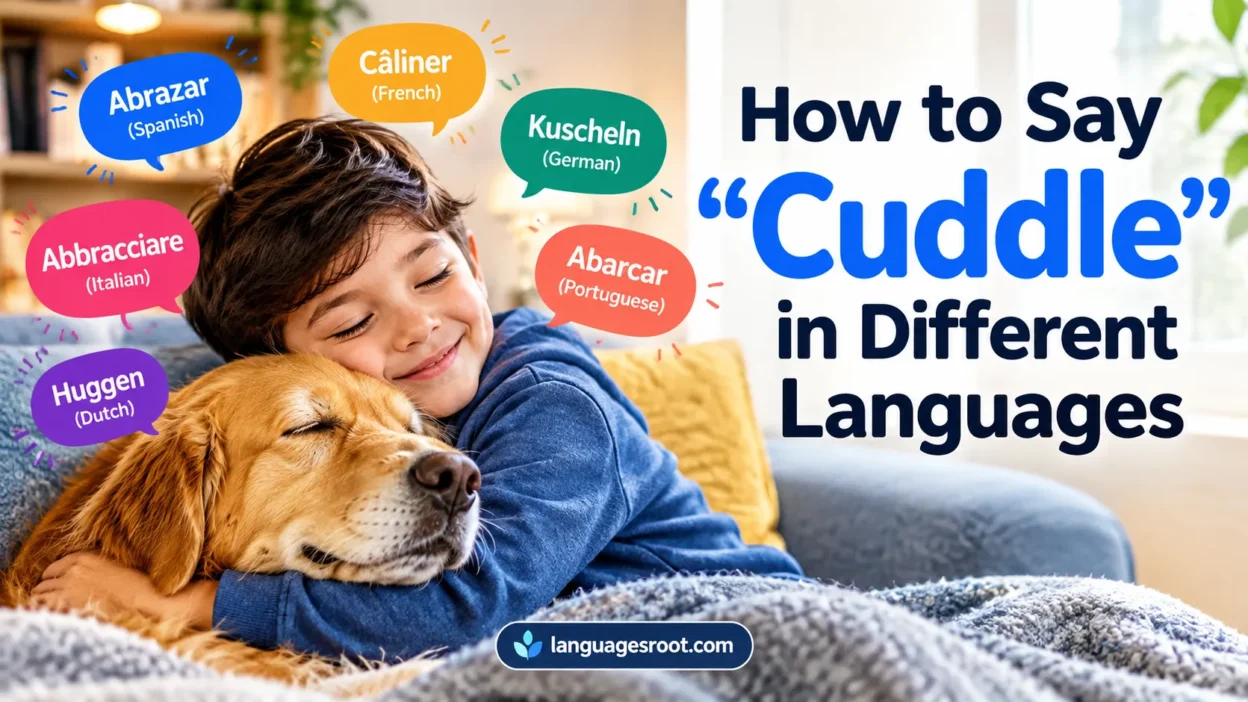
A cuddle expresses warmth, comfort, and tenderness through physical closeness. Across cultures, cuddling and snuggling show affection, emotional closeness, and physical affection. However, language differences can shape how people describe these gentle moments. Learning how to say cuddle in different languages helps you understand affectionate expressions and connect with people worldwide.
This translation guide explores cuddle word translations across European languages, Asian languages, African languages, and Middle Eastern languages. You will discover natural translations, cuddle pronunciation, cuddle synonyms, and example sentences for everyday conversations. Additionally, explore cultural differences, friendly affection, and familial affection to understand each expression better. Whether you enjoy language learning or expressing affection, these translations help you communicate warmth naturally.
Interesting Facts About Cuddle
- Cuddle does not have one universal word-for-word equivalent. Some languages express the idea through words meaning snuggle, hug, embrace, or hold close.
- The English word cuddle usually suggests staying physically close for affection, comfort, or relaxation rather than giving a brief hug.
- Hug and cuddle are not always interchangeable. A hug can be brief, while cuddling often suggests remaining close for longer.
- Snuggle is also closely related to cuddle, but it often emphasizes getting comfortably close, especially while sitting or lying down.
- Some languages use a reflexive verb to describe cuddling together, while others use a noun, ordinary verb, or descriptive phrase.
- In several languages, the most natural expression changes according to formality, relationship, gender, or grammatical structure.
- Physical affection can have different social meanings across communities, so a direct translation does not automatically carry exactly the same emotional tone everywhere.
What Does Cuddle Mean?
Cuddle means to hold, embrace, or stay very close to another person in a comfortable and affectionate way. It can involve sitting, lying, or resting close together while hugging or gently holding one another.
The word can have an emotional meaning as well as a physical one. Someone may cuddle another person to show love, provide comfort, enjoy closeness, or simply relax together. It can be used in romantic relationships, but it is not limited to romance. Parents may cuddle children, and people may use affectionate physical closeness in other family or caring relationships.
In everyday English, cuddle can function as both a verb and a noun. For example, “I want to cuddle” describes an action, while “We had a cuddle” describes the affectionate time spent together.
The closest translation therefore depends on whether you mean cuddle, snuggle, hug closely, embrace, or stay physically close.
Why Can Cuddle Have Different Translations?
There is no single perfect translation for cuddle in every language because languages divide ideas differently. A word that closely matches cuddle in one language may describe only part of the same idea in another.
Context is particularly important. A romantic couple might choose a more intimate expression, while a family situation may call for a general word for hugging or holding someone close.
Other factors include:
- Formality: Casual speech may use a different expression from formal writing.
- Relationship: Romantic partners, friends, parents, and children may use different expressions.
- Gender: Some languages require grammatical agreement based on the speaker or person being addressed.
- Region: A word used naturally in one country may be less common in another.
- Dialect: Spoken varieties can have their own preferred vocabulary.
- Literal meaning: A direct translation may mean “hug” or “embrace” rather than specifically “cuddle.”
- Spoken versus written language: Everyday speech may favor shorter and more expressive forms.
For this reason, the translations below should be understood as natural ways to express the idea of cuddling, rather than identical dictionary equivalents.
European Languages
Europe contains several major language families, including Germanic, Romance, Slavic, Celtic, Baltic, and Uralic languages. Because these languages developed differently, expressions for affection can vary in grammar and emotional tone.
In some European languages, there is a dedicated word for cuddling or snuggling, while others commonly use an expression involving hugging or staying close. The examples below focus on natural everyday meanings rather than forcing every language into the same literal structure.
English Varieties
| 🌍 Language | Country/Region | Translation | Pronunciation | Example Sentence |
| English | International | cuddle | KUHD-uhl | I love to cuddle when we relax together. |
| American English 🇺🇸 | United States | cuddle | KUHD-uhl | Do you want to cuddle on the sofa? |
| British English 🇬🇧 | United Kingdom | cuddle | KUHD-uhl | We had a lovely cuddle before bed. |
| Australian English 🇦🇺 | Australia | cuddle | KUHD-uhl | Let’s cuddle up and watch a movie. |
English uses cuddle naturally as both a verb and a noun. American, British, and Australian English generally use the same basic word, although pronunciation and conversational preferences can vary slightly.
Also Read: How to Say China in Different Languages
European Language Table
| 🌍 Language | Country/Region | Translation | Pronunciation | Example Sentence |
| Spanish | Spain, Latin America | acurrucarse | ah-koo-roo-KAR-seh | Quiero acurrucarme contigo. Meaning: I want to cuddle with you. |
| French | France, Belgium, Canada | se blottir | suh bloh-TEER | J’aime me blottir contre toi. Meaning: I like cuddling close to you. |
| German | Germany, Austria, Switzerland | kuscheln | KOOSH-eln | Ich möchte mit dir kuscheln. Meaning: I want to cuddle with you. |
| Italian | Italy, Switzerland | coccolarsi | kohk-koh-LAR-see | Mi piace coccolarmi con te. Meaning: I like cuddling with you. |
| Portuguese | Portugal, Brazil | aconchegar-se | ah-kon-sheh-GAR-seh | Quero me aconchegar com você. Meaning: I want to cuddle with you. |
| Dutch | Netherlands, Belgium | knuffelen | KNUHF-uh-len | Ik wil met je knuffelen. Meaning: I want to cuddle with you. |
| Swedish | Sweden, Finland | mysa | MEE-sa | Jag vill mysa med dig. Meaning: I want to cuddle with you. |
| Norwegian | Norway | kose | KOO-seh | Jeg vil kose med deg. Meaning: I want to cuddle with you. |
| Danish | Denmark | putte | POO-deh | Jeg vil putte med dig. Meaning: I want to cuddle with you. |
| Finnish | Finland | käpertyä | KAE-per-tyah | Haluan käpertyä viereesi. Meaning: I want to snuggle beside you. |
| Icelandic | Iceland | kúra | KOO-ra | Mig langar að kúra með þér. Meaning: I want to cuddle with you. |
| Irish | Ireland | snuggle | SNUHG-uhl | Ba mhaith liom snuggle leat. Meaning: I would like to cuddle with you. |
| Welsh | Wales | cwtsho | KUT-shoh | Dw i eisiau cwtsho gyda ti. Meaning: I want to cuddle with you. |
| Scottish Gaelic | Scotland | fuireach dlùth | FOO-ree-akh GLOO | Tha mi airson fuireach dlùth riut. Meaning: I want to stay close to you. |
| Polish | Poland | przytulać się | pshi-too-LATCH shyeh | Chcę się do ciebie przytulić. Meaning: I want to cuddle up to you. |
| Czech | Czech Republic | mazlit se | MAHZ-lit seh | Chci se s tebou mazlit. Meaning: I want to cuddle with you. |
| Slovak | Slovakia | túliť sa | TOO-leet sah | Chcem sa s tebou túliť. Meaning: I want to cuddle with you. |
| Slovenian | Slovenia | crkljati se | TSERK-lyah-tee seh | Rad se crkljam s tabo. Meaning: I like cuddling with you. |
| Croatian | Croatia, Bosnia and Herzegovina | maziti se | MAH-zee-tee seh | Volim se maziti s tobom. Meaning: I love cuddling with you. |
| Serbian | Serbia, Bosnia and Herzegovina | maziti se | MAH-zee-tee seh | Volim da se mazim s tobom. Meaning: I love cuddling with you. |
| Bosnian | Bosnia and Herzegovina | maziti se | MAH-zee-tee seh | Volim se maziti s tobom. Meaning: I love cuddling with you. |
| Bulgarian | Bulgaria | гушкам се | GOOSH-kam seh | Искам да се гушкам с теб. Meaning: I want to cuddle with you. |
| Macedonian | North Macedonia | гушкање | GOOSH-kah-nyeh | Сакам да се гушкам со тебе. Meaning: I want to cuddle with you. |
| Russian | Russia and neighboring regions | обниматься | ah-bee-MAHT-sya | Я хочу с тобой обниматься. Meaning: I want to cuddle with you. |
| Ukrainian | Ukraine | обійматися | oh-bee-MAH-tya-sya | Я хочу з тобою обійматися. Meaning: I want to cuddle with you. |
| Belarusian | Belarus | абдымацца | ab-dih-MAHT-sah | Я хачу з табой абдымацца. Meaning: I want to cuddle with you. |
| Lithuanian | Lithuania | glaustytis | GLOW-stih-tis | Noriu glaustytis prie tavęs. Meaning: I want to cuddle close to you. |
| Latvian | Latvia | mīļoties | MEE-lyoh-tyehs | Es gribu mīļoties ar tevi. Meaning: I want to cuddle with you. |
| Estonian | Estonia | kaisutama | KAI-soo-tah-mah | Ma tahan sinuga kaisutada. Meaning: I want to cuddle with you. |
| Hungarian | Hungary | összebújni | UH-suh-boo-ynee | Szeretnék veled összebújni. Meaning: I would like to cuddle with you. |
| Romanian | Romania, Moldova | a se cuibări | ah seh kwee-BAHR-ee | Vreau să mă cuibăresc lângă tine. Meaning: I want to snuggle beside you. |
| Greek | Greece, Cyprus | αγκαλιάζομαι | ah-gah-lee-AH-zoh-meh | Θέλω να αγκαλιαστώ μαζί σου. Meaning: I want to cuddle with you. |
| Albanian | Albania, Kosovo | përqafohem | per-kah-FO-hem | Dua të përqafohem me ty. Meaning: I want to cuddle with you. |
Cultural Notes for European Languages
European languages show particularly well why cuddle does not always have a direct one-word translation. German kuscheln, Spanish acurrucarse, Finnish käpertyä, and Hungarian összebújni can express forms of affectionate closeness, but their exact usage is shaped by each language’s vocabulary and grammar.
In Slavic languages, words associated with hugging, embracing, or cuddling together may overlap more than the English categories do. When using one of these expressions in a personal message, consider the relationship and the level of intimacy intended.
Asian Languages
Asia contains hundreds of languages belonging to many different language families and using writing systems such as Chinese characters, Japanese kana, Korean Hangul, Devanagari, Arabic-derived scripts, and numerous Indic scripts.
Expressions for cuddling often involve hugging, embracing, holding close, or remaining physically close. The natural expression can also depend strongly on grammar, pronouns, and the relationship between speakers.
| 🌍 Language | Country/Region | Translation | Pronunciation | Example Sentence |
| Hindi | India | गले लगना | guh-ley LUG-na | मैं तुम्हारे साथ गले लगना चाहता हूँ। Meaning: I want to cuddle with you. |
| Urdu | Pakistan, India | گلے لگ کر بیٹھنا | galay lag kar BAITH-na | میں تمہارے ساتھ گلے لگ کر بیٹھنا چاہتا ہوں۔ Meaning: I want to sit close and cuddle with you. |
| Bengali | Bangladesh, India | জড়িয়ে থাকা | jo-ri-ye THA-ka | আমি তোমার সঙ্গে জড়িয়ে থাকতে চাই। Meaning: I want to stay cuddled up with you. |
| Punjabi | Pakistan, India | ਜੱਫੀ ਪਾਉਣਾ | JAF-fee PAU-na | ਮੈਂ ਤੇਰੇ ਨਾਲ ਜੱਫੀ ਪਾਉਣਾ ਚਾਹੁੰਦਾ ਹਾਂ। Meaning: I want to cuddle with you. |
| Gujarati | India | ભેટવું | BHAYT-voo | મારે તમારી સાથે ભેટવું છે. Meaning: I want to cuddle with you. |
| Marathi | India | मिठी मारणे | MIH-thee MAR-nay | मला तुझ्यासोबत मिठी मारायची आहे. Meaning: I want to cuddle with you. |
| Nepali | Nepal | अँगालो हाल्नु | ang-GAA-loh haal-noo | म तिमीसँग अँगालो हाल्न चाहन्छु। Meaning: I want to cuddle with you. |
| Sinhala | Sri Lanka | තුරුළු වෙනවා | too-ROO-loo veh-NAH-wah | මට ඔයාට තුරුළු වෙන්න ඕනේ. Meaning: I want to cuddle with you. |
| Tamil | India, Sri Lanka | அணைத்துக்கொள்ளுதல் | ah-nai-thoo-kol-loo-THAL | நான் உன்னுடன் அணைத்துக்கொள்ள விரும்புகிறேன். Meaning: I want to cuddle with you. |
| Telugu | India | కౌగిలించుకోవడం | kow-gee-LIN-cho-koh-VAH-dum | నేను నీతో కౌగిలించుకోవాలనుకుంటున్నాను. Meaning: I want to cuddle with you. |
| Kannada | India | ತಬ್ಬಿಕೊಳ್ಳುವುದು | thab-bee-KOL-loo-voo-doo | ನಾನು ನಿನ್ನ ಜೊತೆ ತಬ್ಬಿಕೊಳ್ಳಲು ಬಯಸುತ್ತೇನೆ. Meaning: I want to cuddle with you. |
| Malayalam | India | കെട്ടിപ്പിടിക്കുക | ket-tee-pi-dee-KOO-kah | എനിക്ക് നിന്നെ കെട്ടിപ്പിടിക്കണം. Meaning: I want to cuddle you. |
| Odia | India | କୁଣ୍ଢାଇ ହେବା | KOON-dhai HEH-bah | ମୁଁ ତୁମ ସହ କୁଣ୍ଢାଇ ହେବାକୁ ଚାହେଁ। Meaning: I want to cuddle with you. |
| Assamese | India | সাৱটি লোৱা | SAH-vo-tee LOH-wah | মই তোমাৰ লগত সাৱটি থাকিব বিচাৰোঁ। Meaning: I want to cuddle with you. |
| Mandarin Chinese | China, Taiwan, Singapore | 抱抱 | BÀO-bào | 我想和你抱抱。Meaning: I want to cuddle with you. |
| Cantonese | Hong Kong, Guangdong | 攬住 | LAAM jyuh | 我想同你攬住。Meaning: I want to cuddle with you. |
| Japanese | Japan | くっつく | KUHT-tsoo-koo | 君とくっついていたい。Meaning: I want to stay cuddled up with you. |
| Korean | South Korea, North Korea | 꼭 껴안다 | kkok kkyeo-AN-da | 너를 꼭 껴안고 싶어. Meaning: I want to cuddle you tightly. |
| Vietnamese | Vietnam | âu yếm | ow YEHM | Em muốn âu yếm bên anh. Meaning: I want to cuddle affectionately beside you. |
| Thai | Thailand | กอด | GAWT | ฉันอยากกอดคุณ. Meaning: I want to cuddle you. |
| Indonesian | Indonesia | berpelukan | ber-peh-LOO-kan | Aku ingin berpelukan denganmu. Meaning: I want to cuddle with you. |
| Malay | Malaysia, Brunei, Singapore | berpelukan | ber-peh-LOO-kan | Saya mahu berpelukan dengan awak. Meaning: I want to cuddle with you. |
| Filipino | Philippines | yumakap | yoo-MAH-kap | Gusto kong yumakap sa iyo. Meaning: I want to cuddle you. |
Cultural Notes for Asian Languages
In several Asian languages, the closest everyday expression may be related to hugging or embracing rather than a separate English-style category of cuddling. Mandarin 抱抱, for example, is an affectionate reduplicated form that can sound warm and informal.
Pronouns and social relationships can also matter. In languages such as Hindi, Urdu, Bengali, and Korean, the form chosen in a personal sentence may change depending on social relationship, politeness, gender, or grammar.
For Japanese, Korean, and Chinese, avoid assuming that an English sentence can be transferred word for word. A natural expression describing being close together can sometimes communicate the intended feeling more effectively.
African Languages
Africa is home to an exceptionally diverse range of languages, including languages from the Niger-Congo, Afroasiatic, Nilo-Saharan, and other language families.
Expressions for physical affection vary between languages and communities. The translations below should therefore be understood as useful equivalents for cuddling, embracing, or staying close, rather than evidence that every language divides these concepts exactly like English.
| 🌍 Language | Country/Region | Translation | Pronunciation | Example Sentence |
| Afrikaans | South Africa, Namibia | knuffel | KNUHF-uhl | Ek wil graag met jou knuffel. Meaning: I would like to cuddle with you. |
| Swahili | Kenya, Tanzania, East Africa | kukumbatiana | koo-koom-bah-tee-AH-nah | Ninataka kukumbatiana nawe. Meaning: I want to cuddle with you. |
| Zulu | South Africa | ukugonana | oo-koo-goh-NAH-nah | Ngifuna ukugonana nawe. Meaning: I want to cuddle with you. |
| Xhosa | South Africa | ukugonama | oo-koo-goh-NAH-mah | Ndifuna ukugonama nawe. Meaning: I want to cuddle with you. |
Cultural Notes for African Languages
African languages should not be treated as though one expression represents an entire continent or even an entire country. Regional variation and multilingualism are important parts of everyday communication.
In many cases, an expression involving embracing or holding one another may be the most natural way to communicate the English idea of cuddle. The surrounding sentence and relationship between speakers help determine the emotional tone.
Middle Eastern Languages
The Middle East includes several distinct linguistic traditions, including Arabic, Persian, Hebrew, Kurdish, Turkish, and Armenian. Arabic itself contains many regional varieties, so Modern Standard Arabic and everyday dialects should not automatically be treated as identical.
The expressions below focus on broadly understandable forms or natural equivalents for affectionate closeness.
| 🌍 Language | Country/Region | Translation | Pronunciation | Example Sentence |
| Arabic | Middle East, North Africa | احتضان | ih-ti-DHAAN | أريد أن أحتضنك. Meaning: I want to hold or cuddle you. |
| Persian | Iran, Afghanistan, Tajikistan | بغل کردن | baghL KAR-dan | میخواهم بغلت کنم. Meaning: I want to cuddle you. |
| Hebrew | Israel | להתכרבל | le-hit-kar-BEL | אני רוצה להתכרבל איתך. Meaning: I want to cuddle with you. |
| Kurdish | Kurdistan regions | hev razan | hev rah-ZAHN | Ez dixwazim bi te re nêzîk bim. Meaning: I want to be close to you. |
| Turkish | Türkiye, Cyprus | sarılmak | sah-RUHL-mahk | Seninle sarılmak istiyorum. Meaning: I want to cuddle or embrace you. |
| Armenian | Armenia, Armenian communities | գրկախառնվել | gir-kah-khar-NVEL | Ուզում եմ քեզ գրկախառնվել։ Meaning: I want to cuddle or embrace you. |
| Georgian | Georgia | ჩახუტება | cha-KHOO-teh-bah | მინდა შენთან ჩახუტება. Meaning: I want to cuddle with you. |
Cultural Notes for Middle Eastern Languages
The English distinction between hug, cuddle, embrace, and snuggle does not map perfectly onto every language in this region. Arabic, Persian, Turkish, Hebrew, and neighboring languages can use expressions associated with embracing or holding close.
Arabic deserves particular care because everyday speech varies considerably by country and dialect. Modern Standard Arabic is useful for broad written communication, but a native speaker may choose a different expression in ordinary conversation.
Other World Languages
Some languages outside the four main regional groups offer especially interesting ways to express affection and closeness. These examples also show why translation should consider meaning and usage rather than individual words alone.
| 🌍 Language | Country/Region | Translation | Pronunciation | Example Sentence |
| Māori | New Zealand | awhi | AH-fee | Kei te hiahia au ki te awhi i a koe. Meaning: I want to cuddle or embrace you. |
| Hawaiian | Hawaii, United States | pūliki | poo-LEE-kee | Makemake au e pūliki iā ʻoe. Meaning: I want to cuddle you. |
How to Say Cuddle in Different Languages
The examples above show that cuddle in different languages can take several forms. English has a familiar word specifically associated with affectionate physical closeness, but other languages may select words connected with hugging, embracing, snuggling, comforting, or staying close.
For example, German kuscheln is strongly associated with cuddling and affectionate closeness. Spanish acurrucarse can express snuggling or getting comfortably close. Swedish mysa describes cozy, pleasant togetherness, while Mandarin 抱抱 uses an affectionate form related to hugging.
This does not mean that these words are perfect one-to-one synonyms. Instead, they represent ways speakers can naturally communicate a similar idea in their own language.
Cuddle in Different Languages: What the Expressions Have in Common
Across many languages, the idea of cuddling can involve several related meanings:
- Holding someone close
- Hugging affectionately
- Snuggling together
- Staying physically close
- Showing tenderness
- Offering comfort
- Relaxing together
- Expressing affection
The important point is that physical closeness is expressed through different linguistic categories. One language may have a dedicated verb, while another may naturally describe the action through a phrase.
Are Cuddle, Hug, and Snuggle the Same?
No. The three words are closely related, but they can carry different shades of meaning.
A hug often means wrapping your arms around someone, sometimes for only a short time. A cuddle usually suggests staying close in a relaxed, affectionate way. A snuggle often emphasizes getting comfortably close, such as while sitting or lying together.
Other languages may not make exactly these three distinctions. A single word can cover several kinds of affectionate physical contact.
That is why a good translation should focus on the intended situation instead of assuming that every English word has one exact foreign-language equivalent.
How to Choose the Right Translation
The best translation depends on the situation in which you plan to use it.
Consider these factors before using a foreign-language expression:
- Think about the context. Decide whether you mean a hug, cuddle, snuggle, or general physical closeness.
- Consider your relationship. A romantic expression may not be appropriate for a friend, child, or acquaintance.
- Check formality. Everyday conversation may use a more relaxed expression.
- Consider the region. A word may be natural in one country but less common elsewhere.
- Check grammar. Some languages require changes based on gender, person, number, or grammatical case.
- Learn the pronunciation. Correct vocabulary can still sound unclear when pronunciation is significantly wrong.
- Prefer natural language. A phrase used naturally by speakers is usually more useful than a literal translation.
When writing a personal message, learning the complete expression is often more useful than memorizing one isolated word.
Common Mistakes When Translating Cuddle
Translating cuddle can seem simple, but several mistakes are common.
Using a Word-for-Word Translation
A direct dictionary equivalent may actually mean hug or embrace. That can be close in meaning but different in usage.
Ignoring Context
A romantic cuddle and a comforting cuddle may require different wording in some languages.
Mixing Regional Varieties
A translation from one dialect should not automatically be presented as the universal form of a language.
Forgetting Grammar
Some languages require the expression to change depending on gender, subject, pronoun, or grammatical structure.
Using the Wrong Pronunciation
A written translation is only part of learning a foreign language. Pay attention to pronunciation, especially with sounds that do not exist in English.
Assuming One Translation Works Everywhere
Even closely related languages can use different words for affection. Natural usage matters more than literal similarity.
Why Learn Cuddle in Different Languages?
Learning how to express cuddle in different languages can be a small but useful part of language learning. Personal expressions often reveal how languages describe closeness, affection, comfort, and relationships.
Learning these expressions can help you:
- Communicate more naturally with speakers of another language.
- Understand how different languages describe affection.
- Build useful vocabulary for travel and conversation.
- Write more thoughtful personal messages.
- Recognize differences between literal and natural translation.
- Improve your pronunciation and listening skills.
- Become more aware of regional variation.
- Develop greater appreciation for multilingual communication.
You do not need to memorize all 70 expressions. Choose a language that interests you, learn one useful phrase, listen to native pronunciation, and practice it in context.
Quick Reference: Cuddle in Different Languages
| Language | Translation |
| English | cuddle |
| American English | cuddle |
| British English | cuddle |
| Australian English | cuddle |
| Spanish | acurrucarse |
| French | se blottir |
| German | kuscheln |
| Italian | coccolarsi |
| Portuguese | aconchegar-se |
| Dutch | knuffelen |
| Swedish | mysa |
| Norwegian | kose |
| Danish | putte |
| Finnish | käpertyä |
| Icelandic | kúra |
| Irish | snuggle |
| Welsh | cwtsho |
| Scottish Gaelic | fuireach dlùth |
| Polish | przytulać się |
| Czech | mazlit se |
| Slovak | túliť sa |
| Slovenian | crkljati se |
| Croatian | maziti se |
| Serbian | maziti se |
| Bosnian | maziti se |
| Bulgarian | гушкам се |
| Macedonian | гушкање |
| Russian | обниматься |
| Ukrainian | обійматися |
| Belarusian | абдымацца |
| Lithuanian | glaustytis |
| Latvian | mīļoties |
| Estonian | kaisutama |
| Hungarian | összebújni |
| Romanian | a se cuibări |
| Greek | αγκαλιάζομαι |
| Albanian | përqafohem |
| Hindi | गले लगना |
| Urdu | گلے لگ کر بیٹھنا |
| Bengali | জড়িয়ে থাকা |
| Punjabi | ਜੱਫੀ ਪਾਉਣਾ |
| Gujarati | ભેટવું |
| Marathi | मिठी मारणे |
| Nepali | अँगालो हाल्नु |
| Sinhala | තුරුළු වෙනවා |
| Tamil | அணைத்துக்கொள்ளுதல் |
| Telugu | కౌగిలించుకోవడం |
| Kannada | ತಬ್ಬಿಕೊಳ್ಳುವುದು |
| Malayalam | കെട്ടിപ്പിടിക്കുക |
| Odia | କୁଣ୍ଢାଇ ହେବା |
| Assamese | সাৱটি লোৱা |
| Mandarin Chinese | 抱抱 |
| Cantonese | 攬住 |
| Japanese | くっつく |
| Korean | 꼭 껴안다 |
| Vietnamese | âu yếm |
| Thai | กอด |
| Indonesian | berpelukan |
| Malay | berpelukan |
| Filipino | yumakap |
| Afrikaans | knuffel |
| Swahili | kukumbatiana |
| Zulu | ukugonana |
| Xhosa | ukugonama |
| Arabic | احتضان |
| Persian | بغل کردن |
| Hebrew | להתכרבל |
| Kurdish | hev razan |
| Turkish | sarılmak |
| Armenian | գրկախառնվել |
| Georgian | ჩახუტება |
| Māori | awhi |
| Hawaiian | pūliki |
Frequently Asked Questions
How do you say cuddle in different languages?
You can express cuddle in many languages using words for hugging, snuggling, or holding someone close. For example, German uses kuscheln, Spanish uses acurrucarse, and Mandarin Chinese uses 抱抱.
What is the difference between cuddle, hug, and snuggle?
A hug often means a brief embrace, while a cuddle suggests staying close for comfort or affection. Snuggling usually means moving close together to feel warm and comfortable.
Why does cuddle have different translations across languages?
Languages express physical affection in different ways because of grammar differences, dialect variations, and cultural differences. Therefore, a natural translation may describe hugging, embracing, or staying close instead of using one exact word.
Can I use cuddle translations in romantic or friendly messages?
Yes, you can use cuddle phrases to express romantic expressions, friendly affection, or familial affection. However, consider your relationship with the person and choose an expression that fits the situation.
How can I pronounce cuddle in different languages correctly?
Start with the cuddle pronunciation guide and practice each word in a complete sentence. Also, listen to native speakers to learn the correct sounds, stress, and rhythm for more natural multilingual communication.
To generate more accurate FAQs, you can also provide the complete article as input so each question reflects its content and search intent.
Conclusion
Learning how to say cuddle in different languages shows how words express warmth, comfort, and emotional closeness across cultures. From German kuscheln to Spanish acurrucarse, these cuddle translations reveal different ways to describe cuddling, snuggling, and physical affection. However, always consider cultural differences, context, and cuddle pronunciation to choose natural expressions. Whether you enjoy language learning or want to share affectionate expressions, these translations help you connect with others through thoughtful multilingual communication.