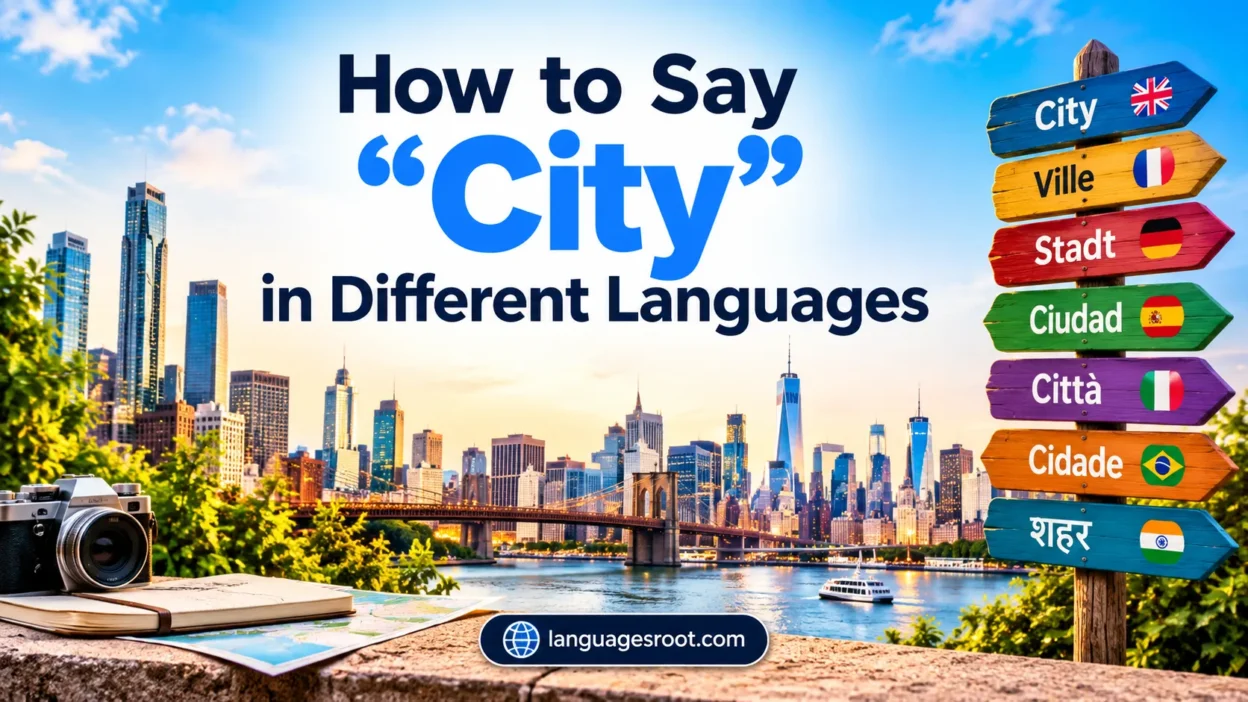
A city is a place where people live, work, and connect. Learning how to say city in different languages helps you explore world languages and understand local culture. Each language has its own city translation, pronunciation, and everyday usage. For example, city in German is die Stadt, while city in Spanish is ciudad. Similarly, city in French is ville, and Afrikaans uses its own word. These multilingual translations make learning everyday words easier and more enjoyable.
In this guide, you will discover translations of city across many foreign languages, along with a helpful pronunciation guide and example sentences. You will also explore regional language variations, alternative words for city, and useful city vocabulary for daily conversations. Additionally, these translations can help with travel vocabulary, language learning, and cross-cultural communication. Whether you are a student, traveler, teacher, or language enthusiast, this guide offers a simple way to expand your vocabulary and explore how people describe urban places around the world.
Interesting Facts About City
- The English word city refers to a large or important urban settlement, but the exact legal definition of a city differs between countries.
- Many languages have more than one word that can translate as city, depending on size, historical status, or context.
- In Japanese, 都市 (toshi) is a general word for an urban city, while 都会 (tokai) can emphasize an urban area or city environment.
- In Mandarin Chinese, 城市 (chéngshì) is a standard general term for a city, while 市 (shì) also appears in administrative and compound terms.
- Several European languages have related words for city that developed through different historical language families. For example, Spanish ciudad, Italian città, and Portuguese cidade have related Romance-language histories.
- Some languages distinguish between a city and a town more clearly than English does, while others use one word broadly depending on context.
- Grammatical gender can affect the way the word city behaves in a sentence. For example, French ville, Italian città, and Spanish ciudad are feminine nouns.
- The pronunciation of the same word can change noticeably between regions, even when the spelling remains identical.
What Does City Mean?
City means a large or significant human settlement with a developed urban environment. Cities commonly contain residential areas, commercial districts, transportation networks, schools, hospitals, government services, cultural institutions, and other public facilities.
The word can also carry a broader cultural meaning. Someone might describe a city as busy, historic, modern, beautiful, crowded, peaceful, expensive, or vibrant. In this sense, “city” can refer not only to buildings and streets but also to the lifestyle and community associated with an urban place.
The meaning can vary slightly by context. In everyday conversation, “city” may simply mean an urban place. In government, geography, or administration, however, a city may have a specific legal or official status. This is why a direct translation does not always have exactly the same scope in every language.
Why Can City Have Different Translations?
There is no single universal word that matches every use of city perfectly. Languages organize concepts differently, and speakers may choose different vocabulary depending on the situation.
Context is especially important. A word may refer specifically to a large urban center in one language but have a broader meaning in another. Formality can also influence word choice, particularly in official documents, news writing, or administrative contexts.
Other factors include:
- Regional usage: Different countries may prefer different words for the same concept.
- Urban size: Some languages distinguish among city, town, and smaller settlements.
- Administrative meaning: A word may describe an officially recognized city rather than any large settlement.
- Spoken versus written language: Everyday speech may favor a shorter or more familiar term.
- Historical usage: Older or literary terms may still appear in formal writing.
- Grammatical structure: Gender, case, number, and articles may change around the noun.
- Local conventions: A translation that sounds natural in one region may sound unusual somewhere else.
For this reason, the tables below focus on natural and commonly understandable words for “city”, rather than forcing a literal translation into every language.
European Languages

Europe contains several major language families, including Romance, Germanic, Slavic, Celtic, Uralic, and Baltic languages. As a result, the word city can look and sound very different from one language to another. Some languages also have separate terms for a city, town, or urban center.
The following translations use commonly recognized forms and include regional notes where they are useful.
| 🌍 Language | Country/Region | Translation | Pronunciation | Example Sentence |
| English | United Kingdom, Ireland, international | city | SIT-ee | This city is beautiful. |
| American English | United States | city | SIT-ee | New York is a large city. |
| British English | United Kingdom | city | SIT-ee | London is a historic city. |
| Australian English | Australia | city | SIT-ee | Sydney is a famous city. |
| Spanish | Spain, Latin America | ciudad | see-oo-DAHD | Madrid es una ciudad hermosa. (Madrid is a beautiful city.) |
| French | France, Belgium, Canada, other regions | ville | veel | Paris est une grande ville. (Paris is a large city.) |
| German | Germany, Austria, Switzerland | Stadt | shtaht | Berlin ist eine große Stadt. (Berlin is a large city.) |
| Italian | Italy, San Marino, Switzerland | città | chee-TAH | Roma è una città antica. (Rome is an ancient city.) |
| Portuguese | Portugal, Brazil, other regions | cidade | see-DAH-deh | Lisboa é uma cidade bonita. (Lisbon is a beautiful city.) |
| Dutch | Netherlands, Belgium | stad | staht | Amsterdam is een mooie stad. (Amsterdam is a beautiful city.) |
| Swedish | Sweden, Finland | stad | stahd | Stockholm är en vacker stad. (Stockholm is a beautiful city.) |
| Norwegian | Norway | by | bee | Oslo er en stor by. (Oslo is a large city.) |
| Danish | Denmark | by | bü | København er en stor by. (Copenhagen is a large city.) |
| Finnish | Finland | kaupunki | KOW-poong-kee | Helsinki on kaunis kaupunki. (Helsinki is a beautiful city.) |
| Icelandic | Iceland | borg | pork | Reykjavík er falleg borg. (Reykjavík is a beautiful city.) |
| Irish | Ireland | cathair | KAH-hir | Is cathair mhór í Baile Átha Cliath. (Dublin is a large city.) |
| Welsh | Wales | dinas | DEE-nas | Mae Caerdydd yn ddinas fawr. (Cardiff is a large city.) |
| Polish | Poland | miasto | MYA-stoh | Warszawa to duże miasto. (Warsaw is a large city.) |
| Czech | Czech Republic | město | MYES-toh | Praha je krásné město. (Prague is a beautiful city.) |
| Slovak | Slovakia | mesto | MES-toh | Bratislava je krásne mesto. (Bratislava is a beautiful city.) |
| Ukrainian | Ukraine | місто | MEE-stoh | Київ – велике місто. (Kyiv is a large city.) |
| Russian | Russia and other Russian-speaking regions | город | GOH-rut | Москва – большой город. (Moscow is a large city.) |
| Romanian | Romania, Moldova | oraș | oh-RASH | București este un oraș mare. (Bucharest is a large city.) |
| Hungarian | Hungary | város | VAA-rosh | Budapest egy gyönyörű város. (Budapest is a beautiful city.) |
| Greek | Greece, Cyprus | πόλη | POH-lee | Η Αθήνα είναι μια μεγάλη πόλη. (Athens is a large city.) |
| Bulgarian | Bulgaria | град | graht | София е голям град. (Sofia is a large city.) |
| Croatian | Croatia | grad | grahd | Zagreb je lijep grad. (Zagreb is a beautiful city.) |
| Serbian | Serbia and neighboring regions | град / grad | grahd | Београд је велики град. (Belgrade is a large city.) |
| Slovenian | Slovenia | mesto | MES-toh | Ljubljana je lepo mesto. (Ljubljana is a beautiful city.) |
| Lithuanian | Lithuania | miestas | MYES-tas | Vilnius yra gražus miestas. (Vilnius is a beautiful city.) |
| Latvian | Latvia | pilsēta | pil-SAY-ta | Rīga ir skaista pilsēta. (Riga is a beautiful city.) |
| Estonian | Estonia | linn | linn | Tallinn on ilus linn. (Tallinn is a beautiful city.) |
| Albanian | Albania, Kosovo and other communities | qytet | chy-TET | Tirana është një qytet i madh. (Tirana is a large city.) |
| Catalan | Catalonia, Valencia, Balearic Islands | ciutat | see-oo-TAHT | Barcelona és una ciutat gran. (Barcelona is a large city.) |
| Basque | Basque Country | hiria | hee-REE-ah | Bilbo hiri handia da. (Bilbao is a large city.) |
| Galician | Galicia, Spain | cidade | see-DAH-deh | Vigo é unha cidade grande. (Vigo is a large city.) |
| Macedonian | North Macedonia | град / grad | graht | Скопје е голем град. (Skopje is a large city.) |
| Maltese | Malta | belt | belt | Valletta hija belt sabiħa. (Valletta is a beautiful city.) |
English Varieties
American, British, and Australian English all use city as the normal word. There is no need to invent separate translations simply because the variety changes.
The pronunciation can differ slightly by accent, particularly in the vowel sound and the pronunciation of the final t. Usage can also vary in local expressions, but the basic noun remains city in all three varieties.
The distinction between city, town, and urban area may also depend on local administrative conventions rather than pronunciation alone.
Asian Languages
Asia contains hundreds of languages and many different writing systems, including Chinese characters, Devanagari, Arabic-derived scripts, Hangul, Japanese kana and kanji, and numerous other scripts. The word for city can therefore vary considerably in both sound and written form.
Some Asian languages also have several words related to cities, urban areas, municipalities, capitals, or historic settlements. The forms below favor common general vocabulary.
| 🌍 Language | Country/Region | Translation | Pronunciation | Example Sentence |
| Mandarin Chinese | China, Taiwan, Singapore | 城市 | chéng-shì | 北京是一座大城市。 (Beijing is a large city.) |
| Cantonese | Hong Kong, Macau, Guangdong | 城市 | sing⁴ si⁵ | 香港是一個繁忙的城市。 (Hong Kong is a busy city.) |
| Japanese | Japan | 都市 | TOH-shee | 東京は大きな都市です。 (Tokyo is a large city.) |
| Korean | South Korea, North Korea | 도시 | DOH-shee | 서울은 큰 도시입니다. (Seoul is a large city.) |
| Hindi | India | शहर | sha-har | दिल्ली एक बड़ा शहर है। (Delhi is a large city.) |
| Urdu | Pakistan, India | شہر | sheh-r | لاہور ایک خوبصورت شہر ہے۔ (Lahore is a beautiful city.) |
| Bengali | Bangladesh, India | শহর | SHO-hor | ঢাকা একটি বড় শহর। (Dhaka is a large city.) |
| Punjabi | Pakistan, India | ਸ਼ਹਿਰ | sheh-hir | لاہور ਇੱਕ ਵੱਡਾ ਸ਼ਹਿਰ ਹੈ। (Lahore is a large city.) |
| Gujarati | India | શહેર | sha-her | અમદાવાદ એક મોટું શહેર છે. (Ahmedabad is a large city.) |
| Marathi | India | शहर | sha-har | मुंबई एक मोठे शहर आहे. (Mumbai is a large city.) |
| Tamil | India, Sri Lanka, Singapore | நகரம் | na-ga-ram | சென்னை ஒரு பெரிய நகரம். (Chennai is a large city.) |
| Telugu | India | నగరం | na-ga-ram | హైదరాబాద్ ఒక పెద్ద నగరం. (Hyderabad is a large city.) |
| Kannada | India | ನಗರ | na-ga-ra | ಬೆಂಗಳೂರು ಒಂದು ದೊಡ್ಡ ನಗರ. (Bengaluru is a large city.) |
| Malayalam | India, Kerala | നഗരം | na-ga-ram | കൊച്ചി ഒരു മനോഹരമായ നഗരമാണ്. (Kochi is a beautiful city.) |
| Nepali | Nepal, India | शहर | sha-har | काठमाडौं एउटा ठूलो शहर हो। (Kathmandu is a large city.) |
| Sinhala | Sri Lanka | නගරය | na-ga-ra-ya | කොළඹ විශාල නගරයකි. (Colombo is a large city.) |
| Thai | Thailand | เมือง | mʉʉang | กรุงเทพฯ เป็นเมืองใหญ่. (Bangkok is a large city.) |
| Vietnamese | Vietnam | thành phố | tahnh foh | Hà Nội là một thành phố lớn. (Hanoi is a large city.) |
| Indonesian | Indonesia | kota | KOH-ta | Jakarta adalah kota besar. (Jakarta is a large city.) |
| Malay | Malaysia, Brunei, Singapore | bandar | BAN-dar | Kuala Lumpur ialah bandar yang besar. (Kuala Lumpur is a large city.) |
| Filipino/Tagalog | Philippines | lungsod | loong-SOD | Ang Maynila ay isang malaking lungsod. (Manila is a large city.) |
| Burmese | Myanmar | မြို့ | myoh | ရန်ကုန်မြို့က ကြီးမားတယ်။ (Yangon is a large city.) |
| Khmer | Cambodia | ទីក្រុង | tee-krong | ភ្នំពេញជាទីក្រុងធំមួយ។ (Phnom Penh is a large city.) |
| Lao | Laos | ເມືອງ | mʉang | ວຽງຈັນເປັນເມືອງໃຫຍ່. (Vientiane is a large city.) |
| Mongolian | Mongolia | хот | khot | Улаанбаатар бол том хот. (Ulaanbaatar is a large city.) |
| Kazakh | Kazakhstan | қала | qa-LA | Алматы үлкен қала. (Almaty is a large city.) |
| Uzbek | Uzbekistan | shahar / шаҳар | sha-HAR | Toshkent katta shahar. (Tashkent is a large city.) |
| Turkmen | Turkmenistan | şäher | sha-HER | Aşgabat uly şäher. (Ashgabat is a large city.) |
| Tajik | Tajikistan | шаҳр | shahr | Душанбе шаҳри калон аст. (Dushanbe is a large city.) |
Asian Language Notes
Mandarin Chinese has several related forms. 城市 (chéngshì) is the general word for “city,” while 市 (shì) commonly appears in administrative names and compounds. Japanese similarly has several context-dependent terms, including 都市 (toshi) for a city or urban center and 都会 (tokai) for an urban area or city environment. These distinctions are useful because a dictionary may list several possible translations without explaining when each one sounds most natural.
Also Read: How to Say “Circle” in Different Languages
African Languages
Africa is linguistically diverse, with hundreds of languages belonging to several major language families. A word such as city may therefore have very different forms across Southern, Eastern, Western, and Northern Africa.
The examples below represent languages spoken in different African regions. A country listed in the table represents an important area of use and does not imply that the language is limited to that country.
| 🌍 Language | Country/Region | Translation | Pronunciation | Example Sentence |
| Swahili | Kenya, Tanzania, Uganda, East Africa | mji | m-jee | Nairobi ni mji mkubwa. (Nairobi is a large city.) |
| Afrikaans | South Africa, Namibia | stad | staht | Kaapstad is ‘n pragtige stad. (Cape Town is a beautiful city.) |
| Zulu | South Africa | idolobha | ee-doh-LOH-bha | IDurban yidolobha elikhulu. (Durban is a large city.) |
| Xhosa | South Africa | isixeko | ee-see-KEH-koh | IKapa sisixeko esikhulu. (Cape Town is a large city.) |
| Amharic | Ethiopia | ከተማ | ke-te-ma | አዲስ አበባ ትልቅ ከተማ ናት። (Addis Ababa is a large city.) |
| Yoruba | Nigeria, Benin | ìlú | ee-loo | Lagos jẹ́ ìlú ńlá. (Lagos is a large city.) |
| Igbo | Nigeria | obodo | oh-BOH-doh | Lagos bụ obodo ukwu. (Lagos is a large city.) |
| Hausa | Nigeria, Niger and West Africa | birni | BEER-nee | Kano babban birni ne. (Kano is a large city.) |
| Somali | Somalia, Somaliland, Horn of Africa | magaalo | ma-GAA-loh | Muqdisho waa magaalo weyn. (Mogadishu is a large city.) |
| Shona | Zimbabwe | guta | GOO-ta | Harare iguta guru. (Harare is a large city.) |
| Sesotho | Lesotho, South Africa | toropo | toh-ROH-poh | Maseru ke toropo e kgolo. (Maseru is a large city.) |
| Setswana | Botswana, South Africa | toropo | toh-ROH-poh | Gaborone ke toropo e kgolo. (Gaborone is a large city.) |
| Kinyarwanda | Rwanda | umujyi | oo-moo-JEE-yee | Kigali ni umujyi munini. (Kigali is a large city.) |
| Malagasy | Madagascar | tanàna | ta-NA-na | Antananarivo dia tanàna lehibe. (Antananarivo is a large city.) |
African Language Notes
Several African languages use vocabulary that can cover more than one English concept depending on context. Swahili mji, for example, can refer to a city or town. Similarly, words such as guta, toropo, and birni should be understood within their local grammatical and cultural context rather than assumed to match every administrative definition of “city.”
Middle Eastern Languages
The Middle East contains several distinct language families and traditions, so there is no single regional word for city. Arabic itself has numerous regional varieties, while Persian, Hebrew, Kurdish, Turkish, and Armenian have their own vocabulary and grammatical patterns.
For Arabic, Modern Standard Arabic is shown as the broad formal reference point. Everyday speech may use different words or pronunciations in individual countries.
| 🌍 Language | Country/Region | Translation | Pronunciation | Example Sentence |
| Arabic | Middle East and North Africa | مدينة | ma-DEE-na | دبي مدينة كبيرة. (Dubai is a large city.) |
| Persian | Iran, Afghanistan, Tajik cultural regions | شهر | shahr | تهران یک شهر بزرگ است. (Tehran is a large city.) |
| Hebrew | Israel | עיר | eer | תל אביב היא עיר גדולה. (Tel Aviv is a large city.) |
| Kurdish | Kurdistan regions | bajar | ba-JAR | Hewlêr bajarê mezin e. (Erbil is a large city.) |
| Turkish | Türkiye, Cyprus and surrounding communities | şehir | sheh-HEER | İstanbul büyük bir şehir. (Istanbul is a large city.) |
| Armenian | Armenia and Armenian communities | քաղաք | kha-GHAK | Երևանը մեծ քաղաք է։ (Yerevan is a large city.) |
| Azerbaijani | Azerbaijan | şəhər | sheh-HER | Bakı böyük şəhərdir. (Baku is a large city.) |
| Georgian | Georgia | ქალაქი | ka-la-kee | თბილისი დიდი ქალაქია. (Tbilisi is a large city.) |
Middle Eastern Language Notes
Arabic requires particular care because مدينة (madīnah) is the standard Modern Standard Arabic word for “city,” while colloquial varieties can differ. Persian شهر (shahr) and Turkish şehir are also useful examples of related-looking vocabulary with distinct pronunciation and language-specific usage.
Kurdish is not a single standardized variety across every region. Bajar is widely recognizable in Kurmanji for “city,” but Kurdish vocabulary can vary among varieties. These regional differences are one reason a simple word-for-word list should not be treated as a universal pronunciation or usage guide.
Other World Languages
Some useful languages do not fit neatly into the four regional categories above. Including them provides a broader view of how the concept of city is expressed around the world.
| 🌍 Language | Country/Region | Translation | Pronunciation | Example Sentence |
| Māori | New Zealand | tāone | TAA-oh-neh | He tāone nui a Tāmaki Makaurau. (Auckland is a large city.) |
| Samoan | Samoa, American Samoa | aʻai | ah-EYE | O Apia o se aʻai tele. (Apia is a large city.) |
| Tongan | Tonga | kolo | KOH-loh | Ko Nukuʻalofa ko ha kolo lahi. (Nukuʻalofa is a large city.) |
| Hawaiian | Hawaii | kulanakauhale | koo-lah-nah-kow-HAH-leh | He kulanākauhale nui ʻo Honolulu. (Honolulu is a large city.) |
| Haitian Creole | Haiti | vil | veel | Pòtoprens se yon gwo vil. (Port-au-Prince is a large city.) |
| Esperanto | International | urbo | OOR-boh | Parizo estas granda urbo. (Paris is a large city.) |
| Quechua | Andes, especially Peru and Bolivia | llaqta | LYAK-ta | Lima hatun llaqtam. (Lima is a large city.) |
| Guarani | Paraguay and neighboring regions | táva | TAA-va | Asunción peteĩ táva guasu. (Asunción is a large city.) |
Quick Reference: City in Different Languages
| Language | Translation |
| English | city |
| American English | city |
| British English | city |
| Australian English | city |
| Spanish | ciudad |
| French | ville |
| German | Stadt |
| Italian | città |
| Portuguese | cidade |
| Dutch | stad |
| Swedish | stad |
| Norwegian | by |
| Danish | by |
| Finnish | kaupunki |
| Icelandic | borg |
| Irish | cathair |
| Welsh | dinas |
| Polish | miasto |
| Czech | město |
| Slovak | mesto |
| Ukrainian | місто |
| Russian | город |
| Romanian | oraș |
| Hungarian | város |
| Greek | πόλη |
| Bulgarian | град |
| Croatian | grad |
| Serbian | град / grad |
| Slovenian | mesto |
| Lithuanian | miestas |
| Latvian | pilsēta |
| Estonian | linn |
| Albanian | qytet |
| Catalan | ciutat |
| Basque | hiria |
| Galician | cidade |
| Macedonian | град / grad |
| Maltese | belt |
| Mandarin Chinese | 城市 |
| Cantonese | 城市 |
| Japanese | 都市 |
| Korean | 도시 |
| Hindi | शहर |
| Urdu | شہر |
| Bengali | শহর |
| Punjabi | ਸ਼ਹਿਰ |
| Gujarati | શહેર |
| Marathi | शहर |
| Tamil | நகரம் |
| Telugu | నగరం |
| Kannada | ನಗರ |
| Malayalam | നഗരം |
| Nepali | शहर |
| Sinhala | නගරය |
| Thai | เมือง |
| Vietnamese | thành phố |
| Indonesian | kota |
| Malay | bandar |
| Filipino/Tagalog | lungsod |
| Burmese | မြို့ |
| Khmer | ទីក្រុង |
| Lao | ເມືອງ |
| Mongolian | хот |
| Kazakh | қала |
| Uzbek | shahar / шаҳар |
| Turkmen | şäher |
| Tajik | шаҳр |
| Swahili | mji |
| Afrikaans | stad |
| Zulu | idolobha |
| Xhosa | isixeko |
| Amharic | ከተማ |
| Yoruba | ìlú |
| Igbo | obodo |
| Hausa | birni |
| Somali | magaalo |
| Shona | guta |
| Sesotho | toropo |
| Setswana | toropo |
| Kinyarwanda | umujyi |
| Malagasy | tanàna |
| Arabic | مدينة |
| Persian | شهر |
| Hebrew | עיר |
| Kurdish | bajar |
| Turkish | şehir |
| Armenian | քաղաք |
| Azerbaijani | şəhər |
| Georgian | ქალაქი |
| Māori | tāone |
| Samoan | aʻai |
| Tongan | kolo |
| Hawaiian | kulanakauhale |
| Haitian Creole | vil |
| Esperanto | urbo |
| Quechua | llaqta |
| Guarani | táva |
How to Choose the Right Translation
The best translation for city depends on what you are trying to say and who will read or hear it.
First, consider the context. If you are simply describing an urban place, the ordinary noun is usually enough. If you are discussing government, geography, or administration, you may need a more specific term.
Next, consider the region. Languages such as Arabic, Chinese, English, and Kurdish contain important regional differences. A word that is perfectly natural in one location may be less common in another.
Pay attention to formality as well. Everyday conversation often favors familiar vocabulary, while official documents may use administrative terminology.
Finally, check the surrounding sentence, not only the individual word. Articles, prepositions, grammatical gender, case endings, and plural forms can change the way the word appears.
A good translation should sound like something a speaker of the target language would naturally say, rather than simply matching each English word one by one.
Common Mistakes When Translating City
Several mistakes can make an otherwise correct translation sound unnatural.
1. Translating Word for Word
A dictionary may provide several related terms. Choosing one without considering the sentence can lead to an unnatural result.
2. Ignoring Regional Variation
Arabic, Chinese, Kurdish, and English all demonstrate why regional usage matters. Always consider where your audience is located.
3. Confusing City and Town
Some languages use one broad word for both concepts, while others make a stronger distinction. Do not assume that English administrative categories map perfectly onto another language.
4. Using an Unfamiliar Formal Term
A formal or literary synonym may be grammatically correct but unusual in casual conversation. For ordinary communication, choose the common everyday word when appropriate.
5. Forgetting Grammatical Gender
In languages such as French, Spanish, Italian, and Portuguese, nouns can have grammatical gender. The surrounding article or adjective may therefore need to agree with the noun.
6. Ignoring Pronunciation
Knowing the written translation is only part of language learning. Pronunciation matters when speaking with native or fluent speakers.
7. Treating One Translation as Universal
A language can contain several valid words for an urban place. The best option depends on meaning, region, context, and register.
Why Learn City in Different Languages?
Learning the word city in different languages is a small but useful way to expand vocabulary. Because cities are common topics in travel, geography, conversation, news, education, and everyday life, the word appears frequently in real communication.
Learning this vocabulary can help you:
- Communicate more confidently while traveling.
- Understand basic geography and directions.
- Build useful foreign-language vocabulary.
- Recognize city names and urban references in another language.
- Better understand regional variation.
- Practice pronunciation and writing systems.
- Make conversations about travel and culture more natural.
- Develop greater appreciation for linguistic diversity.
- Understand how different languages organize similar ideas.
- Connect simple vocabulary with broader language learning goals.
A single word can also reveal interesting differences in grammar and culture. Comparing ciudad, ville, Stadt, город, 城市, शहर, and مدينة shows that languages do not simply replace English words with equivalent labels. They place those concepts inside their own grammatical and cultural systems.
Frequently Asked Questions
How do you say “city” in different languages?
The word city in different languages varies by region. For example, Spanish uses ciudad, French uses ville, German uses Stadt, and Italian uses città. In Mandarin Chinese, it is 城市, while Urdu uses شہر.
How do you say “city” in Spanish, French, and German?
In Spanish, city translates to ciudad. In French, the word is ville, while German uses Stadt. For example, Madrid es una ciudad hermosa means “Madrid is a beautiful city.”
How do you say “city” in Asian languages?
Several Asian languages use different words for city. Mandarin Chinese uses 城市 (chéngshì), Japanese uses 都市 (toshi), and Korean uses 도시 (dosi). Hindi uses शहर (shahar), while Urdu uses شہر (shehr).
Why do some languages have more than one word for “city”?
Some languages use different words for a city, urban center, capital, or metropolitan area. These differences often depend on historical usage, regional variations, and context. For example, Japanese uses 都市 for a city and 都会 for an urban or big-city environment.
What is the easiest way to learn the word “city” in another language?
Start by learning the native spelling, pronunciation, and a simple example sentence. Then, connect the word with a familiar place, such as Madrid, Paris, or Berlin. This method makes language learning easier and helps you use new vocabulary naturally in everyday conversations.
Conclusion
Learning how to say city in different languages helps you build useful vocabulary and improve cross-cultural communication. From Spanish ciudad and French ville to German Stadt, Japanese 都市, and Urdu شہر, each translation offers a glimpse into different languages and cultures. By practicing the pronunciation guide and example sentences, you can use these words naturally in travel conversations and everyday speech.