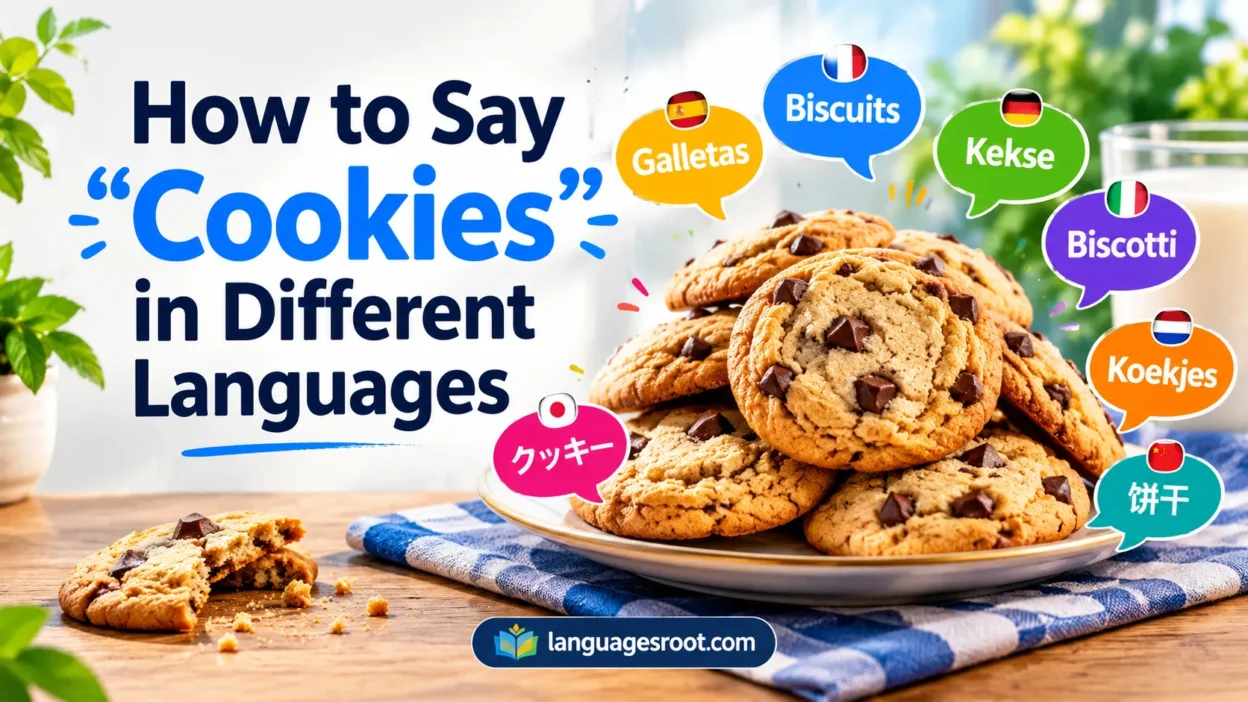
Cookies are sweet baked treats enjoyed worldwide, with flavors and textures that vary across cultures. Learning how to say cookies helps you explore food vocabulary, regional food names, and cookie names around the world. However, American English and British English use different terms, as cookies often mean biscuits in British usage. Understanding these regional language differences makes ordering sweet treats easier when traveling or exploring international recipes.
Moreover, this multilingual food guide explores cookies in different languages, including common translations across European languages, Asian languages, African languages, and Middle Eastern languages. You will discover cookie translation, cookie pronunciation, and useful cookie example sentences for everyday conversations. From chocolate chip cookies to traditional baked treats, these food translations reveal how local cultures name their favorite popular desserts. Whether you enjoy language learning or exploring food across cultures, this guide makes learning words for cookies simple, practical, and enjoyable.
Interesting Facts About Cookies
- Cookies and biscuits: American English generally uses “cookies,” whereas British English commonly uses “biscuits” for many similar sweet baked treats.
- Words reflect local traditions: Different languages may have separate terms for crunchy biscuits, soft cookies, filled pastries, and traditional sweets.
- French vocabulary: The French word biscuit covers several kinds of baked goods, including certain cookies and biscuits.
- Spanish variations: Galleta is a widely understood word for a cookie or biscuit, although specific products may have different regional names.
- German distinctions: Keks commonly means a cookie or biscuit, while Plätzchen often refers to small cookies, particularly homemade or Christmas varieties.
- Japanese loanwords: Japanese uses クッキー (kukkī), a word borrowed from English, alongside other terms for biscuits and baked snacks.
- Context matters: A translation that works in a bakery might not be the best word for a particular traditional dessert or packaged snack.
What Does Cookies Mean?
Cookies are small, usually sweet baked foods made from ingredients such as flour, sugar, butter, eggs, and flavorings. They may be soft, chewy, crisp, crunchy, or filled with chocolate, fruit, cream, or nuts.
The word also has a few different meanings depending on context. In everyday conversation, it usually refers to a snack or dessert. In computing, a cookie is a small piece of data stored by a website in a user’s browser, which is an entirely different meaning.
This article focuses on edible cookies and sweet biscuits. People might use the word when ordering a dessert, asking for a snack, describing a recipe, or discussing traditional baked treats. Some languages have one broad term, while others use different words according to the cookie’s shape, ingredients, or preparation.
Why Can Cookies Have Different Translations?
The translation of cookies depends on more than the dictionary meaning. Food vocabulary develops alongside local cooking traditions, so two languages may classify the same baked treat differently.
Several factors influence the most suitable word:
- Context: A chocolate chip cookie may have a more specific name than a plain biscuit.
- Regional usage: English speakers in the United States usually say cookies, while speakers in Britain often say biscuits.
- Food traditions: Some cultures distinguish traditional pastries and filled sweets from ordinary cookies.
- Formality: Everyday conversation may use a shorter or more familiar name than a recipe or product label.
- Grammar: Some languages change the word’s ending to express plural forms or fit the sentence.
- Pronunciation and writing: A language may borrow the English word and write it in its own script.
- Literal versus natural translation: A natural food name is usually more useful than translating the individual letters or sounds of the English word.
For the tables below, the translation column gives a common word or natural equivalent for edible cookies, rather than a literal translation of the phrase “How to say cookies.” Pronunciation guides are simplified for English-speaking readers. Example sentences demonstrate how the word can be used in everyday conversation.
European Languages
European languages belong to several language families, including Germanic, Romance, Slavic, and Uralic languages. Consequently, the words for cookies can look and sound quite different, even in neighboring countries.
The tables include standard vocabulary and useful regional distinctions. Where the same English word is used across a variety, the entry notes that shared usage rather than inventing a different translation.
| 🌍 Language | Country/Region | Translation | Pronunciation | Example Sentence |
| English | International | Cookies | KUUK-eez | “These cookies are delicious.” |
| American English 🇺🇸 | United States | Cookies | KUUK-eez | “I bought chocolate chip cookies.” |
| British English 🇬🇧 | United Kingdom | Biscuits | BIS-kits | “Would you like some biscuits?” |
| Australian English 🇦🇺 | Australia | Biscuits / cookies | BIS-kits / KUUK-eez | “We had biscuits with tea.” |
| Spanish | Spain, Latin America | Galletas | gah-YEH-tahs | “Me gustan las galletas.” Meaning: I like cookies. |
| French | France, Belgium, Canada | Biscuits | bee-SKWEE | “J’aime les biscuits.” Meaning: I like cookies. |
| German | Germany, Austria | Kekse | KEK-suh | “Ich esse Kekse.” Meaning: I am eating cookies. |
| Italian | Italy, Switzerland | Biscotti | bee-SKOT-tee | “Vorrei dei biscotti.” Meaning: I would like some cookies. |
| Portuguese | Portugal, Brazil | Biscoitos | bees-koy-toos | “Gosto de biscoitos.” Meaning: I like cookies. |
| Dutch | Netherlands, Belgium | Koekjes | KOOK-yuhs | “Ik eet koekjes.” Meaning: I am eating cookies. |
| Swedish | Sweden, Finland | Kakor | KAH-koor | “Jag gillar kakor.” Meaning: I like cookies. |
| Norwegian | Norway | Kjeks | sheks | “Jeg liker kjeks.” Meaning: I like cookies. |
| Danish | Denmark | Småkager | SMOH-kay-er | “Jeg kan godt lide småkager.” Meaning: I like cookies. |
| Finnish | Finland | Keksit | KEK-sit | “Pidän kekseistä.” Meaning: I like cookies. |
| Icelandic | Iceland | Smákökur | SMAU-kur | “Mér finnast smákökur góðar.” Meaning: I think cookies are good. |
| Irish | Ireland | Fianáin | fee-uh-NAWN | “Is maith liom fianáin.” Meaning: I like cookies. |
| Welsh | Wales | Bisgedi | bis-GEH-dee | “Dw i’n hoffi bisgedi.” Meaning: I like biscuits. |
| Polish | Poland | Ciastka | CHYAST-kah | “Lubię ciastka.” Meaning: I like cookies. |
| Czech | Czechia | Sušenky | SOO-shen-kee | “Mám rád sušenky.” Meaning: I like cookies. |
| Slovak | Slovakia | Sušienky | SOO-shyen-kee | “Mám rád sušienky.” Meaning: I like cookies. |
| Ukrainian | Ukraine | Печиво | peh-CHEE-vo | “Я люблю печиво.” Meaning: I like cookies. |
| Russian | Russia and other Russian-speaking regions | Печенье | pee-CHEHN-ye | “Я люблю печенье.” Meaning: I like cookies. |
| Romanian | Romania, Moldova | Biscuiți | bees-KWEEts | “Îmi plac biscuiții.” Meaning: I like cookies. |
| Hungarian | Hungary | Kekszek | KEK-sek | “Szeretem a kekszeket.” Meaning: I like cookies. |
| Greek | Greece, Cyprus | Μπισκότα | bees-KO-ta | “Μου αρέσουν τα μπισκότα.” Meaning: I like cookies. |
| Bulgarian | Bulgaria | Бисквити | bees-KVEET-ee | “Обичам бисквити.” Meaning: I like cookies. |
| Croatian | Croatia | Keksi | KEK-see | “Volim kekse.” Meaning: I like cookies. |
| Serbian | Serbia and neighboring regions | Кекс / кекси | keks / KEK-see | “Волим кекс.” Meaning: I like cookies. |
| Slovenian | Slovenia | Piškoti | pee-SHKO-tee | “Rad imam piškote.” Meaning: I like cookies. |
| Lithuanian | Lithuania | Sausainiai | sow-SAI-nyai | “Aš mėgstu sausainius.” Meaning: I like cookies. |
| Latvian | Latvia | Cepumi | TSEH-poo-mee | “Man garšo cepumi.” Meaning: I like cookies. |
| Estonian | Estonia | Küpsised | KÜP-see-sed | “Mulle meeldivad küpsised.” Meaning: I like cookies. |
Cultural Notes for European Languages
The distinction between cookies and biscuits is especially useful for English learners. In the United States, cookies is the usual everyday term for many small sweet baked treats. In the United Kingdom, biscuits covers many similar foods, although cookie is also understood and used for certain styles, including soft or chunky varieties.
Other European languages may distinguish among everyday biscuits, small homemade cookies, and traditional festive treats. For instance, German Plätzchen often refers to small cookies made for celebrations, while Kekse is a more general term. The best word therefore depends on the actual food, not simply the country.
Asian Languages
Asia includes a wide range of language families, scripts, and regional food traditions. Some languages use words borrowed from English, while others have established terms for biscuits and baked sweets.
The following translations use common words for cookies or their closest everyday equivalents. Where local usage distinguishes a cookie from another type of sweet snack, the example should be understood in that general food context.
| 🌍 Language | Country/Region | Translation | Pronunciation | Example Sentence |
| Mandarin Chinese | China, Taiwan, Singapore | 饼干 | bǐnggān | “我喜欢吃饼干。” Meaning: I like eating cookies. |
| Cantonese | Hong Kong, Guangdong | 曲奇 / 餅乾 | kuk1 kei4 / beng2 gon1 | “我鍾意食曲奇。” Meaning: I like eating cookies. |
| Japanese | Japan | クッキー | kukkī | “クッキーが好きです。” Meaning: I like cookies. |
| Korean | South Korea, North Korea | 쿠키 | ku-ki | “저는 쿠키를 좋아해요.” Meaning: I like cookies. |
| Hindi | India | कुकीज़ / बिस्कुट | koo-keez / bis-kut | “मुझे कुकीज़ पसंद हैं।” Meaning: I like cookies. |
| Urdu | Pakistan, India | کوکیز / بسکٹ | koo-keez / bis-kut | “مجھے کوکیز پسند ہیں۔” Meaning: I like cookies. |
| Bengali | Bangladesh, India | কুকিজ / বিস্কুট | koo-kij / bish-kut | “আমি কুকিজ পছন্দ করি।” Meaning: I like cookies. |
| Punjabi | Punjab in Pakistan and India | ਕੁਕੀਜ਼ / ਬਿਸਕੁਟ | koo-keez / bis-kut | “ਮੈਨੂੰ ਕੁਕੀਜ਼ ਪਸੰਦ ਹਨ।” Meaning: I like cookies. |
| Gujarati | Gujarat, India | કૂકીઝ / બિસ્કિટ | koo-keez / bis-kit | “મને કૂકીઝ ગમે છે.” Meaning: I like cookies. |
| Marathi | Maharashtra, India | कुकीज / बिस्किटे | koo-keej / bis-ki-te | “मला कुकीज आवडतात.” Meaning: I like cookies. |
| Tamil | Tamil Nadu, Sri Lanka, Singapore | குக்கீகள் / பிஸ்கட்டுகள் | kuk-kī-gal / pis-kat-tu-gal | “எனக்கு குக்கீகள் பிடிக்கும்.” Meaning: I like cookies. |
| Telugu | Andhra Pradesh, Telangana | కుకీలు / బిస్కెట్లు | koo-kee-loo / bis-ket-lu | “నాకు కుకీలు ఇష్టం.” Meaning: I like cookies. |
| Kannada | Karnataka, India | ಕುಕೀಸ್ / ಬಿಸ್ಕತ್ತುಗಳು | koo-kees / bis-kat-tu-ga-lu | “ನನಗೆ ಕುಕೀಸ್ ಇಷ್ಟ.” Meaning: I like cookies. |
| Malayalam | Kerala, India | കുക്കീസ് / ബിസ്കറ്റുകൾ | kuk-kees / bis-kit-tu-kal | “എനിക്ക് കുക്കീസ് ഇഷ്ടമാണ്.” Meaning: I like cookies. |
| Nepali | Nepal | बिस्कुट | bis-kut | “मलाई बिस्कुट मन पर्छ।” Meaning: I like cookies. |
| Sinhala | Sri Lanka | බිස්කට් | bis-kat | “මම බිස්කට් වලට කැමතියි।” Meaning: I like biscuits. |
| Thai | Thailand | คุกกี้ | khuk-kîi | “ฉันชอบคุกกี้” Meaning: I like cookies. |
| Vietnamese | Vietnam | Bánh quy | banh kwee | “Tôi thích bánh quy.” Meaning: I like cookies. |
| Indonesian | Indonesia | Kue kering | koo-eh kuh-ring | “Saya suka kue kering.” Meaning: I like cookies. |
| Malay | Malaysia, Brunei, Singapore | Biskut | bis-kut | “Saya suka biskut.” Meaning: I like cookies. |
| Filipino / Tagalog | Philippines | Cookies / biskwit | koo-keez / bis-kweet | “Gusto ko ng cookies.” Meaning: I like cookies. |
| Burmese | Myanmar | ဘီစကွတ် | bi-skuat | “ဘီစကွတ်ကို ကြိုက်တယ်။” Meaning: I like cookies. |
| Khmer | Cambodia | ខូឃី / នំឃុកឃី | koo-kee / num koo-kee | “ខ្ញុំចូលចិត្តខូឃី។” Meaning: I like cookies. |
| Lao | Laos | ຄຸກກີ້ | khuk-kii | “ຂ້ອຍມັກຄຸກກີ້.” Meaning: I like cookies. |
| Mongolian | Mongolia | Жигнэмэг | jig-neh-meg | “Би жигнэмэгт дуртай.” Meaning: I like cookies. |
| Kazakh | Kazakhstan | Печенье | peh-CHEHN-ye | “Мен печеньені жақсы көремін.” Meaning: I like cookies. |
| Uzbek | Uzbekistan | Pechenye / pechenyelar | peh-cheh-nye / peh-cheh-nye-lar | “Men pechenyeni yaxshi ko‘raman.” Meaning: I like cookies. |
Cultural Notes for Asian Languages
Several Asian languages use loanwords for cookies, especially in contemporary bakery and packaged-food contexts. Japanese kukkī and Korean kuki are recognizable examples. In Chinese, 饼干 (bǐnggān) is a broad term for biscuits, while 曲奇 (qūqí) commonly refers to cookies, including Western-style varieties.
In South Asia, biscuit and its local-script forms are widely understood in many everyday settings. However, English loanwords such as cookies are also used, particularly for chocolate chip cookies or other Western-style products. In Indonesia, kue kering refers broadly to dry cakes or cookies and is often associated with festive homemade treats. These terms are related but are not exact equivalents for every baked dessert.
African Languages
Africa is home to hundreds of languages, each with its own vocabulary and regional influences. Words for cookies may be borrowed from English or other European languages, or adapted to local food traditions.
The table below includes languages from different parts of the continent. The examples use everyday expressions for liking, eating, or offering cookies and biscuits.
| 🌍 Language | Country/Region | Translation | Pronunciation | Example Sentence |
| Swahili | Tanzania, Kenya, East Africa | Biskuti | bis-KOO-tee | “Ninapenda biskuti.” Meaning: I like cookies. |
| Afrikaans | South Africa, Namibia | Koekies | KOO-kees | “Ek hou van koekies.” Meaning: I like cookies. |
| Zulu | South Africa | Amabhisikidi | ah-mah-bee-see-KEE-dee | “Ngiyawathanda amabhisikidi.” Meaning: I like biscuits. |
| Xhosa | South Africa | Iibhisikithi | ee-bee-see-KEE-tee | “Ndiyazithanda iibhisikithi.” Meaning: I like biscuits. |
| Amharic | Ethiopia | ብስኩት | bis-kut | “ብስኩት እወዳለሁ።” Meaning: I like biscuits. |
| Yoruba | Nigeria, Benin | Bísíkítì | bee-SEE-kee-tee | “Mo fẹ́ràn bísíkítì.” Meaning: I like biscuits. |
| Igbo | Nigeria | Bisikiti | bee-see-kee-tee | “Ọ na-amasị m bisikiti.” Meaning: I like biscuits. |
| Hausa | Nigeria, Niger, West Africa | Biskit | bis-kit | “Ina son biskit.” Meaning: I like biscuits. |
| Somali | Somalia, Djibouti, Horn of Africa | Buskud | boos-kud | “Waxaan jeclahay buskud.” Meaning: I like cookies. |
| Shona | Zimbabwe | Mabhisikiti | mah-bee-see-KEE-tee | “Ndinoda mabhisikiti.” Meaning: I like biscuits. |
| Sesotho | Lesotho, South Africa | Libisikiti | lee-bee-see-KEE-tee | “Ke rata libisikiti.” Meaning: I like biscuits. |
| Setswana | Botswana, South Africa | Dibisikiti | dee-bee-see-KEE-tee | “Ke rata dibisikiti.” Meaning: I like biscuits. |
| Kinyarwanda | Rwanda | Bisikiti | bee-see-KEE-tee | “Nkunda ibisuguti.” Meaning: I like biscuits. |
| Malagasy | Madagascar | Bisikety | bee-see-KEH-tee | “Tiako ny bisikety.” Meaning: I like cookies. |
Cultural Notes for African Languages
In several African languages, the everyday word for cookies is related to the borrowed term biscuit or biskuti. The spelling and pronunciation may differ because each language adapts borrowed vocabulary to its own sound system.
These words should not be taken to mean that every sweet baked food is identical across African countries. Local bakeries and households may also use names for traditional snacks, pastries, and other regional treats. When asking about a specific product, showing its picture or describing its ingredients can help avoid confusion.
Middle Eastern Languages
The Middle East includes Arabic-speaking communities, Persian speakers, Hebrew speakers, Kurdish-speaking regions, and other distinct linguistic traditions. Food vocabulary can vary between formal writing, daily conversation, and regional dialects.
The following table gives commonly understood terms for cookies or biscuits. Arabic and Persian are separate languages, and their similar-looking scripts do not mean their vocabulary is interchangeable.
| 🌍 Language | Country/Region | Translation | Pronunciation | Example Sentence |
| Modern Standard Arabic | Across the Arab world | بِسْكُوِيت / كَعْك | bis-kweet / kaʿk | “أحب البسكويت.” Meaning: I like cookies. |
| Egyptian Arabic | Egypt | بسكويت | bes-kweet | “أنا بحب البسكويت.” Meaning: I like cookies. |
| Levantine Arabic | Lebanon, Syria, Jordan, Palestine | بسكويت | bis-kweet | “بحب البسكويت.” Meaning: I like cookies. |
| Persian (Farsi) | Iran and Persian-speaking communities | بیسکویت | bees-kweet | “من بیسکویت دوست دارم.” Meaning: I like cookies. |
| Hebrew | Israel | עוגיות | u-gee-YOT | “אני אוהב עוגיות.” Meaning: I like cookies. |
| Kurdish (Kurmanji) | Türkiye, Syria, Iraq, Kurdish communities | Biskuvît | bis-ku-VEET | “Ez biskuvît hez dikim.” Meaning: I like cookies. |
| Turkish | Türkiye, Cyprus | Kurabiye | koo-rah-bee-YEH | “Kurabiye seviyorum.” Meaning: I like cookies. |
| Armenian | Armenia and Armenian-speaking communities | Թխվածքաբլիթներ | tkh-vats-kah-bleet-ner | “Ես սիրում եմ թխվածքաբլիթներ։” Meaning: I like cookies. |
Cultural Notes for Middle Eastern Languages
In Arabic, بسكويت (biskwīt) is a common term for biscuits or cookies, while كعك (kaʿk) can refer to several kinds of cakes, rings, or traditional baked goods depending on the region. The word kaʿk is therefore not always a direct substitute for an American-style cookie.
In Turkish, kurabiye commonly refers to cookies, including homemade varieties. In Persian, biskویت is a familiar word for biscuits, while particular traditional sweets have their own names. When ordering food, a specific description such as chocolate-filled, crisp, or soft can make your meaning clearer.
Also Read:How to Say Corn in Different Languages
Other World Languages
Some languages fall outside the four regional groupings above or are used across several continents. These examples add useful vocabulary from the Pacific, the Americas, and international language learning.
| 🌍 Language | Country/Region | Translation | Pronunciation | Example Sentence |
| Māori | New Zealand | Pihikete | pee-hee-KEH-teh | “He pai ki ahau ngā pihikete.” Meaning: I like cookies. |
| Samoan | Samoa, Pacific communities | Masi | MAH-see | “Ou te fiafia i masi.” Meaning: I like biscuits. |
| Hawaiian | Hawaiʻi | Kuki | KOO-kee | “Makemake au i nā kuki.” Meaning: I like cookies. |
| Quechua | Andean regions of Peru, Bolivia, Ecuador | Galletas (widely used loanword) | gah-YEH-tas | “Galletas-ta munani.” Meaning: I want cookies. |
| Guarani | Paraguay and neighboring regions | Galleta (commonly used loanword) | gah-YEH-tah | “Aipota galleta.” Meaning: I want a cookie. |
| Haitian Creole | Haiti and Haitian communities | Biskwit | bis-kweet | “Mwen renmen biskwit.” Meaning: I like cookies. |
| Esperanto | International constructed language | Kuketoj | koo-keh-TOY | “Mi ŝatas kuketojn.” Meaning: I like cookies. |
Cultural Notes for Other World Languages
Loanwords are particularly useful when a language has adopted a food item through international trade, travel, or modern food culture. Māori pihikete, for example, is a familiar term for biscuits, while Samoan masi can refer to biscuits or related baked snacks.
In Quechua and Guarani, food terminology can vary by region and speaker. The examples above use familiar borrowed vocabulary rather than claiming that one term is the only traditional or universal word for cookies.
Quick Reference: Cookies in Different Languages
Use this table to find the main translation quickly. It includes the language entries covered in the article, with English varieties shown separately where their everyday terminology differs.
| Language | Translation |
| English | Cookies |
| American English | Cookies |
| British English | Biscuits |
| Australian English | Biscuits / cookies |
| Spanish | Galletas |
| French | Biscuits |
| German | Kekse |
| Italian | Biscotti |
| Portuguese | Biscoitos |
| Dutch | Koekjes |
| Swedish | Kakor |
| Norwegian | Kjeks |
| Danish | Småkager |
| Finnish | Keksit |
| Icelandic | Smákökur |
| Irish | Fianáin |
| Welsh | Bisgedi |
| Polish | Ciastka |
| Czech | Sušenky |
| Slovak | Sušienky |
| Ukrainian | Печиво |
| Russian | Печенье |
| Romanian | Biscuiți |
| Hungarian | Kekszek |
| Greek | Μπισκότα |
| Bulgarian | Бисквити |
| Croatian | Keksi |
| Serbian | Кекс / кекси |
| Slovenian | Piškoti |
| Lithuanian | Sausainiai |
| Latvian | Cepumi |
| Estonian | Küpsised |
| Mandarin Chinese | 饼干 |
| Cantonese | 曲奇 / 餅乾 |
| Japanese | クッキー |
| Korean | 쿠키 |
| Hindi | कुकीज़ / बिस्कुट |
| Urdu | کوکیز / بسکٹ |
| Bengali | কুকিজ / বিস্কুট |
| Punjabi | ਕੁਕੀਜ਼ / ਬਿਸਕੁਟ |
| Gujarati | કૂકીઝ / બિસ્કિટ |
| Marathi | कुकीज / बिस्किटे |
| Tamil | குக்கீகள் / பிஸ்கட்டுகள் |
| Telugu | కుకీలు / బిస్కెట్లు |
| Kannada | ಕುಕೀಸ್ / ಬಿಸ್ಕತ್ತುಗಳು |
| Malayalam | കുക്കീസ് / ബിസ്കറ്റുകൾ |
| Nepali | बिस्कुट |
| Sinhala | බිස්කට් |
| Thai | คุกกี้ |
| Vietnamese | Bánh quy |
| Indonesian | Kue kering |
| Malay | Biskut |
| Filipino / Tagalog | Cookies / biskwit |
| Burmese | ဘီစကွတ် |
| Khmer | ខូឃី / នំឃុកឃី |
| Lao | ຄຸກກີ້ |
| Mongolian | Жигнэмэг |
| Kazakh | Печенье |
| Uzbek | Pechenye |
| Swahili | Biskuti |
| Afrikaans | Koekies |
| Zulu | Amabhisikidi |
| Xhosa | Iibhisikithi |
| Amharic | ብስኩት |
| Yoruba | Bísíkítì |
| Igbo | Bisikiti |
| Hausa | Biskit |
| Somali | Buskud |
| Shona | Mabhisikiti |
| Sesotho | Libisikiti |
| Setswana | Dibisikiti |
| Kinyarwanda | Ibisuguti |
| Malagasy | Bisikety |
| Modern Standard Arabic | بِسْكُوِيت |
| Egyptian Arabic | بسكويت |
| Levantine Arabic | بسكويت |
| Persian | بیسکویت |
| Hebrew | עוגיות |
| Kurdish (Kurmanji) | Biskuvît |
| Turkish | Kurabiye |
| Armenian | Թխվածքաբլիթներ |
| Māori | Pihikete |
| Samoan | Masi |
| Hawaiian | Kuki |
| Quechua | Galletas |
| Guarani | Galleta |
| Haitian Creole | Biskwit |
| Esperanto | Kuketoj |
How to Choose the Right Translation
The best translation for cookies depends on what you are describing and who you are speaking to. A word that works for packaged biscuits may not be the most natural choice for a soft chocolate chip cookie or a traditional local dessert.
Use these practical tips when selecting a translation:
- Consider the region: Choose the everyday term used where your audience lives. British biscuits and American cookies are a useful example.
- Identify the food: If you mean a specific type of cookie, include its flavor or style when necessary.
- Check the context: A bakery order, a recipe, and a casual conversation may call for different wording.
- Learn the pronunciation: Read the guide aloud, then listen to a reliable pronunciation recording if you are unsure.
- Use native writing when possible: Showing the original script helps readers recognize the word on menus and food packages.
- Be specific when needed: If a translation has several meanings, describe the ingredients or appearance to make your request clear.
Learning tip: Practice a complete sentence instead of memorizing the word alone. For example, learn how to say “I would like some cookies” alongside the translation of “cookies.”
Common Mistakes When Translating Cookies
Even a familiar food word can become confusing when it crosses language boundaries. These are common mistakes to avoid.
1. Assuming every language uses a direct equivalent of “cookie.” Some languages use a general word for biscuits, while others use a borrowed form of the English word.
2. Ignoring regional differences. British English biscuit and American English cookie overlap in meaning, but their everyday usage is not completely identical.
3. Confusing cookies with pastries. A filled pastry, wafer, cake, and crisp biscuit may belong to different food categories. A broad translation may not identify the exact product.
4. Forgetting grammatical changes. Some languages use different forms depending on whether you mean one cookie or several. Others change word endings to fit the sentence.
5. Relying on pronunciation written in English. Pronunciation guides are approximations. They may not represent unfamiliar sounds, tones, or stress perfectly.
6. Mixing dialects without noticing. A word used in one region may sound unusual or refer to a different food elsewhere.
7. Treating a loanword as universal. Borrowed words can be familiar in cities or commercial settings but less common in other contexts.
The safest approach is to combine a suitable food word with a clear sentence and, when necessary, a description of the treat.
Why Learn Cookies in Different Languages?
Learning how to say cookies in different languages is a small but practical way to expand your vocabulary. It can help when you travel, visit bakeries, read foreign recipes, or shop for snacks in another country.
Food vocabulary is also a useful starting point for language learning because it connects words with familiar experiences. You can practice pronunciation, learn how plural forms work, and build simple sentences about preferences, ingredients, and meals.
Knowing local food terms can also make conversations more personal. Asking someone about their favorite cookies or learning the name of a traditional baked treat creates opportunities to discover regional ingredients and family recipes.
For students, travelers, and multilingual families, these words offer everyday practice without requiring complicated grammar. However, cultural awareness matters as much as vocabulary. A translation is most useful when it reflects the food, context, and audience rather than simply copying the English word.
Frequently Asked Questions
How do you say cookies in different languages?
The word cookies has different translations around the world. For example, Spanish uses galletas, German uses Kekse, Japanese uses クッキー (kukkī), and Mandarin Chinese uses 饼干 (bǐnggān).
What is the difference between cookies and biscuits?
The difference depends on regional usage. American English commonly uses cookies, while British English often uses biscuits for similar sweet baked treats.
How do you say chocolate chip cookies in other languages?
You can combine the local word for cookies with a description of the chocolate chips. In Spanish, galletas con chispas de chocolate is one understandable option, although wording varies by region.
Does the translation of cookies change by country?
Yes, regional language differences can affect the words people use for cookies and biscuits. Local food traditions, dialects, and everyday speech may influence the most natural translation.
How can I pronounce cookie translations correctly?
Use the cookie pronunciation guides in this article to practice each word. For better accuracy, listen to native speakers and practice complete sentences for everyday conversations.
Conclusion
Learning how to say cookies in different languages helps you explore food vocabulary, regional language differences, and food across cultures. From Spanish galletas to German Kekse and Japanese クッキー, each translation offers a glimpse into local food traditions. By practicing cookie pronunciation and useful phrases, you can order sweet treats, explore recipes, and connect with people worldwide.