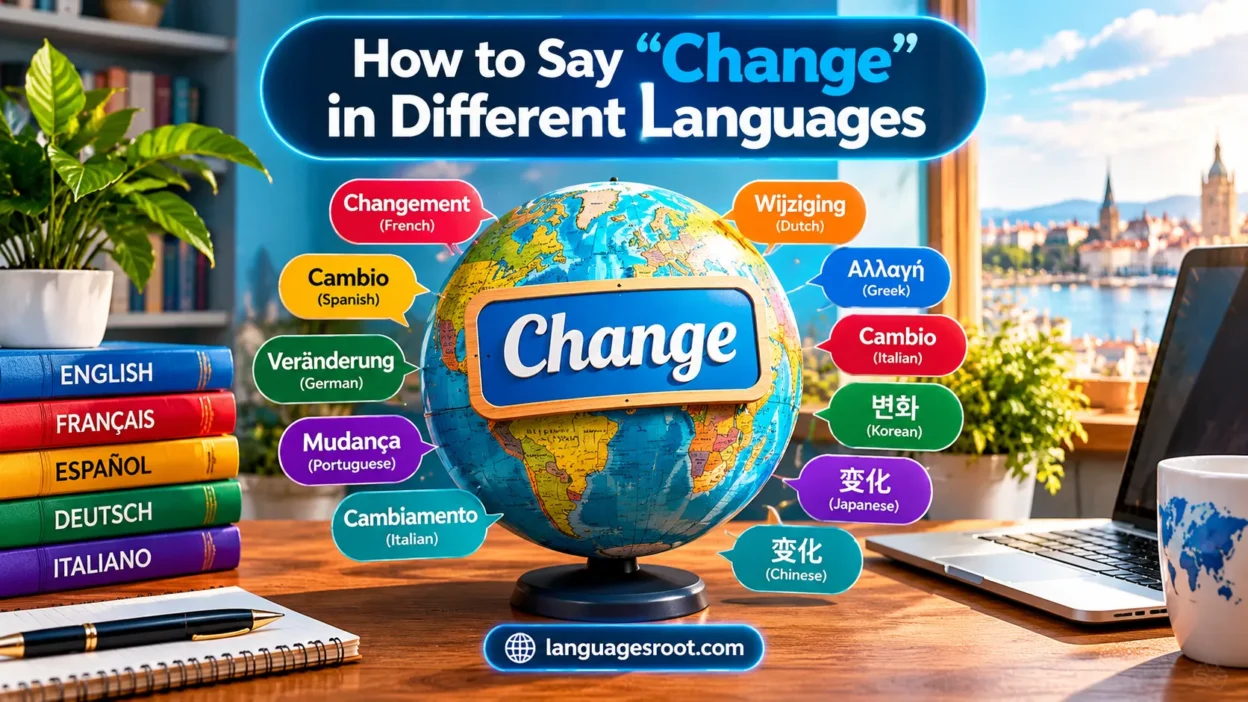
The word change can describe a new situation, a small adjustment, or a major transformation. Learning change in different languages helps you express personal change, life changes, and changing circumstances with greater clarity. However, the meaning of change can vary depending on context, culture, and grammar. This guide explores how to say change across different languages, with useful translations of change for everyday conversations, travel, and writing.
Whether you mean a personal decision, a shift in circumstances, or the act of becoming different, the right change translation depends on how you use the word. Therefore, this translation guide covers major languages, change pronunciation, and natural example sentences to support your language learning. You will also discover alternative translations, regional variations, and grammar differences that shape natural expression. These insights make it easier to understand change over time and communicate across cultures.
Interesting Facts About Change
- The English word change can function as both a noun and a verb. For example, “change is necessary” uses it as a noun, while “things change” uses it as a verb.
- Many languages distinguish between a change itself and the act of changing something. This means a single English word may require different forms in another language.
- The meaning of change can range from a small adjustment to a complete transformation, so context is important when selecting a translation.
- Some languages have separate vocabulary for changing something, becoming different, and a change or alteration.
- Regional variation can affect the most natural expression, particularly in languages spoken across several countries.
- A literal translation of “change” may sound unnatural when the intended meaning is actually modify, replace, transform, switch, improve, or become different.
- Pronunciation can also vary considerably between languages, especially where the target language uses tones, grammatical endings, or a different writing system.
What Does Change Mean?
Change generally means becoming different or making something different. It can describe a difference in appearance, behavior, circumstances, plans, opinions, location, condition, or situation.
As a noun, change can mean an alteration or transformation: “The change was noticeable.” As a verb, it can mean to make something different: “We need to change the plan.” It can also describe a person becoming different over time, as in “People change.”
The word has several context-specific meanings. For example, change clothes means putting on different clothes, while change a decision means deciding differently. In financial contexts, “change” can also mean coins or money returned after a purchase. The translations below focus on the general idea of change, alteration, or transformation.
Why Can Change Have Different Translations?
There is not always one perfect word-for-word translation for change. The best expression depends on what kind of change you mean and how the word functions grammatically.
A translator may need to consider whether change is a noun or verb, whether something is being changed deliberately, whether something is simply becoming different, and whether the situation is formal or casual. Gender and grammatical agreement can also matter in languages where nouns or adjectives have grammatical gender.
The relationship between speakers can influence the wording of a complete question, while regional dialects can affect everyday vocabulary. A natural spoken expression may also differ from a formal written expression. For these reasons, the tables below use the most broadly understandable expression available for the intended meaning and identify important differences where useful.
European Languages
Europe contains several major language families, including Germanic, Romance, Slavic, Celtic, Baltic, and Uralic languages. As a result, the idea of change can be expressed with noticeably different vocabulary and grammatical structures. The following translations focus on the general concept of change or transformation.
English Varieties
| 🌍 Language | Country/Region | Translation | Pronunciation | Example Sentence |
| English | International | How do you say “change”? | how do you say change | Change can be difficult at first. (Change may initially be difficult.) |
| American English 🇺🇸 | United States | How do you say “change”? | how do you say change | Things change over time. (Things become different over time.) |
| British English 🇬🇧 | United Kingdom | How do you say “change”? | how do you say change | Change can bring new opportunities. (Change can create new possibilities.) |
| Australian English 🇦🇺 | Australia | How do you say “change”? | how do you say change | Plans can change quickly. (Plans may become different quickly.) |
The wording is essentially the same across these major English varieties. Pronunciation, vocabulary preferences, and local usage may differ, but there is no need to invent a different translation simply because the speaker is from another English-speaking country.
European Language Table
| 🌍 Language | Country/Region | Translation | Pronunciation | Example Sentence |
| Spanish | Spain, Latin America | ¿Cómo se dice “cambio”? | KOH-moh seh DEE-seh KAHM-byoh | El cambio puede ser difícil. (Change can be difficult.) |
| French | France, Belgium, Canada | Comment dit-on « changement » ? | koh-MAHN dee-TOHN shahnj-MAHN | Le changement demande du temps. (Change takes time.) |
| German | Germany, Austria, Switzerland | Wie sagt man „Veränderung“? | vee zahkt mahn fair-EN-deh-roong | Veränderung gehört zum Leben. (Change is part of life.) |
| Italian | Italy, Switzerland | Come si dice “cambiamento”? | KOH-meh see DEE-cheh kahm-bya-MEN-toh | Il cambiamento può essere positivo. (Change can be positive.) |
| Portuguese | Portugal, Brazil | Como se diz “mudança”? | KOH-moo seh deez moo-DAN-sah | A mudança foi importante. (The change was important.) |
| Dutch | Netherlands, Belgium | Hoe zeg je “verandering”? | hoo zek yuh fair-AN-deh-ring | Verandering kan tijd kosten. (Change can take time.) |
| Swedish | Sweden, Finland | Hur säger man “förändring”? | hoor SEH-yer mahn fur-EN-dring | Förändring är en del av livet. (Change is part of life.) |
| Norwegian | Norway | Hvordan sier man “forandring”? | VOOR-dahn see-er mahn foo-RAN-dring | Forandring kan være nødvendig. (Change can be necessary.) |
| Danish | Denmark | Hvordan siger man “forandring”? | VOOR-dan SEE-er mahn foo-RAN-dring | Forandring tager tid. (Change takes time.) |
| Finnish | Finland | Miten sanotaan “muutos”? | MEE-ten SAH-noh-tahn MOO-tohs | Muutos voi olla hyvä asia. (Change can be a good thing.) |
| Icelandic | Iceland | Hvernig segir maður „breyting“? | KVER-nig SAY-yer MY-thur BRAY-ting | Breyting getur verið erfið. (Change can be difficult.) |
| Irish | Ireland | Conas a deirtear “athrú”? | KUN-us uh DER-shur uh-ROO | Is féidir athrú a bheith deacair. (Change can be difficult.) |
| Welsh | Wales | Sut mae dweud “newid”? | sit my DOYD NEH-wid | Gall newid a bheith deacair. (Change can be difficult.) |
| Polish | Poland | Jak powiedzieć „zmiana”? | yak poh-VYEH-djech ZMYAH-nah | Zmiana jest częścią życia. (Change is part of life.) |
| Czech | Czech Republic | Jak se řekne „změna“? | yak seh RZHEK-neh ZMYEH-nah | Změna může být užitečná. (Change can be useful.) |
| Slovak | Slovakia | Ako sa povie „zmena“? | AH-koh sah POH-vyeh ZMEH-nah | Zmena môže byť potrebná. (Change may be necessary.) |
| Ukrainian | Ukraine | Як сказати «зміна»? | yak skah-ZAH-ty ZMIH-nah | Зміна може бути складною. (Change can be difficult.) |
| Russian | Russia and other Russian-speaking regions | Как сказать «изменение»? | kak skah-ZAHT ee-zmeh-NEE-yeh | Изменение требует времени. (Change takes time.) |
| Romanian | Romania, Moldova | Cum se spune „schimbare”? | koom seh SPOO-neh skeem-BAH-reh | Schimbarea poate fi dificilă. (Change can be difficult.) |
| Hungarian | Hungary | Hogy mondják azt, hogy „változás”? | HOD-y MOND-yak azt, hod VALL-toh-zash | A változás néha nehéz. (Change is sometimes difficult.) |
| Greek | Greece, Cyprus | Πώς λέμε «αλλαγή»; | pos LEH-meh a-la-GHEE | Η αλλαγή μπορεί να είναι δύσκολη. (Change can be difficult.) |
| Bulgarian | Bulgaria | Как се казва „промяна“? | kak seh KAH-zvah pro-MYAH-nah | Промяната може да е трудна. (Change can be difficult.) |
| Croatian | Croatia | Kako se kaže „promjena“? | KAH-koh seh KAH-zheh PROH-myeh-nah | Promjena može biti korisna. (Change can be useful.) |
| Serbian | Serbia and neighboring regions | Како се каже „промена“? | KAH-koh seh KAH-zheh PROH-meh-nah | Промена може бити тешка. (Change can be difficult.) |
| Slovenian | Slovenia | Kako se reče „sprememba“? | KAH-koh seh REH-cheh SPREM-em-bah | Sprememba je del življenja. (Change is part of life.) |
| Lithuanian | Lithuania | Kaip pasakyti „pokytis“? | kaip pah-sah-KEE-tee POH-kee-tis | Pokytis gali būti naudingas. (Change can be useful.) |
| Latvian | Latvia | Kā pateikt „pārmaiņa“? | kaa pah-TEIKT PAHR-my-nya | Pārmaiņas var būt grūtas. (Changes can be difficult.) |
| Estonian | Estonia | Kuidas öelda „muutus“? | KOOY-das UR-da MOO-tus | Muutus võib olla raske. (Change can be difficult.) |
| Macedonian | North Macedonia | Како се вели „промена“? | KAH-koh seh VEH-lee PROH-meh-nah | Промената може да биде тешка. (Change can be difficult.) |
| Albanian | Albania, Kosovo | Si thuhet “ndryshim”? | see THOO-het NDRY-shim | Ndryshimi mund të jetë i vështirë. (Change can be difficult.) |
| Catalan | Catalonia, Valencia, Balearic Islands | Com es diu «canvi»? | kom es DEE KAHN-vee | El canvi pot ser positiu. (Change can be positive.) |
| Basque | Basque Country | Nola esaten da “aldaketa”? | NOH-lah eh-SAH-ten dah al-dah-KEH-tah | Aldaketa batzuetan beharrezkoa da. (Change is sometimes necessary.) |
| Galician | Galicia | Como se di “cambio”? | KOH-moh seh DEE KAHM-byoh | O cambio pode ser difícil. (Change can be difficult.) |
European Cultural Notes
Romance languages such as Spanish, French, Italian, and Portuguese use related vocabulary for the general concept of change, but the exact forms differ according to grammar and regional usage. Slavic languages often distinguish grammatical case, gender, and noun endings, so the form shown in isolation may change inside a sentence.
In Irish and Welsh, the surrounding grammar can affect the form of a word. In Finnish, Hungarian, and Estonian, grammatical endings can also alter how the word appears in a sentence. These differences are a reminder that a dictionary form and a complete sentence are not always identical.
Asian Languages
Asia includes hundreds of languages from many different families, with writing systems ranging from Chinese characters and Japanese kana to Indic scripts and Southeast Asian alphabets. The idea of change can therefore look and sound very different from one language to another. Some languages also make important distinctions between changing something and something changing naturally.
| 🌍 Language | Country/Region | Translation | Pronunciation | Example Sentence |
| Mandarin Chinese | China, Taiwan, Singapore | “变化”怎么说? | biàn huà zěn me shuō | 变化需要时间。 (Change takes time.) |
| Cantonese | Hong Kong, Macau, Guangdong | 「變化」點講? | bin3 faa3 dim2 gong2 | 變化有時好突然。 (Change can sometimes be sudden.) |
| Japanese | Japan | 「変化」は何と言いますか? | henka wa nan to iimasu ka | 変化には時間がかかります。 (Change takes time.) |
| Korean | South Korea, North Korea | “변화”를 어떻게 말해요? | byeonhwa-reul eotteoke malhaeyo | 변화는 자연스러운 일입니다. (Change is natural.) |
| Hindi | India | “बदलाव” को कैसे कहते हैं? | bad-laav ko kai-se keh-te hain | बदलाव कभी-कभी मुश्किल होता है। (Change can sometimes be difficult.) |
| Urdu | Pakistan, India | “تبدیلی” کو کیسے کہتے ہیں؟ | tab-dee-lee ko kai-se keh-te hain | تبدیلی وقت لیتی ہے۔ (Change takes time.) |
| Bengali | Bangladesh, India | ‘পরিবর্তন’ কীভাবে বলা হয়? | po-ri-bor-ton kee-bha-be bo-la hoy | পরিবর্তন জীবনের অংশ। (Change is part of life.) |
| Punjabi | India, Pakistan | ‘ਬਦਲਾਅ’ ਨੂੰ ਕਿਵੇਂ ਕਹਿੰਦੇ ਹਨ? | bad-laa-oon noo kivain kehnde han | ਬਦਲਾਅ ਜ਼ਿੰਦਗੀ ਦਾ ਹਿੱਸਾ ਹੈ। (Change is part of life.) |
| Gujarati | India | ‘બદલાવ’ને કેવી રીતે કહે છે? | bad-laav-ne ke-vee ree-te keh-che | બદલાવ જરૂરી હોઈ શકે છે। (Change may be necessary.) |
| Marathi | India | ‘बदल’ कसे म्हणतात? | ba-dal ka-se mhun-taat | बदल कधी कधी कठीण असतो. (Change can sometimes be difficult.) |
| Tamil | India, Sri Lanka, Singapore | ‘மாற்றம்’ என்பதை எப்படி சொல்வது? | maat-ram en-bathai eppadi solvathu | மாற்றம் வாழ்க்கையின் ஒரு பகுதி. (Change is part of life.) |
| Telugu | India | ‘మార్పు’ ఎలా చెబుతారు? | maar-pu ela che-bu-taaru | మార్పు అవసరం కావచ్చు. (Change may be necessary.) |
| Kannada | India | ‘ಬದಲಾವಣೆ’ ಅನ್ನು ಹೇಗೆ ಹೇಳುತ್ತಾರೆ? | ba-da-laa-va-ne-yannu he-ge hee-lu-taare | ಬದಲಾವಣೆ ಸಹಜ. (Change is natural.) |
| Malayalam | India | ‘മാറ്റം’ എങ്ങനെ പറയുന്നു? | maa-ttam engane parayunnu | മാറ്റം ജീവിതത്തിന്റെ ഭാഗമാണ്. (Change is part of life.) |
| Nepali | Nepal | ‘परिवर्तन’ लाई कसरी भनिन्छ? | pa-ri-var-tan lai ka-sa-ri bha-nin-cha | परिवर्तन जीवनको भाग हो। (Change is part of life.) |
| Sinhala | Sri Lanka | ‘වෙනස’ කියන්නේ කොහොමද? | venasa kiyanne kohomada | වෙනස ජීවිතයේ කොටසක්. (Change is part of life.) |
| Thai | Thailand | “การเปลี่ยนแปลง” พูดว่าอย่างไร? | gaan bplian bplàeng phûut wâa yàang-rai | การเปลี่ยนแปลง ต้องใช้เวลา। (Change takes time.) |
| Vietnamese | Vietnam | “thay đổi” nói thế nào? | thay doi noi the nao | Thay đổi là điều bình thường. (Change is normal.) |
| Indonesian | Indonesia | Bagaimana mengatakan “perubahan”? | ba-gai-ma-na me-nga-ta-kan per-u-ba-han | Perubahan membutuhkan waktu. (Change takes time.) |
| Malay | Malaysia, Brunei, Singapore | Bagaimanakah hendak mengatakan “perubahan”? | ba-gai-ma-na-kah hen-dak me-nga-ta-kan per-u-ba-han | Perubahan memerlukan masa. (Change takes time.) |
| Filipino | Philippines | Paano sabihin ang “pagbabago”? | pa-a-no sa-bi-hin ang pag-ba-ba-go | Ang pagbabago ay bahagi ng buhay. (Change is part of life.) |
| Burmese | Myanmar | “ပြောင်းလဲမှု” ကို ဘယ်လိုပြောလဲ။ | pyaung-leh-hmu ko beh-lo pyaw-leh-leh | ပြောင်းလဲမှု က အချိန်ယူတတ်တယ်။ (Change can take time.) |
| Khmer | Cambodia | “ការផ្លាស់ប្តូរ” និយាយថាម៉េច? | kaa phlahs-doh ni-yay tha mech | ការផ្លាស់ប្តូរ ត្រូវការពេលវេលា។ (Change takes time.) |
| Lao | Laos | “ການປ່ຽນແປງ” ເວົ້າວ່າແນວໃດ? | gaan bplian paeng wao waa naeo dai | ການປ່ຽນແປງ ຕ້ອງໃຊ້ເວລາ. (Change takes time.) |
| Mongolian | Mongolia | “өөрчлөлт” гэж яаж хэлдэг вэ? | öörchlölt gej yaaj heldeg ve | Өөрчлөлт заримдаа хэцүү байдаг. (Change can sometimes be difficult.) |
| Kazakh | Kazakhstan | «өзгеріс» қалай айтылады? | öz-ge-ris qa-lai ai-ty-la-dy | Өзгеріс уақытты қажет етеді. (Change takes time.) |
| Uzbek | Uzbekistan | “o‘zgarish” qanday aytiladi? | uz-ga-rish qan-day ay-ti-la-di | O‘zgarish hayotning bir qismidir. (Change is part of life.) |
| Turkish | Türkiye, Cyprus | “değişim” nasıl denir? | deh-ee-SHEEM nah-suhl deh-neer | Değişim zaman alabilir. (Change can take time.) |
| Persian | Iran, Afghanistan, Tajikistan | «تغییر» را چگونه میگویند؟ | taghyir râ che-goo-neh mee-goy-and | تغییر بخشی از زندگی است. (Change is part of life.) |
Asian Cultural Notes
The word change can be especially context-sensitive in Asian languages because several languages distinguish between a general change, a transformation, an alteration, and the process of changing.
In Mandarin, 变化 (biànhuà) commonly describes change or variation, while 改变 (gǎibiàn) often emphasizes changing something or making something different. Japanese similarly has several related expressions, including 変化 (henka) for change or transformation and 変更 (henkō) for changing or modifying something such as a plan.
In Hindi and Urdu, everyday speakers may choose different words depending on whether they mean change, alteration, improvement, or transformation. The examples above therefore focus on broadly understandable expressions rather than claiming that one word works in every situation.
African Languages
Africa has extraordinary linguistic diversity, with languages from several major language families. Many languages are spoken across national borders, and some countries use several languages in everyday life. The translations below represent the broad concept of change, alteration, or transformation in each language.
| 🌍 Language | Country/Region | Translation | Pronunciation | Example Sentence |
| Swahili | East Africa, especially Kenya and Tanzania | “mabadiliko” unasemaje? | ma-ba-di-li-ko oo-na-se-ma-ye | Mabadiliko yanahitaji muda. (Change takes time.) |
| Afrikaans | South Africa, Namibia | Hoe sê jy “verandering”? | hoo say yay fehr-AN-deh-ring | Verandering kan moeilik wees. (Change can be difficult.) |
| Zulu | South Africa | Usho kanjani “ushintsho”? | oo-sho kan-YAH-nee oo-shint-sho | Ushintsho luyingxenye yokuphila. (Change is part of life.) |
| Xhosa | South Africa | Uthi njani “utshintsho”? | oo-tee nyah-nee oo-tshint-sho | Utshintsho luyinxalenye yobomi. (Change is part of life.) |
| Amharic | Ethiopia | “ለውጥ” እንዴት ይባላል? | lewut endeet yee-ba-lal | ለውጥ ጊዜ ይፈልጋል። (Change takes time.) |
| Yoruba | Nigeria, Benin | Báwo ni a ṣe ń sọ “ìyípadà”? | BAH-woh nee ah sheh n shoh ee-yee-pah-dah | Ìyípadà lè gba àkókò. (Change can take time.) |
| Igbo | Nigeria | Kedu ka esi asị “mgbanwe”? | keh-doo ka eh-see ah-shee m-gban-weh | Mgbanwe nwere ike isi ike. (Change can be difficult.) |
| Hausa | Nigeria, Niger | Yaya ake cewa “canji”? | yah-yah ah-keh cheh-wah CHAN-jee | Canji yana ɗaukar lokaci. (Change takes time.) |
| Somali | Somalia, Somaliland, Djibouti | Sidee loo yiraahdaa “isbeddel”? | see-deh loo yee-rah-daa is-be-del | Isbeddelku waqti ayuu qaataa. (Change takes time.) |
| Shona | Zimbabwe | “shanduko” inonzi chii? | shan-doo-koh in-on-zee chee | Shanduko inogona kuva yakaoma. (Change can be difficult.) |
| Sesotho | Lesotho, South Africa | “phetoho” ho thoe’ng? | peh-toh-ho ho thweh-ng | Phetoho e ka ba thata. (Change can be difficult.) |
| Setswana | Botswana, South Africa | “phetogo” o e bitsa jang? | peh-toh-goh oh eh bee-tsa jang | Phetogo e tsaya nako. (Change takes time.) |
| Kinyarwanda | Rwanda | “impinduka” bayita gute? | im-pin-doo-ka bai-ta goo-teh | Impinduka ishobora kuba ingorabahizi. (Change can be difficult.) |
| Malagasy | Madagascar | Ahoana no ilazana hoe “fiovana”? | a-ho-ah-na no ee-la-za-na hoo fee-oo-va-na | Fiovana dia ampahany amin’ny fiainana. (Change is part of life.) |
African Cultural Notes
In multilingual African settings, the most natural expression can depend on the speaker’s community, region, and language background. A language may also be used alongside another national or regional language, particularly in multilingual cities.
For that reason, a translation should not be treated as the only possible way to express change. The examples provide a practical starting point, while local speakers may use different wording depending on the exact situation.
Middle Eastern Languages
The Middle East includes several distinct language traditions, including Semitic, Iranian, Turkic, and other language families. Arabic itself includes Modern Standard Arabic and many regional varieties. Persian, Hebrew, Kurdish, Armenian, and Turkish also have their own grammatical and cultural conventions.
| 🌍 Language | Country/Region | Translation | Pronunciation | Example Sentence |
| Modern Standard Arabic | Arab world | كيف نقول “تغيير”؟ | kayfa na-qulu tagh-yeer | التغيير جزء من الحياة. (Change is part of life.) |
| Hebrew | Israel and Jewish communities worldwide | איך אומרים “שינוי”? | ekh om-REEM shi-NOO-ee | שינוי יכול לקחת זמן. (Change can take time.) |
| Kurdish, Kurmanji | Türkiye, Iraq, Syria, Iran | “guhertin” çawa tê gotin? | goo-her-tin cha-wa teh go-tin | Guhertin dikare dijwar be. (Change can be difficult.) |
| Armenian | Armenia and Armenian communities | «փոփոխություն» ինչպես է ասվում? | po-po-khoot-yoon inch-pes eh as-vum | Փոփոխությունը ժամանակ է պահանջում։ (Change takes time.) |
Arabic Note
Arabic deserves particular care because Modern Standard Arabic and regional dialects do not always use identical everyday wording. The table uses Modern Standard Arabic for a broadly recognizable written form. In conversation, speakers in Egypt, the Levant, the Gulf, North Africa, and other regions may choose different vocabulary or pronunciation.
Persian also varies somewhat between Iran, Afghanistan, and Tajikistan, and Kurdish has several major varieties. These differences are reasons to check the local variety when using an expression in an important personal or professional conversation.
Also Read: How to Say Caramel in Different Languages
Other World Languages
Some useful languages do not fit naturally into the four regional categories above. These examples broaden the list while keeping the focus on languages for which a practical expression can be given.
| 🌍 Language | Country/Region | Translation | Pronunciation | Example Sentence |
| Māori | New Zealand | Me pēhea te kī “panoni”? | meh PAY-heh teh kee pah-NOH-nee | He wāhanga o te ao te panoni. (Change is part of life.) |
| Samoan | Samoa, American Samoa | E fa’afefea ona fai atu “suiga”? | eh fah-feh-feh-ah oh-na fai ah-too soo-ee-ngah | E iai taimi e manaʻomia ai le suiga. (Sometimes change is necessary.) |
| Tongan | Tonga | ʻOku pehē fēfē ʻa e foʻi lea ko e “liliu”? | oh-koo peh-heh feh-feh ah eh foy leh-ah koh-eh lee-lee-oo | ʻOku fiemaʻu taimi ʻa e liliu. (Change takes time.) |
| Hawaiian | Hawaii | Pehea e ʻōlelo ai “hoʻololi”? | peh-HEH-ah eh oh-LEH-loh eye ho-oh-LOH-lee | He mea maʻamau ka hoʻololi. (Change is normal.) |
| Esperanto | International | Kiel oni diras “ŝanĝo”? | kyehl OH-nee DEE-rahs SHAN-joh | Ŝanĝo estas parto de la vivo. (Change is part of life.) |
Quick Reference: Change in Different Languages
| Language | Translation |
| English | How do you say “change”? |
| American English | How do you say “change”? |
| British English | How do you say “change”? |
| Australian English | How do you say “change”? |
| Spanish | ¿Cómo se dice “cambio”? |
| French | Comment dit-on « changement » ? |
| German | Wie sagt man „Veränderung“? |
| Italian | Come si dice “cambiamento”? |
| Portuguese | Como se diz “mudança”? |
| Dutch | Hoe zeg je “verandering”? |
| Swedish | Hur säger man “förändring”? |
| Norwegian | Hvordan sier man “forandring”? |
| Danish | Hvordan siger man “forandring”? |
| Finnish | Miten sanotaan “muutos”? |
| Icelandic | Hvernig segir maður „breyting“? |
| Irish | Conas a deirtear “athrú”? |
| Welsh | Sut mae dweud “newid”? |
| Polish | Jak powiedzieć „zmiana”? |
| Czech | Jak se řekne „změna“? |
| Slovak | Ako sa povie „zmena“? |
| Ukrainian | Як сказати «зміна»? |
| Russian | Как сказать «изменение»? |
| Romanian | Cum se spune „schimbare”? |
| Hungarian | Hogy mondják azt, hogy „változás”? |
| Greek | Πώς λέμε «αλλαγή»; |
| Bulgarian | Как се казва „промяна“? |
| Croatian | Kako se kaže „promjena“? |
| Serbian | Како се каже „промена“? |
| Slovenian | Kako se reče „sprememba“? |
| Lithuanian | Kaip pasakyti „pokytis“? |
| Latvian | Kā pateikt „pārmaiņa“? |
| Estonian | Kuidas öelda „muutus“? |
| Macedonian | Како се вели „промена“? |
| Albanian | Si thuhet “ndryshim”? |
| Catalan | Com es diu «canvi»? |
| Basque | Nola esaten da “aldaketa”? |
| Galician | Como se di “cambio”? |
| Mandarin Chinese | “变化”怎么说? |
| Cantonese | 「變化」點講? |
| Japanese | 「変化」は何と言いますか? |
| Korean | “변화”를 어떻게 말해요? |
| Hindi | “बदलाव” को कैसे कहते हैं? |
| Urdu | “تبدیلی” کو کیسے کہتے ہیں؟ |
| Bengali | ‘পরিবর্তন’ কীভাবে বলা হয়? |
| Punjabi | ‘ਬਦਲਾਅ’ ਨੂੰ ਕਿਵੇਂ ਕਹਿੰਦੇ ਹਨ? |
| Gujarati | ‘બદલાવ’ને કેવી રીતે કહે છે? |
| Marathi | ‘बदल’ कसे म्हणतात? |
| Tamil | ‘மாற்றம்’ என்பதை எப்படி சொல்வது? |
| Telugu | ‘మార్పు’ ఎలా చెబుతారు? |
| Kannada | ‘ಬದಲಾವಣೆ’ ಅನ್ನು ಹೇಗೆ ಹೇಳುತ್ತಾರೆ? |
| Malayalam | ‘മാറ്റം’ എങ്ങനെ പറയുന്നു? |
| Nepali | ‘परिवर्तन’ लाई कसरी भनिन्छ? |
| Sinhala | ‘වෙනස’ කියන්නේ කොහොමද? |
| Thai | “การเปลี่ยนแปลง” พูดว่าอย่างไร? |
| Vietnamese | “thay đổi” nói thế nào? |
| Indonesian | Bagaimana mengatakan “perubahan”? |
| Malay | Bagaimanakah hendak mengatakan “perubahan”? |
| Filipino | Paano sabihin ang “pagbabago”? |
| Burmese | “ပြောင်းလဲမှု” ကို ဘယ်လိုပြောလဲ။ |
| Khmer | “ការផ្លាស់ប្តូរ” និយាយថាម៉េច? |
| Lao | “ການປ່ຽນແປງ” ເວົ້າວ່າແນວໃດ? |
| Mongolian | “өөрчлөлт” гэж яаж хэлдэг вэ? |
| Kazakh | «өзгеріс» қалай айтылады? |
| Uzbek | “o‘zgarish” qanday aytiladi? |
| Turkish | “değişim” nasıl denir? |
| Persian | «تغییر» را چگونه میگویند؟ |
| Swahili | “mabadiliko” unasemaje? |
| Afrikaans | Hoe sê jy “verandering”? |
| Zulu | Usho kanjani “ushintsho”? |
| Xhosa | Uthi njani “utshintsho”? |
| Amharic | “ለውጥ” እንዴት ይባላል? |
| Yoruba | Báwo ni a ṣe ń sọ “ìyípadà”? |
| Igbo | Kedu ka esi asị “mgbanwe”? |
| Hausa | Yaya ake cewa “canji”? |
| Somali | Sidee loo yiraahdaa “isbeddel”? |
| Shona | “shanduko” inonzi chii? |
| Sesotho | “phetoho” ho thoe’ng? |
| Setswana | “phetogo” o e bitsa jang? |
| Kinyarwanda | “impinduka” bayita gute? |
| Malagasy | Ahoana no ilazana hoe “fiovana”? |
| Modern Standard Arabic | كيف نقول “تغيير”؟ |
| Hebrew | איך אומרים “שינוי”? |
| Kurdish, Kurmanji | “guhertin” çawa tê gotin? |
| Armenian | «փոփոխություն» ինչպես է ասվում? |
| Māori | Me pēhea te kī “panoni”? |
| Samoan | E fa’afefea ona fai atu “suiga”? |
| Tongan | ʻOku pehē fēfē ʻa e foʻi lea ko e “liliu”? |
| Hawaiian | Pehea e ʻōlelo ai “hoʻololi”? |
| Esperanto | Kiel oni diras “ŝanĝo”? |
How to Choose the Right Translation
The best translation of change depends on what you actually want to communicate.
First, decide whether you mean a change, to change something, to become different, or a transformation. Then consider who you are speaking to and whether the situation is formal or casual.
For a message to a friend, an everyday expression is usually more natural than a formal dictionary term. For academic writing, business communication, or an official document, a more precise noun may be appropriate.
You should also consider regional variation. Spanish in Spain and Spanish in Latin America share a large amount of vocabulary, but local expressions can differ. The same principle applies to Arabic, Portuguese, French, Chinese varieties, and many other widely spoken languages.
Finally, check pronunciation before using an unfamiliar expression aloud. A grammatically correct translation can still sound unclear if its pronunciation is significantly wrong.
Common Mistakes When Translating Change
One common mistake is assuming that change always has one direct equivalent. In many languages, the correct word depends on whether something is being modified, replaced, transformed, or simply becoming different.
Another mistake is ignoring noun and verb distinctions. English can use “change” in several grammatical roles, while another language may use completely different words or endings.
Mixing dialects can also cause problems. This is particularly important for languages such as Arabic, Chinese, Kurdish, and English, where regional varieties can have meaningful differences.
Pronunciation is another important issue. Reading a foreign word exactly as it looks in English can lead to an incorrect pronunciation, especially when the language uses tones, unfamiliar consonants, or a different writing system.
Finally, avoid assuming that a literal translation is always the most natural translation. A good multilingual expression should communicate the intended meaning, not merely reproduce the original words.
Why Learn Change in Different Languages?
Learning how to express change in different languages gives you more than a collection of translations. It introduces you to different ways of organizing ideas, describing experiences, and communicating relationships.
For language learners, a word such as change is useful because it appears in conversations about life, work, plans, relationships, habits, technology, travel, and personal growth. Learning related vocabulary can therefore expand practical communication skills.
It can also make travel and international communication easier. Knowing even a simple expression in someone’s native language can show that you are making an effort to communicate respectfully.
Most importantly, comparing translations helps you notice that languages do not always divide concepts in identical ways. That awareness can support better language learning, cultural understanding, and multilingual communication.
Frequently Asked Questions
How do you say change in different languages?
The word change has different translations across languages, such as Spanish cambio, French changement, German Veränderung, and Japanese 変化 (henka). The best choice depends on the intended meaning and language context.
Why does the word change have multiple translations?
Many languages use different words for an alteration, transformation, or the act of becoming different. Therefore, context and grammar help you choose the most accurate translation.
How do you choose the correct translation of change?
First, decide whether you mean a small adjustment, a major transformation, or changing something. Then consider the grammatical context, regional variations, and whether you need formal or casual wording.
Does the pronunciation of change vary between languages and regions?
Yes, change pronunciation varies because languages use different sounds, tones, and writing systems. Use a pronunciation guide and listen to native speakers to learn the most natural way to say each word.
Can I use these translations of change in everyday conversations?
Yes, these translations of change can help with everyday conversations, travel, and writing. However, check the cultural context and natural example sentences to ensure your chosen expression fits the situation.
If you want FAQs tailored to another article, you can add the complete article as input.
Conclusion
Learning how to say change in different languages helps you explore global languages, understand linguistic differences, and communicate with greater confidence. Since the right change translation depends on context, grammar, and regional usage, always consider the intended meaning and check change pronunciation before speaking. With natural example sentences and accurate translations, you can improve your language learning, support cross-cultural communication, and discover how people express personal change, transformation, and change over time around the world.