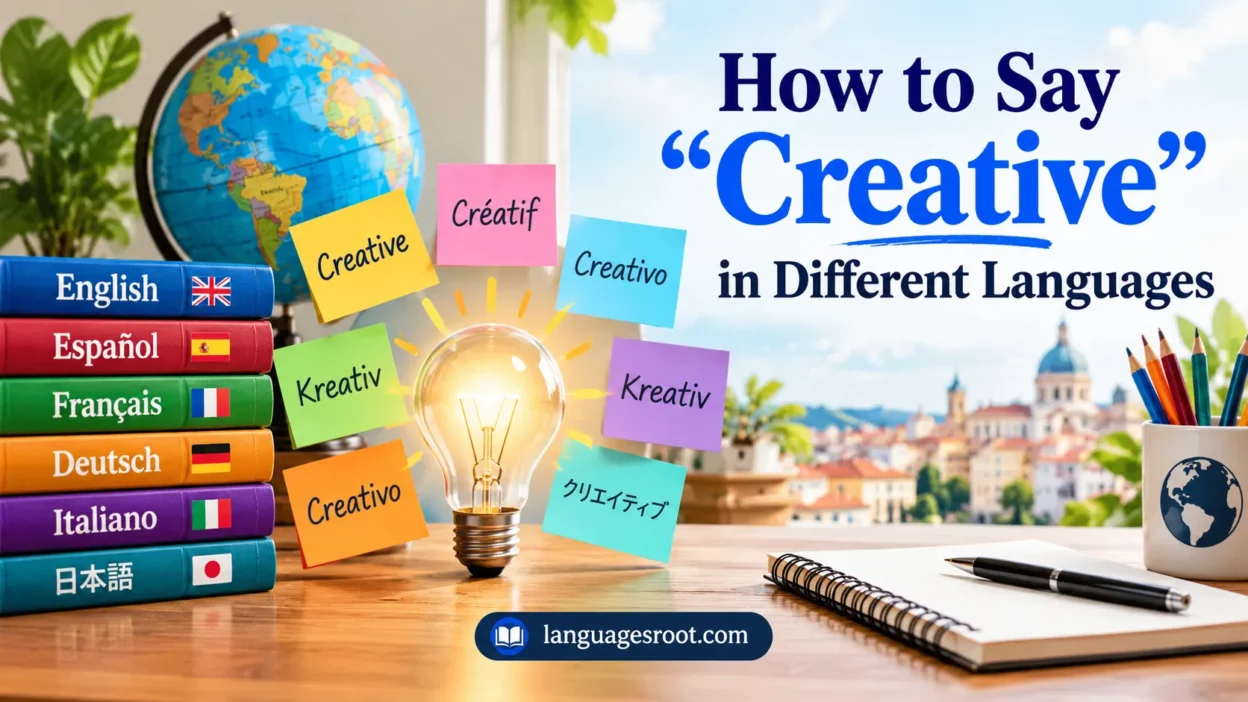
The word creative in different languages helps you explore how cultures express imagination, originality, and inventive thinking. Learning how to say creative also builds your multilingual vocabulary and improves cross-cultural communication. Although the meaning of creative stays similar, creative translations may vary with cultural context and everyday use. Therefore, understanding creative pronunciation and natural expressions helps you choose the right words when speaking with others.
This guide explores creative in 70 languages, featuring useful language translations, a simple pronunciation guide, and practical example sentences. You will discover how European languages, Asian languages, African languages, and Middle Eastern languages express this idea. Additionally, explore synonyms for creative, including inventive, imaginative, innovative, and resourceful, to describe people and ideas more clearly. These translations help language learners, students, travelers, writers, and artists discover new ways to express creativity across cultures.
Interesting Facts About Creative
- Creative describes a quality, not just an activity. It can refer to a person, an idea, a solution, a design, or a way of thinking.
- Creativity extends beyond the arts. Engineering, cooking, teaching, business, science, and everyday problem-solving can all involve creative thinking.
- Translations may emphasize different qualities. Depending on the language, a word for creative may highlight imagination, originality, inventiveness, or artistic expression.
- Grammar affects the translation. Some languages change adjectives according to gender, number, or grammatical case, while others use forms that remain unchanged.
- Context influences the best word choice. Describing a creative child may call for a different expression from describing a creative business strategy.
- Pronunciation varies across writing systems. Languages such as Japanese, Mandarin Chinese, Arabic, and Korean use writing systems that require transliteration or romanization for English readers.
- Creative and creativity are different grammatical forms. The first usually describes a quality, while the second names the ability or process of producing original ideas.
What Does Creative Mean?
Creative means having or showing the ability to produce original ideas, imaginative work, or new ways of doing something. It is an adjective commonly used to describe people, objects, activities, and solutions that demonstrate originality or imagination.
For example, a creative person might write an unusual story, design an original building, invent a new recipe, or find a practical solution to a difficult problem. A creative idea is one that offers an interesting or original approach rather than simply repeating an existing method.
The word can also carry different shades of meaning. In an artistic context, it may refer to imagination and self-expression. within a professional setting, it may emphasize innovation and problem-solving. In everyday conversation, it can be a compliment for someone who thinks differently or makes something interesting from ordinary materials.
When translating creative, it is important to preserve this intended meaning. A word that means artistic may not fully describe a clever business solution, while a word that means inventive may not convey the emotional or imaginative side of creative work.
Why Can Creative Have Different Translations?
The word creative does not always have one exact equivalent in every language. Although many languages have a direct adjective for originality or imagination, the most natural translation depends on what you are describing and how you want the word to sound.
Several factors influence the translation:
- Context: A creative artist, creative solution, and creative business may call for different vocabulary.
- Formality: A professional presentation may use a more formal expression than a casual conversation.
- Gender and number: Some languages change the form of an adjective to match the person or thing being described.
- Regional variation: Speakers in different countries may prefer different words, even when they share a language.
- Cultural meaning: A word associated with artistic talent may not carry exactly the same emphasis as one associated with practical invention.
- Literal versus natural translation: Translating the idea of creativity is often more effective than translating each English word separately.
- Written versus spoken language: A formal dictionary equivalent may differ from the expression someone would naturally use in conversation.
For this article, the translations focus on the adjective creative, rather than translating the entire question “How to say creative?” word for word. This keeps the vocabulary useful for describing people, ideas, and projects.
European Languages
European languages belong to several language families, including Germanic, Romance, Slavic, and Uralic languages. Their translations of creative can emphasize originality, imagination, inventiveness, or artistic ability.
The tables below provide common equivalents and short examples. Pronunciations are approximate reading aids rather than substitutes for listening to fluent speakers.
| 🌍 Language | Country/Region | Translation | Pronunciation | Example Sentence |
| English | International | Creative | kree-AY-tiv | She is a creative artist. Meaning: She makes original art. |
| Spanish | Spain, Mexico, Latin America | Creativo / creativa | kree-ah-TEE-boh / bah | Es una persona creativa. Meaning: This is a creative person. |
| French | France, Belgium, Switzerland, Canada | Créatif / créative | kray-ah-TEEF / teev | Elle est très créative. Meaning: She is very creative. |
| German | Germany, Austria, Switzerland | Kreativ | kray-ah-TEEF | Das ist eine kreative Idee. Meaning: That is a creative idea. |
| Italian | Italy, Switzerland | Creativo / creativa | kreh-ah-TEE-voh / vah | Hai una mente creativa. Meaning: You have a creative mind. |
| Portuguese | Portugal, Brazil | Criativo / criativa | kree-ah-TEE-voo / vah | Ela é muito criativa. Meaning: She is very creative. |
| Dutch | Netherlands, Belgium | Creatief | kray-ah-TEEF | Dat is een creatief idee. Meaning: That is a creative idea. |
| Swedish | Sweden, Finland | Kreativ | kreh-ah-TEEV | Hon är kreativ. Meaning: She is creative. |
| Norwegian | Norway | Kreativ | kreh-ah-TEEV | Han er kreativ. Meaning: He is creative. |
| Danish | Denmark | Kreativ | kreh-ah-TEEV | Hun er kreativ. Meaning: She is creative. |
| Finnish | Finland | Luova | LOO-oh-vah | Hän on luova ihminen. Meaning: They are a creative person. |
| Icelandic | Iceland | Skapandi | SKAH-pan-dee | Hún er skapandi. Meaning: She is creative. |
| Irish | Ireland | Cruthaitheach | kroo-HEE-hakh | Is duine cruthaitheach í. Meaning: She is a creative person. |
| Welsh | Wales | Creadigol | kreh-ah-DIG-ol | Mae hi’n greadigol. Meaning: She is creative. |
| Polish | Poland | Kreatywny / kreatywna | kreh-ah-TIV-nih / nah | To kreatywny pomysł. Meaning: That is a creative idea. |
| Czech | Czechia | Kreativní | kreh-ah-TEEV-nee | Je velmi kreativní. Meaning: They are very creative. |
| Slovak | Slovakia | Kreatívny / kreatívna | kreh-ah-TEEV-nee / nah | Je kreatívna. Meaning: She is creative. |
| Ukrainian | Ukraine | Творчий (tvorchyi) | TVOR-chiy | Вона творча людина. Meaning: She is a creative person. |
| Russian | Russia and Russian-speaking communities | Творческий (tvorcheskiy) | TVOR-chehs-kee | Это творческая идея. Meaning: This is a creative idea. |
| Romanian | Romania, Moldova | Creativ / creativă | kreh-ah-TEEV / veh | Ea este creativă. Meaning: She is creative. |
| Hungarian | Hungary | Kreatív | kreh-ah-TEEV | Kreatív ötlete van. Meaning: They have a creative idea. |
| Greek | Greece, Cyprus | Δημιουργικός / δημιουργική (dimiourgikós / dimiourgikí) | thee-mee-oor-yee-KOS / KEE | Είναι δημιουργική. Meaning: She is creative. |
| Bulgarian | Bulgaria | Творчески (tvorcheski) | TVOR-chehs-kee | Тя е творческа личност. Meaning: She is a creative person. |
| Croatian | Croatia | Kreativan / kreativna | kreh-ah-TEE-vahn / nah | Ona je kreativna. Meaning: She is creative. |
| Serbian | Serbia and neighboring regions | Креативан / креативна (kreativan / kreativna) | kreh-ah-TEE-vahn / nah | Она је креативна. Meaning: She is creative. |
| Slovenian | Slovenia | Ustvarjalen / ustvarjalna | oos-TVAR-yah-len / nah | Je ustvarjalna oseba. Meaning: She is a creative person. |
| Lithuanian | Lithuania | Kūrybingas / kūrybinga | koo-REE-bing-gahs / gah | Ji yra kūrybinga. Meaning: She is creative. |
| Latvian | Latvia | Radošs / radoša | RAH-dosh / shah | Viņa ir radoša. Meaning: She is creative. |
| Estonian | Estonia | Loov | lohv | Ta on loov inimene. Meaning: This is a creative person. |
| Albanian | Albania, Kosovo | Krijues / krijuese | kree-YOOS / seh | Ajo është krijuese. Meaning: She is creative. |
| Catalan | Catalonia, Spain | Creatiu / creativa | kreh-ah-TEE-oo / vah | És una persona creativa. Meaning: This is a creative person. |
English Varieties
English uses the same basic adjective, creative, in the United States, the United Kingdom, and Australia. The spelling and ordinary meaning do not change between these varieties, although accents and some surrounding expressions differ.
| 🌍 Language | Country/Region | Translation | Pronunciation | Example Sentence |
| American English 🇺🇸 | United States | Creative | kree-AY-tiv | He came up with a creative solution. Meaning: He found an original way to solve the problem. |
| British English 🇬🇧 | United Kingdom | Creative | kree-AY-tiv | That is a wonderfully creative design. Meaning: The design is original and imaginative. |
| Australian English 🇦🇺 | Australia | Creative | kree-AY-tiv | She has a creative approach to the project. Meaning: She approaches the project imaginatively. |
Cultural and language note: In Spanish, French, Italian, Portuguese, Polish, and several other languages, adjective forms can change according to grammatical gender. Finnish, Hungarian, and Estonian generally do not change adjectives in the same way. Always match the grammar of the language rather than copying the English form.
Asian Languages
Asia includes a wide range of language families, scripts, and grammatical systems. Some languages have a direct equivalent for creative, while others may favor words that emphasize imagination, originality, or the act of creating something.
The following examples use native writing systems wherever practical, alongside romanization or pronunciation guidance.
| 🌍 Language | Country/Region | Translation | Pronunciation | Example Sentence |
| Mandarin Chinese | China, Taiwan, Singapore | 有创造力的 (yǒu chuàngzàolì de) | yoh choo-ahng-dzaow-lee duh | 她是一个有创造力的人。 Meaning: She is a creative person. |
| Cantonese | Hong Kong, Guangdong | 有創意嘅 (jau5 cong3 ji3 ge3) | yauh tsong yee geh | 佢好有創意。 Meaning: They are very creative. |
| Japanese | Japan | 創造的な (sōzōteki na) | soh-zoh-teh-kee nah | 彼女は創造的な人です。 Meaning: She is a creative person. |
| Korean | South Korea, North Korea | 창의적인 (chang-uijeogin) | chang-ui-juh-gin | 그녀는 창의적인 사람이에요. Meaning: She is a creative person. |
| Hindi | India | रचनात्मक (rachnātmak) | ruh-chuh-naat-muk | वह रचनात्मक है। Meaning: They are creative. |
| Urdu | Pakistan, India | تخلیقی (takhleeqi) | takh-LEE-kee | وہ تخلیقی سوچ رکھتی ہے۔ Meaning: She has creative thinking. |
| Bengali | Bangladesh, India | সৃজনশীল (srijonshil) | sree-jon-sheel | সে খুব সৃজনশীল। Meaning: They are very creative. |
| Punjabi | Punjab, India and Pakistan | ਰਚਨਾਤਮਕ / تخلیقی | ruh-chuh-naat-muk / takh-LEE-kee | ਉਹ ਬਹੁਤ ਰਚਨਾਤਮਕ ਹੈ। Meaning: They are very creative. |
| Gujarati | Gujarat, India | સર્જનાત્મક (sarjanātmak) | sur-juh-naat-muk | તે સર્જનાત્મક છે. Meaning: They are creative. |
| Marathi | Maharashtra, India | सर्जनशील (sarjansheel) | sur-jun-sheel | ती सर्जनशील आहे. Meaning: She is creative. |
| Tamil | India, Sri Lanka, Singapore | படைப்பாற்றல் மிக்க (padaippāṟṟal mikka) | puh-dai-paa-trul mik-kuh | அவள் படைப்பாற்றல் மிக்கவள். Meaning: She is creative. |
| Telugu | Andhra Pradesh, Telangana, India | సృజనాత్మక (srujanātmaka) | sroo-juh-naat-muh-kuh | ఆమె సృజనాత్మకంగా ఆలోచిస్తుంది. Meaning: She thinks creatively. |
| Kannada | Karnataka, India | ಸೃಜನಶೀಲ (srujanashīla) | sroo-juh-nuh-shee-luh | ಅವಳು ಸೃಜನಶೀಲ ವ್ಯಕ್ತಿ. Meaning: She is a creative person. |
| Malayalam | Kerala, India | സർഗാത്മക (sargātmaka) | sur-gaat-muh-kuh | അവൾ സർഗാത്മകയാണ്. Meaning: She is creative. |
| Nepali | Nepal | सिर्जनात्मक (sirjanātmak) | seer-juh-naat-muk | उनी सिर्जनात्मक छिन्। Meaning: She is creative. |
| Sinhala | Sri Lanka | නිර්මාණශීලී (nirmāṇaśīlī) | neer-maa-nuh-shee-lee | ඇය නිර්මාණශීලීයි. Meaning: She is creative. |
| Thai | Thailand | สร้างสรรค์ (sâang-sǎn) | saang-san | เธอเป็นคนสร้างสรรค์ Meaning: She is a creative person. |
| Vietnamese | Vietnam | Sáng tạo | sahng tao | Cô ấy rất sáng tạo. Meaning: She is very creative. |
| Indonesian | Indonesia | Kreatif | kreh-ah-TEEF | Dia sangat kreatif. Meaning: They are very creative. |
| Malay | Malaysia, Brunei, Singapore | Kreatif | kreh-ah-TEEF | Dia seorang yang kreatif. Meaning: They are a creative person. |
| Filipino / Tagalog | Philippines | Malikhain | mah-lik-HIGH-in | Malikhain siya. Meaning: They are creative. |
| Burmese | Myanmar | တီထွင်ဖန်တီးနိုင်သော (tihtwin phantè naing thaw) | tee-twin phan-teh nine-thaw | သူက တီထွင်ဖန်တီးနိုင်သူပါ။ Meaning: They are an inventive, creative person. |
| Khmer | Cambodia | ច្នៃប្រឌិត (chhnai prɑdit) | ch’nai pruh-dit | គាត់មានគំនិតច្នៃប្រឌិត។ Meaning: They have creative ideas. |
| Lao | Laos | ສ້າງສັນ (sang san) | sahng sahn | ລາວເປັນຄົນສ້າງສັນ. Meaning: They are a creative person. |
| Mongolian | Mongolia | Бүтээлч (büteelch) | boo-teelch | Тэр бүтээлч хүн. Meaning: They are a creative person. |
| Kazakh | Kazakhstan | Шығармашыл (şyğarmaşyl) | shuh-ghar-mah-shul | Ол шығармашыл адам. Meaning: They are a creative person. |
| Uzbek | Uzbekistan | Ijodkor | ee-jod-kor | U ijodkor inson. Meaning: They are a creative person. |
| Turkish | Türkiye, Cyprus | Yaratıcı | yah-rah-tuh-juh | O yaratıcı bir insan. Meaning: They are a creative person. |
Cultural and language note: In Mandarin, 有创造力的 describes someone or something with creative ability. In everyday Chinese, 有创意的 can also be a natural choice when emphasizing an original idea or design. throughJapanese, 創造的 is suitable in many contexts, while 創造力のある emphasizes possessing creative ability. In Korean, 창의적인 is a common adjective for creative thinking and originality.
with South Asia, the best word may depend on whether you mean artistic expression, inventive thinking, or general originality. For Punjabi and other languages spoken across multiple countries, scripts and vocabulary may differ by region. The Punjabi example above uses Gurmukhi; the Urdu-script form is also shown in the translation column for readers familiar with Pakistani Punjabi usage.
African Languages
Africa is home to hundreds of languages from several distinct language families. The word creative can be expressed through vocabulary associated with creating, inventing, imagination, and original thought.
The examples below represent individual languages and their communities rather than treating any single expression as universal across an entire country.
| 🌍 Language | Country/Region | Translation | Pronunciation | Example Sentence |
| Swahili | Tanzania, Kenya, East Africa | Ubunifu | oo-boo-NEE-foo | Ana mawazo ya ubunifu. Meaning: They have creative ideas. |
| Afrikaans | South Africa, Namibia | Kreatief | kreh-ah-TEEF | Sy is baie kreatief. Meaning: She is very creative. |
| Zulu | South Africa | Okusungulayo / onobuciko | oh-koo-soong-oo-LAH-yoh / oh-noh-boo-SEE-koh | Unemibono emisha nenobuciko. Meaning: They have new and creative ideas. |
| Xhosa | South Africa | Nobuchule | noh-boo-CHOO-leh | Unobuchule bokuyila. Meaning: They have creative ability. |
| Amharic | Ethiopia | ፈጠራዊ (fet’erawi) | feh-teh-rah-wee | እሷ ፈጠራዊ ሰው ናት። Meaning: She is a creative person. |
| Yoruba | Nigeria, Benin | Oníṣẹ̀dá | oh-nee-sheh-dah | Ó ní èrò ìṣẹ̀dá. Meaning: They have creative ideas. |
| Igbo | Nigeria | Onye okike | oh-nyeh oh-kee-keh | Ọ bụ onye nwere echiche okike. Meaning: They are a person with creative ideas. |
| Hausa | Nigeria, Niger, West Africa | Mai ƙirƙira | mai kir-kee-rah | Shi mutum ne mai ƙirƙira. Meaning: He is an inventive person. |
| Somali | Somalia, Horn of Africa | Hal-abuur leh | hal-ah-boor leh | Waa qof hal-abuur leh. Meaning: They are a creative person. |
| Shona | Zimbabwe | Ane unyanzvi | ah-neh oon-yah-neh-zvee | Ane pfungwa dzitsva uye unyanzvi. Meaning: They have new and creative ideas. |
| Sesotho | Lesotho, South Africa | Boqapi | boh-QAH-pee | O na le boqapi. Meaning: They are creative. |
| Setswana | Botswana, South Africa | Boitlhamedi | boy-tlha-MEH-dee | O na le boitlhamedi. Meaning: They are creative. |
| Kinyarwanda | Rwanda | Ubuhanzi | oo-boo-HAHN-zee | Afite ibitekerezo by’ubuhanzi. Meaning: They have creative ideas. |
| Malagasy | Madagascar | Mamorona / mahay mamorona | mah-moo-ROO-nah / mah-hai mah-moo-ROO-nah | Mahay mamorona hevitra vaovao izy. Meaning: They can create new ideas. |
| Lingala | Democratic Republic of the Congo, Republic of the Congo | Ya bokeli | yah boh-KEH-lee | Azali na makanisi ya bokeli. Meaning: They have creative ideas. |
Cultural and language note: Some entries use a noun or descriptive phrase rather than a one-word adjective. For example, Swahili ubunifu refers to creativity or innovation, while mawazo ya ubunifu means creative ideas. These constructions can sound more natural than forcing an English-style adjective into every sentence.
In African languages, spelling, pronunciation, and everyday usage may differ between communities. The example sentences are intended as useful illustrations, not as claims that a particular expression is the only possible translation.
Middle Eastern Languages
The Middle East includes Arabic, Persian, Hebrew, Kurdish, Turkish, Armenian, and other language traditions. The natural expression for creative depends on the language, the grammatical structure, and whether the intended meaning concerns artistic ability or inventive thinking.
| 🌍 Language | Country/Region | Translation | Pronunciation | Example Sentence |
| Modern Standard Arabic | Across the Arab world | إبداعي (ibdāʿī), creative; مُبدِع (mubdiʿ), creative person | ib-daa-ee / mub-dee | إنها شخصية مبدعة. Meaning: She is a creative person. |
| Persian (Farsi) | Iran, Persian-speaking communities | خلاق (khalāq) | kha-laaq | او فردی خلاق است. Meaning: They are a creative person. |
| Hebrew | Israel | יצירתי / יצירתית (yetzirati / yetziratit) | yets-ee-rah-TEE / yets-ee-rah-TEET | היא אדם יצירתי. Meaning: She is a creative person. |
| Kurdish (Kurmanji) | Türkiye, Iraq, Syria, and surrounding regions | Afirîner | ah-fee-ree-NEHR | Ew kesekî afirîner e. Meaning: They are a creative person. |
| Armenian | Armenia and Armenian-speaking communities | Ստեղծագործ (steghtsagorts) | stegh-tsah-GORts | Նա ստեղծագործ մարդ է։ Meaning: They are a creative person. |
Cultural and language note: Modern Standard Arabic is useful in formal writing and cross-regional communication, but spoken Arabic varies considerably between countries and communities. In Arabic, مُبدِع (mubdiʿ) commonly describes a creative person, while إبداعي (ibdāʿī) can describe something creative. The feminine form of mubdiʿ is مُبدِعة (mubdiʿa).
Persian خلاق (khalāq) is widely used for creative or inventive. Hebrew uses different adjective forms depending on grammatical gender. Kurdish and Armenian also have their own grammatical patterns, so example sentences should be understood within their particular language.
Other World Languages
Several languages outside the main regional groups offer useful ways to express creative. These examples include Indigenous languages, regional languages, a creole language, and an internationally constructed language.
| 🌍 Language | Country/Region | Translation | Pronunciation | Example Sentence |
| Māori | New Zealand | Auaha | ow-AH-hah | He tangata auaha ia. Meaning: They are a creative person. |
| Samoan | Samoa, Pacific Islands | Fatufatuaʻi | fah-too-fah-too-ah-ee | O ia o se tagata fatufatuaʻi. Meaning: They are a creative person. |
| Tongan | Tonga, Pacific Islands | Fakakaukau foʻou | fah-kah-kow-kow foh-oh-oo | ʻOku ʻi ai ʻene fakakaukau foʻou. Meaning: They have a new idea. |
| Hawaiian | Hawaiʻi | Hoʻokumu | hoh-oh-KOO-moo | He kanaka hoʻokumu ʻo ia. Meaning: They are an innovative or creative person. |
| Quechua | Andean regions of Peru, Bolivia, Ecuador | Kamayuq | kah-MAI-yook | Regional vocabulary varies; this term is associated with skilled expertise or mastery rather than being a universal adjective for creative. |
| Guarani | Paraguay and surrounding regions | Py’aguapy / apytu’ũ rehegua | puh-ah-goo-ah-puh / ah-puh-too-oo reh-heh-goo-ah | Expressions for creativity vary by context; a descriptive phrase may be preferable to a single adjective. |
| Haitian Creole | Haiti and Haitian communities | Kreyatif | kreh-yah-TEEF | Li se yon moun kreyatif. Meaning: They are a creative person. |
| Esperanto | International constructed language | Kreema | kreh-EH-mah | Ŝi estas kreema. Meaning: She is creative. |
Important accuracy note: Some regional and Indigenous languages express creativity through a descriptive phrase rather than one direct adjective. The Quechua and Guarani entries illustrate why it is important not to treat every related word as an exact equivalent of English creative. Their terminology can depend on dialect and intended meaning, so these entries should not be used as universal translations without checking the relevant community’s usage.
Also Read: How to Say Cute in Different Languages
Quick Reference: Creative in Different Languages
Use this compact reference to find the main translation for each language covered in the article. Where a language has multiple grammatical forms or the earlier table uses a descriptive expression, the entry below gives a representative equivalent.
| Language | Translation |
| English | Creative |
| Spanish | Creativo / creativa |
| French | Créatif / créative |
| German | Kreativ |
| Italian | Creativo / creativa |
| Portuguese | Criativo / criativa |
| Dutch | Creatief |
| Swedish | Kreativ |
| Norwegian | Kreativ |
| Danish | Kreativ |
| Finnish | Luova |
| Icelandic | Skapandi |
| Irish | Cruthaitheach |
| Welsh | Creadigol |
| Polish | Kreatywny / kreatywna |
| Czech | Kreativní |
| Slovak | Kreatívny / kreatívna |
| Ukrainian | Творчий |
| Russian | Творческий |
| Romanian | Creativ / creativă |
| Hungarian | Kreatív |
| Greek | Δημιουργικός / δημιουργική |
| Bulgarian | Творчески |
| Croatian | Kreativan / kreativna |
| Serbian | Креативан / креативна |
| Slovenian | Ustvarjalen / ustvarjalna |
| Lithuanian | Kūrybingas / kūrybinga |
| Latvian | Radošs / radoša |
| Estonian | Loov |
| Albanian | Krijues / krijuese |
| Catalan | Creatiu / creativa |
| American English | Creative |
| British English | Creative |
| Australian English | Creative |
| Mandarin Chinese | 有创造力的 |
| Cantonese | 有創意嘅 |
| Japanese | 創造的な |
| Korean | 창의적인 |
| Hindi | रचनात्मक |
| Urdu | تخلیقی |
| Bengali | সৃজনশীল |
| Punjabi | ਰਚਨਾਤਮਕ / تخلیقی |
| Gujarati | સર્જનાત્મક |
| Marathi | सर्जनशील |
| Tamil | படைப்பாற்றல் மிக்க |
| Telugu | సృజనాత్మక |
| Kannada | ಸೃಜನಶೀಲ |
| Malayalam | സർഗാത്മക |
| Nepali | सिर्जनात्मक |
| Sinhala | නිර්මාණශීලී |
| Thai | สร้างสรรค์ |
| Vietnamese | Sáng tạo |
| Indonesian | Kreatif |
| Malay | Kreatif |
| Filipino / Tagalog | Malikhain |
| Burmese | တီထွင်ဖန်တီးနိုင်သော |
| Khmer | ច្នៃប្រឌិត |
| Lao | ສ້າງສັນ |
| Mongolian | Бүтээлч |
| Kazakh | Шығармашыл |
| Uzbek | Ijodkor |
| Turkish | Yaratıcı |
| Swahili | Ubunifu |
| Afrikaans | Kreatief |
| Zulu | Onobuciko / okusungulayo |
| Xhosa | Nobuchule |
| Amharic | ፈጠራዊ |
| Yoruba | Oníṣẹ̀dá |
| Igbo | Onye okike |
| Hausa | Mai ƙirƙira |
| Somali | Hal-abuur leh |
| Shona | Ane unyanzvi |
| Sesotho | Boqapi |
| Setswana | Boitlhamedi |
| Kinyarwanda | Ubuhanzi |
| Malagasy | Mahay mamorona |
| Lingala | Ya bokeli |
| Modern Standard Arabic | إبداعي / مُبدِع |
| Persian | خلاق |
| Hebrew | יצירתי / יצירתית |
| Kurdish (Kurmanji) | Afirîner |
| Armenian | Ստեղծագործ |
| Māori | Auaha |
| Samoan | Fatufatuaʻi |
| Tongan | Fakakaukau foʻou |
| Hawaiian | Hoʻokumu |
| Quechua | Context-dependent; verify regional usage |
| Guarani | Context-dependent; verify regional usage |
| Haitian Creole | Kreyatif |
| Esperanto | Kreema |
How to Choose the Right Translation
The best translation of creative depends on what you want to describe, who will read your message, and the language they use. A word that fits an art project may not communicate the same idea when describing a business strategy, a child’s imagination, or a scientific invention.
Follow these practical tips to choose the right expression:
- Identify your meaning. Decide whether you mean imaginative, inventive, artistic, or generally original.
- Consider your audience. Choose vocabulary that suits your reader’s age, familiarity with the language, and relationship with you.
- Check grammatical agreement. In languages such as French, Spanish, and Italian, adjectives may change according to gender and number.
- Consider regional usage. Spanish spoken in Spain and Latin America, for example, can differ in vocabulary and everyday expressions.
- Match the situation. A formal presentation may require a different sentence from a friendly conversation.
- Read the entire sentence. Check whether the adjective sounds natural alongside the noun it describes.
- Confirm pronunciation. Listen to a reliable language-learning resource or fluent speaker when using an unfamiliar expression aloud.
A useful rule: Translate the idea you want to communicate, not simply the English letters or individual words.
Common Mistakes When Translating Creative
Translating creative may appear straightforward, but several mistakes can change the intended meaning. Understanding these problems helps you use multilingual vocabulary more naturally.
1. Translating word for word
Some languages express creativity through a phrase rather than a single adjective. Choosing a natural expression is more important than preserving the exact English structure.
2. Confusing creative with artistic
An artistic person may be creative, but creativity also includes invention, original thinking, and practical problem-solving. Choose a translation that matches the intended quality.
3. Ignoring grammatical gender
French, Spanish, Italian, and several other languages have adjective forms that depend on grammatical gender. Using the wrong form can make a sentence sound incorrect.
4. Mixing regional expressions
A word or expression used in one region may not be the most natural choice elsewhere. This is particularly relevant for languages spoken across several countries.
5. Using incorrect pronunciation
A translation may be correct in writing but difficult to understand if pronounced incorrectly. Pay attention to stress, vowel sounds, tones, and unfamiliar consonants.
6. Assuming every language has a perfect equivalent
Some words express imagination, others emphasize inventiveness, and still others describe the ability to create. These meanings overlap, but they are not always identical.
7. Forgetting the surrounding sentence
A translation that works for a person may sound different when describing an idea or object. Always check the adjective in context.
Why Learn Creative in Different Languages?
Learning how to say creative in different languages expands your vocabulary and helps you appreciate how people describe imagination and originality around the world. It can be useful when traveling, studying a foreign language, communicating with international colleagues, or exchanging ideas with people from different backgrounds.
For students, learning these translations introduces new adjectives and sentence structures. Writers and artists may find useful words for describing their work, while teachers and parents can use them to discuss imagination and problem-solving with multilingual learners.
Exploring several translations also highlights the relationship between language and culture. One expression may emphasize artistic skill, while another focuses on inventiveness or the ability to develop new ideas. Recognizing these differences encourages more thoughtful communication and helps prevent misunderstandings.
You do not need to memorize every word at once. Start with a few languages that interest you, practice each expression in a complete sentence, and gradually expand your vocabulary. Learning pronunciation alongside meaning will make it easier to recognize and use the words in real conversations.
Frequently Asked Questions
How do you say creative in different languages?
The word creative translates as creativo in Spanish, créatif in French, kreativ in German, and luova in Finnish. However, the correct translation depends on the language, context, and intended meaning.
What does creative mean in different languages?
The meaning of creative generally relates to imagination, originality, and the ability to develop new ideas. However, some languages emphasize artistic expression, while others focus on invention or problem-solving.
Why do creative translations differ across languages?
Creative translations vary because of cultural context, grammar, and regional usage. For example, Spanish and French use different adjective forms based on grammatical gender, while other languages may use descriptive phrases.
How do you pronounce creative in other languages?
A pronunciation guide helps you learn unfamiliar words, such as Japanese 創造的な (sōzōteki na) and Mandarin Chinese 有创造力的 (yǒu chuàngzàolì de). For better accuracy, listen to fluent speakers and practice each word in example sentences.
What is the difference between creative and creativity?
Creative is an adjective that describes a person, idea, or activity, while creativity is a noun for the ability to produce original ideas. Both relate to imaginative thinking, but they serve different roles in a sentence.
Conclusion
Learning creative in different languages reveals how cultures express imagination, originality, and inventive thinking through unique words and phrases. From creativo in Spanish to 創造的な in Japanese, these creative translations show why context, grammar, and pronunciation matter. By practicing each word with example sentences and exploring synonyms for creative, you can build vocabulary and improve cross-cultural communication.