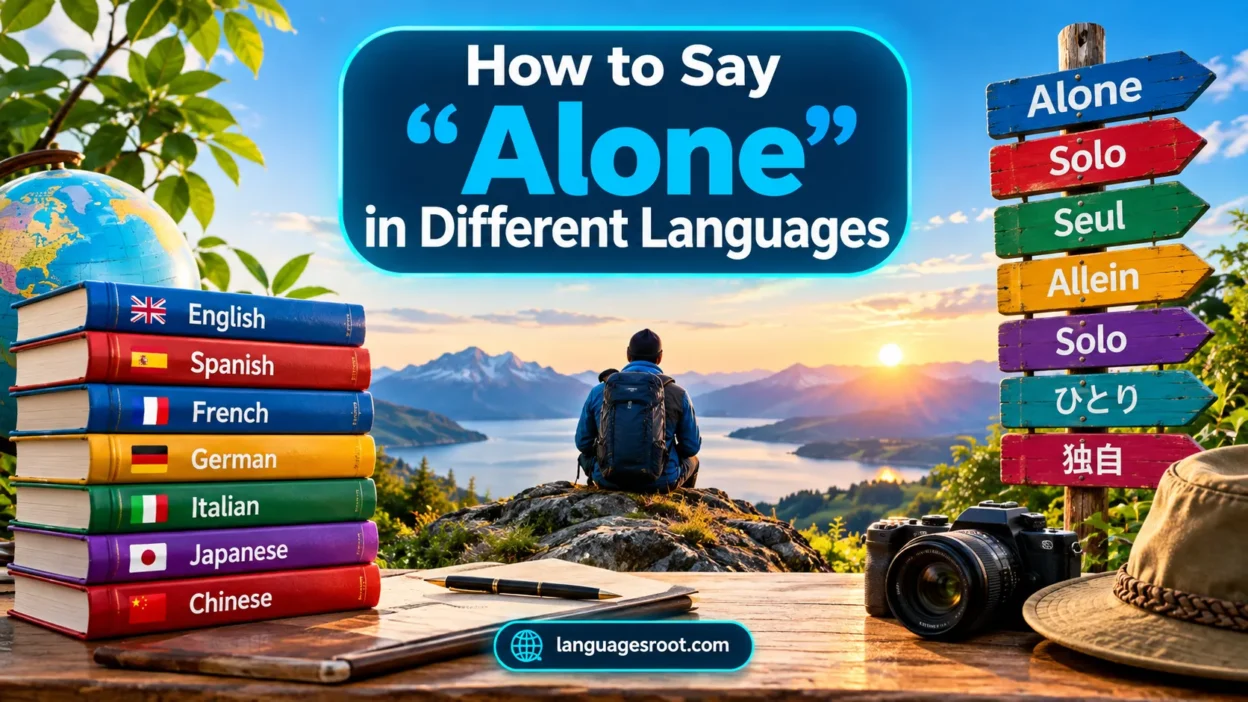
The alone meaning describes being by yourself or without other people nearby. However, alone can express peaceful, independent, or lonely feelings depending on context. Therefore, learning how to say alone in different languages reveals interesting cultural and linguistic differences. This guide helps you understand each translation, pronunciation, and natural expression clearly.
Whether you are learning a new language, traveling, or studying world cultures, these translations can help. You will also find related expressions, example sentence ideas, and useful cultural context. Some languages change the word based on gender, number, or grammatical role. Understanding these details helps you choose a natural translation when expressing solitude, personal space, or personal independence.
Interesting Facts About “Alone”
- “Alone” does not always mean “lonely.” Being alone describes a situation, while loneliness describes an emotional state.
- The English word alone can describe both physical solitude and independence.
- English speakers commonly say “I am alone” when they mean they are by themselves.
- “All alone” adds emphasis and can suggest complete solitude.
- “By myself” is another common English expression with a similar meaning.
- Some languages use different forms of the word depending on whether the speaker is male or female.
- In several languages, the most natural expression is closer to “by myself” than a direct equivalent of “alone.”
- The meaning can change depending on whether you are talking about a person, place, activity, or emotional experience.
- In literature, “alone” can suggest independence, mystery, sadness, freedom, or reflection.
- In everyday conversation, context usually determines whether “alone” sounds positive or negative.
- Learning words related to solitude can help language learners understand cultural attitudes toward privacy and independence.
- The English expression “leave me alone” has a different function from simply saying “alone.”
- “Alone” and “lonely” should not automatically be treated as synonyms.
- Some languages have separate expressions for being physically alone and feeling emotionally isolated.
- Translation dictionaries may provide several options because the best word depends on the sentence.
How to Say “Alone” in Different Languages
The following sections cover more than 70 languages from different parts of the world. Pronunciations are simplified learner-friendly guides rather than strict phonetic transcriptions. Where a language commonly changes the form according to gender or grammar, the most useful everyday form is provided.
European Languages
European languages belong to several different language families, including Romance, Germanic, Slavic, Celtic, and others. Although many of these languages have words that directly correspond to “alone,” their grammatical forms can differ. The examples below focus on common everyday usage.
| Language | Country/Region | Translation | Pronunciation | Synonyms / Related Expression | Example |
| 🇬🇧 British English | United Kingdom | alone | uh-LONE | by oneself, solitary | I am alone at home. |
| 🇺🇸 American English | United States | alone | uh-LONE | by myself, on my own | I prefer to be alone sometimes. |
| 🇦🇺 Australian English | Australia | alone | uh-LONE | by myself, on my own | She went alone. |
| 🇫🇷 French | France, Belgium | seul / seule | suhl / suhl | solitaire, tout seul | Je suis seul. |
| 🇪🇸 Spanish | Spain, Latin America | solo / sola | SO-lo / SO-la | a solas | Estoy solo. |
| 🇮🇹 Italian | Italy | solo / sola | SO-lo / SO-la | da solo, solitario | Sono solo. |
| 🇵🇹 Portuguese | Portugal, Brazil | sozinho / sozinha | so-ZEEN-yoo / so-ZEEN-ya | só, isolado | Estou sozinho. |
| 🇩🇪 German | Germany, Austria | allein | ah-LINE | einsam, für sich | Ich bin allein. |
| 🇳🇱 Dutch | Netherlands, Belgium | alleen | ah-LAYN | op mezelf | Ik ben alleen. |
| 🇸🇪 Swedish | Sweden | ensam | EN-sam | själv, allena | Jag är ensam. |
| 🇳🇴 Norwegian | Norway | alene | ah-LEH-neh | for seg selv | Jeg er alene. |
| 🇩🇰 Danish | Denmark | alene | ah-LEH-neh | for sig selv | Jeg er alene. |
| 🇫🇮 Finnish | Finland | yksin | ÜK-sin | yksinäinen | Olen yksin. |
| 🇮🇸 Icelandic | Iceland | einn / ein | ayn | einn saman | Ég er einn. |
| 🇮🇪 Irish | Ireland | inaonar | in-uh-NAR | liom féin | Tá mé i m’aonar. |
| 🏴 Welsh | Wales | ar fy mhen fy hun | ar vuh men vuh hun | ar eich pen eich hun | Rwy’n ar fy mhen fy hun. |
| 🇵🇱 Polish | Poland | sam / sama | sahm / SAH-mah | samotny | Jestem sam. |
| 🇨🇿 Czech | Czech Republic | sám / sama | saam / SAH-mah | osamělý | Jsem sám. |
| 🇸🇰 Slovak | Slovakia | sám / sama | saam / SAH-mah | osamelý | Som sám. |
| 🇷🇺 Russian | Russia | один / одна | ah-DEEN / ahd-NAH | в одиночестве | Я один. |
| 🇺🇦 Ukrainian | Ukraine | сам / сама | sahm / sah-MAH | наодинці | Я сам. |
| 🇧🇬 Bulgarian | Bulgaria | сам / сама | sahm / sah-MAH | самотен | Аз съм сам. |
| 🇷🇸 Serbian | Serbia | sam / sama | sahm / SAH-mah | usamljen | Ja sam sam. |
| 🇭🇷 Croatian | Croatia | sam / sama | sahm / SAH-mah | usamljen | Ja sam sam. |
| 🇸🇮 Slovenian | Slovenia | sam / sama | sahm / SAH-mah | osamljen | Sam sem. |
| 🇸🇰 Slovak | Slovakia | sám / sama | saam / SAH-mah | osamelý | Som sám. |
| 🇬🇷 Greek | Greece | μόνος / μόνη | MO-nos / MO-nee | μοναχικός | Είμαι μόνος. |
| 🇷🇴 Romanian | Romania | singur / singură | SEEN-goor / SEEN-goo-ruh | solitar | Sunt singur. |
| 🇭🇺 Hungarian | Hungary | egyedül | EH-yed-ool | magamban | Egyedül vagyok. |
| 🇱🇹 Lithuanian | Lithuania | vienas / viena | VYEH-nas / VYEH-na | vienišas | Aš vienas. |
| 🇱🇻 Latvian | Latvia | viens / viena | vyens / VYEH-na | vientuļš | Es esmu viens. |
| 🇪🇪 Estonian | Estonia | üksi | OOK-see | üksinda | Ma olen üksi. |
| 🇦🇱 Albanian | Albania, Kosovo | vetëm | VEH-tuhm | i vetmuar | Jam vetëm. |
| 🇲🇹 Maltese | Malta | waħdu / waħedha | WAH-doo / wa-ED-ha | waħdu biss | Jien waħdi. |
| 🇧🇦 Bosnian | Bosnia and Herzegovina | sam / sama | sahm / SAH-mah | usamljen | Ja sam sam. |
| 🇲🇰 Macedonian | North Macedonia | сам / сама | sahm / SAH-mah | осамен | Јас сум сам. |
Understanding European Usage
A particularly important point is that many European languages change the form of “alone” according to gender. French uses seul and seule, Spanish uses solo and sola, while Polish uses sam and sama. This means learners should consider who is speaking before choosing a form.
German allein, Dutch alleen, Finnish yksin, and Hungarian egyedül are useful examples where the everyday expression does not follow the same masculine and feminine pattern found in some Romance and Slavic languages.
Asian Languages
Asia contains thousands of languages and many different writing systems. Words for “alone” can work differently in East Asian, South Asian, Southeast Asian, and Central Asian languages. Some expressions focus on physical solitude, while others can suggest doing something independently.
| Language | Country/Region | Translation | Pronunciation | Synonyms / Related Expression | Example |
| 🇨🇳 Mandarin Chinese | China, Taiwan | 一个人 / 独自 | yí ge rén / dúzì | 独处 | 我一个人。 |
| 🇯🇵 Japanese | Japan | 一人で | hitori de | 独りで | 一人で行きます。 |
| 🇰🇷 Korean | South Korea | 혼자 | hon-ja | 홀로 | 저는 혼자예요. |
| 🇻🇳 Vietnamese | Vietnam | một mình | moht ming | đơn độc | Tôi ở một mình. |
| 🇹🇭 Thai | Thailand | คนเดียว | kon diao | ตามลำพัง | ฉันอยู่คนเดียว |
| 🇮🇩 Indonesian | Indonesia | sendirian | sen-DEE-ree-an | sendiri | Saya sendirian. |
| 🇲🇾 Malay | Malaysia, Brunei | bersendirian | ber-sen-DEE-ree-an | sendiri | Saya bersendirian. |
| 🇵🇭 Filipino | Philippines | mag-isa | mag-ee-SA | nag-iisa | Mag-isa ako. |
| 🇮🇳 Hindi | India | अकेला / अकेली | uh-KAY-la / uh-KAY-lee | एकांत में | मैं अकेला हूँ। |
| 🇧🇩 Bengali | Bangladesh, India | একা | EH-ka | একাকী | আমি একা। |
| 🇵🇰 Urdu | Pakistan, India | اکیلا / اکیلی | uh-KEH-la / uh-KEH-lee | تنہا | میں اکیلا ہوں۔ |
| 🇮🇳 Punjabi | India, Pakistan | ਇਕੱਲਾ / ਇਕੱਲੀ | ik-LAH / ik-LLEE | ਤਨਹਾ | ਮੈਂ ਇਕੱਲਾ ਹਾਂ۔ |
| 🇮🇳 Marathi | India | एकटा / एकटी | EK-ta / EK-tee | एकाकी | मी एकटा आहे. |
| 🇮🇳 Gujarati | India | એકલો / એકલી | EK-lo / EK-lee | એકાંતમાં | હું એકલો છું. |
| 🇮🇳 Tamil | India, Sri Lanka | தனியாக | ta-nee-YAA-ga | தனிமையில் | நான் தனியாக இருக்கிறேன். |
| 🇮🇳 Telugu | India | ఒంటరిగా | on-ta-ree-GAA | ఏకాంతంగా | నేను ఒంటరిగా ఉన్నాను. |
| 🇮🇳 Kannada | India | ಒಬ್ಬಂಟಿಯಾಗಿ | ob-ban-TI-gee | ಏಕಾಂಗಿಯಾಗಿ | ನಾನು ಒಬ್ಬಂಟಿಯಾಗಿದ್ದೇನೆ. |
| 🇮🇳 Malayalam | India | ഒറ്റയ്ക്ക് | OT-tak-ku | തനിച്ച് | ഞാൻ ഒറ്റയ്ക്കാണ്. |
| 🇳🇵 Nepali | Nepal | एक्लै | EK-lai | एकान्तमा | म एक्लै छु। |
| 🇱🇰 Sinhala | Sri Lanka | තනියම | ta-nee-YA-ma | තනිව | මම තනියම. |
| 🇲🇳 Mongolian | Mongolia | ганцаараа | gan-tsaa-RAA | ганцаарангaa | Би ганцаараа. |
| 🇰🇿 Kazakh | Kazakhstan | жалғыз | zhal-GHIZ | жалғыз өзі | Мен жалғызбын. |
| 🇺🇿 Uzbek | Uzbekistan | yolg‘iz | yol-GHIZ | bir o‘zi | Men yolg‘izman. |
| 🇹🇯 Tajik | Tajikistan | танҳо | tan-HO | танҳоӣ | Ман танҳо ҳастам. |
| 🇦🇲 Armenian | Armenia | մենակ | meh-NAK | միայնակ | Ես մենակ եմ։ |
| 🇬🇪 Georgian | Georgia | მარტო | MAR-to | მარტოხელა | მე მარტო ვარ. |
| 🇦🇿 Azerbaijani | Azerbaijan | tək | tek | təkbaşına | Mən təkəm. |
| 🇮🇱 Hebrew | Israel | לבד | le-VAD | לבדו, לבדה | אני לבד. |
| 🇮🇷 Persian | Iran, Afghanistan | تنها | tan-HAA | به تنهایی | من تنها هستم. |
| 🇦🇫 Pashto | Afghanistan, Pakistan | یوازې | YAA-ze | یواځې | زه یوازې یم. |
Cultural Notes for Asian Languages
Asian languages demonstrate why context matters in translation. In Japanese, 一人で often means doing something alone or by oneself. Korean 혼자 is widely used in everyday speech for being alone. Mandarin Chinese can use 一个人 when emphasizing that someone is by themselves, while 独自 has a stronger sense of doing something alone or independently.
South Asian languages also show interesting grammatical differences. Hindi, Urdu, Punjabi, Marathi, and Gujarati may change forms based on gender. In Tamil, Telugu, Kannada, and Malayalam, the most natural expression can function more like an adverbial phrase meaning “alone” or “by oneself.”
Also Read: How to Say “What Time Is It” in Different Languages
African Languages
Africa is home to enormous linguistic diversity, including major language families such as Niger-Congo, Afroasiatic, Nilo-Saharan, and others. The translations below represent widely used languages from different African regions. As with every multilingual guide, local dialects can have additional forms.
| Language | Country/Region | Translation | Pronunciation | Synonyms / Related Expression | Example |
| 🇿🇦 Zulu | South Africa | yedwa | YEH-dwa | yedwa yodwa | Ngindedwa. |
| 🇿🇦 Xhosa | South Africa | yedwa | YEH-dwa | wedwa | Ndisedwa. |
| 🇰🇪 Swahili | East Africa | peke yangu | PEH-keh YAN-goo | mwenyewe | Niko peke yangu. |
| 🇰🇪 Kikuyu | Kenya | nyamũ | nya-MOO | wega | Ndi nyamũ. |
| 🇸🇴 Somali | Somalia | kaligiis / kaligeed | ka-li-GEES / ka-li-GEED | keligiis | Kaligay baan ahay. |
| 🇪🇹 Amharic | Ethiopia | ብቻ | bu-cha | ብቻዬ | ብቻዬ ነኝ። |
| 🇳🇬 Yoruba | Nigeria | nikan | nee-KAN | nikanṣoṣo | Mo wa nikan. |
| 🇳🇬 Igbo | Nigeria | naanị | NAH-nee-yeh | naanị ya | Anọ m naanị. |
| 🇳🇬 Hausa | Nigeria, Niger | shi kaɗai / ita kaɗai | shee ka-DYE / ee-ta ka-DYE | shi kaɗai | Ni kaɗai nake. |
| 🇬🇭 Akan | Ghana | nkutoo | n-koo-TOH | nko ara | Me nko ara. |
| 🇸🇳 Wolof | Senegal | kenn | ken | kenn rekk | Maa ngi kenn. |
| 🇲🇬 Malagasy | Madagascar | irery | ee-REH-ree | irery ihany | Irery aho. |
| 🇷🇼 Kinyarwanda | Rwanda | wenyine | weh-NYEE-neh | jyenyine | Ndi wenyine. |
| 🇧🇼 Setswana | Botswana | nosi | NO-see | esi nosi | Ke nosi. |
| 🇿🇼 Shona | Zimbabwe | ndega | NDEH-ga | ndega ndega | Ndiri ndega. |
| 🇳🇦 Oshiwambo | Namibia | yedwa | YEH-dwa | mwene | Onda li yedwa. |
| 🇿🇦 Sesotho | Lesotho, South Africa | ke le mong | keh leh mong | a le mong | Ke le mong. |
African Language Notes
In many African languages, the concept of being alone is expressed through a phrase meaning “by myself,” “only me,” “by oneself,” or “without others.” Swahili’s peke yangu, for example, emphasizes being by oneself.
Expressions can also differ according to grammatical person. A form used for “I am alone” may not be identical to the form used for “he is alone” or “she is alone.” This is why using a translation in a complete sentence is often safer than memorizing a single isolated word.
Middle Eastern Languages
The Middle East contains languages from several major families, including Semitic, Indo-European, and Turkic languages. Arabic alone has many regional varieties, so everyday expressions can differ between countries. Persian, Hebrew, Kurdish, and Turkish also provide useful examples of how the idea of solitude can be expressed.
| Language | Country/Region | Translation | Pronunciation | Synonyms / Related Expression | Example |
| 🇸🇦 Arabic | Arab world | وحدي | wah-DEE | بمفردي | أنا وحدي. |
| 🇪🇬 Egyptian Arabic | Egypt | لوحدي | li-WAH-dee | بمفردي | أنا لوحدي. |
| 🇱🇧 Lebanese Arabic | Lebanon | لحالي | la-HA-lee | وحدي | أنا لحالي. |
| 🇮🇷 Persian | Iran | تنها | tan-HAA | به تنهایی | من تنها هستم. |
| 🇮🇱 Hebrew | Israel | לבד | le-VAD | לבדי | אני לבד. |
| 🇹🇷 Turkish | Turkey | yalnız | yah-LUHZ | tek başına | Yalnızım. |
| 🇮🇶 Kurdish | Iraq, Turkey, Syria | tenê | teh-NEH | bi tenê | Ez tenê me. |
| 🇦🇫 Dari | Afghanistan | تنها | tan-HAA | به تنهایی | من تنها هستم. |
| 🇦🇫 Pashto | Afghanistan | یوازې | YAA-ze | یواځې | زه یوازې یم. |
| 🇦🇲 Armenian | Armenia | մենակ | meh-NAK | միայնակ | Ես մենակ եմ։ |
| 🇦🇿 Azerbaijani | Azerbaijan | tək | tek | təkbaşına | Mən təkəm. |
Middle Eastern Language Notes
Arabic requires special attention because Modern Standard Arabic and regional dialects are not identical in everyday speech. The expression وحدي is widely understandable, while dialects such as Egyptian and Lebanese Arabic often use different conversational constructions.
Turkish yalnız can mean “alone” or “lonely,” depending on context, while tek başına more specifically emphasizes doing something by oneself. Persian تنها can also carry meanings related to solitude or being solitary.
Additional Languages Around the World
The concept of being alone exists in every culture, but languages do not always divide the idea in exactly the same way. The following examples expand the list with languages from the Americas, Pacific region, and other parts of the world.
| Language | Country/Region | Translation | Pronunciation | Synonyms / Related Expression | Example |
| 🇧🇷 Brazilian Portuguese | Brazil | sozinho / sozinha | so-ZEEN-yoo / so-ZEEN-ya | só | Estou sozinho. |
| 🇨🇦 Canadian French | Canada | seul / seule | suhl | tout seul | Je suis seul. |
| 🇲🇽 Mexican Spanish | Mexico | solo / sola | SO-lo / SO-la | a solas | Estoy solo. |
| 🇦🇷 Argentine Spanish | Argentina | solo / sola | SO-lo / SO-la | por mi cuenta | Estoy solo. |
| 🇭🇹 Haitian Creole | Haiti | pou kont mwen | poo kont mwen | pou kont li | Mwen pou kont mwen. |
| 🇬🇹 K’iche’ | Guatemala | junel | hoo-NEL | jun | In junel. |
| 🇵🇪 Quechua | Andes, South America | sapalla | sa-PAL-ya | sapallan | Sapallam kani. |
| 🇳🇿 Māori | New Zealand | ko ia anake | ko ee-ah AH-na-keh | anake | Ko au anake. |
| 🇼🇸 Samoan | Samoa | na o aʻu | nah oh ow | toʻatasi | Na o aʻu. |
| 🇹🇴 Tongan | Tonga | toko taha | TOH-koh TAH-ha | taha pē | Ko au toko taha. |
| 🇫🇯 Fijian | Fiji | duadua | doo-ah-DOO-ah | vakataki koya | Au duadua. |
| 🇵🇬 Tok Pisin | Papua New Guinea | wanpela tasol | wan-PEH-la ta-SOL | wanpela yet | Mi stap wanpela tasol. |
| 🇮🇩 Javanese | Indonesia | dhewe | DHEH-weh | piyambakan | Aku dhewe. |
| 🇮🇩 Sundanese | Indonesia | sorangan | so-RA-ngan | nyalira | Abdi sorangan. |
| 🇱🇦 Lao | Laos | ຄົນດຽວ | khon diao | ຢູ່ຄົນດຽວ | ຂ້ອຍຢູ່ຄົນດຽວ. |
| 🇰🇭 Khmer | Cambodia | ម្នាក់ឯង | mneak aeng | តែម្នាក់ឯង | ខ្ញុំនៅម្នាក់ឯង។ |
| 🇲🇲 Burmese | Myanmar | တစ်ယောက်တည်း | ta-yauk-teh | တစ်ယောက်ထဲ | ကျွန်တော်တစ်ယောက်တည်းပါ။ |
| 🇱🇰 Tamil | Sri Lanka, India | தனியாக | ta-nee-YAA-ga | தனிமையில் | நான் தனியாக இருக்கிறேன். |
| 🇮🇳 Sanskrit | India, historical/classical | एकाकी | eh-KAA-kee | एकः | सः एकाकी अस्ति। |
“Alone” vs. “Lonely”
One of the most important distinctions for English learners is the difference between alone and lonely.
Alone describes a situation. If you say, “I am alone,” you normally mean that no one else is with you. This statement does not necessarily mean that you are unhappy.
Lonely, however, describes an emotional experience. Someone can feel lonely even while surrounded by many people. Likewise, someone can be completely alone while feeling peaceful, relaxed, or happy.
For example:
- I am alone at home. This describes a situation.
- I feel lonely at home. This describes an emotion.
- She enjoys being alone. This suggests that solitude is positive for her.
- He feels lonely even when he is with friends. This describes emotional isolation.
This distinction is important when translating the word into another language because some languages have words that overlap with both meanings.
Common English Expressions Using “Alone”
English has several expressions that are closely related to alone.
By myself: This commonly means without another person’s help or company.
On my own: This can mean alone or independently.
All alone: This strongly emphasizes complete solitude.
Leave me alone: This asks someone to stop bothering or approaching you.
Alone time: This refers to private time spent without other people.
Go alone: This means traveling or attending something without another person.
Stay alone: This means remaining without other people.
Live alone: This means having a home or living arrangement without other people.
The best translation depends on the exact expression. A translator should therefore consider the entire sentence rather than replacing “alone” mechanically.
How to Say “I Am Alone” in Different Languages
If your goal is to express the complete sentence “I am alone,” the wording can be different from the isolated word.
| Language | “I am alone” |
| English | I am alone. |
| Spanish | Estoy solo / sola. |
| French | Je suis seul / seule. |
| Italian | Sono solo / sola. |
| German | Ich bin allein. |
| Portuguese | Estou sozinho / sozinha. |
| Dutch | Ik ben alleen. |
| Russian | Я один / одна. |
| Polish | Jestem sam / sama. |
| Greek | Είμαι μόνος / μόνη. |
| Turkish | Yalnızım. |
| Arabic | أنا وحدي. |
| Persian | من تنها هستم. |
| Hebrew | אני לבד. |
| Hindi | मैं अकेला / अकेली हूँ। |
| Urdu | میں اکیلا / اکیلی ہوں۔ |
| Bengali | আমি একা। |
| Punjabi | ਮੈਂ ਇਕੱਲਾ / ਇਕੱਲੀ ਹਾਂ। |
| Mandarin Chinese | 我一个人。 |
| Japanese | 一人です。 |
| Korean | 저는 혼자예요. |
| Vietnamese | Tôi ở một mình. |
| Indonesian | Saya sendirian. |
| Filipino | Mag-isa ako. |
| Swahili | Niko peke yangu. |
| Yoruba | Mo wa nikan. |
| Somali | Kaligay baan ahay. |
How to Use “Alone” Naturally
When learning a new language, avoid memorizing only a single translation. Instead, learn the word together with a practical sentence.
For example, if you are learning Spanish, knowing solo is useful, but knowing how to say “I am alone” gives you a much better understanding of actual usage. The same principle applies to French, German, Japanese, Korean, Arabic, Hindi, and other languages.
Context is particularly important when “alone” relates to emotions. Saying that someone is alone is not necessarily negative. Saying that someone is lonely adds an emotional meaning that may require a different expression.
It is also useful to learn related phrases such as “by myself,” “on my own,” “all alone,” and “leave me alone.” These expressions may have different translations even when they contain the same English word.
Frequently Asked Questions
What does “alone” mean in different languages?
The alone meaning usually describes being by yourself or without other people. However, the exact translation can change with context, grammar, and culture.
How do you say “alone” in Spanish?
In Spanish, solo and sola mean alone, depending on gender and context. The phrase a solas can also describe being alone or having privacy.
How do you say “alone” in French?
French uses seul and seule for alone, depending on gender. Tout seul and toute seule can add emphasis and mean being completely alone.
What is the difference between alone and lonely?
Alone describes a situation where someone is without company, while lonely describes an emotional feeling. Therefore, someone can enjoy solitude without feeling lonely.
Why does the translation of “alone” change between languages?
The best natural translation depends on grammar, gender, and the complete sentence. Some languages use a single word, while others use phrases meaning by myself or on my own.
Conclusion
Learning alone in different languages shows how cultures express solitude, independence, and personal space. Each translation may change with context, grammar, gender, or the situation, so learning a complete phrase is often more useful. These alone expressions and pronunciation guides offer a practical way to communicate naturally while exploring languages around the world.