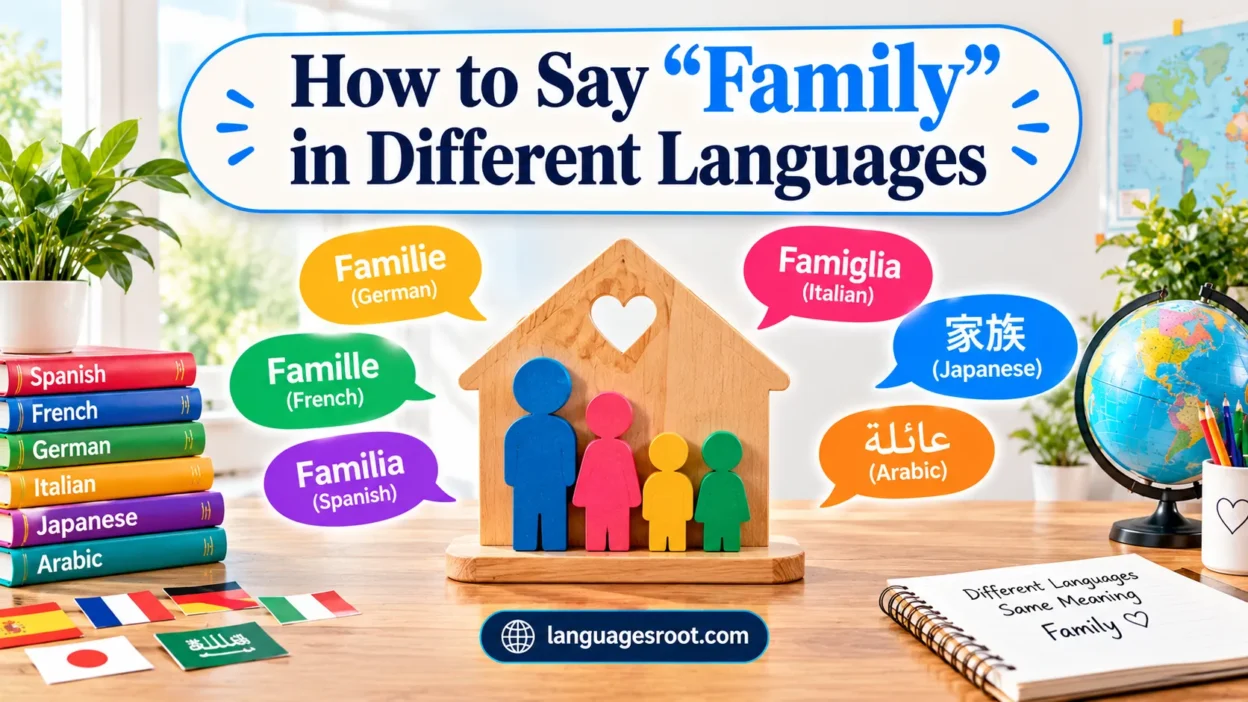
Learning how to say family in different languages helps you connect with people and cultures worldwide. The family meaning can reflect love, trust, respect, and a deep sense of belonging. However, family words across cultures often carry unique meanings shaped by cultural traditions and family relationships. This guide explores family translation, family pronunciation, and family in native scripts across many languages. You will also discover useful family example sentences for everyday conversations and language learning.
Whether you are exploring family heritage or preparing for international travel, these words offer valuable cultural insights. From parents, siblings, and children to grandparents and cousins, family terms help describe important relationships. Additionally, learning family vocabulary across cultures reveals how languages express family bonds, family support, and family unity. Explore family around the world and discover natural ways to express this meaningful connection across different languages and traditions.
Interesting Facts About Family
- Family is a broad concept. In English, the word can describe a household, a group of relatives, or people connected through adoption, marriage, and other close relationships.
- Some languages distinguish family relationships more precisely. Depending on the language, separate words may identify older and younger siblings or distinguish maternal and paternal relatives.
- Grammar affects translation. Some languages change nouns according to grammatical gender, number, or case, while others use the same basic noun in several sentence structures.
- The idea of extended family varies in expression. Languages may have specific words for grandparents, aunts, uncles, cousins, and other relatives rather than relying on one general term.
- Writing systems differ widely. The word for family can appear in Latin, Cyrillic, Arabic, Devanagari, Chinese, Japanese, Korean, and other scripts.
- Pronunciation is not always obvious from spelling. Languages such as Mandarin use tones, while Japanese and Korean follow pronunciation patterns that may be unfamiliar to English speakers.
- The same concept can have multiple translations. A formal term, an affectionate expression, and a word for a household or family unit may overlap in meaning without being interchangeable.
What Does Family Mean?
Family generally means a group of people connected through birth, marriage, adoption, partnership, or close personal bonds. It commonly includes parents, children, siblings, and other relatives, although the exact boundaries depend on the individual and context.
The word can also carry an emotional meaning. People may use family to describe those who provide care, belonging, encouragement, and companionship. In this sense, family can include chosen family members who are not related by blood.
In everyday English, the word appears in many situations. Someone might introduce their family, talk about family traditions, describe a family gathering, or explain how important their family is to them. It can also refer to a family household or a wider group of relatives.
When translating family, it is important to identify the intended meaning. A word for one’s relatives may differ from a word describing the household, a family lineage, or a close-knit group. The translations below generally focus on the ordinary noun family, meaning relatives or a family unit, rather than a specific household or ancestry.
Why Can Family Have Different Translations?
The word family does not have one universal translation because languages organize relationships and grammatical meaning differently. A common noun in one language may have several equivalents in another, depending on what the speaker wants to express.
Context is one important factor. A person discussing parents and children may choose a different expression from someone describing an entire extended family. Likewise, a word used in a formal document may not be the most natural choice in a casual conversation.
Grammar and gender can also influence the wording. Some languages have grammatical gender, noun cases, or different forms for singular and plural nouns. Others use distinct words for relatives according to age, side of the family, or relationship.
Regional variation matters, too. Speakers of Arabic, Spanish, Portuguese, Chinese, and many other widely spoken languages may use different expressions depending on their country or dialect. A translation may also differ between formal writing and everyday speech.
For this reason, the guide provides a common equivalent for the general concept of family. Example sentences show how the word can appear naturally in context, but the precise wording may change when discussing a particular relative, household, or cultural setting.
European Languages
Europe has a rich mix of Romance, Germanic, Slavic, Celtic, and other language traditions. Although many European languages have a single everyday word for family, their grammar, pronunciation, and expressions for relatives can differ. The following translations focus on the general meaning of family, with example sentences that demonstrate natural usage.
| 🌍 Language | Country/Region | Translation | Pronunciation | Example Sentence |
| English 🇬🇧 | United Kingdom and worldwide | Family | FAM-uh-lee | My family lives nearby. Meaning: My relatives live close by. |
| American English 🇺🇸 | United States | Family | FAM-uh-lee | My family gets together every Sunday. Meaning: My relatives meet every Sunday. |
| British English 🇬🇧 | United Kingdom | Family | FAM-uh-lee | Her family is visiting this weekend. Meaning: Her relatives are visiting. |
| Australian English 🇦🇺 | Australia | Family | FAM-uh-lee | My family loves a weekend barbecue. Meaning: My relatives enjoy weekend barbecues. |
| Spanish 🇪🇸 | Spain and Latin America | Familia | fah-MEE-lyah | Mi familia vive cerca. Meaning: My family lives nearby. |
| French 🇫🇷 | France and other Francophone regions | Famille | fah-MEE | Ma famille est très importante pour moi. Meaning: My family is very important to me. |
| German 🇩🇪 | Germany, Austria, Switzerland | Familie | fah-MEE-lee-uh | Meine Familie kommt heute zu Besuch. Meaning: My family is visiting today. |
| Italian 🇮🇹 | Italy and Italian-speaking regions | Famiglia | fah-MEE-lyah | La mia famiglia abita qui. Meaning: My family lives here. |
| Portuguese 🇵🇹 | Portugal, Brazil, and other Lusophone regions | Família | fah-MEE-lee-ah | A minha família está em casa. Meaning: My family is at home. |
| Dutch 🇳🇱 | Netherlands and Flanders | Familie | fah-MEE-lee | Mijn familie woont in Nederland. Meaning: My family lives in the Netherlands. |
| Swedish 🇸🇪 | Sweden | Familj | fah-MEEL-y | Min familj bor nära havet. Meaning: My family lives near the sea. |
| Norwegian 🇳🇴 | Norway | Familie | fah-MEE-lee-uh | Familien min kommer på besøk. Meaning: My family is coming to visit. |
| Danish 🇩🇰 | Denmark | Familie | fah-MEE-lee-uh | Min familie bor i Aarhus. Meaning: My family lives in Aarhus. |
| Finnish 🇫🇮 | Finland | Perhe | PEHR-heh | Perheeni asuu täällä. Meaning: My family lives here. |
| Icelandic 🇮🇸 | Iceland | Fjölskylda | FYUHL-sgil-dah | Fjölskyldan mín er stór. Meaning: My family is large. |
| Irish 🇮🇪 | Ireland | Teaghlach | CHYOW-lakh, approximately | Tá mo theaghlach sa bhaile. Meaning: My family is at home. |
| Welsh 🏴 | Wales | Teulu | TAY-lee | Mae fy nheulu yn fawr. Meaning: My family is large. |
| Polish 🇵🇱 | Poland | Rodzina | roh-JEE-nah | Moja rodzina mieszka w Krakowie. Meaning: My family lives in Kraków. |
| Czech 🇨🇿 | Czechia | Rodina | ROH-dee-nah | Moje rodina bydlí v Praze. Meaning: My family lives in Prague. |
| Slovak 🇸🇰 | Slovakia | Rodina | ROH-dee-nah | Moja rodina býva na Slovensku. Meaning: My family lives in Slovakia. |
| Ukrainian 🇺🇦 | Ukraine | Сім’я | sim-YA | Моя сім’я живе у Львові. Meaning: My family lives in Lviv. |
| Russian 🇷🇺 | Russia and other Russian-speaking communities | Семья | sem-YA | Моя семья живёт рядом. Meaning: My family lives nearby. |
| Romanian 🇷🇴 | Romania and Moldova | Familie | fah-MEE-lee-eh | Familia mea locuiește aici. Meaning: My family lives here. |
| Hungarian 🇭🇺 | Hungary | Család | CHAH-laad | A családom Budapesten él. Meaning: My family lives in Budapest. |
| Greek 🇬🇷 | Greece and Cyprus | Οικογένεια | ee-koh-YEH-nee-ah | Η οικογένειά μου μένει εδώ. Meaning: My family lives here. |
| Bulgarian 🇧🇬 | Bulgaria | Семейство | seh-MEY-stvoh | Моето семейство живее тук. Meaning: My family lives here. |
| Croatian 🇭🇷 | Croatia | Obitelj | oh-BYEH-tehl | Moja obitelj živi blizu. Meaning: My family lives nearby. |
| Serbian 🇷🇸 | Serbia and neighboring communities | Породица | poh-ROH-dee-tsah | Моја породица живи овде. Meaning: My family lives here. |
| Slovenian 🇸🇮 | Slovenia | Družina | droo-ZHEE-nah | Moja družina živi v Ljubljani. Meaning: My family lives in Ljubljana. |
| Lithuanian 🇱🇹 | Lithuania | Šeima | SHAY-mah | Mano šeima gyvena čia. Meaning: My family lives here. |
| Latvian 🇱🇻 | Latvia | Ģimene | GYEE-meh-neh | Mana ģimene dzīvo Rīgā. Meaning: My family lives in Riga. |
| Estonian 🇪🇪 | Estonia | Perekond | PEH-reh-kond | Minu perekond elab siin. Meaning: My family lives here. |
English varieties: American, British, and Australian English
American, British, and Australian English all use family as the ordinary word for relatives or a family unit. There is no need to invent a different translation for each variety. Pronunciation and everyday expressions may vary, and speakers may use terms such as relatives, extended family, or immediate family when they need greater precision.
Cultural notes for European languages
- Familia, famille, famiglia, and família share a recognizable resemblance because Spanish, French, Italian, and Portuguese are Romance languages. Their pronunciation differs, even when the words look similar.
- In Irish, teaghlach can refer to a family or household, while clann is also used for family or descendants in certain contexts.
- In German, Familie is the usual general term, while Verwandtschaft refers more broadly to relatives or kinship.
- In Slavic languages, several common words for family share historical roots, but they should not be assumed to have identical pronunciation or grammatical usage.
Asian Languages
Asia includes languages from many different families, including Sino-Tibetan, Indo-Aryan, Dravidian, Turkic, and Austroasiatic. Some use alphabets, while others use syllabic or character-based writing systems. These translations show common words for family, with romanization or pronunciation guidance to help readers approach unfamiliar scripts.
| 🌍 Language | Country/Region | Translation | Pronunciation | Example Sentence |
| Mandarin Chinese 🇨🇳 | China, Taiwan, and Chinese-speaking communities | 家庭 | jiātíng, approximately jya-ting | 我的家庭很温暖。Meaning: My family is loving and warm. |
| Cantonese 🇭🇰 | Hong Kong and Guangdong | 家庭 | gaa1 ting4 | 我嘅家庭好溫暖。Meaning: My family is loving and warm. |
| Japanese 🇯🇵 | Japan | 家族 | kazoku, kah-zoh-koo | 私の家族は大阪に住んでいます。Meaning: My family lives in Osaka. |
| Korean 🇰🇷 | South Korea and Korean-speaking communities | 가족 | gajok, gah-jok | 우리 가족은 함께 저녁을 먹어요. Meaning: My family eats dinner together. |
| Hindi 🇮🇳 | India | परिवार | parivār, puh-ree-VAAR | मेरा परिवार दिल्ली में रहता है।Meaning: My family lives in Delhi. |
| Urdu 🇵🇰 | Pakistan and South Asian communities | خاندان | khandān, khan-DAAN | میرا خاندان لاہور میں رہتا ہے۔Meaning: My family lives in Lahore. |
| Bengali 🇧🇩 | Bangladesh and eastern India | পরিবার | poribār, poh-ree-BAAR | আমার পরিবার ঢাকায় থাকে।Meaning: My family lives in Dhaka. |
| Punjabi 🇮🇳🇵🇰 | Punjab in India and Pakistan | ਪਰਿਵਾਰ / خاندان | parivār / khandān | ਮੇਰਾ ਪਰਿਵਾਰ ਇੱਥੇ ਰਹਿੰਦਾ ਹੈ।Meaning: My family lives here. |
| Gujarati 🇮🇳 | Gujarat, India | પરિવાર | parivār, puh-ree-VAAR | મારો પરિવાર અમદાવાદમાં રહે છે. Meaning: My family lives in Ahmedabad. |
| Marathi 🇮🇳 | Maharashtra, India | कुटुंब | kuṭumb, koo-toom-buh | माझे कुटुंब पुण्यात राहते. Meaning: My family lives in Pune. |
| Tamil 🇮🇳🇱🇰 | Tamil Nadu, Sri Lanka, and Tamil-speaking communities | குடும்பம் | kuṭumbam, koo-doom-bam | என் குடும்பம் சென்னையில் வாழ்கிறது. Meaning: My family lives in Chennai. |
| Telugu 🇮🇳 | Andhra Pradesh and Telangana | కుటుంబం | kuṭumbam, koo-toom-bam | నా కుటుంబం హైదరాబాద్లో ఉంటుంది. Meaning: My family lives in Hyderabad. |
| Kannada 🇮🇳 | Karnataka, India | ಕುಟುಂಬ | kuṭumba, koo-toom-buh | ನನ್ನ ಕುಟುಂಬ ಬೆಂಗಳೂರಿನಲ್ಲಿ ವಾಸಿಸುತ್ತದೆ. Meaning: My family lives in Bengaluru. |
| Malayalam 🇮🇳 | Kerala, India | കുടുംബം | kuṭumbam, koo-doom-bam | എന്റെ കുടുംബം കൊച്ചിയിലാണ് താമസിക്കുന്നത്. Meaning: My family lives in Kochi. |
| Nepali 🇳🇵 | Nepal | परिवार | parivār, puh-ree-VAAR | मेरो परिवार काठमाडौंमा बस्छ।Meaning: My family lives in Kathmandu. |
| Sinhala 🇱🇰 | Sri Lanka | පවුල | pawula, pah-oo-lah | මගේ පවුල කොළඹ ජීවත් වෙනවා. Meaning: My family lives in Colombo. |
| Thai 🇹🇭 | Thailand | ครอบครัว | khrop khrua, approximately khrop-khrua | ครอบครัวของฉันอยู่ที่เชียงใหม่ Meaning: My family is in Chiang Mai. |
| Vietnamese 🇻🇳 | Vietnam | Gia đình | zya ding, northern pronunciation approximation | Gia đình tôi sống ở Hà Nội. Meaning: My family lives in Hanoi. |
| Indonesian 🇮🇩 | Indonesia | Keluarga | kuh-loo-AR-gah | Keluarga saya tinggal di Jakarta. Meaning: My family lives in Jakarta. |
| Malay 🇲🇾 | Malaysia, Brunei, Singapore | Keluarga | kuh-loo-AR-gah | Keluarga saya tinggal di Kuala Lumpur. Meaning: My family lives in Kuala Lumpur. |
| Filipino / Tagalog 🇵🇭 | Philippines | Pamilya | pah-MEEL-yah | Nasa Cebu ang pamilya ko. Meaning: My family is in Cebu. |
| Burmese 🇲🇲 | Myanmar | မိသားစု | mi-tha-zu, approximate | ကျွန်တော့်မိသားစု ရန်ကုန်မှာ နေပါတယ်။Meaning: My family lives in Yangon. |
| Khmer 🇰🇭 | Cambodia | គ្រួសារ | kruo-saa, approximate | គ្រួសារខ្ញុំនៅភ្នំពេញ។Meaning: My family is in Phnom Penh. |
| Lao 🇱🇦 | Laos | ຄອບຄົວ | khop khua, approximate | ຄອບຄົວຂ້ອຍຢູ່ວຽງຈັນ. Meaning: My family is in Vientiane. |
| Mongolian 🇲🇳 | Mongolia | Гэр бүл | ger bül, geh-r bool | Манай гэр бүл Улаанбаатарт амьдардаг. Meaning: My family lives in Ulaanbaatar. |
| Kazakh 🇰🇿 | Kazakhstan and Kazakh-speaking communities | Отбасы | otbasy, oht-bah-suh | Менің отбасым Алматыда тұрады. Meaning: My family lives in Almaty. |
| Uzbek 🇺🇿 | Uzbekistan | Oila | oh-ee-lah | Mening oilam Toshkentda yashaydi. Meaning: My family lives in Tashkent. |
Cultural notes for Asian languages
- Mandarin 家庭 (jiātíng) often refers to the family as a unit, while 家人 (jiārén) means family members. The best choice depends on the sentence.
- In Japanese, 家族 (kazoku) is a general word for family. More specific terms are used when talking about one’s own relatives or another person’s family in polite conversation.
- In Korean, 가족 (gajok) is a general term. Words for individual relatives may depend on age, gender, and the relationship between speakers.
- Hindi and Urdu share many everyday expressions, but their written forms and some vocabulary differ. Urdu commonly uses an Arabic-derived script, while Hindi uses Devanagari.
- Keluarga is used in both Indonesian and Malay. Similar spelling does not mean that every sentence or pronunciation will be identical in the two languages.
African Languages
Africa is home to a remarkable range of language families, including Niger-Congo, Afroasiatic, and several other traditions. Many languages have everyday words for family as well as more specific terms for relatives, households, and extended kinship groups. The examples below represent different regions of the continent rather than suggesting that any single language represents all African communities.
| 🌍 Language | Country/Region | Translation | Pronunciation | Example Sentence |
| Swahili 🇹🇿 | Tanzania, Kenya, and East Africa | Familia | fah-MEE-lee-ah | Familia yangu inaishi Dar es Salaam. Meaning: My family lives in Dar es Salaam. |
| Afrikaans 🇿🇦 | South Africa and Namibia | Familie | fah-MEE-lee | My familie woon in Kaapstad. Meaning: My family lives in Cape Town. |
| Zulu 🇿🇦 | South Africa | Umndeni | oom-n-DEH-nee | Umndeni wami uhlala lapha. Meaning: My family lives here. |
| Xhosa 🇿🇦 | South Africa | Usapho | oo-SAH-poh | Usapho lwam luhlala eKapa. Meaning: My family lives in Cape Town. |
| Amharic 🇪🇹 | Ethiopia | ቤተሰብ | beteseb, approximately beh-teh-seb | ቤተሰቤ በአዲስ አበባ ይኖራል። Meaning: My family lives in Addis Ababa. |
| Yoruba 🇳🇬 | Nigeria and neighboring communities | Ẹbí | eh-BEE | Ẹbí mi ń gbé ní Èkó. Meaning: My family lives in Lagos. |
| Igbo 🇳🇬 | Southeastern Nigeria | Ezinụlọ | eh-zee-NOO-loh | Ezinụlọ m bi na Enugu. Meaning: My family lives in Enugu. |
| Hausa 🇳🇬🇳🇪 | Northern Nigeria and Niger | Iyali | ee-YAH-lee | Iyalina suna zaune a Kano. Meaning: My family lives in Kano. |
| Somali 🇸🇴 | Somalia and the Horn of Africa | Qoys | koys | Qoyskaygu wuxuu ku nool yahay Muqdisho. Meaning: My family lives in Mogadishu. |
| Shona 🇿🇼 | Zimbabwe | Mhuri | MOO-ree | Mhuri yangu inogara muHarare. Meaning: My family lives in Harare. |
| Sesotho 🇱🇸 | Lesotho and South Africa | Lelapa | leh-LAH-pah | Lelapa la ka le lula Maseru. Meaning: My family lives in Maseru. |
| Setswana 🇧🇼 | Botswana and South Africa | Lelapa | leh-LAH-pah | Lelapa la me le nna kwa Gaborone. Meaning: My family lives in Gaborone. |
| Kinyarwanda 🇷🇼 | Rwanda | Umuryango | oo-moo-RYAHN-goh | Umuryango wanjye uba i Kigali. Meaning: My family lives in Kigali. |
| Malagasy 🇲🇬 | Madagascar | Fianakaviana | fee-ah-nah-kah-vee-AH-nah | Mipetraka eto Antananarivo ny fianakaviako. Meaning: My family lives in Antananarivo. |
Cultural notes for African languages
- Familia is used in Swahili and resembles the word used in several European languages. It is a familiar example of how words can travel between languages through historical contact.
- In isiZulu, umndeni is commonly used for family, while umndeni and other related terms can have different grammatical forms in sentences.
- Yoruba ẹbí can refer to family or relatives, while the precise interpretation depends on context.
- In languages such as Shona, Sesotho, and Setswana, the words for family may also be associated with a household or a wider kinship group. The exact scope depends on how the word is used.
Middle Eastern Languages
The Middle East contains Arabic, Persian, Kurdish, Turkish, Armenian, and other distinct language traditions. These languages do not all belong to the same language family, and their writing systems and grammatical structures vary considerably. Arabic also has a formal standard variety and many regional dialects, so the most natural everyday expression can depend on where a speaker lives.
| 🌍 Language | Country/Region | Translation | Pronunciation | Example Sentence |
| Modern Standard Arabic 🇵🇸 | Palestine and Arabic-speaking regions | عائلة | ʿāʾilah, approximately AA-ih-lah | عائلتي تعيش في القدس. Meaning: My family lives in Jerusalem. |
| Persian (Farsi) 🇮🇷 | Iran and Persian-speaking communities | خانواده | khānevādeh, approximately khaaneh-vaadeh | خانوادهٔ من در تهران زندگی میکند. Meaning: My family lives in Tehran. |
| Kurdish (Kurmanji) 🟩🟥🟨 | Kurdish-speaking regions, including parts of Iraq, Türkiye, Syria, and Iran | Malbat | mahl-BAHT | Malbata min li Amedê dijî. Meaning: My family lives in Diyarbakır. |
| Turkish 🇹🇷 | Türkiye and Turkish-speaking communities | Aile | ah-ee-LEH | Ailem Ankara’da yaşıyor. Meaning: My family lives in Ankara. |
| Armenian 🇦🇲 | Armenia and Armenian-speaking communities worldwide | Ընտանիք | əntanik, approximately uhn-tah-NEEK | Իմ ընտանիքը Երևանում է ապրում։Meaning: My family lives in Yerevan. |
Cultural notes for Middle Eastern languages
- Arabic: عائلة (ʿāʾilah) is a widely understood word for family. أسرة (usrah) is another common term, often used for a family unit. In everyday conversation, regional dialects may have different preferences and pronunciation.
- Persian: خانواده (khānevādeh) is the general word for family. The word does not have the same grammatical structure as the Arabic equivalent, even though Persian also uses a modified Arabic script.
- Kurdish: Kurdish has multiple varieties. The example above uses Kurmanji, and other Kurdish varieties may use different vocabulary or spelling.
- Turkish: Aile is the ordinary word for family. More specific words are used when distinguishing relatives, household members, or family relationships.
Other World Languages
Some useful family words come from languages spoken in Oceania, the Americas, and international communities. These languages add further perspectives on how people express kinship and belonging. The examples below include indigenous languages and a constructed international language, with wording chosen for the general concept of family.
| 🌍 Language | Country/Region | Translation | Pronunciation | Example Sentence |
| Māori 🇳🇿 | Aotearoa New Zealand | Whānau | FAA-now, approximate | Kei Tāmaki Makaurau taku whānau. Meaning: My family is in Auckland. |
| Samoan 🇼🇸 | Samoa and Samoan-speaking communities | Aiga | eye-nga | O lo’o nonofo lo’u aiga i Apia. Meaning: My family lives in Apia. |
| Tongan 🇹🇴 | Tonga | Fāmili | faa-MEE-lee | ʻOku nofo hoku fāmili ʻi Nukuʻalofa. Meaning: My family lives in Nukuʻalofa. |
| Hawaiian 🇺🇸 | Hawaiʻi | ʻOhana | oh-HAH-nah | Aia koʻu ʻohana ma Honolulu. Meaning: My family is in Honolulu. |
| Quechua 🇵🇪 | Andean regions of Peru, Bolivia, and neighboring countries | Ayllu | EYE-yoo | Ñuqaq aylluy Cusco llaqtapi kawsan. Meaning: My family or community lives in Cusco. |
| Guarani 🇵🇾 | Paraguay and neighboring regions | Ogaygua | oh-guy-GWAH, approximate | Che rogagua oiko Paraguaýpe. Meaning: My family lives in Asunción. |
| Haitian Creole 🇭🇹 | Haiti and Haitian communities worldwide | Fanmi | fan-MEE | Fanmi mwen rete Pòtoprens. Meaning: My family lives in Port-au-Prince. |
| Esperanto 🌍 | International constructed language | Familio | fah-mee-LEE-oh | Mia familio loĝas en la urbo. Meaning: My family lives in the city. |
Cultural notes for other world languages
- Māori whānau can refer to family and may also encompass wider networks of relatives and relationships. Its meaning can be broader than the English word in some contexts.
- Hawaiian ʻohana is widely recognized as a word for family. The ʻokina, written as ʻ, represents a consonant and should not simply be omitted when learning the word.
- Quechua ayllu has a broader historical and social meaning that can include a community or kinship group. It is not always interchangeable with the English word family.
- Haitian Creole fanmi is a straightforward everyday word for family, closely related in form to French famille.
Also Read: How to Say Water in Different Languages
Quick Reference: Family in Different Languages
The following table collects the main translations for easy reference. Some languages have alternative terms, especially when distinguishing immediate family from extended relatives or a household.
| Language | Translation |
| English | Family |
| American English | Family |
| British English | Family |
| Australian English | Family |
| Spanish | Familia |
| French | Famille |
| German | Familie |
| Italian | Famiglia |
| Portuguese | Família |
| Dutch | Familie |
| Swedish | Familj |
| Norwegian | Familie |
| Danish | Familie |
| Finnish | Perhe |
| Icelandic | Fjölskylda |
| Irish | Teaghlach |
| Welsh | Teulu |
| Polish | Rodzina |
| Czech | Rodina |
| Slovak | Rodina |
| Ukrainian | Сім’я |
| Russian | Семья |
| Romanian | Familie |
| Hungarian | Család |
| Greek | Οικογένεια |
| Bulgarian | Семейство |
| Croatian | Obitelj |
| Serbian | Породица |
| Slovenian | Družina |
| Lithuanian | Šeima |
| Latvian | Ģimene |
| Estonian | Perekond |
| Mandarin Chinese | 家庭 |
| Cantonese | 家庭 |
| Japanese | 家族 |
| Korean | 가족 |
| Hindi | परिवार |
| Urdu | خاندان |
| Bengali | পরিবার |
| Punjabi | ਪਰਿਵਾਰ / خاندان |
| Gujarati | પરિવાર |
| Marathi | कुटुंब |
| Tamil | குடும்பம் |
| Telugu | కుటుంబం |
| Kannada | ಕುಟುಂಬ |
| Malayalam | കുടുംബം |
| Nepali | परिवार |
| Sinhala | පවුල |
| Thai | ครอบครัว |
| Vietnamese | Gia đình |
| Indonesian | Keluarga |
| Malay | Keluarga |
| Filipino / Tagalog | Pamilya |
| Burmese | မိသားစု |
| Khmer | គ្រួសារ |
| Lao | ຄອບຄົວ |
| Mongolian | Гэр бүл |
| Kazakh | Отбасы |
| Uzbek | Oila |
| Swahili | Familia |
| Afrikaans | Familie |
| Zulu | Umndeni |
| Xhosa | Usapho |
| Amharic | ቤተሰብ |
| Yoruba | Ẹbí |
| Igbo | Ezinụlọ |
| Hausa | Iyali |
| Somali | Qoys |
| Shona | Mhuri |
| Sesotho | Lelapa |
| Setswana | Lelapa |
| Kinyarwanda | Umuryango |
| Malagasy | Fianakaviana |
| Arabic | عائلة |
| Persian | خانواده |
| Kurdish (Kurmanji) | Malbat |
| Turkish | Aile |
| Armenian | Ընտանիք |
| Māori | Whānau |
| Samoan | Aiga |
| Tongan | Fāmili |
| Hawaiian | ʻOhana |
| Quechua | Ayllu |
| Guarani | Ogaygua |
| Haitian Creole | Fanmi |
| Esperanto | Familio |
How to Choose the Right Translation
The best translation of family depends on the people and relationships you want to describe. If you are speaking about parents, children, and siblings, a general word for family will usually work. However, if you mean a household, extended relatives, or a wider community, another expression may communicate your meaning more accurately.
Consider these practical tips before using a translation:
- Check the context. Decide whether you mean immediate family, extended relatives, or family members collectively.
- Consider formality. A word used in everyday conversation may differ from terminology used in legal documents or official forms.
- Check the region. Speakers of the same language may use different words or pronunciations in different countries.
- Learn the pronunciation. Pay attention to tones, stress, and unfamiliar sounds rather than relying entirely on English spelling.
- Use the correct writing system. When writing a message in another language, check spelling, accents, and special characters.
- Ask for clarification when needed. If the translation will appear in an important document, a permanent inscription, or a formal message, consult a qualified speaker or translator.
The most useful translation is the one that communicates your intended meaning clearly and respectfully.
Common Mistakes When Translating Family
Translating family may appear simple, but several common mistakes can change the intended meaning.
- Translating word for word: A dictionary equivalent may not fit every sentence. A word for a household, for example, may not always mean the same thing as a group of relatives.
- Ignoring context: A sentence about family traditions may need different wording from one about family members living together.
- Mixing regional forms: Combining vocabulary from different dialects can make an expression sound inconsistent or unfamiliar.
- Overlooking grammatical agreement: Some languages require changes to nouns, pronouns, or verbs according to number, gender, or grammatical case.
- Using misleading pronunciation guides: English-style spellings are only approximations and may fail to represent important sounds or tones.
- Assuming one word fits every situation: Some languages distinguish between relatives, ancestors, households, and broader kinship groups.
- Ignoring special characters: Accents, tone marks, apostrophe-like characters, and other writing features may be important to correct spelling and meaning.
A helpful rule: Learn the basic word first, then study how it behaves in a complete sentence. This approach is more reliable than memorizing isolated vocabulary alone.
Why Learn Family in Different Languages?
Learning how to say family in different languages helps you build vocabulary while discovering how languages express relationships. It can be useful when visiting another country, meeting relatives who speak a different language, studying your heritage, or communicating with multilingual friends.
Learning the word also provides an opportunity to explore related vocabulary, including mother, father, sibling, grandparents, relatives, and household. These words help you move beyond simple translations and describe relationships more precisely. As you practice, you can improve your pronunciation, understand unfamiliar writing systems, and recognize regional differences in everyday speech.
There is also a personal benefit. Using a meaningful word in someone’s native language can make a greeting, conversation, or family message feel more thoughtful. However, learning vocabulary should go hand in hand with cultural awareness. No single word captures every person’s understanding of family, and language alone cannot explain all the traditions associated with it.
By learning the translation alongside its pronunciation and context, you can communicate more confidently and develop a deeper appreciation for linguistic diversity.
Frequently Asked Questions
How do you say family in different languages?
The word family varies across languages. For example, Spanish uses familia, French uses famille, Japanese uses 家族 (kazoku), and Urdu uses خاندان (khandān).
What does family mean in different cultures?
The family meaning can include relatives, household members, or people connected through care and love. However, cultural traditions and language context can shape how people describe family relationships.
Why do some languages have multiple words for family?
Some languages distinguish between immediate relatives, extended family, and household members. Therefore, family translation depends on context, regional usage, and the relationships being described.
How can I pronounce family correctly in another language?
Start with the family pronunciation guide and learn the word in its native script. Then, listen to native speakers and practice the sounds, stress, and tones to improve accuracy.
Can I use these family translations in messages or everyday conversations?
Yes, many family words across cultures work in greetings, personal messages, and everyday speech. However, check the meaning, grammar, and regional usage to make sure your expression sounds natural.
Conclusion
Learning how to say family in different languages helps you explore family words across cultures and understand how people express love, connection, and belonging. From Spanish familia to Japanese 家族 and Māori whānau, each family translation offers insight into different traditions and relationships. By practicing family pronunciation, native scripts, and example sentences, you can communicate more naturally and appreciate the rich diversity of family around the world.