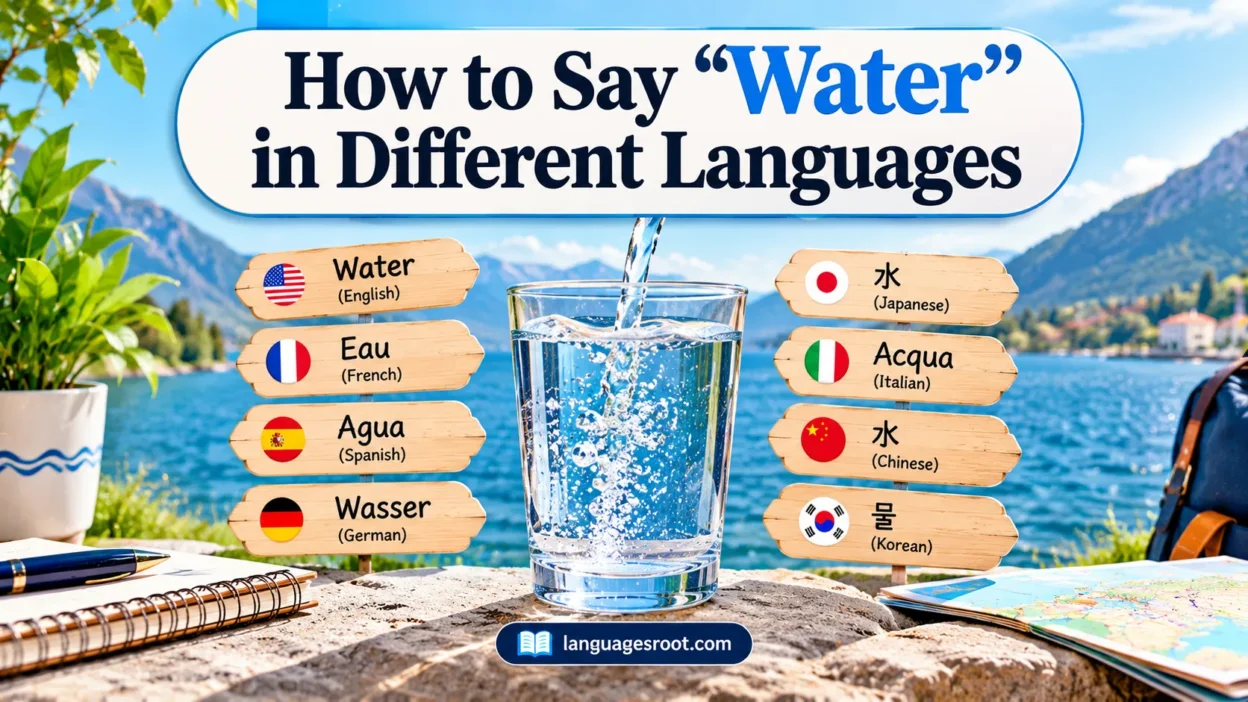
Water is an essential resource that connects people, cultures, and daily life. Learning how to say water in different languages helps you build everyday vocabulary and communicate confidently while traveling. From agua in Spanish to eau in French and mizu in Japanese, each language has its own water translations and water pronunciation. This guide explores water in different languages, making it easier for language learners, language students, and language enthusiasts to discover useful words.
You will also explore water in European languages, water in Asian languages, water in African languages, and water in Middle Eastern languages. Along the way, discover water word origins, water etymology, regional differences, and interesting water facts. Moreover, practical example sentences, a simple pronunciation guide, and useful travel vocabulary can help you ask for drinking water abroad. Whether you are studying languages or exploring global water vocabulary, these translations offer a helpful starting point.
Interesting Facts About Water
- Water has different names across languages. Spanish uses agua, Italian uses acqua, and Portuguese uses água. These words have related historical roots, but their spelling and pronunciation differ.
- Some languages use grammatical gender for water. In French, eau is feminine, while German Wasser is neuter. This affects the articles and adjectives used with the word.
- Water can be written in several scripts. Mandarin Chinese uses 水, Japanese commonly uses 水, and Arabic uses ماء. Their writing systems reflect different linguistic traditions.
- Pronunciation can be very different from spelling. The French word eau is pronounced approximately like “oh,” while its three letters may initially confuse English learners.
- Many languages distinguish between kinds of water. Everyday vocabulary may include separate terms for drinking water, seawater, mineral water, and wastewater.
- The same language can have regional vocabulary differences. Spanish-speaking communities may use different everyday terms for bottled water, sparkling water, or drinking water, even though agua remains widely understood.
- Water appears in common expressions and place names. Across languages, words for water occur in descriptions of rivers, rainfall, oceans, and other features of the natural world.
What Does Water Mean?
Water is a liquid chemical substance made of hydrogen and oxygen, with the formula H₂O. It is essential for human life and supports plants, animals, and ecosystems. In everyday conversation, the word usually refers to the liquid people drink, wash with, or encounter in rivers, lakes, seas, and rain.
Beyond its literal meaning, water can represent life, renewal, cleanliness, peace, and nature in literature and everyday expression. These associations depend on the particular story, tradition, or situation rather than applying universally to every culture.
People use the word in many ordinary situations. Someone might ask for a glass of water at a restaurant, discuss water quality at school, describe a river during a trip, or explain why clean drinking water matters. The intended meaning is usually clear from context.
When translating water, it is important to distinguish the basic noun from related expressions. For example, drinking water, mineral water, seawater, and sparkling water may require additional words. Learning the basic translation is a useful starting point, but understanding these distinctions makes communication more accurate.
Why Can Water Have Different Translations?
The word water has different translations because languages organize vocabulary, grammar, and everyday expressions in different ways. Although the substance itself is the same, the most natural word or phrase can depend on the situation.
- Context: A word for water in a scientific discussion may appear alongside technical terms, while ordering water at a café requires everyday vocabulary.
- Formality: Some languages offer polite expressions for requesting water, even though the noun itself stays unchanged.
- Grammar: Grammatical gender, number, articles, and case endings can affect how a word appears within a sentence.
- Regional variation: Local communities may have different terms for particular kinds of water or use different expressions when ordering drinks.
- Writing systems: Some languages use Latin letters, while others use Chinese characters, Arabic script, or other writing systems.
- Literal versus natural translation: A dictionary equivalent may be correct by itself but need extra words to communicate a complete request naturally.
- Spoken versus written language: Pronunciation, contractions, and informal expressions may differ from the forms used in formal writing.
For this reason, the tables below focus on the common word for water and show how it is used in a natural example sentence. The main translation column gives the equivalent of the word itself, rather than translating the entire English question “How to Say Water” literally.
European Languages
Europe contains languages from several distinct families, including Romance, Germanic, Slavic, and Uralic languages. The word for water may share historical roots with words in neighboring languages, or it may look and sound entirely different. The examples below show everyday vocabulary in standard forms, with regional English varieties listed separately where their wording remains the same.
| 🌍 Language | Country/Region | Translation | Pronunciation | Example Sentence |
| English 🇬🇧 | United Kingdom and worldwide | Water | WAW-ter | I drink water every morning. |
| American English 🇺🇸 | United States | Water | WAW-ter, often with a distinct American t sound | Please bring me some water. |
| British English 🇬🇧 | United Kingdom | Water | WAW-tuh, with regional variation | The water is cold today. |
| Australian English 🇦🇺 | Australia | Water | WAW-tuh, with regional variation | Could I have some water, please? |
| Spanish 🇪🇸 | Spain and Latin America | Agua | AH-gwah | Necesito agua. (I need water.) |
| French 🇫🇷 | France and other French-speaking regions | Eau | Oh | Je bois de l’eau. (I drink water.) |
| German 🇩🇪 | Germany, Austria, Switzerland | Wasser | VAH-ser | Das Wasser ist kalt. (The water is cold.) |
| Italian 🇮🇹 | Italy and parts of Switzerland | Acqua | AHK-kwah | Vorrei dell’acqua. (I would like some water.) |
| Portuguese 🇵🇹 | Portugal, Brazil, and other Portuguese-speaking regions | Água | AH-gwah | Preciso de água. (I need water.) |
| Dutch 🇳🇱 | Netherlands and Belgium | Water | VAA-ter | Ik drink water. (I drink water.) |
| Swedish 🇸🇪 | Sweden and parts of Finland | Vatten | VAT-ten | Jag behöver vatten. (I need water.) |
| Norwegian 🇳🇴 | Norway | Vann | Vahn | Jeg drikker vann. (I drink water.) |
| Danish 🇩🇰 | Denmark | Vand | Van | Jeg vil gerne have vand. (I would like water.) |
| Finnish 🇫🇮 | Finland | Vesi | VEH-see | Vesi on kylmää. (The water is cold.) |
| Icelandic 🇮🇸 | Iceland | Vatn | Vahtn | Ég drekk vatn. (I drink water.) |
| Irish 🇮🇪 | Ireland | Uisce | ISH-keh | Tá uisce agam. (I have water.) |
| Welsh 🏴 | Wales | Dŵr | Approximately door, with a Welsh vowel sound | Mae dŵr yn oer. (The water is cold.) |
| Polish 🇵🇱 | Poland | Woda | VOH-dah | Poproszę wodę. (Water, please.) |
| Czech 🇨🇿 | Czechia | Voda | VOH-dah | Piju vodu. (I drink water.) |
| Slovak 🇸🇰 | Slovakia | Voda | VOH-dah | Potrebujem vodu. (I need water.) |
| Ukrainian 🇺🇦 | Ukraine | Вода | Voh-DAH | Я п’ю воду. (I drink water.) |
| Russian 🇷🇺 | Russia and other Russian-speaking communities | Вода | Vuh-DAH | Я пью воду. (I drink water.) |
| Romanian 🇷🇴 | Romania and Moldova | Apă | AH-puh | Beau apă. (I drink water.) |
| Hungarian 🇭🇺 | Hungary | Víz | VEEZ | Vizet kérek. (Water, please.) |
| Greek 🇬🇷 | Greece and Cyprus | Νερό | Neh-ROH | Θέλω νερό. (I want water.) |
| Bulgarian 🇧🇬 | Bulgaria | Вода | Voh-DAH | Искам вода. (I want water.) |
| Croatian 🇭🇷 | Croatia | Voda | VOH-dah | Želim vodu. (I want water.) |
| Serbian 🇷🇸 | Serbia and neighboring communities | Вода / Voda | VOH-dah | Желим воду. (I want water.) |
| Slovenian 🇸🇮 | Slovenia | Voda | VOH-dah | Pijem vodo. (I drink water.) |
| Lithuanian 🇱🇹 | Lithuania | Vanduo | Vahn-DWOH | Geriu vandenį. (I drink water.) |
| Latvian 🇱🇻 | Latvia | Ūdens | OO-dens | Es dzeru ūdeni. (I drink water.) |
| Estonian 🇪🇪 | Estonia | Vesi | VEH-see | Ma joon vett. (I drink water.) |
English Varieties: American, British, and Australian
The basic noun water is the same in American, British, and Australian English. The main differences are often found in pronunciation, accent, and certain expressions surrounding the word. American English commonly uses a different pronunciation of the middle consonant, while British and Australian pronunciations vary by region and speaker. In all three varieties, water is understood in ordinary conversation.
Cultural and Language Notes
Several European languages have grammatical forms that change according to how the word is used in a sentence. For example, Spanish uses agua as its basic noun, but the phrase beber agua means “to drink water.” Polish, Czech, Croatian, and other Slavic languages may change the noun’s ending depending on its grammatical role. These changes are normal features of the languages, not separate translations.
Asian Languages
Asia contains a wide range of language families and writing systems. Some languages use characters, others use alphabets or abugidas, and several have distinctive tone systems. The table includes widely used words for water and short examples that demonstrate their everyday use.
| 🌍 Language | Country/Region | Translation | Pronunciation | Example Sentence |
| Mandarin Chinese 🇨🇳 | China, Taiwan, and Chinese-speaking communities | 水 | Shuǐ, third tone | 我想喝水。 (I want to drink water.) |
| Cantonese 🇭🇰 | Hong Kong and Guangdong, China | 水 | Seoi², commonly represented in Jyutping as seoi2 | 我想飲水。 (I want to drink water.) |
| Japanese 🇯🇵 | Japan | 水 | Mizu | 水を飲みます。 (I drink water.) |
| Korean 🇰🇷 | South Korea and North Korea | 물 | Mul | 물을 마셔요. (I drink water.) |
| Hindi 🇮🇳 | India | पानी | Paani | मुझे पानी चाहिए। (I need water.) |
| Urdu 🇵🇰 | Pakistan and Urdu-speaking communities | پانی | Paani | مجھے پانی چاہیے۔ (I need water.) |
| Bengali 🇧🇩 | Bangladesh and eastern India | পানি / জল | Pani / jol | আমি পানি খাই। (I drink water.) |
| Punjabi 🇮🇳 🇵🇰 | Punjab in India and Pakistan | ਪਾਣੀ / پانی | Paani | ਮੈਨੂੰ ਪਾਣੀ ਚਾਹੀਦਾ ਹੈ। (I need water.) |
| Gujarati 🇮🇳 | Gujarat, India | પાણી | Paani | મને પાણી જોઈએ છે. (I need water.) |
| Marathi 🇮🇳 | Maharashtra, India | पाणी | Paani | मला पाणी हवे आहे. (I need water.) |
| Tamil 🇮🇳 🇱🇰 | Tamil Nadu, India, and Sri Lanka | தண்ணீர் | Thanneer | எனக்குத் தண்ணீர் வேண்டும். (I need water.) |
| Telugu 🇮🇳 | Andhra Pradesh and Telangana, India | నీరు | Neeru | నాకు నీరు కావాలి. (I need water.) |
| Kannada 🇮🇳 | Karnataka, India | ನೀರು | Neeru | ನನಗೆ ನೀರು ಬೇಕು. (I need water.) |
| Malayalam 🇮🇳 | Kerala, India | വെള്ളം | Vellam | എനിക്ക് വെള്ളം വേണം. (I need water.) |
| Nepali 🇳🇵 | Nepal | पानी | Paani | मलाई पानी चाहिन्छ। (I need water.) |
| Sinhala 🇱🇰 | Sri Lanka | වතුර | Vathura | මට වතුර ඕනෑ. (I need water.) |
| Thai 🇹🇭 | Thailand | น้ำ | Náam, with a high tone | ฉันต้องการน้ำ (I need water.) |
| Vietnamese 🇻🇳 | Vietnam | Nước | Nước, with a falling-rising tone in standard northern pronunciation | Tôi cần nước. (I need water.) |
| Indonesian 🇮🇩 | Indonesia | Air | Ah-eer | Saya minum air. (I drink water.) |
| Malay 🇲🇾 | Malaysia and Brunei | Air | Ah-eer | Saya perlukan air. (I need water.) |
| Filipino/Tagalog 🇵🇭 | Philippines | Tubig | Too-big | Kailangan ko ng tubig. (I need water.) |
| Burmese 🇲🇲 | Myanmar | ရေ | Yay | ရေလိုချင်ပါတယ်။ (I would like water.) |
| Khmer 🇰🇭 | Cambodia | ទឹក | Tœ̆k, approximately “tuk” | ខ្ញុំចង់បានទឹក។ (I want water.) |
| Lao 🇱🇦 | Laos | ນ້ຳ | Nam, with a falling tone | ຂ້ອຍຕ້ອງການນ້ຳ. (I need water.) |
| Mongolian 🇲🇳 | Mongolia | Ус | Us | Би ус ууж байна. (I am drinking water.) |
| Kazakh 🇰🇿 | Kazakhstan | Су | Su | Маған су керек. (I need water.) |
| Uzbek 🇺🇿 | Uzbekistan | Suv | Soov | Menga suv kerak. (I need water.) |
Cultural and Language Notes
Some Asian languages use different words depending on region or context. In Bengali, both pani and jol are used for water, with preferences varying among speakers and settings. Mandarin uses 水 (shuǐ), while Japanese uses the same character, pronounced mizu in its common standalone form. Shared characters do not mean the words have identical pronunciation or usage.
Tonal languages require particular care. In Mandarin, the third tone in shuǐ is meaningful. Thai, Vietnamese, and Lao also use tones, so a pronunciation guide written only with ordinary English letters may not fully capture the spoken word. Listen to recordings from reliable language-learning sources when accuracy is important.
African Languages
Africa is home to a remarkable range of languages, including Niger-Congo, Afroasiatic, and other language families. A word used for water in one community may differ significantly from the word used in a neighboring region. The examples below represent specific languages and their everyday vocabulary rather than suggesting that one word represents an entire country.
| 🌍 Language | Country/Region | Translation | Pronunciation | Example Sentence |
| Swahili 🇹🇿 🇰🇪 | Tanzania, Kenya, and East Africa | Maji | MAH-jee | Ninahitaji maji. (I need water.) |
| Afrikaans 🇿🇦 | South Africa and Namibia | Water | VAA-ter | Ek drink water. (I drink water.) |
| Zulu 🇿🇦 | South Africa | Amanzi | Ah-MAHN-zee | Ngicela amanzi. (Please give me water.) |
| Xhosa 🇿🇦 | South Africa | Amanzi | Ah-MAHN-zee, with a click in some related sounds elsewhere in the language | Ndifuna amanzi. (I want water.) |
| Amharic 🇪🇹 | Ethiopia | ውሃ | Wəha, approximately “wuh-ha” | ውሃ እፈልጋለሁ። (I need water.) |
| Yoruba 🇳🇬 | Nigeria and neighboring communities | Omi | Oh-mee | Mo fẹ́ omi. (I want water.) |
| Igbo 🇳🇬 | Southeastern Nigeria | Mmiri | Mmee-ree | Achọrọ m mmiri. (I need water.) |
| Hausa 🇳🇬 🇳🇪 | Nigeria, Niger, and West Africa | Ruwa | Roo-wah | Ina bukatar ruwa. (I need water.) |
| Somali 🇸🇴 | Somalia and the Horn of Africa | Biyo | Bee-yo | Waxaan u baahanahay biyo. (I need water.) |
| Shona 🇿🇼 | Zimbabwe | Mvura | M-VOO-rah | Ndinoda mvura. (I want water.) |
| Sesotho 🇱🇸 🇿🇦 | Lesotho and South Africa | Metsi | MEH-tsee | Ke hloka metsi. (I need water.) |
| Setswana 🇧🇼 🇿🇦 | Botswana and South Africa | Metsi | MEH-tsee | Ke batla metsi. (I want water.) |
| Kinyarwanda 🇷🇼 | Rwanda | Amazi | Ah-MAH-zee | Nkeneye amazi. (I need water.) |
| Malagasy 🇲🇬 | Madagascar | Rano | RAH-noo | Mila rano aho. (I need water.) |
Cultural and Language Notes
In Swahili, maji is the everyday word for water and is widely used across East Africa. In several Southern African languages, including Sesotho and Setswana, metsi is a common word for water. Similarities between vocabulary can sometimes reflect historical relationships or contact between languages, but they do not make the languages interchangeable.
African languages also have distinct sound systems. For example, Zulu and Xhosa include click consonants in their broader sound inventories. The words shown in the table should be learned with their language’s pronunciation patterns rather than pronounced entirely according to English spelling.
Middle Eastern Languages
The Middle East includes Arabic, Persian, Kurdish, Turkish, Armenian, and other language traditions. Some languages use related vocabulary across neighboring regions, while others have distinct roots and writing systems. Regional dialects can also influence how people refer to water in everyday conversation.
| 🌍 Language | Country/Region | Translation | Pronunciation | Example Sentence |
| Arabic, Modern Standard Arabic 🇵🇸 | Palestine and Arabic-speaking regions | ماء | Māʾ, approximately “maa” with a glottal stop at the end | أحتاج إلى ماء. (I need water.) |
| Persian (Farsi) 🇮🇷 | Iran and Persian-speaking communities | آب | Āb | من آب میخواهم. (I want water.) |
| Kurdish, Kurmanji 🇹🇯 | Kurdish-speaking communities in parts of Türkiye, Iraq, Syria, and Iran | Av | Ahv | Ez av dixwazim. (I want water.) |
| Turkish 🇹🇷 | Türkiye and Turkish-speaking communities | Su | Soo | Su istiyorum. (I want water.) |
| Armenian 🇦🇲 | Armenia and Armenian-speaking communities worldwide | Ջուր | Jur, approximately “joor” | Ես ջուր եմ ուզում։ (I want water.) |
Cultural and Language Notes
Arabic has many regional varieties. The table uses Modern Standard Arabic, which is suitable for formal writing and broadly recognizable across Arabic-speaking regions. In Palestinian Arabic and several other dialects, mayy or related pronunciations are commonly used in everyday speech. Actual usage varies by dialect and sentence.
Persian uses آب (āb), while Turkish uses su. Although both languages have long histories of contact with neighboring cultures, their ordinary words for water are different. Kurdish also has regional varieties, so a phrase used in Kurmanji may not be identical to one used in Sorani.
Also Read: How to Say Welcome in Different Languages
Other World Languages
Languages outside the main regional groups provide additional examples of how people name water. The following languages are used in the Pacific, the Americas, and international communication. They illustrate the variety of words and grammatical patterns found around the world.
| 🌍 Language | Country/Region | Translation | Pronunciation | Example Sentence |
| Māori 🇳🇿 | New Zealand | Wai | Why | Kei te hiahia au ki te wai. (I need water.) |
| Samoan 🇼🇸 | Samoa and Samoan-speaking communities | Vai | Vai, with a sound similar to “why” in many English accents | Ou te fia inu vai. (I want to drink water.) |
| Tongan 🇹🇴 | Tonga | Vai | Vai | ʻOku ou fiemaʻu ha vai. (I need water.) |
| Hawaiian 🇺🇸 | Hawaiʻi | Wai | Why | Makemake au i ka wai. (I want water.) |
| Quechua 🇵🇪 | Peru and the Andes | Yaku | YAH-koo | Yaku munani. (I want water.) |
| Guarani 🇵🇾 | Paraguay and surrounding regions | Y | A short vowel, roughly like “ü” in some European languages | Aikotevẽ y. (I need water.) |
| Haitian Creole 🇭🇹 | Haiti and Haitian communities worldwide | Dlo | Dloh | Mwen bezwen dlo. (I need water.) |
| Esperanto 🌍 | International constructed language | Akvo | AH-kvoh | Mi trinkas akvon. (I drink water.) |
Cultural and Language Notes
In Māori, Hawaiian, Samoan, and Tongan, the word wai or a related form is used for water. These similarities occur among languages in the wider Austronesian family and reflect linguistic relationships, although pronunciation and usage differ.
Haitian Creole uses dlo, a word that may look unfamiliar to English speakers. Esperanto, meanwhile, is a constructed international language with regular vocabulary and grammar. The example sentences demonstrate the basic meaning of water in each language, but some regional and Indigenous languages have varieties that may require local guidance for more detailed or specialized use.
Quick Reference: Water in Different Languages
Use this compact table to find the word for water quickly. The entries follow the regional tables above, including the same wording for English varieties where no separate translation exists.
| 🌍 Language | Translation |
| English | Water |
| American English | Water |
| British English | Water |
| Australian English | Water |
| Spanish | Agua |
| French | Eau |
| German | Wasser |
| Italian | Acqua |
| Portuguese | Água |
| Dutch | Water |
| Swedish | Vatten |
| Norwegian | Vann |
| Danish | Vand |
| Finnish | Vesi |
| Icelandic | Vatn |
| Irish | Uisce |
| Welsh | Dŵr |
| Polish | Woda |
| Czech | Voda |
| Slovak | Voda |
| Ukrainian | Вода |
| Russian | Вода |
| Romanian | Apă |
| Hungarian | Víz |
| Greek | Νερό |
| Bulgarian | Вода |
| Croatian | Voda |
| Serbian | Вода / Voda |
| Slovenian | Voda |
| Lithuanian | Vanduo |
| Latvian | Ūdens |
| Estonian | Vesi |
| Mandarin Chinese | 水 |
| Cantonese | 水 |
| Japanese | 水 |
| Korean | 물 |
| Hindi | पानी |
| Urdu | پانی |
| Bengali | পানি / জল |
| Punjabi | ਪਾਣੀ / پانی |
| Gujarati | પાણી |
| Marathi | पाणी |
| Tamil | தண்ணீர் |
| Telugu | నీరు |
| Kannada | ನೀರು |
| Malayalam | വെള്ളം |
| Nepali | पानी |
| Sinhala | වතුර |
| Thai | น้ำ |
| Vietnamese | Nước |
| Indonesian | Air |
| Malay | Air |
| Filipino/Tagalog | Tubig |
| Burmese | ရေ |
| Khmer | ទឹក |
| Lao | ນ້ຳ |
| Mongolian | Ус |
| Kazakh | Су |
| Uzbek | Suv |
| Swahili | Maji |
| Afrikaans | Water |
| Zulu | Amanzi |
| Xhosa | Amanzi |
| Amharic | ውሃ |
| Yoruba | Omi |
| Igbo | Mmiri |
| Hausa | Ruwa |
| Somali | Biyo |
| Shona | Mvura |
| Sesotho | Metsi |
| Setswana | Metsi |
| Kinyarwanda | Amazi |
| Malagasy | Rano |
| Arabic, Modern Standard Arabic | ماء |
| Persian (Farsi) | آب |
| Kurdish, Kurmanji | Av |
| Turkish | Su |
| Armenian | Ջուր |
| Māori | Wai |
| Samoan | Vai |
| Tongan | Vai |
| Hawaiian | Wai |
| Quechua | Yaku |
| Guarani | Y |
| Haitian Creole | Dlo |
| Esperanto | Akvo |
How to Choose the Right Translation
The best translation of water depends on where you are, whom you are speaking to, and what you want to communicate. For ordinary conversation, learning the standard noun is usually enough to get started. However, ordering drinking water, asking whether water is safe, and discussing water in a scientific context may require different expressions.
Here are some practical tips:
- Consider the situation. Learn the word for water first, then study useful phrases such as “Water, please” or “Is this drinking water?”
- Check the region. A language may have different dialects or local vocabulary. Use a regional expression when speaking with people who regularly use it.
- Pay attention to grammar. Some languages change the word’s ending or use different articles depending on the sentence.
- Learn the pronunciation. Listen to reliable recordings, especially for tonal languages and words with unfamiliar sounds.
- Use polite expressions. When ordering water, a polite request is often more natural than saying the noun by itself.
- Check the type of water. If you need bottled, sparkling, still, or potable water, learn the appropriate additional words.
Learning tip: Memorize the basic word alongside one practical sentence. This makes it easier to remember the vocabulary and use it in real conversations.
Common Mistakes When Translating Water
Although water is a simple word, a few common mistakes can make communication less natural or less accurate.
- Translating word for word: A direct translation of an entire English sentence may not follow the target language’s normal grammar. Learn complete phrases when possible.
- Ignoring grammatical changes: Languages such as Polish, Russian, and Spanish may change the form of a noun or use different articles depending on the sentence.
- Mixing regional varieties: Modern Standard Arabic differs from everyday Palestinian Arabic, and other languages also have meaningful dialect differences. Avoid assuming that every regional form is interchangeable.
- Using the wrong pronunciation: A small sound or tone difference can matter, especially in Mandarin, Thai, Vietnamese, and other tonal languages.
- Confusing water-related terms: Drinking water, seawater, mineral water, and wastewater are not necessarily expressed using the same word alone.
- Assuming spelling reveals pronunciation: French eau and English water illustrate how spelling conventions differ across languages.
- Treating one translation as universal: A word can have several valid uses depending on region, context, and the type of water being discussed.
The most reliable approach is to learn the standard word, understand how it fits into a sentence, and check local usage when precision matters.
Why Learn Water in Different Languages?
Learning how to say water in different languages is a practical way to build vocabulary and improve everyday communication. Water is a common subject in restaurants, hotels, schools, homes, and outdoor activities, so knowing the word can be useful even for beginners.
For travelers, a few basic words can make it easier to ask for a drink or understand simple instructions. Language learners can use the translations to compare spelling, pronunciation, grammatical patterns, and writing systems. Students may also find the examples useful when studying geography, cultural differences, or multilingual communication.
Learning familiar words in another language can also encourage curiosity about the people who speak it. Comparing agua, eau, mizu, and maji, for example, reveals how different languages express the same everyday concept.
However, vocabulary is only one part of communication. Understanding polite requests, local expressions, and pronunciation helps make conversations more natural. Even a small amount of language learning can help people approach unfamiliar situations with greater confidence and respect.
Frequently Asked Questions
How do you say water in different languages?
The word for water in different languages varies by region. For example, Spanish uses agua, French uses eau, Japanese uses mizu, Hindi uses paani, and Swahili uses maji.
What is the word for water in Spanish, French, and Japanese?
Inside Spanish, water is agua. In French, it is eau, pronounced like “oh.” In Japanese, it is mizu, commonly written as 水.
Why does the word for water change across languages?
Languages develop different words through their histories, cultures, and writing systems. Also, regional differences, grammar, and pronunciation can affect how people use water translations in everyday speech.
How can I pronounce water correctly in another language?
Use a pronunciation guide and listen to reliable recordings from native speakers. Then, practice the word in example sentences to improve accuracy and speak more naturally.
How do you ask for drinking water in another language?
Learn a polite phrase along with the word for water. For example, say “Agua, por favor” in Spanish or “De l’eau, s’il vous plaît” in French to request water politely.
Conclusion
Learning water in different languages is a simple way to build vocabulary and connect with other cultures. From agua and eau to mizu, maji, and su, these water translations reveal the beauty of language diversity. Moreover, a clear pronunciation guide, example sentences, and knowledge of regional differences help you speak with confidence. Whether you travel or study languages, these useful words make everyday conversations easier.