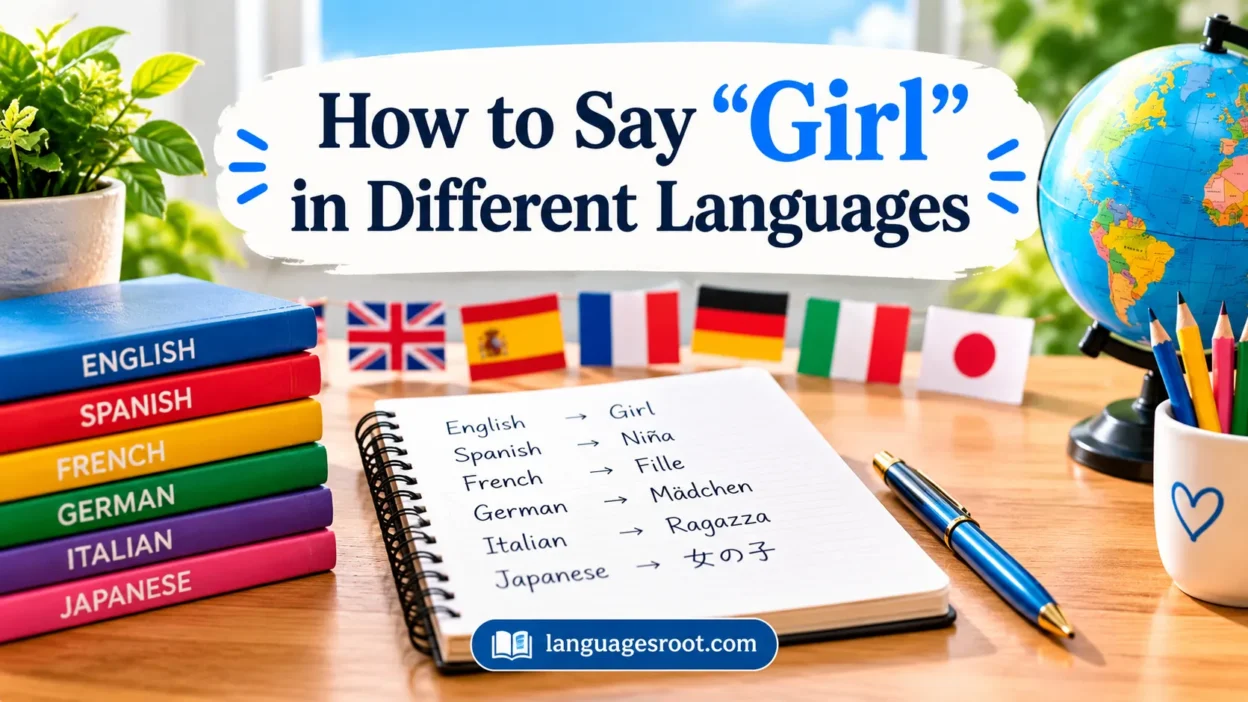
Learning how to say girl in different languages helps you explore world languages and understand cultural differences. The word can mean a female child, a young woman, or a little girl, depending on context. Therefore, knowing girl translations, girl meaning, and girl pronunciation helps you choose the right word. This guide explores girl in different languages, including European languages, Asian languages, African languages, and Middle Eastern languages.
Moreover, you will discover translation examples, example sentences, and pronunciation differences across cultures. Each language may have unique word forms, regional expressions, and language-specific meanings. Understanding cultural context and intended meaning can improve translation accuracy in everyday conversations. Whether you enjoy language learning, build multilingual vocabulary, or prepare travel vocabulary, these translations offer a helpful starting point. Explore different expressions and learn how people use this familiar word around the world.
Interesting Facts About Girl
- Age matters: Many languages distinguish between a female child and a young adult woman. The English word girl can cover both in some contexts, but another language may require a more specific term.
- Grammar changes words: In languages such as Spanish, French, and Italian, words for girl have grammatical gender and often change in number.
- Pronunciation varies: The same written word may sound different across regional accents, even when the spelling remains unchanged.
- Affectionate expressions exist: Some languages have familiar words for a daughter, little girl, or beloved young person. These expressions do not always work as direct replacements for girl.
- Context can change the meaning: Calling someone a girl may be natural when referring to a child, but using it for an adult can sound informal or inappropriate in some situations.
- Writing systems differ: Translations may appear in Latin, Cyrillic, Arabic, Devanagari, Chinese, Japanese, and other scripts. Romanization can help learners read unfamiliar writing.
- One English word may have several equivalents: The best choice depends on age, formality, regional usage, and whether the speaker means a child, daughter, teenager, or young woman.
What Does Girl Mean?
Girl generally means a female child or young female person. It is commonly used for children, daughters, school-age people, and, in suitable contexts, young women. For example, someone might say, “The girl is reading a book,” or “Their daughter is a cheerful girl.”
The word can also appear in friendly expressions such as girl friend in a general conversational sense, girlhood, and girls’ night. However, the meaning depends on the expression. A girlfriend, written as one word, usually means a female romantic partner, while girl friend can refer to a female friend.
In translation, it is important to consider whether you mean a female child, a teenage girl, a daughter, or a young woman. These meanings overlap in English, but other languages may use different vocabulary for each one.
Why Can Girl Have Different Translations?
The word girl does not have one universal equivalent because languages organize age, gender, and social relationships differently. A term that works for a young child may sound unsuitable for an adult woman. Likewise, a word meaning daughter describes a family relationship rather than simply identifying a female person.
Other factors also influence translation:
- Context: A girl in a school may be described differently from a daughter in a family conversation.
- Formality: Everyday speech may use a familiar expression, while formal writing may prefer a neutral term.
- Grammar: Some languages change nouns and related words according to grammatical gender, case, or number.
- Regional dialects: Speakers in different countries or communities may prefer different everyday expressions.
- Cultural conventions: Terms of affection can communicate warmth but may sound too familiar when used with strangers.
- Literal versus natural translation: A dictionary equivalent may not be the most natural choice in a complete sentence.
- Written versus spoken language: A word used in literature or formal writing may be less common in everyday conversation.
The translations below generally use a common, neutral word for a girl or female child, with notes where age or meaning requires extra care.
European Languages
Europe has many languages with different histories, grammatical systems, and everyday expressions. Some use a word that refers specifically to a female child, while others commonly use a term for a girl or young woman. The examples below focus on natural, broadly understandable vocabulary rather than affectionate or highly regional alternatives.
English varieties
American, British, and Australian English use the same standard spelling, girl. Differences are mainly related to accent, intonation, and local expressions, rather than a different translation.
| 🌍 Language | Country/Region | Translation | Pronunciation | Example Sentence |
| 🇺🇸 American English | United States | Girl | gurl | The girl is waiting outside. Meaning: The girl is waiting outside. |
| 🇬🇧 British English | United Kingdom | Girl | gurl, with a regional accent | The girl is reading a story. Meaning: The girl is reading a story. |
| 🇦🇺 Australian English | Australia | Girl | gurl, with an Australian accent | That girl plays the violin. Meaning: That girl plays the violin. |
European language translations
| 🌍 Language | Country/Region | Translation | Pronunciation | Example Sentence |
| 🇪🇸 Spanish | Spain and Latin America | Niña | NEE-nyah | La niña dibuja una flor. Meaning: The girl draws a flower. |
| 🇫🇷 French | France and French-speaking regions | Fille | FEE-yuh | La fille chante très bien. Meaning: The girl sings very well. |
| 🇩🇪 German | Germany, Austria, Switzerland | Mädchen | MET-khen | Das Mädchen liest ein Buch. Meaning: The girl is reading a book. |
| 🇮🇹 Italian | Italy and Italian-speaking regions | Ragazza | rah-GAHT-tsah | La ragazza studia musica. Meaning: The girl studies music. |
| 🇵🇹 Portuguese | Portugal, Brazil, and other Lusophone regions | Menina | meh-NEE-nah | A menina gosta de flores. Meaning: The girl likes flowers. |
| 🇳🇱 Dutch | Netherlands and Flanders | Meisje | MAY-shuh | Het meisje speelt buiten. Meaning: The girl is playing outside. |
| 🇸🇪 Swedish | Sweden and Swedish-speaking Finland | Flicka | FLIK-kah | Flickan läser en bok. Meaning: The girl is reading a book. |
| 🇳🇴 Norwegian | Norway | Jente | YEN-teh | Jenta liker å tegne. Meaning: The girl likes drawing. |
| 🇩🇰 Danish | Denmark | Pige | PEE-uh | Pigen går til skolen. Meaning: The girl is going to school. |
| 🇫🇮 Finnish | Finland | Tyttö | TUHT-tuh | Tyttö lukee kirjaa. Meaning: The girl is reading a book. |
| 🇮🇸 Icelandic | Iceland | Stelpa | STEL-pah | Stelpan syngur fallega. Meaning: The girl sings beautifully. |
| 🇮🇪 Irish | Ireland | Cailín | kah-LEEN | Tá an cailín ag léamh. Meaning: The girl is reading. |
| 🏴 Welsh | Wales | Merch | MEERKH, approximately | Mae’r ferch yn canu. Meaning: The girl is singing. |
| 🇵🇱 Polish | Poland | Dziewczyna | jehf-CHUH-nah | Dziewczyna czyta powieść. Meaning: The girl is reading a novel. |
| 🇨🇿 Czech | Czechia | Dívka | DEEV-kah | Dívka kreslí obrázek. Meaning: The girl is drawing a picture. |
| 🇸🇰 Slovak | Slovakia | Dievča | DYEH-vchah | Dievča hrá na klavíri. Meaning: The girl plays the piano. |
| 🇺🇦 Ukrainian | Ukraine | Дівчина | DEEV-chuh-nah | Дівчина читає книжку. Meaning: The girl is reading a book. |
| 🇷🇺 Russian | Russia and Russian-speaking communities | Девочка | DYEH-vuhch-kah | Девочка рисует цветок. Meaning: The girl is drawing a flower. |
| 🇷🇴 Romanian | Romania and Moldova | Fată | FAH-tuh | Fata citește o carte. Meaning: The girl is reading a book. |
| 🇭🇺 Hungarian | Hungary | Lány | LAAN-y | A lány szépen énekel. Meaning: The girl sings beautifully. |
| 🇬🇷 Greek | Greece and Cyprus | Κορίτσι | koh-REET-see | Το κορίτσι παίζει στον κήπο. Meaning: The girl is playing in the garden. |
| 🇧🇬 Bulgarian | Bulgaria | Момиче | MOH-mee-cheh | Момичето чете книга. Meaning: The girl is reading a book. |
| 🇭🇷 Croatian | Croatia | Djevojka | DYEH-voy-kah | Djevojka voli glazbu. Meaning: The girl likes music. |
| 🇷🇸 Serbian | Serbia and Serbian-speaking communities | Девојка | DEH-voy-kah | Девојка чита књигу. Meaning: The girl is reading a book. |
| 🇸🇮 Slovenian | Slovenia | Dekle | DEH-kleh | Dekle se uči plavati. Meaning: The girl is learning to swim. |
| 🇱🇹 Lithuanian | Lithuania | Mergaitė | mehr-guy-TEH | Mergaitė piešia saulę. Meaning: The girl is drawing a sun. |
| 🇱🇻 Latvian | Latvia | Meitene | MAY-teh-neh | Meitene lasa grāmatu. Meaning: The girl is reading a book. |
| 🇪🇪 Estonian | Estonia | Tüdruk | TUH-drook | Tüdruk kuulab muusikat. Meaning: The girl is listening to music. |
| 🇦🇱 Albanian | Albania and Kosovo | Vajzë | VAHZ-uh | Vajza po lexon. Meaning: The girl is reading. |
| 🌍 Basque | Basque Country, Spain and France | Neska | NES-kah | Neska liburu bat irakurtzen ari da. Meaning: The girl is reading a book. |
| 🏴 Catalan | Catalonia and other Catalan-speaking regions | Nena | NEH-nah | La nena juga al parc. Meaning: The girl is playing in the park. |
| 🇲🇹 Maltese | Malta | Tfajla | tf-EYE-lah | It-tfajla qed taqra. Meaning: The girl is reading. |
Cultural and usage notes
In Spanish, niña usually emphasizes a girl who is a child, while chica often suits a teenager or young woman. In Italian, ragazza can refer to a teenage girl or young woman, while bambina more specifically means a little girl. French fille can mean either girl or daughter, depending on the sentence.
German Mädchen is grammatically neuter, even though it refers to a female person. This is a useful reminder that grammatical gender does not always match a person’s gender. In Polish and several other European languages, the appropriate form may also change according to the sentence’s grammatical structure.
Asian Languages
Asia contains a wide range of language families, including Sino-Tibetan, Indo-Aryan, Dravidian, Turkic, and Austroasiatic languages. Its writing systems include Chinese characters, Japanese scripts, Hangul, Devanagari, Arabic-derived scripts, and many others. The translations below distinguish between commonly used words and terms whose meaning depends on age or context.
| 🌍 Language | Country/Region | Translation | Pronunciation | Example Sentence |
| 🇨🇳 Mandarin Chinese | China, Taiwan, and Chinese-speaking communities | 女孩 | nǚhái, third tone on nǚ | 那个女孩喜欢画画。Meaning: That girl likes drawing. |
| 🇭🇰 Cantonese | Hong Kong and Guangdong, China | 女仔 | neoi5 zai2 | 個女仔好鍾意畫畫。Meaning: The girl really likes drawing. |
| 🇯🇵 Japanese | Japan | 女の子 | onna no ko | 女の子が公園で遊んでいます。Meaning: The girl is playing in the park. |
| 🇰🇷 Korean | South Korea and North Korea | 소녀 | sonyeo | 소녀가 노래를 부릅니다. Meaning: The girl is singing. |
| 🇮🇳 Hindi | India | लड़की | laṛkī | लड़की किताब पढ़ रही है।Meaning: The girl is reading a book. |
| 🇵🇰 Urdu | Pakistan and Urdu-speaking communities | لڑکی | laṛkī | لڑکی کتاب پڑھ رہی ہے۔Meaning: The girl is reading a book. |
| 🇧🇩 Bengali | Bangladesh and West Bengal, India | মেয়ে | meye | মেয়েটি গান গাইছে।Meaning: The girl is singing. |
| 🇮🇳 Punjabi | Punjab, India and Pakistan | ਕੁੜੀ / کڑی | kuṛī | ਕੁੜੀ ਕਿਤਾਬ ਪੜ੍ਹ ਰਹੀ ਹੈ।Meaning: The girl is reading a book. |
| 🇮🇳 Gujarati | Gujarat, India | છોકરી | chhokrī | છોકરી ચિત્ર દોરી રહી છે. Meaning: The girl is drawing a picture. |
| 🇮🇳 Marathi | Maharashtra, India | मुलगी | mulgī | मुलगी गाणे गात आहे. Meaning: The girl is singing. |
| 🇮🇳 Tamil | Tamil Nadu, India and Sri Lanka | பெண் குழந்தை | peṇ kuḻantai | அந்தப் பெண் குழந்தை பாடுகிறாள். Meaning: That girl is singing. |
| 🇮🇳 Telugu | Andhra Pradesh and Telangana, India | అమ్మాయి | ammāyi | ఆ అమ్మాయి పుస్తకం చదువుతోంది. Meaning: That girl is reading a book. |
| 🇮🇳 Kannada | Karnataka, India | ಹುಡುಗಿ | huḍugi | ಹುಡುಗಿ ಹಾಡು ಹಾಡುತ್ತಾಳೆ. Meaning: The girl sings a song. |
| 🇮🇳 Malayalam | Kerala, India | പെൺകുട്ടി | peṇkuṭṭi | പെൺകുട്ടി പുസ്തകം വായിക്കുന്നു. Meaning: The girl is reading a book. |
| 🇳🇵 Nepali | Nepal | केटी | keṭī | केटी किताब पढ्दैछे।Meaning: The girl is reading a book. |
| 🇱🇰 Sinhala | Sri Lanka | ගැහැණු ළමයා | gæhæṇu lamayā | ගැහැණු ළමයා පොතක් කියවනවා. Meaning: The girl is reading a book. |
| 🇹🇭 Thai | Thailand | เด็กผู้หญิง | dèk phûu-yǐng | เด็กผู้หญิงกำลังอ่านหนังสือ Meaning: The girl is reading a book. |
| 🇻🇳 Vietnamese | Vietnam | Cô gái | koh guy, approximate | Cô gái đang đọc sách. Meaning: The girl is reading a book. |
| 🇮🇩 Indonesian | Indonesia | Anak perempuan | ah-nak pe-rem-puan | Anak perempuan itu sedang membaca. Meaning: The girl is reading. |
| 🇲🇾 Malay | Malaysia and Brunei | Budak perempuan | boo-dak puh-rem-puan | Budak perempuan itu sedang membaca buku. Meaning: The girl is reading a book. |
| 🇵🇭 Filipino/Tagalog | Philippines | Babae / batang babae | bah-bah-EH / bah-tang bah-bah-EH | Ang batang babae ay mahilig gumuhit. Meaning: The girl enjoys drawing. |
| 🇲🇲 Burmese | Myanmar | မိန်းကလေး | mein-ka-lay | မိန်းကလေးက စာအုပ်ဖတ်နေတယ်။Meaning: The girl is reading a book. |
| 🇰🇭 Khmer | Cambodia | ក្មេងស្រី | kmeng srei | ក្មេងស្រីកំពុងអានសៀវភៅ។Meaning: The girl is reading a book. |
| 🇱🇦 Lao | Laos | ເດັກຍິງ | dek nying | ເດັກຍິງກຳລັງອ່ານປຶ້ມ។Meaning: The girl is reading a book. |
| 🇲🇳 Mongolian | Mongolia | Охин | okhin | Охин ном уншиж байна. Meaning: The girl is reading a book. |
| 🇰🇿 Kazakh | Kazakhstan and Kazakh-speaking regions | Қыз | qyz | Қыз кітап оқып отыр. Meaning: The girl is reading a book. |
| 🇺🇿 Uzbek | Uzbekistan | Qiz | qiz | Qiz kitob o‘qiyapti. Meaning: The girl is reading a book. |
Cultural and usage notes
In Mandarin, 女孩 (nǚhái) is a common word for girl. In Japanese, 女の子 (onna no ko) is an everyday expression for a girl, while 少女 (shōjo) can sound more literary or emphasize youth. Korean 소녀 (sonyeo) can also sound more descriptive or literary than everyday expressions used in conversation.
In Hindi and Urdu, लड़की / لڑکی (laṛkī) is a common equivalent, but spelling and script differ. In Filipino, babae means woman or female, while batang babae more clearly identifies a girl who is a child. Likewise, anak perempuan in Indonesian means daughter or female child, so context matters.
African Languages
Africa is home to thousands of languages and many distinct cultural and linguistic traditions. Words for a girl can differ according to age, family relationships, and the language used in everyday conversation. These examples cover several widely spoken African languages without suggesting that any one language represents an entire country.
| 🌍 Language | Country/Region | Translation | Pronunciation | Example Sentence |
| 🇰🇪 Swahili | Tanzania, Kenya, and East Africa | Msichana | m-see-CHA-nah | Msichana anasoma kitabu. Meaning: The girl is reading a book. |
| 🇿🇦 Afrikaans | South Africa and Namibia | Meisie | MAY-see | Die meisie lees ‘n boek. Meaning: The girl is reading a book. |
| 🇿🇦 Zulu | South Africa | Intombazane | in-tom-bah-ZAH-neh | Intombazane ifunda incwadi. Meaning: The girl is reading a book. |
| 🇿🇦 Xhosa | South Africa | Intombazana | in-tom-bah-ZAH-nah | Intombazana ifunda incwadi. Meaning: The girl is reading a book. |
| 🇪🇹 Amharic | Ethiopia | ሴት ልጅ | set lij | ሴት ልጅ መጽሐፍ ታነባለች። Meaning: The girl is reading a book. |
| 🇳🇬 Yoruba | Nigeria and Yoruba-speaking communities | Ọmọbìnrin | aw-maw-BEEN-reen | Ọmọbìnrin náà ń ka ìwé. Meaning: The girl is reading a book. |
| 🇳🇬 Igbo | Nigeria | Nwa agbọghọ | nwah ah-baw-ghaw | Nwa agbọghọ ahụ na-agụ akwụkwọ. Meaning: The girl is reading a book. |
| 🇳🇬 Hausa | Nigeria, Niger, and West Africa | Yarinya | yah-reen-yah | Yarinyar tana karanta littafi. Meaning: The girl is reading a book. |
| 🇸🇴 Somali | Somalia and the Horn of Africa | Gabar | gah-bar | Gabadhu buug bay akhrinaysaa. Meaning: The girl is reading a book. |
| 🇿🇼 Shona | Zimbabwe | Musikana | moo-see-KAH-nah | Musikana ari kuverenga bhuku. Meaning: The girl is reading a book. |
| 🇱🇸 Sesotho | Lesotho and South Africa | Ngoanana | ngwah-AH-nah-nah | Ngoanana o bala buka. Meaning: The girl is reading a book. |
| 🇷🇼 Kinyarwanda | Rwanda | Umukobwa | oo-moo-KOH-bwah | Umukobwa arimo gusoma igitabo. Meaning: The girl is reading a book. |
| 🇲🇬 Malagasy | Madagascar | Ankizivavy | an-kee-zee-VAH-vee | Mamaky boky ilay ankizivavy. Meaning: The girl is reading a book. |
Cultural and usage notes
Some African languages distinguish clearly between a girl, a woman, and a daughter. In Swahili, msichana commonly means girl, while mwanamke means woman. In Afrikaans, meisie is a familiar word for a girl, and in Zulu and Xhosa, the forms shown above refer to a girl or young female person.
Pronunciation guides in this table are simplified for English-speaking learners. Sounds such as the clicks in some southern African languages, or tones in certain African languages, may require additional practice beyond an English approximation.
Middle Eastern Languages
The Middle East includes Arabic-speaking communities and several other distinct language traditions. Arabic varies between Modern Standard Arabic and regional dialects, while Persian, Kurdish, Hebrew, Armenian, and Turkish have their own vocabularies and grammatical systems. The examples below use broadly recognizable words, with care taken to distinguish a girl from a woman or daughter.
| 🌍 Language | Country/Region | Translation | Pronunciation | Example Sentence |
| 🇵🇸 Arabic (Modern Standard Arabic) | Palestine and Arabic-speaking communities across the Middle East and North Africa | فتاة | fatāh | الفتاة تقرأ كتابًا. Meaning: The girl is reading a book. |
| 🇮🇷 Persian (Farsi) | Iran and Persian-speaking communities | دختر | dokhtar | دختر کتاب میخواند. Meaning: The girl is reading a book. |
| 🌍 Hebrew | Jewish communities worldwide | ילדה | yal-dah | הילדה קוראת ספר. Meaning: The girl is reading a book. |
| 🟨🟥🟩 Kurdish (Kurmanji) | Kurdish-speaking regions across several countries | Keç | kech | Keçik pirtûk dixwîne. Meaning: The girl is reading a book. |
| 🇹🇷 Turkish | Türkiye and Turkish-speaking communities | Kız | kuhz | Kız kitap okuyor. Meaning: The girl is reading a book. |
| 🇦🇲 Armenian | Armenia and Armenian-speaking communities | Աղջիկ | agh-jeek | Աղջիկը գիրք է կարդում։Meaning: The girl is reading a book. |
Cultural and usage notes
In Modern Standard Arabic, fatāh (فتاة) is a general word for a girl or young woman. The everyday word بنت (bint) is also widely used, particularly in conversation, and can mean girl or daughter. Regional pronunciation and wording vary across Arabic-speaking communities.
Persian دختر (dokhtar) can mean girl or daughter. Turkish kız also has both meanings, depending on the sentence. In Hebrew, ילדה (yalda) usually refers to a girl who is a child, while נערה (na’arah) can refer to an adolescent girl. Kurdish vocabulary and pronunciation differ among Kurdish varieties, so the table specifically identifies Kurmanji.
Also Read: How to Say Man in Different Languages
Other World Languages
Many other languages offer useful equivalents for girl, including languages spoken in the Pacific, the Americas, and international language-learning communities. These examples broaden the comparison beyond the four main regions.
| 🌍 Language | Country/Region | Translation | Pronunciation | Example Sentence |
| 🇳🇿 Māori | Aotearoa New Zealand | Kōtiro | KOH-tee-raw | Kei te pānui te kōtiro i tētahi pukapuka. Meaning: The girl is reading a book. |
| 🇼🇸 Samoan | Samoa and Samoan-speaking communities | Teine | TAY-neh | O lo’o faitau le teine i se tusi. Meaning: The girl is reading a book. |
| 🇹🇴 Tongan | Tonga | Ta’ahine | tah-ah-HEE-neh | ‘Oku lau ‘e he ta’ahine ha tohi. Meaning: The girl is reading a book. |
| 🇺🇸 Hawaiian | Hawaiʻi | Kaikamahine | kye-kah-mah-HEE-neh | Ke heluhelu nei ke kaikamahine i kahi puke. Meaning: The girl is reading a book. |
| 🇵🇪 Quechua | Andean regions of Peru, Bolivia, and neighboring countries | Warmi | WAR-mee | Warmiqa liwruta ñawirin. Meaning: The woman is reading a book. |
| 🇵🇾 Guarani | Paraguay and neighboring regions | Kuña | koo-NYAH | Pe kuña omoñe’ẽ peteĩ aranduka. Meaning: That woman is reading a book. |
| 🇭🇹 Haitian Creole | Haiti and Haitian communities worldwide | Tifi | tee-FEE | Tifi a ap li yon liv. Meaning: The girl is reading a book. |
| 🌍 Esperanto | International constructed language | Knabino | knah-BEE-noh | La knabino legas libron. Meaning: The girl is reading a book. |
Important context note: Some entries above require a more specific explanation. Quechua warmi and Guarani kuña generally mean woman or female, not specifically a girl who is a child. They are included to illustrate the importance of context, but they should not be treated as exact child-specific equivalents. In Quechua, a term such as sipas may refer to a young woman or girl in some varieties. Vocabulary differs substantially between Quechua dialects, so the most suitable word depends on the region and age intended.
Quick Reference: Girl in Different Languages
Use this compact table to look up the main translations quickly. The words below generally mean girl, although a few can also mean daughter, young woman, or female person depending on context.
| Language | Translation |
| American English | Girl |
| British English | Girl |
| Australian English | Girl |
| Spanish | Niña |
| French | Fille |
| German | Mädchen |
| Italian | Ragazza |
| Portuguese | Menina |
| Dutch | Meisje |
| Swedish | Flicka |
| Norwegian | Jente |
| Danish | Pige |
| Finnish | Tyttö |
| Icelandic | Stelpa |
| Irish | Cailín |
| Welsh | Merch |
| Polish | Dziewczyna |
| Czech | Dívka |
| Slovak | Dievča |
| Ukrainian | Дівчина |
| Russian | Девочка |
| Romanian | Fată |
| Hungarian | Lány |
| Greek | Κορίτσι |
| Bulgarian | Момиче |
| Croatian | Djevojka |
| Serbian | Девојка |
| Slovenian | Dekle |
| Lithuanian | Mergaitė |
| Latvian | Meitene |
| Estonian | Tüdruk |
| Albanian | Vajzë |
| Basque | Neska |
| Catalan | Nena |
| Maltese | Tfajla |
| Mandarin Chinese | 女孩 |
| Cantonese | 女仔 |
| Japanese | 女の子 |
| Korean | 소녀 |
| Hindi | लड़की |
| Urdu | لڑکی |
| Bengali | মেয়ে |
| Punjabi | ਕੁੜੀ / کڑی |
| Gujarati | છોકરી |
| Marathi | मुलगी |
| Tamil | பெண் குழந்தை |
| Telugu | అమ్మాయి |
| Kannada | ಹುಡುಗಿ |
| Malayalam | പെൺകുട്ടി |
| Nepali | केटी |
| Sinhala | ගැහැණු ළමයා |
| Thai | เด็กผู้หญิง |
| Vietnamese | Cô gái |
| Indonesian | Anak perempuan |
| Malay | Budak perempuan |
| Filipino/Tagalog | Batang babae |
| Burmese | မိန်းကလေး |
| Khmer | ក្មេងស្រី |
| Lao | ເດັກຍິງ |
| Mongolian | Охин |
| Kazakh | Қыз |
| Uzbek | Qiz |
| Swahili | Msichana |
| Afrikaans | Meisie |
| Zulu | Intombazane |
| Xhosa | Intombazana |
| Amharic | ሴት ልጅ |
| Yoruba | Ọmọbìnrin |
| Igbo | Nwa agbọghọ |
| Hausa | Yarinya |
| Somali | Gabar |
| Shona | Musikana |
| Sesotho | Ngoanana |
| Kinyarwanda | Umukobwa |
| Malagasy | Ankizivavy |
| Arabic | فتاة |
| Persian | دختر |
| Hebrew | ילדה |
| Kurdish (Kurmanji) | Keç |
| Turkish | Kız |
| Armenian | Աղջիկ |
| Māori | Kōtiro |
| Samoan | Teine |
| Tongan | Ta’ahine |
| Hawaiian | Kaikamahine |
| Quechua | Warmi, generally woman |
| Guarani | Kuña, generally woman |
| Haitian Creole | Tifi |
| Esperanto | Knabino |
How to Choose the Right Translation
The best translation of girl depends on age, context, relationship, and the language community. Before choosing a word, decide whether you mean a female child, a teenage girl, a daughter, or a young woman. For example, Spanish niña is especially suitable for a child, whereas chica often works for a teenager or young woman. In Japanese, 女の子 (onna no ko) is a common everyday expression for a girl.
Follow these practical tips when choosing a translation:
- Identify the intended age: Choose a child-specific word when referring to a young girl.
- Check the relationship: A word meaning daughter may not work when describing someone else’s child.
- Consider formality: A literary or formal term may sound unusual in everyday conversation.
- Check regional usage: A word may be familiar in one country but less common in another.
- Learn the complete sentence: Grammar may change the word’s form depending on its role.
- Listen to pronunciation: Use reliable recordings when possible instead of depending entirely on English sound approximations.
If you are writing a greeting, caption, story, or personal message, consider how the word sounds to the intended reader. A natural sentence is often more useful than a translation taken out of context.
Common Mistakes When Translating Girl
Translating girl seems straightforward, but several common mistakes can change the intended meaning. Paying attention to context and grammar helps you avoid awkward or misleading expressions.
- Translating every age group identically: Some languages distinguish a little girl from an adolescent or young woman. Use a word that fits the person’s age.
- Confusing girl with daughter: Words such as Persian dokhtar and Turkish kız can mean either girl or daughter. The surrounding sentence determines the meaning.
- Ignoring grammatical gender: In languages with grammatical gender, the noun and related words may follow specific grammatical rules. German Mädchen, for example, is grammatically neuter.
- Assuming regional words are interchangeable: A familiar expression in one country may have a different tone elsewhere.
- Using an informal term in a formal setting: Friendly expressions can sound too familiar when speaking to strangers or writing professionally.
- Relying on misleading pronunciation: English spellings can only approximate sounds from other languages. Tones, stress, and unfamiliar consonants may change the pronunciation considerably.
- Treating every equivalent as exact: Words meaning female, woman, or daughter do not always mean girl. Check the definition before using them.
The safest approach is to learn the word together with a natural example sentence. This helps you understand how people use it rather than memorizing an isolated translation.
Why Learn Girl in Different Languages?
Learning how to say girl in different languages expands your everyday vocabulary and helps you recognize how languages describe people. It can be useful when traveling, reading foreign-language stories, studying another language, or communicating with people from different backgrounds.
Comparing translations also reveals interesting linguistic patterns. For example, Spanish niña and French fille express a similar basic idea, but their use and grammatical behavior differ. Mandarin 女孩 (nǚhái) uses Chinese characters, while Hindi लड़की (laṛkī) uses Devanagari. These differences show how languages organize meaning through their own vocabulary and writing systems.
Learning words in context can also improve pronunciation, listening, reading, and sentence construction. Rather than memorizing dozens of translations without understanding them, try learning a word alongside a complete sentence and its English meaning. You can then notice how age, relationships, and formality affect word choice.
Most importantly, language learning encourages curiosity and respect. Understanding a word’s cultural and grammatical context helps you communicate more naturally and appreciate the diversity of human expression.
Frequently Asked Questions
How do you say girl in different languages?
The word girl has different translations across world languages. For example, Spanish uses niña, French uses fille, German uses Mädchen, and Japanese uses 女の子. The best girl translation depends on age, context, and intended meaning.
What is the difference between girl, daughter, and young woman?
A girl usually means a female child, while a daughter describes a family relationship. A young woman generally refers to an adult. However, some languages use different words for each meaning, so context matters.
Can girl translations change by country or region?
Yes, regional expressions, local vocabulary, and pronunciation can vary across countries. For example, Spanish speakers may use niña or chica depending on age and context. Therefore, check language variations before choosing a word.
How can I pronounce girl correctly in different languages?
Use a language pronunciation guide alongside the original spelling and pronunciation examples. Also, listen to native speakers when possible, because accents, stress, and tones can affect pronunciation. Practicing complete example sentences helps you speak more naturally.
Why is cultural context important when translating girl?
Cultural context helps you choose words that sound natural and respectful. Some translations refer specifically to a child, while others can mean a young woman or daughter. Therefore, consider age, formality, and everyday communication before using a translation.
Conclusion
Learning how to say girl in different languages helps you explore world languages, build multilingual vocabulary, and understand cultural differences. From Spanish niña and French fille to Japanese 女の子 and Arabic فتاة, each language offers unique girl translations. However, consider age, regional expressions, pronunciation differences, and cultural context to choose the right word. By practicing example sentences and learning each word’s intended meaning, you can improve translation accuracy and communicate with greater confidence and respect.