A cloak is a long garment that covers the shoulders and back. It can be a loose outer garment designed for warmth, protection, or covering. Across cultures, cloaks have appeared as traditional clothing, ceremonial garments, and symbols in historical stories. Today, they also appear often in fantasy books, films, games, and costumes.
Learning the word for cloak in different languages helps expand clothing vocabulary. This translation guide provides the native word, English pronunciation, English meaning, and a real-life example. It can help language learners, travelers, writers, and students understand cultural context. You can also explore related clothing terms, garment history, and traditional outerwear across global languages.
Interesting Facts About Cloak
- A cloak is usually an outer garment designed to cover the body without fitting tightly around it.
- Traditional cloaks have been used for warmth, protection from weather, ceremony, travel, and fashion.
- A cloak may be similar to a cape, mantle, robe, or wrap, but these garments are not always identical.
- The English word “cloak” has historical connections to the Middle English word cloke and older European clothing terms.
- Cloaks are strongly associated with medieval clothing and historical European fashion.
- Fantasy literature often uses cloaks to create a mysterious, magical, royal, or adventurous appearance.
- Some languages use one common word for both a cloak and a cape.
- Other languages distinguish between different types of outer garments according to their shape, length, material, or cultural use.
- The word “cloak” can have a figurative meaning related to concealment or hiding.
- In technology and science fiction, “to cloak” can mean to hide or make something difficult to detect.
- Historical garments called cloaks have appeared in many different parts of the world.
- Modern fashion sometimes uses cloak-like designs in coats, capes, evening wear, and theatrical costumes.
- The Japanese word マント and Korean 망토 are commonly used for modern cloak or cape-like garments.
- Chinese commonly uses 斗篷 for a cloak or cape-like outer garment.
- There is no single universal definition of a cloak across every culture because traditional garments vary in design and purpose.
How to Say “Cloak” in Different Languages
The tables below provide more than 70 ways to express “cloak” across major world languages. Pronunciations are approximate learner-friendly guides rather than replacements for native pronunciation. Synonyms are included where a language commonly uses a related term such as cape, mantle, wrap, or outer garment.
European Languages

European languages contain many historical words for cloaks, capes, mantles, and other outer garments. Some terms are closely related because European clothing traditions influenced one another over centuries. However, a word that translates as “cloak” in English may describe a particular style of garment in another language.
| Language | Country/Region | Translation | Pronunciation | Synonyms | Example sentence |
| 🇬🇧 British English | United Kingdom | cloak | klohk | cape, mantle | She wore a dark cloak. |
| 🇺🇸 American English | United States | cloak | klohk | cape, mantle | The character wore a long cloak. |
| 🇦🇺 Australian English | Australia | cloak | klohk | cape, wrap | He carried a warm cloak. |
| 🇫🇷 French | France | pelisse | puh-LEES | pèlerine, cape | Elle porte une pelisse noire. |
| 🇩🇪 German | Germany | Umhang | OOM-hahng | Pelerine, Mantel | Er trägt einen langen Umhang. |
| 🇪🇸 Spanish | Spain, Latin America | capa | KAH-pah | manto, capa larga | Ella lleva una capa negra. |
| 🇮🇹 Italian | Italy | tabarro | tah-BAHR-roh | mantello, cappa | Indossa un tabarro scuro. |
| 🇵🇹 Portuguese | Portugal, Brazil | capa | KAH-pah | manto, capote | Ela usa uma capa longa. |
| 🇳🇱 Dutch | Netherlands, Belgium | mantel | MAHN-tel | cape | Hij draagt een mantel. |
| 🇩🇰 Danish | Denmark | kappe | KAH-puh | kåbe | Hun bærer en kappe. |
| 🇳🇴 Norwegian | Norway | kappe | KAP-peh | frakk | Hun har på seg en kappe. |
| 🇸🇪 Swedish | Sweden | slängkappa | SLENG-kap-pa | mantel | Han bär en slängkappa. |
| 🇫🇮 Finnish | Finland | viitta | VEE-tah | viitta-asu | Hän käyttää viittaa. |
| 🇮🇸 Icelandic | Iceland | skikkja | SKIT-kya | möntull | Hún klæðist skikkju. |
| 🇮🇪 Irish | Ireland | clóca | KLOH-ka | brat | Tá clóca dubh uirthi. |
| 🏴 Scottish Gaelic | Scotland | cleòc | KLEEK | brat | Tha cleòc dhubh oirre. |
| 🏴 Welsh | Wales | clogyn | KLOG-in | capan | Mae ganddo glogyn. |
| 🇵🇱 Polish | Poland | peleryna | peh-leh-RI-na | płaszcz | Ona nosi pelerynę. |
| 🇨🇿 Czech | Czech Republic | plášť | PLAHSHt | plášťový oděv | Má na sobě plášť. |
| 🇸🇰 Slovak | Slovakia | plášť | PLAHSHt | plášťový odev | Nosí dlhý plášť. |
| 🇭🇺 Hungarian | Hungary | köpeny | KUR-pehn | köpönyeg | Hosszú köpenyt visel. |
| 🇷🇴 Romanian | Romania | mantie | MAHN-tee-eh | manta | Poartă o mantie lungă. |
| 🇧🇬 Bulgarian | Bulgaria | плащ | plahsh | наметало | Той носи плащ. |
| 🇷🇺 Russian | Russia | плащ | plashch | мантия, накидка | Он носит длинный плащ. |
| 🇺🇦 Ukrainian | Ukraine | плащ | plashch | накидка | Вона носить плащ. |
| 🇧🇾 Belarusian | Belarus | плашч | plashch | плаш | Ён носіць плашч. |
| 🇵🇱 Slovene | Slovenia | plašč | plahshch | ogrinjalo | Nosi dolg plašč. |
| 🇭🇷 Croatian | Croatia | ogrtač | oh-GR-tach | plašt | On nosi ogrtač. |
| 🇷🇸 Serbian | Serbia | ogrtač | oh-GR-tach | plašt | On nosi ogrtač. |
| 🇲🇰 Macedonian | North Macedonia | наметка | NA-met-ka | плашт | Таа носи наметка. |
| 🇬🇷 Greek | Greece | κάπα | KA-pa | μανδύας | Φοράει μια κάπα. |
| 🇦🇱 Albanian | Albania | mantel | MAN-tel | pelerinë | Ai mban një mantel. |
| 🇪🇪 Estonian | Estonia | keep | KEE-ep | mantel | Ta kannab keepi. |
| 🇱🇻 Latvian | Latvia | apmetnis | ahp-MET-nis | apmetnis | Viņš valkā apmetni. |
| 🇱🇹 Lithuanian | Lithuania | apsiaustas | ap-see-OWS-tas | skraistė | Jis dėvi apsiaustą. |
| 🇸🇮 Slovenian | Slovenia | plašč | PLASHCH | ogrinjalo | Nosi dolg plašč. |
| 🇦🇲 Armenian | Armenia | թիկնոց | tik-NOTS | ծածկոց | Նա կրում է թիկնոց։ |
The European vocabulary for cloaks shows why translation should be treated as a cultural process rather than a simple word-for-word exchange. Wiktionary records several European equivalents, including Umhang in German, kappe in Danish and Norwegian, mantie in Romanian, peleryna in Polish, plašt in several Slavic languages, and clogyn in Welsh.
Asian Languages

Asia has an enormous range of clothing traditions, so the closest word for “cloak” can depend heavily on the type of garment being described. Some languages use terms associated with capes or wraps, while others have traditional words for long outer garments. The following expressions are useful for general references to cloaks and cloak-like garments.
| Language | Country/Region | Translation | Pronunciation | Synonyms | Example sentence |
| 🇨🇳 Mandarin Chinese | China | 斗篷 | dòu péng | 披风 | 他穿着一件斗篷。 |
| 🇯🇵 Japanese | Japan | マント | MAN-to | クローク | 彼はマントを着ています。 |
| 🇰🇷 Korean | South Korea | 망토 | mang-toh | 외투 | 그는 망토를 입고 있습니다. |
| 🇮🇳 Hindi | India | चोग़ा | cho-GAA | लबादा | वह एक लंबा चोग़ा पहनता है। |
| 🇵🇰 Urdu | Pakistan | چغہ | chugha | چادر, جبہ | وہ ایک لمبا چغہ پہنتا ہے۔ |
| 🇧🇩 Bengali | Bangladesh | আলখাল্লা | al-khal-la | চাদর | সে একটি আলখাল্লা পরে। |
| 🇮🇳 Punjabi | India, Pakistan | ਚੋਗਾ | CHO-ga | ਚਾਦਰ | ਉਹ ਲੰਮਾ ਚੋਗਾ ਪਾਉਂਦਾ ਹੈ। |
| 🇮🇳 Marathi | India | झगा | jha-GAA | अंगरखा | तो लांब झगा घालतो. |
| 🇮🇳 Gujarati | India | ઝભ્ભો | JHAB-bho | ચાદર | તે લાંબો ઝભ્ભો પહેરે છે. |
| 🇮🇳 Tamil | India, Sri Lanka | மேலங்கி | may-la-NGI | போர்வை | அவன் மேலங்கி அணிந்திருக்கிறான். |
| 🇮🇳 Telugu | India | అంగీ | an-GEE | వస్త్రం | అతను అంగీ ధరిస్తాడు. |
| 🇮🇳 Kannada | India | ಮೇಲಂಗಿ | may-LANG-gee | ಹೊದಿಕೆ | ಅವನು ಮೇಲಂಗಿ ಧರಿಸಿದ್ದಾನೆ. |
| 🇹🇭 Thai | Thailand | เสื้อคลุม | suea khlum | ผ้าคลุม | เขาสวมเสื้อคลุม |
| 🇻🇳 Vietnamese | Vietnam | áo choàng | ow chowng | áo khoác | Anh ấy mặc áo choàng. |
| 🇮🇩 Indonesian | Indonesia | jubah | JOO-bah | mantel | Dia memakai jubah. |
| 🇲🇾 Malay | Malaysia, Brunei | jubah | JOO-bah | mantel | Dia memakai jubah panjang. |
| 🇵🇭 Filipino | Philippines | balabal | ba-la-BAL | kapa | Nakasuot siya ng balabal. |
| 🇮🇳 Nepali | Nepal | लबादा | la-BAA-da | ओढ्नी | उसले लामो लबादा लगाएको छ। |
| 🇱🇰 Sinhala | Sri Lanka | සළුව | sa-LU-wa | ආවරණය | ඔහු සළුවක් පැළඳ සිටී. |
| 🇲🇳 Mongolian | Mongolia | нөмрөг | NOM-rog | дээл | Тэр нөмрөг өмссөн. |
| 🇰🇿 Kazakh | Kazakhstan | желбегей | zhel-beh-GEY | шапан | Ол желбегей киді. |
| 🇺🇿 Uzbek | Uzbekistan | plash | plash | yopinchiq | U plash kiygan. |
| 🇦🇿 Azerbaijani | Azerbaijan | plaş | plash | örtük | O, plaş geyinir. |
| 🇬🇪 Georgian | Georgia | მოსასხამი | mo-sa-SKHAM-ee | მანტია | მას მოსასხამი აცვია. |
| 🇮🇱 Hebrew | Israel | גלימה | gli-MAH | אדרת | הוא לובש גלימה. |
| 🇮🇷 Persian | Iran | قبا | qa-BAA | ردا, شنل | او یک قبای بلند پوشیده است. |
| 🇦🇫 Dari | Afghanistan | چپن | cha-PAN | ردا | او چپن پوشیده است. |
| 🇹🇯 Tajik | Tajikistan | ҷома | jo-MA | рӯпӯш | Ӯ ҷома пӯшидааст. |
| 🇱🇦 Lao | Laos | ເສື້ອຄຸມ | seu-a khum | ຜ້າຄຸມ | ລາວໃສ່ເສື້ອຄຸມ. |
| 🇰🇭 Khmer | Cambodia | អាវធំ | av thom | អាវក្រៅ | គាត់ពាក់អាវធំ។ |
For example, Wiktionary specifically records Mandarin 斗篷, Japanese マント, Korean 망토, Hindi चोग़ा, Persian قبا, and Kazakh желбегей as translations or equivalents associated with cloak-like garments.
African Languages
African languages describe outer clothing through a wide range of traditional and modern vocabulary. In some languages, a general word for a robe, wrap, shawl, or covering may be more natural than a direct equivalent of the English word “cloak.” Context is therefore particularly important when translating clothing terminology.
Also Read: How to Say “April” in Different Languages
| Language | Country/Region | Translation | Pronunciation | Synonyms | Example sentence |
| 🇿🇦 Afrikaans | South Africa, Namibia | mantel | MAN-tel | kaap | Hy dra ‘n lang mantel. |
| 🇪🇹 Amharic | Ethiopia | ካባ | ka-ba | መጎናጸፊያ | እሱ ካባ ለብሷል። |
| 🇸🇴 Somali | Somalia | maro | MA-ro | go’ | Wuxuu xiran yahay maro. |
| 🇰🇪 Swahili | East Africa | joho | JOH-ho | vazi | Amevaa joho refu. |
| 🇰🇪 Kikuyu | Kenya | nguo ya nje | NGOO-oh yah NJEH | vazi | Yambata nguo ya nje. |
| 🇳🇬 Yoruba | Nigeria | aṣọ ibora | ah-SHAW ee-BO-ra | aṣọ | Ó wọ aṣọ ibora. |
| 🇳🇬 Igbo | Nigeria | uwe mkpuchi | oo-weh m-KOO-chee | uwe | Ọ na-eyi uwe mkpuchi. |
| 🇳🇬 Hausa | Nigeria, Niger | mayafi | mah-YAH-fee | riga | Ya saka mayafi. |
| 🇬🇭 Akan | Ghana | ntoma | n-TO-ma | ntade | Ɔhyɛ ntoma tenten. |
| 🇲🇬 Malagasy | Madagascar | akanjo lava | ah-KAN-dzoh LA-va | lamba | Manao akanjo lava izy. |
| 🇿🇦 Zulu | South Africa | ingubo | in-GOO-bo | ingubo ende | Ugqoke ingubo ende. |
| 🇿🇦 Xhosa | South Africa | ingubo | in-GOO-bo | isambatho | Unxibe ingubo ende. |
| 🇧🇼 Setswana | Botswana | kobo | KOH-bo | seaparo | O apere kobo e telele. |
| 🇿🇼 Shona | Zimbabwe | jira | JEE-ra | nguo | Akapfeka jira refu. |
| 🇷🇼 Kinyarwanda | Rwanda | umwambaro | oom-wam-BA-ro | igishura | Yambaye umwambaro muremure. |
| 🇸🇳 Wolof | Senegal | mbubb | MBOOB | yére | Mu ngi sol mbubb. |
| 🇲🇱 Bambara | Mali | fini | FEE-nee | kaftan | A ye fini don. |
These examples also illustrate an important translation principle: the most natural local expression may describe the garment by its function or general category rather than matching the English noun exactly. This is especially relevant for traditional clothing.
Middle Eastern Languages
The Middle East contains several major language families and long-standing clothing traditions. Words for cloaks, robes, mantles, and outer coverings can carry cultural meanings that are difficult to reproduce with a single English word. The Arabic, Persian, Hebrew, Kurdish, and Turkish examples below therefore include terms that can refer to cloak-like or outer garments.
| Language | Country/Region | Translation | Pronunciation | Synonyms | Example sentence |
| 🇸🇦 Arabic | Middle East, North Africa | عباءة | a-BAA-ya | رداء, جلباب | ترتدي عباءة سوداء. |
| 🇮🇱 Hebrew | Israel | גלימה | gli-MAH | אדרת | הוא לבש גלימה. |
| 🇮🇷 Persian | Iran | قبا | qa-BAA | ردا, شنل | او قبای بلندی پوشید. |
| 🇹🇷 Turkish | Turkey | pelerin | peh-leh-REEN | kaftan | Siyah bir pelerin giydi. |
| Kurdish | Kurdistan regions | cilîk | jee-LEEK | derpê | Ew cilîkek dirêj li xwe dike. |
| 🇦🇫 Pashto | Afghanistan, Pakistan | چپن | cha-PAN | ردا | هغه چپن اغوستی دی. |
| 🇮🇶 Iraqi Arabic | Iraq | عباءة | a-BAA-ya | رداء | هو لابس عباءة. |
| 🇯🇴 Jordanian Arabic | Jordan | عباءة | a-BAA-ya | جلباب | هي ترتدي عباءة. |
| 🇱🇧 Lebanese Arabic | Lebanon | عباءة | a-BAA-ya | رداء | لابس عباءة طويلة. |
| 🇪🇬 Egyptian Arabic | Egypt | عباءة | a-BAA-ya | جلابية | هو لابس عباءة. |
| 🇦🇲 Armenian | Armenia | թիկնոց | tik-NOTS | վերարկու | Նա թիկնոց է կրում։ |
Arabic and Persian illustrate why context matters. A traditional cloak-like garment may have a different cultural identity from a fantasy-style European cloak. Wiktionary gives Arabic مِعْطَف فَضْفَاض and Persian terms such as قبا among equivalents associated with “cloak.”
Additional Languages Around the World
The idea of a cloak is not limited to Europe, Asia, Africa, or the Middle East. Many other languages have words for outer coverings, traditional wraps, capes, mantles, and similar garments. Including these terms provides a broader picture of how different communities describe clothing.
| Language | Country/Region | Translation | Pronunciation | Synonyms | Example sentence |
| 🇳🇿 Māori | New Zealand | tūpuni | too-POO-nee | korowai | Kei te mau ia i te tūpuni. |
| 🇵🇪 Quechua | Andes, South America | yaqulla | ya-KOOL-ya | p’acha | Payqa yaqullata churakun. |
| Esperanto | International | mantelo | man-TEH-lo | kapo | Li portas mantelon. |
| 🇻🇦 Latin | Historical Europe | pallium | PAL-lee-um | lacerna | Vir pallium gerit. |
| Ancient Greek | Ancient Greece | χλαῖνα | KHLAY-na | φᾶρος | Ὁ ἀνὴρ χλαῖναν φορεῖ. |
| Gothic | Historical Germanic Europe | 𐌷𐌰𐌺𐌿𐌻𐍃 | ha-kools | paida | — |
| Walloon | Belgium | caban | ka-BAN | pelurene | Il pwète on caban. |
| Norman | Channel Islands, Normandy | cliôque | KLYOHK | manté | Il porte une cliôque. |
| Scottish Gaelic | Scotland | cleòc | KLEEK | brat | Tha cleòc aige. |
| Welsh | Wales | clogyn | KLOG-in | capan | Mae hi’n gwisgo clogyn. |
| Irish | Ireland | clóca | KLOH-ka | brat | Tá clóca uirthi. |
| Māori | New Zealand | tūpuni | too-POO-nee | korowai | Kei a ia he tūpuni. |
| Catalan | Catalonia | capa | KA-pa | mantell | Porta una capa negra. |
| Galician | Galicia | capa | KA-pa | gurullo | Leva unha capa longa. |
| Basque | Basque Country | kapa | KA-pa | mantu | Kapa beltza darama. |
| Maltese | Malta | mantell | MAN-tel | kapott | Hu jilbes mantell. |
Some of these words refer more closely to a mantle, wrap, cape, or traditional covering than to the exact modern English concept of a cloak. That distinction is important because clothing vocabulary is strongly connected to local history and culture.
Cloak in American, British, and Australian English
Although American, British, and Australian English share the same basic word “cloak,” pronunciation can vary slightly by accent. In standard British pronunciation, cloak is commonly represented as /kləʊk/, while General American pronunciation is /kloʊk/. Australian English has its own vowel quality as well.
| English variety | Word | Pronunciation | Example |
| 🇺🇸 American English | cloak | klohk | The wizard wore a black cloak. |
| 🇬🇧 British English | cloak | klohk | The traveler wrapped himself in a cloak. |
| 🇦🇺 Australian English | cloak | klohk | She bought a warm cloak for the costume. |
The differences are mainly related to accent and vowel pronunciation rather than a different word.
What Does “Cloak” Mean?
The most common meaning of “cloak” is a long outer garment worn over the shoulders and back. A cloak can be similar to a cape, but traditional designs vary. Some cloaks have hoods, while others are open at the front or fasten around the neck.
The word can also be used metaphorically. For example, someone might describe darkness as a “cloak” because darkness seems to cover or hide something. The verb “to cloak” can similarly mean to cover, conceal, or hide something.
In science fiction, “cloaking” can have another specialized meaning. A fictional spacecraft, for example, may use a “cloaking device” to become invisible or difficult to detect. This meaning is different from the ordinary clothing-related use.
Cloak, Cape, Mantle, and Robe: What Is the Difference?
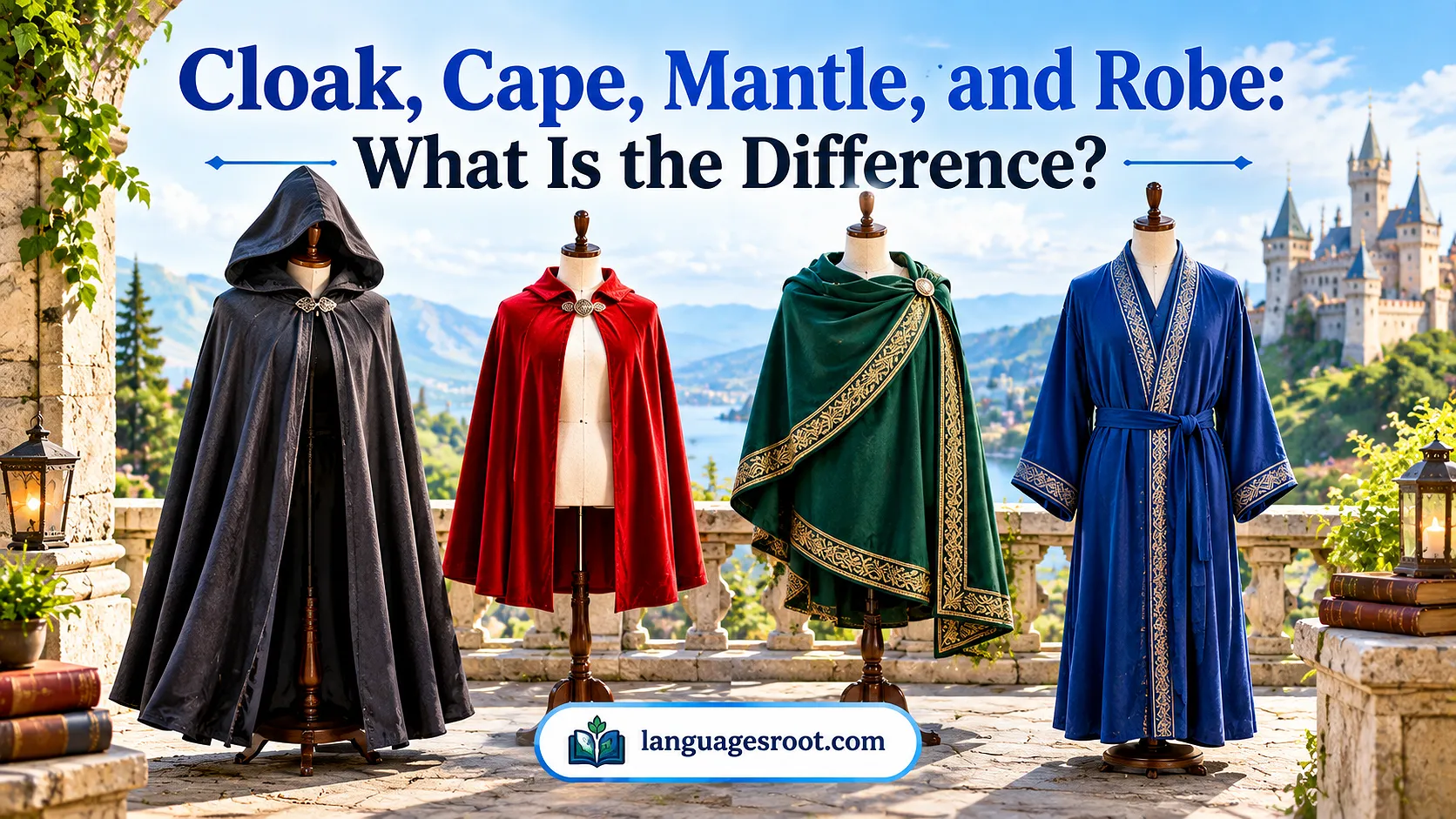
These words are related, but they are not always interchangeable.
A cloak is generally a loose outer garment covering the back and shoulders. It can be long and may include a hood.
A cape is usually shorter and often covers the shoulders and upper back without extending as far down the body.
A mantle can mean a loose outer garment and is also widely used in figurative language. Some traditional mantles resemble cloaks.
A robe is normally a loose garment that covers more of the body and may have sleeves. Religious, ceremonial, academic, and household robes are common examples.
The exact distinction changes across cultures. In fact, several dictionaries and multilingual resources group cloak, cape, and mantle together because the garments overlap in appearance and use.
How Do You Pronounce “Cloak”?
The pronunciation of “cloak” changes slightly between English accents.
In British English, it is commonly pronounced /kləʊk/. In General American English, it is commonly pronounced /kloʊk/. The word has one syllable and rhymes closely with words such as “smoke” and “joke.”
The initial sound is the consonant cluster “cl,” followed by a long vowel sound and a final “k.” When speaking naturally, the word is usually short and clear.
How to Use “Cloak” in a Sentence
Here are some simple English examples:
- The wizard wore a long black cloak.
- She wrapped herself in a warm cloak.
- The traveler carried a heavy cloak.
- The character’s red cloak moved in the wind.
- He used a cloak to protect himself from the cold.
- Darkness seemed to cloak the quiet village.
- The mysterious stranger disappeared beneath his cloak.
- The historical costume included a long cloak and boots.
- The actor wore a hooded cloak for the scene.
- The knight placed a cloak around his shoulders.
These examples demonstrate both the literal clothing meaning and the figurative meaning of the word.
Why Does “Cloak” Have Different Translations?
Languages divide the world into concepts differently. One language may have a single word for several cloak-like garments, while another may have separate words for a hooded cloak, cape, robe, mantle, or ceremonial garment.
Historical clothing also influences vocabulary. European languages, for example, contain many related terms because clothing traditions developed alongside one another. Asian and Middle Eastern languages may use words connected to robes, wraps, coats, shawls, or traditional outer garments.
For this reason, a good translation should consider context, garment style, culture, and intended meaning rather than simply replacing one dictionary word with another.
Frequently Asked Questions
What is “cloak” in French?
The French word pelisse can describe a cloak-like garment, while pèlerine may fit certain styles. Context helps choose the most natural clothing vocabulary.
What is “cloak” in Spanish?
Spanish commonly uses capa for a cloak or cape-like garment. However, traditional clothing terms may vary depending on the garment’s style and cultural context.
What is “cloak” in German?
The German word Umhang commonly refers to a cloak or loose outer garment. Related terms may describe specific cape-like or traditional outerwear styles.
What is “cloak” in Chinese?
In Mandarin Chinese, 斗篷 is commonly used for a cloak or cape-like outer garment. The best translation can change with the garment’s style and context.
Is a cloak the same as a cape?
Not always. A cloak is generally longer and covers more of the body, while a cape usually covers the shoulders and upper back.
Conclusion
Learning cloak across different languages reveals how clothing vocabulary connects with culture, history, and everyday communication. The article shows why translation depends on context, especially when related garments include capes, mantles, robes, and traditional outerwear. By exploring these multilingual translations, you can build stronger language skills, understand cultural differences, and choose more natural words for each setting.