
The word cleanse means to clean thoroughly, remove unwanted substances, or make something pure. It can describe physical cleaning, purification, or a figurative sense of clearing something unwanted away. Moreover, cleanse in different languages can change with context, cultures, and everyday usage. Learning the closest translation helps you express ideas differently and communicate clearly in various situations.
This guide explores cleanse translations for cleaning, washing, and purifying, including nettoyer in French and limpiar in Spanish. You will also find säubern in German, plus meanings linked to personal hygiene, skincare, spiritual practices, and cleaning objects or places. Each translation includes English pronunciations, a native word or phrase, and an easy English pronunciation with a real-life example.
Interesting Facts About Cleanse
- Cleanse can mean more than simply washing something. It can also mean removing impurities or unwanted elements.
- The word is often used for both physical and figurative cleaning.
- In health and beauty contexts, “cleanse” is commonly associated with cleaning the skin or body.
- In environmental contexts, cleansing may refer to purifying water, air, or another substance.
- Some languages use their ordinary word for “clean” instead of having a direct equivalent of the English word “cleanse.”
- Religious and cultural traditions often have their own vocabulary for purification.
- The context can determine whether “cleanse” should be translated as “wash,” “clean,” “purify,” or “remove impurities.”
- English speakers may use “cleanse” in a more formal or gentle way than the simpler word “clean.”
- The word can describe both an action and a process of becoming free from unwanted material.
- Learning related words such as clean, wash, purify, and purification can make multilingual communication easier.
- Translation dictionaries may provide several choices because the most natural word depends on the object being cleansed.
- A word used for cleansing the body may not be the same word used for cleansing water or a spiritual space.
How to Say “Cleanse” in Different Languages
The following translations provide common or contextually natural equivalents for “cleanse.” Where a language normally uses a broader word meaning “clean,” “wash,” or “purify,” that meaning is noted in the synonyms and examples.
European Languages
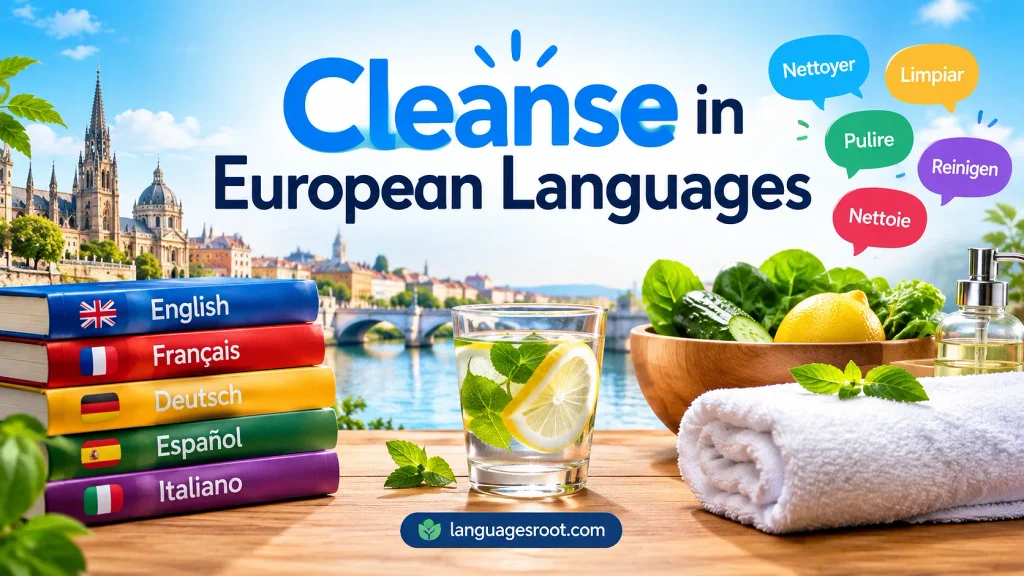
European languages come from several major language families, including Romance, Germanic, Slavic, and Celtic languages. Because of this variety, the idea of cleansing can be expressed through words connected with cleaning, washing, purification, or removing impurities. The translations below use common forms that can work naturally in everyday or general contexts.
| Language | Country/Region | Translation | Pronunciation | Synonyms | Example sentence |
| 🇬🇧 English | United Kingdom, International | Cleanse | klenz | clean, purify, wash | Cleanse your face gently every evening. |
| 🇺🇸 American English | United States | Cleanse | klenz | clean, purify, wash | Cleanse the skin before applying the cream. |
| 🇦🇺 Australian English | Australia | Cleanse | klenz | clean, wash, purify | Cleanse the area before using the product. |
| 🇪🇸 Spanish | Spain, Latin America | Limpiar | lee-MPYAR | clean, purify, wash | Debes limpiar la piel con cuidado. |
| 🇫🇷 French | France, Francophone regions | Nettoyer | neh-twah-YAY | clean, wash, purify | Il faut nettoyer la peau doucement. |
| 🇮🇹 Italian | Italy | Detergere | deh-TEHR-jeh-reh | clean, wash, purify | È importante detergere bene la pelle. |
| 🇵🇹 Portuguese | Portugal, Brazil | Limpar | leem-PAR | clean, wash, purify | É importante limpar a pele. |
| 🇩🇪 German | Germany, Austria | Reinigen | RY-nih-gen | clean, purify, wash | Reinige die Haut vorsichtig. |
| 🇳🇱 Dutch | Netherlands, Belgium | Reinigen | RY-nih-gen | clean, wash, purify | Reinig je gezicht voorzichtig. |
| 🇩🇰 Danish | Denmark | Rense | REN-seh | clean, purify, wash | Du bør rense huden forsigtigt. |
| 🇳🇴 Norwegian | Norway | Rense | REN-seh | clean, wash, purify | Du bør rense huden forsiktig. |
| 🇸🇪 Swedish | Sweden | Rengöra | RENG-yur-ah | clean, purify, wash | Rengör huden försiktigt. |
| 🇫🇮 Finnish | Finland | Puhdistaa | POOH-dis-tah | clean, purify, clear | Puhdista iho varovasti. |
| 🇮🇸 Icelandic | Iceland | Hreinsa | HREYN-sah | clean, purify, wash | Hreinsaðu húðina varlega. |
| 🇮🇪 Irish | Ireland | Glan | glan | clean, purify, wash | Glan an craiceann go réidh. |
| 🇵🇱 Polish | Poland | Oczyszczać | oh-CHISH-chach | clean, purify | Należy delikatnie oczyszczać skórę. |
| 🇨🇿 Czech | Czech Republic | Čistit | CHIS-tit | clean, wash, purify | Je důležité čistit pokožku. |
| 🇸🇰 Slovak | Slovakia | Čistiť | CHIS-teet | clean, wash, purify | Je dôležité čistiť pokožku. |
| 🇺🇦 Ukrainian | Ukraine | Очищати | oh-chy-SHCHA-ty | clean, purify | Потрібно очищати шкіру обережно. |
| 🇷🇺 Russian | Russia | Очищать | ah-chee-SHCHAT | clean, purify | Нужно очищать кожу осторожно. |
| 🇧🇬 Bulgarian | Bulgaria | Почиствам | poh-CHIST-vam | clean, purify | Трябва да почиствате кожата внимателно. |
| 🇷🇸 Serbian | Serbia | Čistiti | CHIS-tee-tee | clean, wash, purify | Treba pažljivo čistiti kožu. |
| 🇭🇷 Croatian | Croatia | Čistiti | CHIS-tee-tee | clean, wash, purify | Treba nježno čistiti kožu. |
| 🇸🇮 Slovenian | Slovenia | Očistiti | oh-CHIS-tee-tee | clean, purify | Pomembno je očistiti kožo. |
| 🇬🇷 Greek | Greece, Cyprus | Καθαρίζω | ka-tha-REE-zo | clean, purify | Πρέπει να καθαρίζεις απαλά το δέρμα. |
| 🇷🇴 Romanian | Romania, Moldova | A curăța | ah koo-ruh-TSA | clean, wash, purify | Trebuie să cureți pielea cu grijă. |
| 🇭🇺 Hungarian | Hungary | Tisztítani | TISH-tee-taa-nee | clean, purify | Óvatosan kell tisztítani a bőrt. |
| 🇱🇹 Lithuanian | Lithuania | Valyti | VAH-lee-tee | clean, wipe, purify | Reikia švelniai valyti odą. |
| 🇱🇻 Latvian | Latvia | Tīrīt | TEE-reet | clean, purify | Ir svarīgi maigi tīrīt ādu. |
| 🇪🇪 Estonian | Estonia | Puhastama | POO-has-ta-ma | clean, purify | Nahka tuleb õrnalt puhastada. |
In European languages, the most natural translation often depends on what is being cleansed. For example, nettoyer, limpiar, reinigen, and similar words commonly mean “clean.” More specialized contexts may call for a word closer to “purify.” Therefore, a literal dictionary translation is not always the best choice for everyday conversation.
Asian Languages
Asia contains thousands of languages and many different cultural traditions surrounding cleanliness and purification. In several Asian languages, the same basic verb can describe cleaning an object, washing something, or removing impurities. Other languages distinguish these actions more clearly. The examples below use commonly understandable forms for the general idea of cleansing.
| Language | Country/Region | Translation | Pronunciation | Synonyms | Example sentence |
| 🇨🇳 Mandarin Chinese | China, Taiwan | 清洁 | qīngjié | clean, purify | 请清洁皮肤。 |
| 🇯🇵 Japanese | Japan | 清める | kiyomeru | purify, cleanse | 肌を清めます。 |
| 🇰🇷 Korean | South Korea | 정화하다 | jeonghwahada | purify, cleanse | 피부를 깨끗하게 정화합니다. |
| 🇮🇳 Hindi | India | साफ़ करना | saaf karna | clean, purify | त्वचा को साफ़ करें। |
| 🇵🇰 Urdu | Pakistan, India | صاف کرنا | saaf karna | clean, purify | جلد کو صاف کریں۔ |
| 🇧🇩 Bengali | Bangladesh, India | পরিষ্কার করা | porishkar kora | clean, purify | ত্বক পরিষ্কার করুন। |
| 🇮🇳 Punjabi | India, Pakistan | ਸਾਫ਼ ਕਰਨਾ | saaf karna | clean, purify | ਚਮੜੀ ਨੂੰ ਸਾਫ਼ ਕਰੋ। |
| 🇮🇳 Gujarati | India | સાફ કરવું | saaf karvu | clean, purify | ત્વચાને સાફ કરો. |
| 🇮🇳 Marathi | India | स्वच्छ करणे | swachchha karne | clean, purify | त्वचा स्वच्छ करा. |
| 🇳🇵 Nepali | Nepal | सफा गर्नु | safa garnu | clean, purify | छाला सफा गर्नुहोस्। |
| 🇱🇰 Sinhala | Sri Lanka | පිරිසිදු කරනවා | pirisidu karanava | clean, purify | සම පිරිසිදු කරන්න. |
| 🇮🇩 Indonesian | Indonesia | Membersihkan | mem-BER-sih-kan | clean, purify | Bersihkan kulit dengan lembut. |
| 🇲🇾 Malay | Malaysia, Brunei | Membersihkan | mem-BER-sih-kan | clean, wash | Bersihkan kulit dengan lembut. |
| 🇵🇭 Filipino | Philippines | Linisin | lee-NEE-sin | clean, wash | Linisin ang balat nang maingat. |
| 🇹🇭 Thai | Thailand | ทำความสะอาด | tham khwaam sa-at | clean, purify | ทำความสะอาดผิวอย่างอ่อนโยน |
| 🇻🇳 Vietnamese | Vietnam | Làm sạch | lam sahk | clean, purify | Hãy làm sạch da nhẹ nhàng. |
| 🇲🇲 Burmese | Myanmar | သန့်စင်သည် | than-sin-deh | clean, purify | အရေပြားကို သန့်စင်ပါ။ |
| 🇰🇭 Khmer | Cambodia | សម្អាត | sam-at | clean, purify | សូមសម្អាតស្បែក។ |
| 🇱🇦 Lao | Laos | ເຮັດໃຫ້ສະອາດ | het hai sa-at | clean, purify | ກະລຸນາເຮັດຄວາມສະອາດຜິວ. |
| 🇲🇳 Mongolian | Mongolia | Цэвэрлэх | tseverlekh | clean, purify | Арьсыг зөөлөн цэвэрлэ. |
| 🇮🇱 Hebrew | Israel | לטהר | letaḥer | purify, cleanse | לטהר את העור בעדינות. |
| 🇦🇲 Armenian | Armenia | Մաքրել | makrel | clean, purify | Մաքրեք մաշկը նրբորեն։ |
| 🇬🇪 Georgian | Georgia | გაწმენდა | gatsmenda | clean, purify | კანი ნაზად გაწმინდეთ. |
| 🇦🇿 Azerbaijani | Azerbaijan | Təmizləmək | teh-miz-leh-mek | clean, purify | Dərini yumşaq şəkildə təmizləyin. |
| 🇰🇿 Kazakh | Kazakhstan | Тазалау | ta-za-lau | clean, purify | Теріні абайлап тазалаңыз. |
| 🇺🇿 Uzbek | Uzbekistan | Tozalamoq | to-za-la-moq | clean, purify | Terini ehtiyotkorlik bilan tozalang. |
Asian languages demonstrate why context is important when translating cleanse. For example, an expression used for ordinary cleaning may be preferred when discussing a surface, while a word meaning “purify” may sound more appropriate in a spiritual or symbolic context.
See Also: How to Say “Cloak” in Different Languages
African Languages
Africa is home to an extraordinary number of languages, including major languages such as Swahili, Amharic, Hausa, Yoruba, Zulu, and Afrikaans. Concepts related to cleanliness are commonly expressed through verbs meaning clean, wash, purify, or make something clean. These words can be adapted to different situations depending on the language and sentence structure.
| Language | Country/Region | Translation | Pronunciation | Synonyms | Example sentence |
| 🇰🇪 Swahili | Kenya, Tanzania, East Africa | Kusafisha | koo-sa-FEE-sha | clean, purify, wash | Safisha ngozi kwa upole. |
| 🇪🇹 Amharic | Ethiopia | ማጽዳት | ma-tsdaat | clean, purify | ቆዳውን በጥንቃቄ ያጽዱ። |
| 🇳🇬 Hausa | Nigeria, Niger | Tsarkake | tsar-ka-keh | purify, clean | A tsarkake fata a hankali. |
| 🇳🇬 Yoruba | Nigeria | Fọ | faw | wash, clean | Fọ awọ ara daradara. |
| 🇿🇦 Zulu | South Africa | Hlanza | HLAN-za | clean, wash | Hlanza isikhumba ngobumnene. |
| 🇿🇦 Xhosa | South Africa | Coca | TSOH-tsa | clean, purify | Coca ulusu ngobunono. |
| 🇿🇦 Afrikaans | South Africa, Namibia | Skoonmaak | skohn-mahk | clean, purify | Maak die vel sagkens skoon. |
| 🇳🇬 Igbo | Nigeria | Sachaa | sa-cha | clean, wash | Sachaa akpụkpọ ahụ nke ọma. |
| 🇲🇬 Malagasy | Madagascar | Manadio | ma-na-dee-oo | clean, purify | Manadio ny hoditra moramora. |
| 🇸🇴 Somali | Somalia, Horn of Africa | Nadiifin | na-DEEF-in | clean, purify | Nadiifi maqaarka si tartiib ah. |
| 🇷🇼 Kinyarwanda | Rwanda | Gusukura | goo-soo-koo-ra | clean, purify | Sukura uruhu witonze. |
| 🇧🇼 Tswana | Botswana, South Africa | Go phepafatsa | go fe-pa-fat-sa | clean, purify | Phepafatsa letlalo ka bonolo. |
African languages show another important translation principle: a direct equivalent may sometimes be grammatically different from the English infinitive “to cleanse.” The natural form depends on how verbs are used in a particular sentence. For practical communication, it is usually better to learn the word together with an example rather than memorize a single isolated translation.
Middle Eastern Languages
The Middle East includes languages from several distinct linguistic families. Arabic is spoken across many countries and has regional varieties, while Persian, Turkish, Hebrew, and Kurdish represent different linguistic traditions. Words connected with cleansing may describe ordinary cleaning, purification, or spiritual cleansing, so context remains especially important.
| Language | Country/Region | Translation | Pronunciation | Synonyms | Example sentence |
| 🇸🇦 Arabic | Middle East, North Africa | يُنظّف | yunad-dhif | clean, purify, wash | نظّف البشرة بلطف. |
| 🇮🇷 Persian | Iran | پاک کردن | paak kardan | clean, purify | پوست را به آرامی پاک کنید. |
| 🇹🇷 Turkish | Turkey | Temizlemek | teh-MEEZ-leh-mek | clean, purify | Cildi nazikçe temizleyin. |
| 🇮🇱 Hebrew | Israel | לנקות | lenakot | clean, purify | נקה את העור בעדינות. |
| 🇮🇶 Kurdish | Iraq, Turkey, Syria | Paqij kirin | pa-qij-ki-rin | clean, purify | Pêdivî ye ku çerm paqij bikî. |
| 🇦🇫 Pashto | Afghanistan | پاکول | paakawul | clean, purify | پوست پاک کړئ. |
| 🇦🇲 Armenian | Armenia | Մաքրել | makrel | clean, purify | Մաքրեք մակերեսը։ |
| 🇬🇪 Georgian | Georgia | გაწმენდა | gatsmenda | clean, purify | ზედაპირი ფრთხილად გაწმინდეთ. |
Arabic deserves special attention because the form of a word can change according to grammar and sentence structure. In everyday speech, regional Arabic varieties may also use different expressions. Likewise, Persian commonly uses expressions connected with making something clean or removing something from a surface.
Additional Languages Around the World
Languages outside the major regional groups also provide interesting ways to express the idea of cleansing. Some use a broad word for cleaning, while others have specific vocabulary for purification. The examples below expand the list and show how widely the concept can be expressed around the world.
| Language | Country/Region | Translation | Pronunciation | Synonyms | Example sentence |
| 🇧🇷 Portuguese | Brazil | Limpar | leem-PAR | clean, wash, purify | Limpe a pele com cuidado. |
| 🇲🇽 Spanish | Mexico | Limpiar | lee-MPYAR | clean, purify | Limpia la piel con cuidado. |
| 🇨🇦 French | Canada | Nettoyer | neh-twah-YAY | clean, wash | Nettoyez la surface doucement. |
| 🇱🇺 Luxembourgish | Luxembourg | Botzen | BOT-sen | clean, wash | Botz d’Uewerfläch virsiichteg. |
| 🇲🇹 Maltese | Malta | Naddaf | nad-DAF | clean, purify | Naddaf il-ġilda bil-mod. |
| 🇦🇱 Albanian | Albania, Kosovo | Pastroj | pas-TROY | clean, purify | Pastroje lëkurën butësisht. |
| 🇧🇦 Bosnian | Bosnia and Herzegovina | Očistiti | oh-CHIS-tee-tee | clean, purify | Očisti kožu nježno. |
| 🇲🇰 Macedonian | North Macedonia | Исчисти | is-CHIS-tee | clean, purify | Исчистете ја кожата нежно. |
| 🇲🇪 Montenegrin | Montenegro | Očistiti | oh-CHIS-tee-tee | clean, purify | Očisti kožu pažljivo. |
| 🇧🇾 Belarusian | Belarus | Ачышчаць | a-chy-SHCHAT | clean, purify | Ачышчайце скуру асцярожна. |
| 🇦🇲 Western Armenian | Armenian communities | Մաքրել | makrel | clean, purify | Մաքրեք մակերեսը։ |
| 🇻🇦 Latin | Historical, academic, religious use | Purificare | poo-ree-fee-KAH-reh | purify, cleanse | Aquam purificare necesse est. |
| 🇪🇸 Catalan | Spain, Catalonia | Netejar | neh-teh-ZHAR | clean, wash | Cal netejar la pell suaument. |
| 🇪🇺 Basque | Basque Country | Garbitu | gar-bee-too | clean, purify | Azala astiro garbitu. |
| 🇪🇸 Galician | Galicia, Spain | Limpar | leem-PAR | clean, wash | Limpa a pel con coidado. |
| 🇪🇪 Estonian | Estonia | Puhastama | POO-has-ta-ma | clean, purify | Puhasta pind hoolikalt. |
| 🇳🇿 Māori | New Zealand | Horoi | ho-roi | wash, clean | Horoi te kiri. |
| 🇼🇸 Samoan | Samoa | Fa’amama | fa-a-ma-ma | clean, purify | Fa’amama le pa’u. |
| 🇹🇴 Tongan | Tonga | Fakama’a | fa-ka-ma-a | clean, purify | Fakama’a ‘a e kili. |
| 🇭🇹 Haitian Creole | Haiti | Netwaye | net-wa-yeh | clean, wash | Netwaye po a dousman. |
| 🇯🇲 Jamaican Creole | Jamaica | Clean | kleen | wash, clean | Clean di area carefully. |
Cleanse, Clean, Wash, and Purify: What Is the Difference?
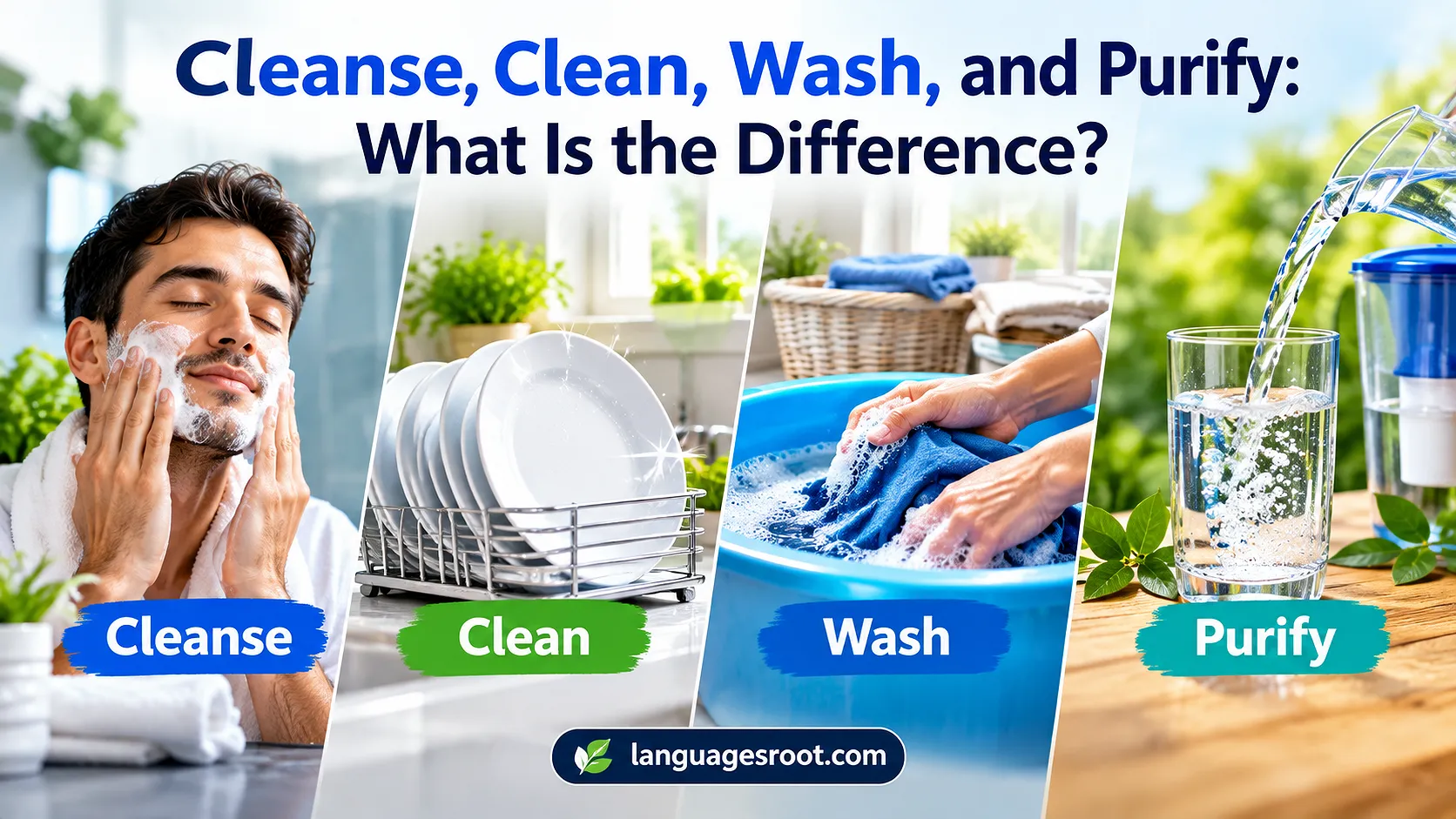
Although these words can overlap, they do not always have exactly the same meaning. Clean is the broadest everyday term. You can clean a room, clean a table, clean clothes, or clean your hands.
Wash normally suggests using water or another liquid. You might wash your hands, wash your face, or wash clothing. In contrast, cleanse often sounds more deliberate or thorough. It is frequently used for skin, beauty routines, health-related descriptions, or removing impurities.
Purify has a stronger meaning of removing impurities or making something pure. It can be used for water, air, substances, or figurative and spiritual ideas. Therefore, when translating “cleanse,” it is important to consider what is being cleansed and why.
How to Use “Cleanse” in English Sentences
The word cleanse can be used in several everyday and formal situations.
For skincare, you might say:
“Cleanse your face before applying moisturizer.”
For an object or surface, you could say:
“Cleanse the surface before preparing the food.”
For a figurative meaning, someone might say:
“Some people use meditation as a way to cleanse their minds.”
For water or another substance, you could say:
“The process helps cleanse the water.”
These examples show why translation should focus on meaning rather than replacing one English word with one foreign word in every situation.
Common Synonyms for Cleanse
Several English words are closely related to cleanse. However, each one carries a slightly different meaning.
Clean means to remove dirt or unwanted material.
Wash usually means to clean with water or another liquid.
Purify means to remove impurities and make something cleaner or purer.
Rinse means to wash something quickly, usually with water.
Sanitize means to reduce harmful microorganisms to a safer level.
Disinfect means to destroy or deactivate many harmful microorganisms.
Refresh can mean to make something feel clean, fresh, or renewed.
Clear can mean removing unwanted material, objects, or substances.
Choosing the right synonym makes communication more precise, especially when translating into another language.
Why Learn How to Say “Cleanse” in Different Languages?
Learning words in different languages is more than memorizing vocabulary. It helps people understand how different cultures organize ideas and describe everyday experiences. A simple word such as “cleanse” can reveal differences between concepts such as washing, cleaning, purification, renewal, and hygiene.
Multilingual vocabulary can also be helpful for travelers, students, translators, healthcare workers, beauty professionals, writers, and people communicating with international audiences. Knowing a relevant word can make a conversation easier and help avoid confusion.
It is also useful to remember that language varies by country and region. A word that sounds natural in one country may be less common in another place where the same language is spoken. For this reason, learning an example sentence can be more useful than learning a dictionary definition alone.
Frequently Asked Questions
What does “cleanse” mean in different languages?
“Cleanse” usually means to clean thoroughly, remove unwanted substances, or purify something. However, the closest translation depends on the context, such as washing, physical cleaning, or purification.
How do you say “cleanse” in Spanish?
A common Spanish translation is limpiar, meaning “to clean.” However, the best translation can change when the meaning focuses on purifying or removing impurities.
How do you say “cleanse” in French?
In French, nettoyer commonly expresses the idea of “cleanse” or “clean.” The suitable word can vary between cleaning, washing, and purification.
What is the difference between “cleanse,” “clean,” and “purify”?
Clean is a broad everyday term, while cleanse often suggests thorough or deliberate cleaning. Purify focuses more on removing impurities and making something purer.
Can one translation of “cleanse” work in every situation?
Not always, because context affects the most natural choice. A word for washing skin may differ from one used for purifying water, objects, or describing spiritual cleansing.
Conclusion
Learning how to say cleanse in different languages shows how cleaning, washing, and purification can vary by context and culture. By comparing each translation, pronunciation, and example, you can choose the closest translation for skincare, objects, water, or spiritual cleansing. Most importantly, understanding context helps you communicate the intended meaning naturally and clearly.