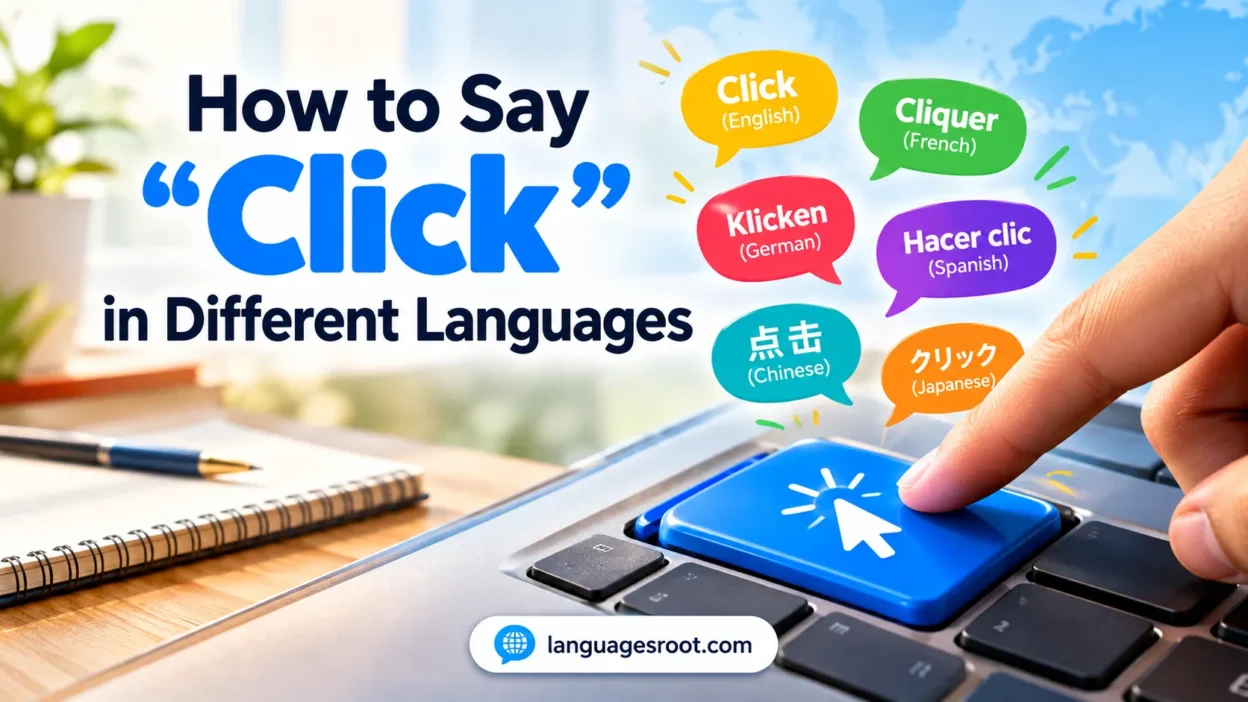
In modern digital life, click appears across websites, computers, and phones. It can describe pressing a button, selecting links, or opening menus online. However, the best translation meaning depends on the context and intended computer action. So, learning its native wording helps improve language learning and digital communication.
For example, Spanish uses hacer clic, while Chinese uses 点击 for this action. French uses cliquer, German uses klicken, and Japanese uses クリックする. These terms show how computer terminology across languages can vary with local usage. This guide explores language translation, contextual meaning, and multilingual communication clearly.
Interesting Facts About Click
- “Click” has more than one meaning. It can describe a computer action, a short sound, or a moment when something suddenly makes sense.
- The computer meaning of “click” is closely connected with the invention and widespread use of the computer mouse.
- Many languages have adopted a form of the English word “click,” especially in technology and internet vocabulary.
- Some languages translate the computer action using words that more literally mean press, tap, or select.
- In Spanish, hacer clic is a common computer expression, while chasquear can describe making a short sound.
- In Chinese, 点击 is widely used for the digital action of clicking.
- Japanese commonly uses the borrowed expression クリックする for the computer action.
- Korean uses 클릭하다, another technology-related borrowing from English.
- French uses cliquer, which is now a familiar technology verb.
- German uses klicken for clicking on something digitally.
- Italian uses cliccare, especially for computer and internet actions.
- In Portuguese, clicar is commonly used for the computer action.
- The noun can also change from language to language. For example, English “click,” Spanish clic, French clic, and German Klick can describe the sound or action.
- “Double-click” is also widely understood internationally, although each language has its own grammatical form.
- “Click here” is often translated as an instruction rather than as a single isolated word.
- Context is especially important when translating short technology words because a literal translation may not sound natural to native speakers.
How to Say “Click” in Different Languages
The tables below focus primarily on the computer or website meaning of “click.” Pronunciations are simplified guides for English readers and may vary by regional accent. Synonyms are included as useful contextual alternatives rather than claiming that every word is a perfect one-to-one synonym.
European Languages

European languages show a fascinating mix of native vocabulary and technology terms borrowed from English. Several languages use forms that sound very similar to “click,” while others use expressions based on pressing or selecting something. The examples below are written in natural, everyday contexts so you can see how the word may actually appear in a sentence.
| Language | Country/Region | Translation | Pronunciation | Synonyms | Example sentence |
| 🇬🇧 English | UK | click | klik | press, select | Click the button. |
| 🇺🇸 American English | USA | click | klik | press, select | Click the link. |
| 🇦🇺 Australian English | Australia | click | klik | press, select | Click the menu. |
| 🇪🇸 Spanish | Spain, Latin America | hacer clic | ah-SEHR kleek | pulsar, seleccionar | Haz clic en el botón. |
| 🇫🇷 French | France | cliquer | klee-KAY | appuyer, sélectionner | Cliquez sur le bouton. |
| 🇩🇪 German | Germany | klicken | KLIK-en | drücken, auswählen | Klicken Sie auf die Schaltfläche. |
| 🇮🇹 Italian | Italy | cliccare | klee-KAH-reh | premere, selezionare | Clicca sul pulsante. |
| 🇵🇹 Portuguese | Portugal, Brazil | clicar | klee-KAR | pressionar, selecionar | Clique no botão. |
| 🇳🇱 Dutch | Netherlands | klikken | KLIK-en | drukken, selecteren | Klik op de knop. |
| 🇩🇰 Danish | Denmark | klikke | KLEE-keh | trykke, vælge | Klik på knappen. |
| 🇸🇪 Swedish | Sweden | klicka | KLIK-ka | trycka, välja | Klicka på knappen. |
| 🇳🇴 Norwegian | Norway | klikke | KLIK-keh | trykke, velge | Klikk på knappen. |
| 🇫🇮 Finnish | Finland | klikata | KLEE-ka-ta | painaa, valita | Napsauta painiketta. |
| 🇮🇸 Icelandic | Iceland | smella | SMEH-tla | ýta, velja | Smelltu á hnappinn. |
| 🇮🇪 Irish | Ireland | cliceáil | KLI-kayl | brúigh, roghnaigh | Cliceáil ar an gcnaipe. |
| 🏴 Welsh | Wales | clicio | KLI-kee-oh | pwyso, dewis | Cliciwch ar y botwm. |
| 🇵🇱 Polish | Poland | kliknąć | KLIK-nonch | nacisnąć, wybrać | Kliknij przycisk. |
| 🇨🇿 Czech | Czechia | kliknout | KLIK-nowt | stisknout, vybrat | Klikněte na tlačítko. |
| 🇸🇰 Slovak | Slovakia | kliknúť | KLIK-noot | stlačiť, vybrať | Kliknite na tlačidlo. |
| 🇭🇺 Hungarian | Hungary | kattintani | KAT-tin-ta-nee | megnyomni, választani | Kattintson a gombra. |
| 🇷🇴 Romanian | Romania | a face clic | ah FA-cheh klik | apăsa, selecta | Faceți clic pe buton. |
| 🇧🇬 Bulgarian | Bulgaria | щраквам | shtrak-vam | натискам, избирам | Щракнете върху бутона. |
| 🇭🇷 Croatian | Croatia | kliknuti | KLIK-noo-tee | pritisnuti, odabrati | Kliknite na gumb. |
| 🇷🇸 Serbian | Serbia | кликнути | KLIK-noo-tee | притиснути, изабрати | Кликните на дугме. |
| 🇸🇮 Slovenian | Slovenia | klikniti | KLIK-nee-tee | pritisniti, izbrati | Kliknite gumb. |
| 🇺🇦 Ukrainian | Ukraine | натиснути | na-TYS-noo-tee | клацнути, вибрати | Натисніть кнопку. |
| 🇷🇺 Russian | Russia | кликнуть | KLIK-noot | нажать, выбрать | Нажмите кнопку. |
| 🇱🇹 Lithuanian | Lithuania | spustelėti | spoos-teh-LAY-tee | paspausti, pasirinkti | Spustelėkite mygtuką. |
| 🇱🇻 Latvian | Latvia | noklikšķināt | nok-lik-SKHEE-nat | nospiest, izvēlēties | Noklikšķiniet uz pogas. |
| 🇪🇪 Estonian | Estonia | klõpsama | KLURP-sa-ma | vajutama, valima | Klõpsake nuppu. |
| 🇦🇱 Albanian | Albania | klikoj | klee-KOY | shtyp, zgjidh | Klikoni butonin. |
| 🇬🇷 Greek | Greece | κάνω κλικ | KAH-no klik | πατάω, επιλέγω | Κάντε κλικ στο κουμπί. |
| 🇲🇹 Maltese | Malta | ikklikkja | ik-KLIK-ya | agħfas, agħżel | Ikklikkja l-buttuna. |
| 🇨🇾 Turkish | Turkey | tıklamak | TUHK-la-mak | basmak, seçmek | Düğmeye tıklayın. |
| 🇨🇦 Catalan | Catalonia | fer clic | fehr KLIK | prémer, seleccionar | Fes clic al botó. |
| 🇧🇦 Bosnian | Bosnia and Herzegovina | kliknuti | KLIK-noo-tee | pritisnuti, izabrati | Kliknite na dugme. |
| 🇲🇰 Macedonian | North Macedonia | кликнува | KLIK-noo-va | притиска, избира | Кликнете на копчето. |
| 🇧🇾 Belarusian | Belarus | націснуць | na-TSEES-noots | клікнуць, выбраць | Націсніце кнопку. |
Common European translations such as cliquer, klicken, cliccare, klikken, klikke, kliknąć, kliknout, кликнуть, and related forms are also reflected in major bilingual dictionary resources.
Also Read: How to Say “Cleanse” in Different Languages
Asian Languages
Asia contains thousands of languages and many different writing systems. Digital vocabulary is especially interesting here because some languages have created native expressions for computer actions, while others have adopted an international technology word. The translations below include languages from East Asia, South Asia, Southeast Asia, and Central Asia.
| Language | Country/Region | Translation | Pronunciation | Synonyms | Example sentence |
| 🇨🇳 Mandarin Chinese | China, Taiwan | 点击 | diǎn jī | 按一下, 选择 | 点击这个按钮。 |
| 🇯🇵 Japanese | Japan | クリックする | kurikku suru | 押す, 選択する | ボタンをクリックしてください。 |
| 🇰🇷 Korean | South Korea | 클릭하다 | keul-lik-ha-da | 누르다, 선택하다 | 버튼을 클릭하세요. |
| 🇻🇳 Vietnamese | Vietnam | nhấp | nyup | bấm, chọn | Nhấp vào nút. |
| 🇹🇭 Thai | Thailand | คลิก | klik | กด, เลือก | คลิกปุ่มนี้ |
| 🇱🇦 Lao | Laos | ຄລິກ | klik | ກົດ, ເລືອກ | ຄລິກປຸ່ມນີ້ |
| 🇰🇭 Khmer | Cambodia | ចុច | chohch | ចុចប៊ូតុង, ជ្រើស | ចុចប៊ូតុងនេះ។ |
| 🇲🇲 Burmese | Myanmar | နှိပ်ပါ | hneik-pa | ရွေးပါ, ထိပါ | ဒီခလုတ်ကို နှိပ်ပါ။ |
| 🇮🇩 Indonesian | Indonesia | mengeklik | meng-eh-KLIK | menekan, memilih | Klik tombol ini. |
| 🇲🇾 Malay | Malaysia, Brunei | klik | klik | tekan, pilih | Klik butang ini. |
| 🇵🇭 Filipino | Philippines | i-click | ee-KLIK | pindutin, piliin | I-click ang button. |
| 🇮🇳 Hindi | India | क्लिक करना | klik karna | दबाना, चुनना | बटन पर क्लिक करें। |
| 🇵🇰 Urdu | Pakistan | کلک کرنا | klik karna | دبانا, منتخب کرنا | بٹن پر کلک کریں۔ |
| 🇧🇩 Bengali | Bangladesh | ক্লিক করা | klik kora | চাপা, নির্বাচন করা | বোতামে ক্লিক করুন। |
| 🇮🇳 Punjabi | India, Pakistan | ਕਲਿੱਕ ਕਰਨਾ | klik karna | ਦਬਾਉਣਾ, ਚੁਣਨਾ | ਬਟਨ ‘ਤੇ ਕਲਿੱਕ ਕਰੋ। |
| 🇮🇳 Gujarati | India | ક્લિક કરવું | klik karvu | દબાવવું, પસંદ કરવું | બટન પર ક્લિક કરો. |
| 🇮🇳 Marathi | India | क्लिक करणे | klik karne | दाबणे, निवडणे | बटणावर क्लिक करा. |
| 🇮🇳 Tamil | India, Sri Lanka | கிளிக் செய்யவும் | klik seyyavum | அழுத்தவும், தேர்ந்தெடுக்கவும் | பொத்தானைக் கிளிக் செய்யவும். |
| 🇮🇳 Telugu | India | క్లిక్ చేయండి | klik cheyandi | నొక్కండి, ఎంచుకోండి | బటన్ను క్లిక్ చేయండి. |
| 🇮🇳 Kannada | India | ಕ್ಲಿಕ್ ಮಾಡುವುದು | klik maduvudu | ಒತ್ತುವುದು, ಆಯ್ಕೆ | ಬಟನ್ ಕ್ಲಿಕ್ ಮಾಡಿ. |
| 🇮🇳 Malayalam | India | ക്ലിക്ക് ചെയ്യുക | klik cheyyuka | അമർത്തുക, തിരഞ്ഞെടുക്കുക | ബട്ടൺ ക്ലിക്ക് ചെയ്യുക. |
| 🇳🇵 Nepali | Nepal | क्लिक गर्नुहोस् | klik garnuhos | थिच्नुहोस्, छान्नुहोस् | बटनमा क्लिक गर्नुहोस्। |
| 🇱🇰 Sinhala | Sri Lanka | ක්ලික් කරන්න | klik karanna | ඔබන්න, තෝරන්න | බොත්තම ක්ලික් කරන්න. |
| 🇰🇿 Kazakh | Kazakhstan | басу | ba-soo | шерту, таңдау | Түймені басыңыз. |
| 🇺🇿 Uzbek | Uzbekistan | bosmoq | bos-mok | tanlamoq, bosish | Tugmani bosing. |
| 🇲🇳 Mongolian | Mongolia | дарах | da-rakh | сонгох, товших | Товчийг дарна уу. |
| 🇦🇲 Armenian | Armenia | սեղմել | seh-mel | ընտրել, սեղմել | Սեղմեք կոճակը։ |
| 🇬🇪 Georgian | Georgia | დაწკაპუნება | dats-ka-pu-ne-ba | დაჭერა, არჩევა | დააწკაპუნეთ ღილაკზე. |
| 🇦🇿 Azerbaijani | Azerbaijan | klikləmək | klik-leh-mek | basmaq, seçmək | Düyməni klikləyin. |
| 🇮🇷 Persian | Iran | کلیک کردن | kelik kardan | فشار دادن, انتخاب کردن | روی دکمه کلیک کنید. |
| 🇮🇱 Hebrew | Israel | ללחוץ | lil-KHOTS | לבחור, להקיש | לחץ על הכפתור. |
| 🇦🇫 Pashto | Afghanistan | کلیک کول | klik kawal | وهل, ټاکل | په تڼۍ کلیک وکړئ. |
| 🇮🇳 Assamese | India | ক্লিক কৰা | klik kora | টিপা, বাছনি কৰা | বুটামটোত ক্লিক কৰক। |
| 🇮🇳 Odia | India | କ୍ଲିକ୍ କରିବା | klik kariba | ଦବାଇବା, ବାଛିବା | ବଟନ୍ରେ କ୍ଲିକ୍ କରନ୍ତୁ। |
Cambridge’s multilingual dictionary resources list “click” translations across many Asian languages, including Chinese, Hindi, Japanese, Korean, Marathi, Tamil, Gujarati, Malay, Indonesian, Thai, Vietnamese, Bengali, Telugu, and Urdu.
African Languages

African languages offer another useful look at how modern technology vocabulary develops. Some languages use words related to pressing or touching, while others commonly adapt international technology terminology. In everyday digital instructions, the most natural expression can depend on the country, language variety, and type of device being discussed.
| Language | Country/Region | Translation | Pronunciation | Synonyms | Example sentence |
| 🇿🇦 Afrikaans | South Africa | klik | klik | druk, kies | Klik op die knoppie. |
| 🇪🇹 Amharic | Ethiopia | ጠቅ ማድረግ | teq ma-dreg | መጫን, መምረጥ | አዝራሩን ጠቅ ያድርጉ። |
| 🇰🇪 Swahili | East Africa | kubofya | koo-BOF-ya | kushinikiza, kuchagua | Bofya kitufe hiki. |
| 🇳🇬 Hausa | Nigeria, Niger | danna | DAN-na | zaɓa, matsa | Danna maɓallin. |
| 🇳🇬 Yoruba | Nigeria | tẹ | teh | yan, tẹ bọtini | Tẹ bọtini naa. |
| 🇳🇬 Igbo | Nigeria | pịa | pee-ah | họrọ, pịa bọtịnụ | Pịa bọtịnụ ahụ. |
| 🇿🇦 Zulu | South Africa | chofoza | cho-FO-za | cindezela, khetha | Chofoza inkinobho. |
| 🇿🇦 Xhosa | South Africa | cofa | KOH-fa | cinezela, khetha | Cofa iqhosha. |
| 🇸🇴 Somali | Somalia | guji | goo-jee | taabo, dooro | Guji badhanka. |
| 🇲🇬 Malagasy | Madagascar | tsindrio | tsin-DREE-oh | fidio, safidio | Tsindrio ilay bokotra. |
| 🇿🇼 Shona | Zimbabwe | tinya | TIN-ya | dzvanya, sarudza | Tinya bhatani. |
| 🇿🇦 Sesotho | Lesotho, South Africa | tobetsa | toh-BET-sa | khetha, hatella | Tobetsa konopo. |
| 🇿🇦 Setswana | Botswana, South Africa | tobetsa | toh-BET-sa | tlhopha, gatelela | Tobetsa konopo. |
| 🇲🇿 Portuguese | Mozambique, Angola | clicar | klee-KAR | premir, selecionar | Clique no botão. |
| 🇨🇩 Lingala | Central Africa | kofina | koh-FEE-na | kopona, kopisa | Kofina bouton yango. |
When using African languages in software, websites, or educational materials, it is helpful to consider the intended country and audience. A word that is familiar in one region may not be the preferred digital expression in another. For professional localization, native-language review is therefore valuable.
Middle Eastern Languages
The Middle East includes several major language families and writing traditions. Arabic is spoken across many countries, while Persian, Hebrew, Turkish, and Kurdish are also important regional languages. Computer instructions often use verbs meaning “click,” “press,” or “select,” so the exact wording may depend on the user interface.
| Language | Country/Region | Translation | Pronunciation | Synonyms | Example sentence |
| 🇸🇦 Arabic | Arab countries | انقر | in-qur | اضغط, اختر | انقر على الزر. |
| 🇮🇷 Persian | Iran | کلیک کردن | kelik kardan | فشار دادن, انتخاب کردن | روی دکمه کلیک کنید. |
| 🇮🇱 Hebrew | Israel | ללחוץ | lil-KHOTS | לבחור, להקיש | לחץ על הכפתור. |
| 🇹🇷 Turkish | Turkey | tıklamak | TUHK-la-mak | basmak, seçmek | Düğmeye tıklayın. |
| 🇮🇶 Kurdish | Iraq, Syria, Turkey | کلیک کردن | klik kirin | pêl kirin, hilbijartin | Li bişkojkê bitikînin. |
| 🇦🇲 Armenian | Armenia | սեղմել | seh-MEL | ընտրել, սեղմել | Սեղմեք կոճակը։ |
| 🇬🇪 Georgian | Georgia | დაწკაპუნება | dats-ka-pu-NE-ba | დაჭერა, არჩევა | დააწკაპუნეთ ღილაკზე. |
| 🇦🇿 Azerbaijani | Azerbaijan | klikləmək | klik-leh-MEK | basmaq, seçmək | Düyməni klikləyin. |
| 🇦🇫 Pashto | Afghanistan | کلیک کول | klik kawal | وهل, ټاکل | په تڼۍ کلیک وکړئ. |
| 🇮🇱 Arabic Levantine | Levant | اكبس | ik-bas | اضغط, اختار | اكبس على الزر. |
Arabic dictionaries distinguish the computer meaning of “click” from the noun or sound meaning, showing why context matters when translating this short word.
Additional Languages Around the World
The word “click” appears in digital communication almost everywhere, but local expressions can differ considerably. These additional examples include languages from Oceania, the Americas, Africa, Europe, and international language communities. They can be especially useful when creating multilingual websites, educational resources, travel guides, or language-learning materials.
| Language | Country/Region | Translation | Pronunciation | Synonyms | Example sentence |
| 🇳🇿 Māori | New Zealand | pāwhiri | pah-fee-ree | pēhi, tohu | Pāwhiritia te pātene. |
| 🇼🇸 Samoan | Samoa | kiliki | kee-lee-kee | oomi, filifili | Kiliki le faamau. |
| 🇭🇹 Haitian Creole | Haiti | klike | klee-keh | peze, chwazi | Klike sou bouton an. |
| 🇱🇺 Luxembourgish | Luxembourg | klicken | KLIK-en | drécken, auswielen | Klickt op de Knäppchen. |
| 🇪🇸 Basque | Basque Country | klik egin | klik EH-gin | sakatu, hautatu | Egin klik botoian. |
| 🇬🇱 Greenlandic | Greenland | toorsarlugu | toor-sa-LAR-loo | naqillugu, toqqarlugu | Toorsarlugu taanna. |
| 🇪🇺 Esperanto | International | klaki | KLA-kee | premi, elekti | Klaku la butonon. |
| 🇻🇦 Latin | Classical/Church contexts | premere | PREH-meh-reh | eligere, urgere | Preme puga. |
| 🇫🇷 Haitian French | Haiti | cliquer | klee-KAY | appuyer, sélectionner | Cliquez sur le bouton. |
| 🇨🇻 Cape Verdean Creole | Cape Verde | klika | KLEE-ka | puxa, skodje | Klika na boton. |
| 🇸🇷 Sranan Tongo | Suriname | klik | klik | druk, kies | Klik a knop. |
| 🇨🇺 Spanish Caribbean | Caribbean | hacer clic | ah-SEHR kleek | pulsar, seleccionar | Haz clic aquí. |
| 🇧🇷 Brazilian Portuguese | Brazil | clicar | klee-KAR | apertar, selecionar | Clique aqui. |
| 🇨🇱 Chilean Spanish | Chile | hacer clic | ah-SEHR kleek | pinchar, pulsar | Haz clic en el enlace. |
| 🇲🇽 Mexican Spanish | Mexico | hacer clic | ah-SEHR kleek | picar, seleccionar | Haz clic en el botón. |
How to Say “Click” in American, British, and Australian English
English itself has several major varieties. The spelling and pronunciation of click remain essentially the same across American, British, and Australian English, but the surrounding vocabulary and technology instructions can vary slightly.
American English
In American English, click is the standard word for selecting something with a computer mouse or similar pointing device.
Example: Click the blue button to continue.
Useful alternatives include press, select, tap, and double-click, depending on the device and action.
British English
British English also commonly uses click for computer actions. A British speaker may say “click on the link” or simply “click the link.”
Example: Click on the link to open the page.
British English also uses “click” as a noun for a short sharp sound. Major dictionaries list the same basic pronunciation, /klɪk/, for British and American English.
Australian English
Australian English generally uses click in the same technology context.
Example: Click the menu to see more options.
As with American and British English, tap is more appropriate for many touchscreen actions, while click usually suggests a mouse, trackpad, or clickable interface element.
Click as a Computer Action

The most common modern meaning of “click” is a computer action. You click a button, link, icon, menu item, checkbox, image, or other interactive element.
For example:
Click the button to submit the form.
In this sentence, “click” does not describe a sound. It tells the reader to perform an action with a mouse, trackpad, or similar device.
Many languages translate this meaning with a word that literally means “press.” Others use a direct loanword based on English “click.” Cambridge’s multilingual dictionary entries show this distinction across languages such as Spanish, Chinese, Japanese, Portuguese, and others.
Click as a Sound
“Click” can also describe a short, sharp sound.
For example:
I heard a click when the door locked.
This meaning is different from the computer action. A camera can click, a lock can click, a switch can click, or a mechanical device can produce a click.
Some languages use completely different words for this sound. For example, dictionary sources list forms such as chasquido in Spanish, Klicken in German, щелчок in Russian, and other sound-related expressions.
This is one reason it is better to translate “click” according to the sentence rather than translating the isolated English word automatically.
Click in Online Instructions
Websites frequently use phrases such as:
- Click here
- Click the button
- Click the link
- Click the image
- Click the menu
- Click to continue
- Click to download
- Click to open
- Click twice
- Right-click
- Double-click
When translating these phrases, the entire instruction should be considered. A direct translation of the single word may not produce the most natural instruction in the target language.
For example, Spanish commonly uses hacer clic, while Chinese commonly uses 点击. Japanese uses クリックする, and German uses klicken. These forms are especially common in digital contexts.
Click vs. Tap
One common mistake is assuming that “click” and “tap” always mean exactly the same thing.
A click usually suggests a mouse, trackpad, or clickable computer interface. A tap usually suggests touching a touchscreen with a finger.
For example:
Click the button with your mouse.
Tap the button on your phone.
Modern websites and applications may use both words depending on the device. Therefore, translators working on user interfaces should consider whether the text is intended for desktop, tablet, or mobile users.
Click vs. Press
“Press” is another important related word. A person may press a physical button, while they click a digital button.
However, the distinction is not absolute. Some languages use a word equivalent to “press” even when English speakers would normally say “click.” This is a normal part of localization rather than a translation error.
For this reason, good multilingual writing focuses on the meaning and user action, not just a word-for-word replacement.
Frequently Asked Questions About
How do you say “click” in Spanish?
The common computer expression is hacer clic. For example, “Click the button” becomes “Haz clic en el botón.”
How do you say “click” in Chinese?
Mandarin Chinese commonly uses 点击 for the computer action. It works naturally for buttons, links, menus, and other digital actions.
How do you say “click” in Japanese?
Japanese commonly uses クリックする for digital computer actions. This expression comes from the English technology word “click.”
Is “click” the same in every language?
No. Some languages borrow click, while others use words meaning press, tap, or select, depending on the context.
What is the difference between “click” and “tap”?
A click usually refers to a mouse or computer interface, while a tap usually describes touching a phone or tablet screen. The correct term depends on the device and user action.
Conclusion
Learning click in different languages shows how digital communication connects people across cultures. Understanding context, translation meaning, and computer terminology helps you choose natural words for each digital action. Whether you use language translation for websites, apps, or multilingual communication, clear wording makes every interaction easier.