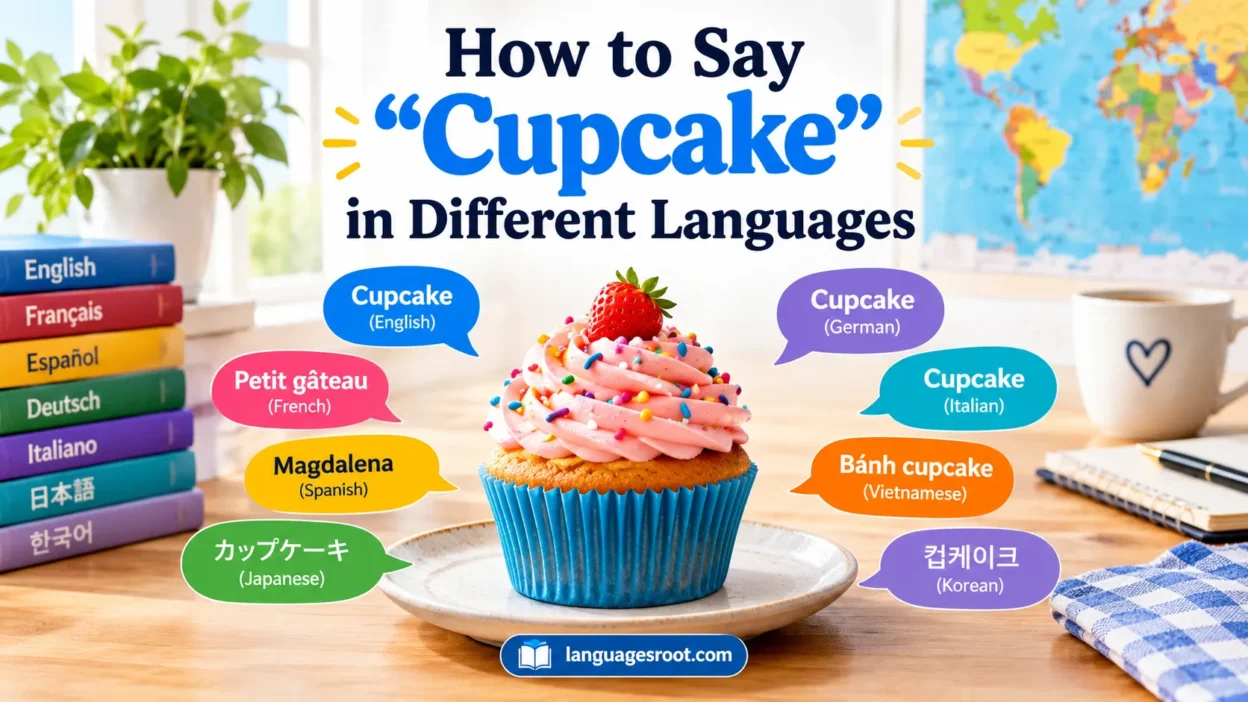
A cupcake is a small cake that brings sweetness to everyday moments. However, cupcake in different languages reveals interesting language differences and cultural food traditions. From colorful frosting to sweet toppings, these treats reflect global baking traditions. Therefore, learning how to say cupcake in different languages helps you explore international desserts and discover new food names in other languages.
This guide shares cupcake translations, cupcake pronunciation, and the English meaning across many world languages. You will also discover native cupcake translations, regional expressions, and local words for small cakes. Moreover, simple example sentences and an easy pronunciation guide help language learners use these words naturally. Whether you enjoy learning languages, explore international food culture, or plan on ordering cupcakes abroad, this guide makes discovering dessert vocabulary easier and more enjoyable.
Interesting Facts About Cupcake
- Cupcake is an internationally recognizable food name. Many languages use the English word directly or adapt its spelling and pronunciation.
- Not every small cake is a cupcake. A muffin, fairy cake, petit gâteau, and other individual desserts can look similar but may differ in ingredients, texture, preparation, or decoration.
- Some languages describe the baking method. Instead of borrowing the English name, speakers may use a phrase referring to a small cake or a cake baked in a cup or paper liner.
- Frosting can influence how people describe a cupcake. A decorated cupcake may be distinguished from a simpler small cake, depending on the local food vocabulary.
- Borrowed food words often adapt to local pronunciation. Speakers may change the sounds or spelling of cupcake to fit their language’s usual patterns.
- Food vocabulary reflects cultural exchange. International bakeries, cookbooks, cooking videos, and social media have helped familiar English dessert names circulate across borders.
- A menu translation should be clear to customers. When no exact equivalent exists, keeping cupcake alongside a short local-language explanation can be more helpful than substituting an unrelated dessert.
What Does Cupcake Mean?
A cupcake is a small, single-serving cake usually baked in a paper liner or small mold. It commonly has a soft cake base and may feature buttercream, whipped cream, chocolate, fruit, or decorative toppings.
The word combines cup and cake, reflecting the traditional practice of baking individual portions in small cups or cup-shaped containers. Modern cupcakes are made in specialized baking trays and paper cases, so the name does not necessarily mean that the cake is baked inside a drinking cup.
Cupcakes are often associated with celebrations, treats, creativity, and sharing. People may choose them because they are easy to serve individually and can be decorated for birthdays, holidays, themed parties, or special occasions.
The word also appears in affectionate expressions and nicknames, although those uses depend on context. In this article, the main meaning is the sweet baked dessert, not a person’s nickname or a figurative expression.
Why Can Cupcake Have Different Translations?
The word cupcake does not have one universally accepted equivalent in every language. Some languages borrow the English name, while others use a descriptive expression based on the dessert’s size, shape, or preparation.
Several factors influence the best translation:
- Context: A bakery menu may use a familiar food name, while a recipe may need a more precise description.
- Regional usage: Bakeries in different countries may use different names for similar products.
- Formality: A casual conversation may use an English loanword, while an explanatory text may describe the dessert in local vocabulary.
- Food traditions: A local small cake may resemble a cupcake without having exactly the same ingredients or toppings.
- Writing systems: Languages using non-Latin scripts may represent the borrowed word in their own writing system.
- Pronunciation: Speakers may adapt the English sounds to their native language.
- Literal versus natural translation: A word-for-word translation of cup and cake may sound unnatural or refer to another kind of dessert.
Translation note: The tables below distinguish established borrowed names from descriptive alternatives. Where a descriptive phrase is provided, it explains the cupcake concept rather than claiming that every speaker uses it as a fixed dictionary term.
How to Say Cupcake in Different Languages
The following tables cover more than 70 languages and regional varieties. Pronunciation guides are approximate aids for English-speaking readers, not substitutes for listening to fluent speakers. Example sentences show how the dessert can be discussed naturally in everyday contexts.
European Languages
European food vocabulary comes from several language families, including Germanic, Romance, and Slavic languages. Many European bakeries use the English word cupcake, but local expressions may be more useful when explaining the dessert to someone unfamiliar with it.
English varieties
| Language | Country/Region | Translation | Pronunciation | Example Sentence |
| English | International | Cupcake | KUP-kayk | I made a chocolate cupcake. |
| American English 🇺🇸 | United States | Cupcake | KUP-kayk | She decorated each cupcake with sprinkles. |
| British English 🇬🇧 | United Kingdom | Cupcake | KUP-kayk | We bought cupcakes for the party. |
| Australian English 🇦🇺 | Australia | Cupcake | KUP-kayk | The bakery sells delicious cupcakes. |
English usage note: The word cupcake is standard in all three varieties. British English also uses fairy cake for a related, often smaller cake, but the terms are not always interchangeable.
European language table
| 🌍 Language | Country/Region | Translation | Pronunciation | Example Sentence |
| Spanish | Spain, Latin America | Magdalena decorada / cupcake | mahg-dah-LEH-nah deh-koh-RAH-dah / KUP-kayk | Compré un cupcake de chocolate. (I bought a chocolate cupcake.) |
| French | France, Belgium, Canada | Cupcake | kup-kayk | J’ai préparé des cupcakes au chocolat. (I made chocolate cupcakes.) |
| German | Germany, Austria, Switzerland | Cupcake | KUP-kayk | Ich esse einen Schokoladen-Cupcake. (I’m eating a chocolate cupcake.) |
| Italian | Italy, Switzerland | Cupcake | kap-kayk | Ho preparato un cupcake al cioccolato. (I made a chocolate cupcake.) |
| Portuguese | Portugal, Brazil | Cupcake | KUP-kayk | Comprei um cupcake de chocolate. (I bought a chocolate cupcake.) |
| Dutch | Netherlands, Belgium | Cupcake | KUP-kayk | Ik heb een cupcake gebakken. (I baked a cupcake.) |
| Swedish | Sweden, Finland | Cupcake | approximately KUP-kayk | Jag bakade cupcakes till festen. (I baked cupcakes for the party.) |
| Norwegian | Norway | Cupcake | approximately KUP-kayk | Jeg laget cupcakes til bursdagen. (I made cupcakes for the birthday.) |
| Danish | Denmark | Cupcake | approximately KUP-kayk | Jeg bagte cupcakes til festen. (I baked cupcakes for the party.) |
| Finnish | Finland | Kuorrutettu pikkukakku / cupcake | KWOOR-roo-tet-too PEEK-koo-kak-koo | Tein suklaacupcakeja juhliin. (I made chocolate cupcakes for the celebration.) |
| Icelandic | Iceland | Bollakaka | BOL-lah-kah-kah | Ég bakaði bollakökur fyrir veisluna. (I baked small cakes for the party.) |
| Irish | Ireland | Cupcake / cáca beag maisithe | KUP-kayk / KAH-kah byug MAH-shih-heh | Rinne mé cupcakes don chóisir. (I made cupcakes for the party.) |
| Welsh | Wales | Teisen fach / cupcake | TAY-sen vahkh | Prynais cupcake siocled. (I bought a chocolate cupcake.) |
| Polish | Poland | Babeczka | bah-BETCH-kah | Upiekłam babeczki czekoladowe. (I baked chocolate cupcakes.) |
| Czech | Czechia | Košíček / cupcake | KOH-shee-check | Upekl jsem čokoládový cupcake. (I baked a chocolate cupcake.) |
| Slovak | Slovakia | Košíček / cupcake | KOH-shee-check | Upiekla som čokoládový cupcake. (I baked a chocolate cupcake.) |
| Ukrainian | Ukraine | Капкейк | kap-KEYK | Я спекла шоколадні капкейки. (I baked chocolate cupcakes.) |
| Russian | Russia and neighboring regions | Капкейк | kap-KEYK | Я испекла шоколадные капкейки. (I baked chocolate cupcakes.) |
| Romanian | Romania, Moldova | Brioșă decorată / cupcake | bree-OH-shuh deh-koh-RAH-tuh | Am făcut cupcakes cu ciocolată. (I made chocolate cupcakes.) |
| Hungarian | Hungary | Cupcake / muffin díszítéssel | KUP-kayk / MOO-fin DEE-see-taysh-shel | Csokoládés cupcake-et sütöttem. (I baked a chocolate cupcake.) |
| Greek | Greece, Cyprus | Κάπκεϊκ | KAP-keik | Έφτιαξα cupcakes σοκολάτας. (I made chocolate cupcakes.) |
| Bulgarian | Bulgaria | Къпкейк | KUP-keyk | Направих шоколадови къпкейкове. (I made chocolate cupcakes.) |
| Croatian | Croatia | Kolačić / cupcake | koh-LAH-cheech | Ispekla sam čokoladne cupcakese. (I baked chocolate cupcakes.) |
| Serbian | Serbia and neighboring regions | Капкејк / kapkejk | KAP-keyk | Направила сам čokoladne kapkejkove. (I made chocolate cupcakes.) |
| Slovenian | Slovenia | Kolaček / cupcake | koh-LAH-check | Spekla sem čokoladne kolačke. (I baked chocolate cupcakes.) |
| Lithuanian | Lithuania | Keksiukas / cupcake | kek-see-OO-kas | Iškepiau šokoladinius keksiukus. (I baked chocolate cupcakes.) |
| Latvian | Latvia | Kēksiņš / cupcake | KAYK-sinsh | Es izcepu šokolādes kēksiņus. (I baked chocolate cupcakes.) |
| Estonian | Estonia | Tassikook | TAS-see-kook | Küpsetasin šokolaadist tassikooke. (I baked chocolate cupcakes.) |
European cultural notes: Some translations in this table are descriptive or refer to related small cakes, not exact equivalents in every bakery. For example, Spanish magdalena and Polish babeczka can refer to other kinds of small baked goods, depending on local usage. If the icing and decoration are important, cupcake may be the clearest choice on an international menu.
Also Read: How to Say Curly in Different Languages
Asian Languages
Asia includes many language families and writing systems, from Chinese characters and Japanese kana to the scripts used for Hindi, Urdu, Thai, and Khmer. In many places, the English dessert name is borrowed, while a descriptive local expression can help explain what the item is.
| 🌍 Language | Country/Region | Translation | Pronunciation | Example Sentence |
| Mandarin Chinese | China, Taiwan, Singapore | 纸杯蛋糕 | zhǐbēi dàngāo | 我买了一个巧克力纸杯蛋糕。 (I bought a chocolate cupcake.) |
| Cantonese | Hong Kong, Guangdong | 紙杯蛋糕 | zi² bui¹ daan⁶ gou¹ | 我買咗個朱古力紙杯蛋糕。 (I bought a chocolate cupcake.) |
| Japanese | Japan | カップケーキ | kappukēki | チョコレートのカップケーキを作りました。 (I made chocolate cupcakes.) |
| Korean | South Korea | 컵케이크 | keopkeikeu | 초콜릿 컵케이크를 만들었어요. (I made chocolate cupcakes.) |
| Hindi | India | कपकेक | kap-kek | मैंने चॉकलेट कपकेक बनाया। (I made a chocolate cupcake.) |
| Urdu | Pakistan, India | کپ کیک | kap-kek | میں نے چاکلیٹ کپ کیک بنایا۔ (I made a chocolate cupcake.) |
| Bengali | Bangladesh, India | কাপকেক | kap-kek | আমি একটি চকলেট কাপকেক বানিয়েছি। (I made a chocolate cupcake.) |
| Punjabi | Pakistan, India | ਕੱਪਕੇਕ / کپ کیک | kap-kek | ਮੈਂ ਚਾਕਲੇਟ ਕੱਪਕੇਕ ਬਣਾਇਆ। (I made a chocolate cupcake.) |
| Gujarati | India | કપકેક | kap-kek | મેં ચોકલેટ કપકેક બનાવ્યો. (I made a chocolate cupcake.) |
| Marathi | India | कपकेक | kap-kek | मी चॉकलेट कपकेक बनवला. (I made a chocolate cupcake.) |
| Tamil | India, Sri Lanka, Singapore | கப்கேக் | kap-kēk | நான் சாக்லேட் கப்கேக் செய்தேன். (I made a chocolate cupcake.) |
| Telugu | India | కప్కేక్ | kap-kēk | నేను చాక్లెట్ కప్కేక్ తయారు చేశాను. (I made a chocolate cupcake.) |
| Kannada | India | ಕಪ್ಕೇಕ್ | kap-kēk | ನಾನು ಚಾಕೊಲೇಟ್ ಕಪ್ಕೇಕ್ ಮಾಡಿದೆ. (I made a chocolate cupcake.) |
| Malayalam | India | കപ്പ്കേക്ക് | kap-kēk | ഞാൻ ചോക്ലേറ്റ് കപ്പ്കേക്ക് ഉണ്ടാക്കി. (I made a chocolate cupcake.) |
| Nepali | Nepal, India | कपकेक | kap-kek | मैले चकलेट कपकेक बनाएँ। (I made a chocolate cupcake.) |
| Sinhala | Sri Lanka | කප්කේක් | kap-kēk | මම චොකලට් කප්කේක් හැදුවා. (I made a chocolate cupcake.) |
| Thai | Thailand | คัพเค้ก | khap-khéek | ฉันทำคัพเค้กช็อกโกแลต (I made chocolate cupcakes.) |
| Vietnamese | Vietnam | Bánh cupcake | banh KUP-kayk | Tôi đã làm bánh cupcake sô-cô-la. (I made chocolate cupcakes.) |
| Indonesian | Indonesia | Cupcake / kue mangkuk | KUP-kayk / koo-eh MANG-kook | Saya membuat cupcake cokelat. (I made a chocolate cupcake.) |
| Malay | Malaysia, Brunei, Singapore | Kek cawan / cupcake | kek CHAH-wan | Saya membuat kek cawan coklat. (I made chocolate cupcakes.) |
| Filipino/Tagalog | Philippines | Cupcake | KUP-kayk | Gumawa ako ng chocolate cupcake. (I made a chocolate cupcake.) |
| Burmese | Myanmar | ကပ်ကိတ် | kap-keik | ချောကလက် ကပ်ကိတ် လုပ်ခဲ့တယ်။ (I made chocolate cupcakes.) |
| Khmer | Cambodia | ខាប់ខេក | approximately kap-khek | ខ្ញុំធ្វើខាប់ខេកសូកូឡា។ (I made chocolate cupcakes.) |
| Lao | Laos | ຄັບເຄັກ | khap-khek | ຂ້ອຍເຮັດຄັບເຄັກຊັອກໂກແລັດ. (I made chocolate cupcakes.) |
| Mongolian | Mongolia | Капкейк | kap-keyk | Би шоколадтай капкейк хийсэн. (I made chocolate cupcakes.) |
| Kazakh | Kazakhstan | Капкейк | kap-keyk | Мен шоколадты капкейк пісірдім. (I baked a chocolate cupcake.) |
| Uzbek | Uzbekistan | Kapkeyk | kap-keyk | Men shokoladli kapkeyk tayyorladim. (I made a chocolate cupcake.) |
Asian cultural notes: The borrowed term is especially useful for modern bakery products with frosting and decorative toppings. Malay kek cawan literally describes a cup cake, but local products called kek cawan may vary. In Chinese, 纸杯蛋糕 describes a paper-cup cake, making it a useful descriptive term. Local shop menus may use other spellings or English loanwords.
African Languages
Africa has a rich range of languages, including Bantu, Semitic, and Niger-Congo languages, alongside many others. English and French food vocabulary may appear on bakery menus in some regions, while speakers may also use local descriptions for small cakes. The entries below provide recognizable borrowed names or descriptive equivalents where appropriate.
| 🌍 Language | Country/Region | Translation | Pronunciation | Example Sentence |
| Swahili | Tanzania, Kenya, East Africa | Keki ndogo / cupcake | KEH-kee n-DOH-goh | Nimenunua cupcake ya chokoleti. (I bought a chocolate cupcake.) |
| Afrikaans | South Africa, Namibia | Kolwyntjie / cupcake | koh-LAYN-kee | Ek het sjokolade-kolwyntjies gebak. (I baked chocolate cupcakes.) |
| Zulu | South Africa | Ikhekhe elincane / cupcake | ee-KHE-khe eh-lin-CAH-neh | Ngithenge ikhekhe elincane likashokoledi. (I bought a small chocolate cake.) |
| Xhosa | South Africa | Ikeyiki encinci / cupcake | ee-kay-yee-kee en-CHEEN-chee | Ndithenge ikeyiki encinci yetshokolethi. (I bought a small chocolate cake.) |
| Amharic | Ethiopia | ካፕኬክ | kap-kek | ቸኮሌት ካፕኬክ ገዛሁ። (I bought a chocolate cupcake.) |
| Yoruba | Nigeria, West Africa | Kẹ́kẹ́ kékeré / cupcake | keh-keh keh-keh-reh | Mo ra cupcake ṣókólẹ́ẹ̀tì kan. (I bought a chocolate cupcake.) |
| Igbo | Nigeria | Obere achicha / cupcake | OH-beh-reh ah-CHEE-cha | Azụtara m cupcake chọkọlet. (I bought a chocolate cupcake.) |
| Hausa | Nigeria, Niger, West Africa | Ƙaramin kek / cupcake | KAH-rah-meen kek | Na sayi cupcake na cakulan. (I bought a chocolate cupcake.) |
| Somali | Somalia, Horn of Africa | Keeg yar / cupcake | keeg yar | Waxaan iibsaday cupcake shukulaato ah. (I bought a chocolate cupcake.) |
| Shona | Zimbabwe | Keke kadiki / cupcake | KEH-keh kah-DEE-kee | Ndakatenga cupcake yechokoreti. (I bought a chocolate cupcake.) |
| Sesotho | Lesotho, South Africa | Kuku e nyenyane / cupcake | KOO-koo eh nyeh-NYEH-neh | Ke rekile cupcake ea chokolete. (I bought a chocolate cupcake.) |
| Setswana | Botswana, South Africa | Kuku e nnye / cupcake | KOO-koo eh nnyeh | Ke rekile cupcake ya tšhokolete. (I bought a chocolate cupcake.) |
| Kinyarwanda | Rwanda | Agakeke gato / cupcake | ah-gah-KEH-keh GAH-toh | Naguzwe cupcake ya shokola. (I bought a chocolate cupcake.) |
| Malagasy | Madagascar | Mofomamy kely / cupcake | moo-foo-MAH-mee KEH-lee | Nividy cupcake sôkôla aho. (I bought a chocolate cupcake.) |
African cultural notes: Many of these expressions are descriptive rather than fixed equivalents used by every speaker. A phrase meaning small cake may refer to several kinds of baked goods. For a bakery menu, the borrowed word cupcake alongside a local description can help customers recognize the intended dessert.
Middle Eastern Languages
The Middle East includes Arabic, Persian, Hebrew, Kurdish, Turkish, and Armenian language traditions. Because these languages differ in grammar, scripts, and everyday food vocabulary, cupcake names may be borrowed from English or explained through a descriptive phrase.
| 🌍 Language | Country/Region | Translation | Pronunciation | Example Sentence |
| Arabic, Modern Standard Arabic | Middle East and North Africa | كاب كيك | kāb kīk | اشتريت كاب كيك بالشوكولاتة. (I bought a chocolate cupcake.) |
| Persian (Farsi) | Iran | کاپکیک | kāp-kīk | من یک کاپکیک شکلاتی خریدم. (I bought a chocolate cupcake.) |
| Hebrew | Israel | קאפקייק | kap-keyk | קניתי קאפקייק שוקולד. (I bought a chocolate cupcake.) |
| Kurdish, Kurmanji | Türkiye, Iraq, Syria, Iran | Kapkek | kap-kek | Min kapkekê çîkolatayî kirî. (I bought a chocolate cupcake.) |
| Turkish | Türkiye, Cyprus | Cupcake / küçük kek | KUP-kayk / koo-CHUK kek | Çikolatalı cupcake aldım. (I bought a chocolate cupcake.) |
| Armenian | Armenia and Armenian-speaking communities | Քափքեյք | kap-keyk | Ես շոկոլադե քափքեյք գնեցի։ (I bought a chocolate cupcake.) |
Middle Eastern cultural notes: The Arabic spelling كاب كيك is a borrowed rendering of cupcake, not a literal translation of the two English components. Regional Arabic dialects may differ in pronunciation and spelling conventions. Turkish küçük kek means small cake, but it is a description rather than an exact technical synonym for a frosted cupcake.
Other World Languages
Cupcake vocabulary also appears in languages spoken in the Pacific, the Americas, and international communities. The translations below use familiar borrowed words where available and descriptive alternatives where useful.
| 🌍 Language | Country/Region | Translation | Pronunciation | Example Sentence |
| Māori | New Zealand | Keke iti / cupcake | KEH-keh EE-tee | I hokona e au he cupcake tiakarete. (I bought a chocolate cupcake.) |
| Samoan | Samoa, Pacific Islands | Keke laʻitiiti / cupcake | KEH-keh lah-ee-TEE-ee-tee | Na ou faatauina se cupcake sukalati. (I bought a chocolate cupcake.) |
| Tongan | Tonga, Pacific Islands | Keke siʻisiʻi / cupcake | KEH-keh see-EE-see-EE | Naʻá ku fakatau ha cupcake sukalati. (I bought a chocolate cupcake.) |
| Hawaiian | Hawaiʻi, United States | Keke liʻiliʻi / cupcake | KEH-keh lee-EE-lee-EE | Ua kūʻai au i cupcake kokoleka. (I bought a chocolate cupcake.) |
| Quechua | Andean regions of Peru, Bolivia, Ecuador | Small-cake description varies by dialect | Varies by dialect | Local wording depends on the Quechua variety and the intended baked dessert. |
| Guarani | Paraguay and neighboring regions | Cupcake / torta’i | KUP-kayk / tor-tah-EE | A borrowed word may be clearer than a dialect-dependent description. |
| Haitian Creole | Haiti and Haitian communities | Cupcake / ti gato | KUP-kayk / tee gah-toh | Mwen achte yon cupcake chokola. (I bought a chocolate cupcake.) |
| Esperanto | International constructed language | Kuketeto / cupcake | koo-keh-TEH-toh | Mi aĉetis ĉokoladan kuketon. (I bought a little chocolate cake.) |
Other-language note: Quechua includes multiple varieties, so a single unverified term would be misleading. The same caution applies to descriptive food names in languages with strong regional variation. Where a local equivalent is uncertain, a borrowed product name with a clear explanation is often the safer choice.
Quick Reference: Cupcake in Different Languages
This compact reference collects the main names and descriptive equivalents from the language tables. Some entries are borrowed names, while others describe a small cake or a related baked product. English regional varieties are grouped together because they use the same word.
| Language | Translation |
| English, American English, British English, Australian English | Cupcake |
| Spanish | Magdalena decorada / cupcake |
| French | Cupcake |
| German | Cupcake |
| Italian | Cupcake |
| Portuguese | Cupcake |
| Dutch | Cupcake |
| Swedish | Cupcake |
| Norwegian | Cupcake |
| Danish | Cupcake |
| Finnish | Kuorrutettu pikkukakku / cupcake |
| Icelandic | Bollakaka |
| Irish | Cupcake / cáca beag maisithe |
| Welsh | Teisen fach / cupcake |
| Polish | Babeczka |
| Czech | Košíček / cupcake |
| Slovak | Košíček / cupcake |
| Ukrainian | Капкейк |
| Russian | Капкейк |
| Romanian | Brioșă decorată / cupcake |
| Hungarian | Cupcake |
| Greek | Κάπκεϊκ |
| Bulgarian | Къпкейк |
| Croatian | Kolačić / cupcake |
| Serbian | Капкејк / kapkejk |
| Slovenian | Kolaček / cupcake |
| Lithuanian | Keksiukas |
| Latvian | Kēksiņš |
| Estonian | Tassikook |
| Mandarin Chinese | 纸杯蛋糕 |
| Cantonese | 紙杯蛋糕 |
| Japanese | カップケーキ |
| Korean | 컵케이크 |
| Hindi | कपकेक |
| Urdu | کپ کیک |
| Bengali | কাপকেক |
| Punjabi | ਕੱਪਕੇਕ / کپ کیک |
| Gujarati | કપકેક |
| Marathi | कपकेक |
| Tamil | கப்கேக் |
| Telugu | కప్కేక్ |
| Kannada | ಕಪ್ಕೇಕ್ |
| Malayalam | കപ്പ്കേക്ക് |
| Nepali | कपकेक |
| Sinhala | කප්කේක් |
| Thai | คัพเค้ก |
| Vietnamese | Bánh cupcake |
| Indonesian | Cupcake / kue mangkuk |
| Malay | Kek cawan |
| Filipino/Tagalog | Cupcake |
| Burmese | ကပ်ကိတ် |
| Khmer | ខាប់ខេក |
| Lao | ຄັບເຄັກ |
| Mongolian | Капкейк |
| Kazakh | Капкейк |
| Uzbek | Kapkeyk |
| Swahili | Keki ndogo / cupcake |
| Afrikaans | Kolwyntjie / cupcake |
| Zulu | Ikhekhe elincane / cupcake |
| Xhosa | Ikeyiki encinci / cupcake |
| Amharic | ካፕኬክ |
| Yoruba | Kẹ́kẹ́ kékeré / cupcake |
| Igbo | Obere achicha / cupcake |
| Hausa | Ƙaramin kek / cupcake |
| Somali | Keeg yar / cupcake |
| Shona | Keke kadiki / cupcake |
| Sesotho | Kuku e nyenyane / cupcake |
| Setswana | Kuku e nnye / cupcake |
| Kinyarwanda | Agakeke gato / cupcake |
| Malagasy | Mofomamy kely / cupcake |
| Arabic | كاب كيك |
| Persian | کاپکیک |
| Hebrew | קאפקייק |
| Kurdish, Kurmanji | Kapkek |
| Turkish | Cupcake / küçük kek |
| Armenian | Քափքեյք |
| Māori | Keke iti / cupcake |
| Samoan | Keke laʻitiiti / cupcake |
| Tongan | Keke siʻisiʻi / cupcake |
| Hawaiian | Keke liʻiliʻi / cupcake |
| Quechua | Dialect-dependent description |
| Guarani | Cupcake / torta’i |
| Haitian Creole | Cupcake / ti gato |
| Esperanto | Kuketeto / cupcake |
How to Choose the Right Translation
The best way to translate cupcake depends on where you are, who you are speaking to, and what kind of dessert you mean. For example, an international bakery menu may use the familiar English word, while a conversation with someone learning English may benefit from a local-language description.
Keep these tips in mind:
- For ordering food: Use the borrowed word cupcake if it is recognized locally, and point to a picture if necessary.
- For recipes: Describe the baking method, portion size, and frosting when the distinction matters.
- For menus: Consider listing the local name alongside cupcake so customers understand the product.
- For language learning: Learn the native spelling and pronunciation rather than relying entirely on English sounds.
- For regional audiences: Check whether the local word refers to a cupcake, muffin, fairy cake, or another small dessert.
- For online content: Use a clear, recognizable term and explain it briefly when an exact equivalent is unavailable.
The key is to choose wording that helps the listener understand the dessert, rather than translating every part of the English word literally.
Common Mistakes When Translating Cupcake
Even a familiar food word can be confusing when translated without context. These are some common mistakes to avoid.
- Translating each word separately: A literal translation of cup and cake may not be the name people use for the dessert.
- Confusing cupcakes with muffins: Although both are individual baked goods, they can differ in texture, ingredients, and decoration.
- Assuming every small cake is identical: Local desserts may resemble cupcakes without being the same product.
- Ignoring regional vocabulary: A term that works in one country may sound unfamiliar or refer to something different elsewhere.
- Using misleading pronunciation: Reading an English loanword as though every language follows English spelling rules can produce errors.
- Overlooking writing systems: Chinese, Japanese, Korean, Arabic, and other languages have their own ways of writing borrowed words.
- Assuming a descriptive phrase is an established name: Expressions meaning small cake or cup-shaped cake may explain the concept without being the usual bakery term.
Practical tip: When accuracy matters, check a local bakery menu or a reliable dictionary, especially if you are translating a commercial menu or published recipe.
Why Learn Cupcake in Different Languages?
Learning the word cupcake in different languages is a simple way to build food vocabulary and become more comfortable discussing everyday experiences across cultures. Food often brings people together, whether they are sharing a birthday treat, visiting a bakery abroad, or preparing a recipe with international friends.
meant for travelers, knowing a dessert’s name can make ordering and asking questions easier. For students, comparing borrowed words and local descriptions can reveal how languages adapt to new foods. For bakers and food bloggers, multilingual vocabulary can make recipes and menus more accessible to different audiences.
It can also make small gestures more thoughtful. Learning the name of a treat in someone’s native language shows an interest in communicating clearly, even when the word is unfamiliar.
You do not need to memorize every translation at once. Start with a few languages that interest you, practise their pronunciation, and learn how the word appears in a natural sentence. Over time, these small steps can strengthen your vocabulary, cultural awareness, and language-learning confidence.
Frequently Asked Questions
How do you say cupcake in different languages?
The word cupcake is used in many languages, while others have local names. For example, Japanese uses カップケーキ, Mandarin Chinese uses 纸杯蛋糕, and Urdu uses کپ کیک.
What is the meaning of cupcake?
A cupcake is a small cake baked in an individual portion, often with frosting and sweet toppings. People enjoy these treats at birthdays, parties, and other special occasions.
Is cupcake the same as a muffin in different languages?
No, a cupcake and a muffin are different individual desserts. Cupcakes often have colorful frosting and decorations, while muffins usually have a different texture and are less often topped with frosting.
How do you pronounce cupcake correctly?
In English, cupcake pronunciation is commonly written as KUP-kayk. However, other languages may adapt the borrowed word to their own sounds and pronunciation patterns.
Why do cupcake translations vary across countries?
Cupcake translations vary because of cultural differences, local baking traditions, and regional vocabulary. Some languages borrow the English word, while others use descriptive names for small cakes.
If you share the complete article as input, these FAQs can be tailored to its exact content, key details, and reader questions.
Conclusion
Learning how to say cupcake in different languages helps you explore cupcake translations, native words, and global baking traditions. Although many languages borrow the English word, others use local names that reflect their cultural food traditions. By practising cupcake pronunciation and learning food vocabulary, you can communicate more clearly when traveling, reading recipes, or ordering desserts abroad.