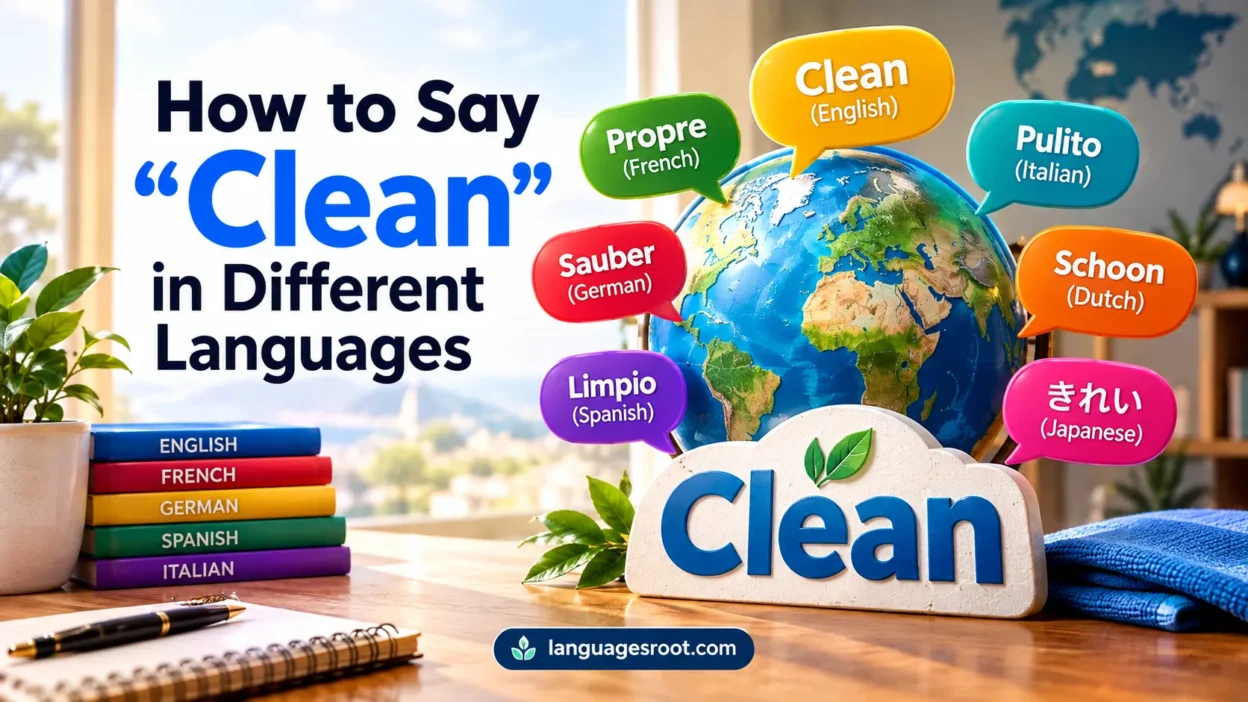
Learning clean in different languages helps language learners build useful language vocabulary for everyday situations. The word clean can describe fresh clothes, hygienic hands, pure water, or a dirt-free environment. However, its clean meaning can change with language context, culture, and common usage. So, understanding clean translations makes real communication clearer and more natural.
This guide explores different languages, including Spanish limpio, Japanese kirei, Urdu saf, sauber in German, and propre in French. You will also discover clean pronunciation, synonyms, grammar, gender, word forms, and practical example sentences. These cultural insights can support language learning, travel communication, and respectful conversations. Together, these useful examples make language communication easier across cultures.
Interesting Facts About “Clean”
- The English word clean can work as an adjective and a verb. For example, you can say “The room is clean” or “I clean the room.”
- Many languages change the form of “clean” according to grammatical gender, number, or case.
- In some languages, the common word for clean can also mean pure, neat, tidy, or clear, depending on the context.
- Japanese uses きれい (kirei) for something clean, but the same word can also mean beautiful or pretty.
- Chinese commonly uses 干净 (gānjìng) to describe something that is clean or free from dirt.
- In Spanish, limpio is masculine while limpia is feminine.
- French commonly uses propre for clean, and the same word can have meanings related to being proper or one’s own depending on context.
- German uses sauber for clean and can also use related expressions for neatness and cleanliness.
- Arabic adjectives can change according to gender and number, so forms of “clean” may vary in different sentences.
- Hindi and Urdu commonly use साफ़ / صاف (saaf) for clean, clear, or free from dirt.
- In many cultures, describing food, water, clothing, homes, and public spaces as clean is an important part of everyday communication.
- Learning a simple word such as “clean” can help language learners understand how adjectives behave in another language.
How to Say “Clean” in 75+ Languages
The tables below focus mainly on the everyday adjective “clean.” Some languages have masculine and feminine forms, while others use one common form. Pronunciations are simplified learner-friendly guides rather than full phonetic transcriptions. In actual conversation, pronunciation can vary by region.
European Languages
European languages belong to several different language families, including Romance, Germanic, Slavic, Celtic, Uralic, and Hellenic languages. This means that a simple word such as “clean” can look and sound very different from one country to another. The examples below use common everyday forms.
| Language | Country/Region | Translation | Pronunciation | Synonyms | Example Sentence |
| 🇺🇸 American English | United States | clean | kleen | tidy, spotless | The room is clean. |
| 🇬🇧 British English | United Kingdom | clean | kleen | tidy, spotless | The kitchen is clean. |
| 🇦🇺 Australian English | Australia | clean | kleen | tidy, neat | The house is clean. |
| 🇪🇸 Spanish | Spain, Latin America | limpio / limpia | LEEM-pyoh / LEEM-pyah | aseado, pulcro | La habitación está limpia. |
| 🇫🇷 French | France | propre | pro-pr | net, impeccable | La chambre est propre. |
| 🇮🇹 Italian | Italy | pulito / pulita | poo-LEE-toh / poo-LEE-tah | lindo, netto | La casa è pulita. |
| 🇵🇹 Portuguese | Portugal, Brazil | limpo / limpa | LEEM-poo / LEEM-pah | asseado, puro | A casa está limpa. |
| 🇷🇴 Romanian | Romania | curat / curată | koo-RAT / koo-RAH-tuh | îngrijit, pur | Camera este curată. |
| 🇩🇪 German | Germany, Austria | sauber | ZOW-ber | rein, ordentlich | Das Zimmer ist sauber. |
| 🇳🇱 Dutch | Netherlands, Belgium | schoon | skhohn | netjes, rein | De kamer is schoon. |
| 🇸🇪 Swedish | Sweden | ren | rehn | snygg, hygienisk | Rummet är rent. |
| 🇳🇴 Norwegian | Norway | ren | rehn | ryddig, hygienisk | Rommet er rent. |
| 🇩🇰 Danish | Denmark | ren | rehn | pæn, hygiejnisk | Værelset er rent. |
| 🇮🇸 Icelandic | Iceland | hreinn / hrein | khreyn / khreyn | snyrtilegur, laus við óhreinindi | Herbergið er hreint. |
| 🇫🇮 Finnish | Finland | puhdas | POOH-das | siisti, hygieeninen | Huone on puhdas. |
| 🇪🇪 Estonian | Estonia | puhas | POO-has | korras, puhtakas | Tuba on puhas. |
| 🇱🇻 Latvian | Latvia | tīrs / tīra | teers / TEE-rah | kārtīgs, nevainojams | Istaba ir tīra. |
| 🇱🇹 Lithuanian | Lithuania | švarus / švari | SHVAH-roos / SHVAH-ree | tvarkingas, grynas | Kambarys yra švarus. |
| 🇵🇱 Polish | Poland | czysty / czysta | CHIS-tih / CHIS-tah | schludny, nieskazitelny | Pokój jest czysty. |
| 🇨🇿 Czech | Czech Republic | čistý / čistá | CHIS-tee / CHIS-tah | uklizený, hygienický | Pokoj je čistý. |
| 🇸🇰 Slovak | Slovakia | čistý / čistá | CHIS-tee / CHIS-tah | uprataný, hygienický | Izba je čistá. |
| 🇸🇮 Slovenian | Slovenia | čist / čista | cheest / CHEES-tah | urejen, brez umazanije | Soba je čista. |
| 🇭🇷 Croatian | Croatia | čist / čista | cheest / CHEES-tah | uredan, higijenski | Soba je čista. |
| 🇧🇦 Bosnian | Bosnia and Herzegovina | čist / čista | cheest / CHEES-tah | uredan, higijenski | Soba je čista. |
| 🇷🇸 Serbian | Serbia | čist / чист | cheest | uredan, higijenski | Soba je čista. |
| 🇧🇬 Bulgarian | Bulgaria | чист | cheest | подреден, хигиеничен | Стаята е чиста. |
| 🇲🇰 Macedonian | North Macedonia | чист | cheest | уреден, хигиенски | Собата е чиста. |
| 🇺🇦 Ukrainian | Ukraine | чистий / чиста | CHIS-tiy / CHIS-tah | охайний, без бруду | Кімната чиста. |
| 🇷🇺 Russian | Russia | чистый / чистая | CHEES-tiy / CHEES-tah | аккуратный, опрятный | Комната чистая. |
| 🇧🇾 Belarusian | Belarus | чысты / чыстая | CHIS-tih / CHIS-tah | ахайны, акуратны | Пакой чысты. |
| 🇬🇷 Greek | Greece | καθαρός / καθαρή | ka-tha-ROS / ka-tha-REE | αγνός, τακτικός | Το δωμάτιο είναι καθαρό. |
| 🇦🇱 Albanian | Albania, Kosovo | i pastër / e pastër | ee PAS-ter | i rregullt, i kulluar | Dhoma është e pastër. |
| 🇭🇺 Hungarian | Hungary | tiszta | TISH-tah | rendezett, higiénikus | A szoba tiszta. |
| 🇮🇪 Irish | Ireland | glan | glahn | néata, slachtmhar | Tá an seomra glan. |
| 🏴 Welsh | Wales | glân | glahn | taclus, pur | Mae’r ystafell yn lân. |
| 🏴 Scottish Gaelic | Scotland | glan | glahn | grinn, glan | Tha an seòmar glan. |
Asian Languages

Asia is home to thousands of languages and many distinct writing systems. The word “clean” can therefore appear in Latin, Cyrillic, Arabic-derived, Indic, Chinese, Japanese, Korean, and other scripts. The examples below highlight widely spoken Asian languages and provide simple pronunciation guides for learners.
Also Read: How to Say “Angel” in Different Languages
| Language | Country/Region | Translation | Pronunciation | Synonyms | Example Sentence |
| 🇨🇳 Mandarin Chinese | China, Taiwan | 干净 | gān jìng | 清洁, 整洁 | 房间很干净。 |
| 🇯🇵 Japanese | Japan | きれい | kee-reh-ee | 清潔, 清らか | 部屋はきれいです。 |
| 🇰🇷 Korean | South Korea | 깨끗하다 | kkae-kkeut-ha-da | 청결하다, 깔끔하다 | 방이 깨끗해요. |
| 🇻🇳 Vietnamese | Vietnam | sạch | sahk | tinh tươm, vệ sinh | Căn phòng sạch. |
| 🇹🇭 Thai | Thailand | สะอาด | sa-at | บริสุทธิ์, เรียบร้อย | ห้องสะอาด |
| 🇮🇩 Indonesian | Indonesia | bersih | ber-seeh | rapi, suci | Kamarnya bersih. |
| 🇲🇾 Malay | Malaysia, Brunei | bersih | ber-seeh | kemas, suci | Bilik itu bersih. |
| 🇵🇭 Filipino | Philippines | malinis | mah-LEE-nees | maayos, walang dumi | Malinis ang kuwarto. |
| 🇮🇳 Hindi | India | साफ़ | saaf | स्वच्छ, निर्मल | कमरा साफ़ है। |
| 🇵🇰 Urdu | Pakistan, India | صاف | saaf | پاک, ستھرا | کمرہ صاف ہے۔ |
| 🇧🇩 Bengali | Bangladesh, India | পরিষ্কার | po-ree-shkar | পরিচ্ছন্ন, নির্মল | ঘরটি পরিষ্কার। |
| 🇮🇳 Punjabi | India, Pakistan | ਸਾਫ਼ | saaf | ਸੁਥਰਾ, ਪਵਿੱਤਰ | ਕਮਰਾ ਸਾਫ਼ ਹੈ। |
| 🇮🇳 Gujarati | India | સ્વચ્છ | svach-chh | ચોખ્ખું, નિર્મળ | ઓરડો સ્વચ્છ છે. |
| 🇮🇳 Marathi | India | स्वच्छ | svach-chha | निर्मळ, नीटनेटका | खोली स्वच्छ आहे. |
| 🇳🇵 Nepali | Nepal | सफा | sa-fa | स्वच्छ, शुद्ध | कोठा सफा छ। |
| 🇱🇰 Sinhala | Sri Lanka | පිරිසිදු | pee-ree-see-doo | පවිත්ර, නිසි | කාමරය පිරිසිදුයි. |
| 🇮🇳 Tamil | India, Sri Lanka | சுத்தமான | soot-tha-maa-na | தூய்மையான, பரிசுத்தமான | அறை சுத்தமாக உள்ளது. |
| 🇮🇳 Telugu | India | శుభ్రమైన | shub-hra-my-na | పరిశుభ్రమైన, స్వచ్ఛమైన | గది శుభ్రంగా ఉంది. |
| 🇮🇳 Kannada | India | ಸ್ವಚ್ಛ | sva-chchha | ಶುಚಿ, ನಿರ್ಮಲ | ಕೋಣೆ ಸ್ವಚ್ಛವಾಗಿದೆ. |
| 🇮🇳 Malayalam | India | വൃത്തിയുള്ള | vrit-tee-yul-la | ശുദ്ധമായ, വെടിപ്പുള്ള | മുറി വൃത്തിയുള്ളതാണ്. |
| 🇮🇳 Assamese | India | পৰিষ্কাৰ | po-ri-shkar | নিৰ্মল, পৰিচ্ছন্ন | কোঠাটো পৰিষ্কাৰ। |
| 🇦🇫 Pashto | Afghanistan, Pakistan | پاک | paak | صفا, سپېڅلی | کوټه پاکه ده. |
| 🇰🇿 Kazakh | Kazakhstan | таза | ta-za | ұқыпты, кірсіз | Бөлме таза. |
| 🇺🇿 Uzbek | Uzbekistan | toza | TOH-za | pokiza, ozoda | Xona toza. |
| 🇹🇲 Turkmen | Turkmenistan | arassa | a-ras-sa | tämiz, päk | Otag arassa. |
| 🇲🇳 Mongolian | Mongolia | цэвэр | tseh-ver | ариун, эмх цэгцтэй | Өрөө цэвэр байна. |
| 🇰🇭 Khmer | Cambodia | ស្អាត | sa-at | បរិសុទ្ធ, ស្អំ | បន្ទប់ស្អាត។ |
| 🇱🇦 Lao | Laos | ສະອາດ | sa-aht | ບໍລິສຸດ, ຮຽບຮ້ອຍ | ຫ້ອງສະອາດ. |
| 🇲🇲 Burmese | Myanmar | သန့်ရှင်း | than-shin | စင်ကြယ်, သပ်ရပ် | အခန်းက သန့်ရှင်းတယ်။ |
| 🇵🇱 Polish-speaking Asia | Some communities | czysty | CHIS-tih | schludny, czysty | Pokój jest czysty. |
| 🇹🇷 Turkish | Turkey, Cyprus | temiz | teh-MEEZ | pak, arı | Oda temiz. |
African Languages
Africa has extraordinary linguistic diversity, with major language families including Niger-Congo, Afroasiatic, Nilo-Saharan, and others. Many African languages are spoken across national borders, so a language may belong to several countries or communities. Here are useful everyday forms of “clean” from widely spoken African languages.
| Language | Country/Region | Translation | Pronunciation | Synonyms | Example Sentence |
| 🇰🇪 Swahili | East Africa | safi | SAH-fee | safisha, takatifu | Chumba ni safi. |
| 🇿🇦 Zulu | South Africa | hlanzekile | hlan-zeh-kee-leh | msulwa, kuhlanzekile | Igumbi lihlanzekile. |
| 🇿🇦 Xhosa | South Africa | icocekile | ee-ko-cheh-kee-leh | msulwa, kucocekile | Igumbi licocekile. |
| 🇿🇦 Afrikaans | South Africa, Namibia | skoon | skohn | netjies, rein | Die kamer is skoon. |
| 🇪🇹 Amharic | Ethiopia | ንጹህ | nit-sooh | ንጹሕ, ንፁህ | ክፍሉ ንጹህ ነው። |
| 🇸🇴 Somali | Somalia, Horn of Africa | nadiif | na-DEEF | daahir, hagaagsan | Qolku waa nadiif. |
| 🇳🇬 Yoruba | Nigeria, Benin | mọ́tótó | moh-toh-toh | mímọ́, pẹ̀tẹ́lẹ̀ | Yàrá náà mọ́tótó. |
| 🇳🇬 Igbo | Nigeria | dị ọcha | dee OH-cha | dị ọcha nke ọma | Ụlọ ahụ dị ọcha. |
| 🇳🇬 Hausa | Nigeria, Niger | tsabta | TSAH-bah | tsafta, mai tsabta | Dakin yana da tsabta. |
| 🇿🇼 Shona | Zimbabwe | yakachena | ya-ka-che-na | mutsvene, yakarongeka | Imba yakachena. |
| 🇱🇸 Sesotho | Lesotho, South Africa | hloekile | hloh-eh-kee-leh | makhethe, hlwekile | Kamore e hloekile. |
| 🇧🇼 Setswana | Botswana, South Africa | phepa | peh-pa | phepa sentle, phepa | Ntlo e phepa. |
| 🇸🇳 Wolof | Senegal | set | set | sell, sellal | Kër gi set na. |
| 🇲🇬 Malagasy | Madagascar | madio | ma-dee-oo | madio tsara, madio be | Madio ny efitra. |
| 🇷🇼 Kinyarwanda | Rwanda | isukuye | ee-soo-kwee-yeh | gutungana, kweza | Icyumba kirasukuye. |
| 🇲🇿 Portuguese African usage | Mozambique, Angola | limpo / limpa | LEEM-poo / LEEM-pah | asseado, puro | A sala está limpa. |
Middle Eastern Languages

The Middle East contains languages from several major language families. Arabic has many regional varieties, while Persian, Hebrew, Turkish, Kurdish, Armenian, and Azerbaijani are also important languages in the wider region. Words for cleanliness often appear in conversations about homes, food, clothing, personal hygiene, and religious or cultural practices.
| Language | Country/Region | Translation | Pronunciation | Synonyms | Example Sentence |
| 🇸🇦 Arabic | Arab world | نظيف / نظيفة | na-ZEEF / na-ZEE-fah | طاهر, مرتب | الغرفة نظيفة. |
| 🇮🇱 Hebrew | Israel | נקי / נקייה | na-KEE / ne-kee-YAH | טהור, מסודר | החדר נקי. |
| 🇮🇷 Persian | Iran, Afghanistan | تمیز | ta-MEEZ | پاک, پاکیزه | اتاق تمیز است. |
| 🇹🇷 Turkish | Turkey | temiz | teh-MEEZ | pak, arı | Oda temiz. |
| 🇮🇶 Kurdish | Iraq, Iran, Turkey, Syria | پاک | paak | ڕوون, پاکیزە | ژوورەکە پاکە. |
| 🇦🇲 Armenian | Armenia | մաքուր | ma-KOOR | մաքուր, անբիծ | Սենյակը մաքուր է։ |
| 🇬🇪 Georgian | Georgia | სუფთა | SOOP-ta | სუფთა, ნათელი | ოთახი სუფთაა. |
| 🇦🇿 Azerbaijani | Azerbaijan | təmiz | teh-MEEZ | saf, pak | Otaq təmizdir. |
| 🇦🇫 Dari | Afghanistan | تمیز | ta-MEEZ | پاک, پاکیزه | اتاق تمیز است. |
Additional Languages Around the World
Languages outside Europe, Asia, Africa, and the Middle East also offer interesting ways to express the idea of cleanliness. Some have one straightforward adjective, while others use words that can also mean pure, fresh, tidy, or free from dirt. These examples show how widely the concept of “clean” is expressed across the world.
| Language | Country/Region | Translation | Pronunciation | Synonyms | Example Sentence |
| 🇧🇷 Brazilian Portuguese | Brazil | limpo / limpa | LEEM-poo / LEEM-pah | asseado, puro | A casa está limpa. |
| 🇭🇹 Haitian Creole | Haiti | pwòp | pwoh | pwòp anpil, san salte | Kay la pwòp. |
| 🇨🇺 Spanish Caribbean | Caribbean | limpio / limpia | LEEM-pyoh / LEEM-pyah | aseado, pulcro | La casa está limpia. |
| 🌎 Esperanto | International | pura | POO-ra | pura, senmakula | La ĉambro estas pura. |
| 🇳🇿 Māori | New Zealand | mā | mah | parakore, ma | He mā te rūma. |
| 🇼🇸 Samoan | Samoa | mama | MAH-mah | mamā, pa’ia | E mama le potu. |
| 🇹🇴 Tongan | Tonga | ma’a | mah-ah | tapu, ma | ‘Oku ma’a ‘a e loki. |
| 🇵🇫 Tahitian | French Polynesia | mâ | maa | vi’ivi’i, mâ | E mâ te fare. |
| 🇭🇺 Romani | Europe | šužo | SHOO-zho | lačho, čistó | O kher si šužo. |
| 🇵🇪 Quechua | Andes | chuyu | CHOO-yoo | allin, chuyu | Wasiqa chuyum. |
| 🇧🇴 Aymara | Andes | q’uma | QOO-mah | suma, q’uma | Uta q’umawa. |
| 🇫🇯 Fijian | Fiji | savasava | sa-va-sa-va | savasava vinaka | Na vale e savasava. |
| 🇵🇬 Tok Pisin | Papua New Guinea | klinpela | KLIN-peh-la | stret, klin | Haus i klinpela. |
| 🇻🇺 Bislama | Vanuatu | klin | klin | klin tumas | Haos i klin. |
| 🇲🇹 Maltese | Malta | nadif / nadifa | NA-deef / NA-dee-fa | pur, imnaddaf | Il-kamra nadifa. |
| 🇮🇱 Arabic Levantine | Levant | نضيف / نظيف | n-deef / na-zeef | مرتب, طاهر | الغرفة نظيفة. |
How “Clean” Changes Depending on Context

The English word clean has several meanings, and choosing the correct translation depends on context. A direct translation may not always be the most natural expression.
For example, when talking about a room, clean usually means that there is no dirt, dust, rubbish, or mess. When talking about clothing, it can mean freshly washed. When describing water, it can mean safe, clear, or free from contamination. In a moral or figurative sense, clean can mean innocent, honest, or free from wrongdoing.
The word can also describe actions. In English, “clean the house” is different from “the house is clean.” Some languages use a separate verb rather than simply changing the adjective into a verb. This distinction is important for learners who want to use the word naturally instead of translating word for word.
How to Say “Clean” Politely
When asking someone to clean something, the tone matters. A direct command such as “Clean the room” can sound strong depending on the relationship between speakers. A softer expression such as “Could you please clean the room?” is usually more polite.
When speaking another language, learners should pay attention to polite forms, honorifics, and local communication styles. In some cultures, a polite request is preferred even when speaking to someone familiar. Learning both the basic word and a polite expression makes your communication more natural.
Common Phrases With “Clean”
Here are several useful English expressions involving the word clean:
- Clean room: A room without dirt or mess.
- Clean water: Water that is safe or free from unwanted substances.
- Clean clothes: Freshly washed clothing.
- Clean hands: Hands without dirt or contamination.
- Clean house: A home that has been cleaned and organized.
- Clean air: Air with little or no harmful pollution.
- Clean food: Food associated with simple, fresh, or minimally processed ingredients, depending on context.
- Clean record: A record without offenses or negative incidents.
- Clean energy: Energy sources generally described as producing low or no direct greenhouse gas emissions during operation.
- Clean design: A simple, uncluttered visual style.
Difference Between “Clean,” “Tidy,” “Neat,” and “Pure”
These words are related, but they are not always interchangeable.
Clean usually means free from dirt, stains, germs, or unwanted material. For example, “The floor is clean.”
Tidy usually means arranged properly and without unnecessary clutter. A room can be tidy without having been deeply cleaned.
Neat can describe something orderly, attractive, or well arranged. It can overlap with tidy, but it does not always mean hygienically clean.
Pure often describes something without contamination or unwanted substances. It can also have religious, moral, or figurative meanings.
Understanding these differences helps language learners select a better translation instead of using one word in every situation.
Useful “Clean” Sentences for Language Learners

If you are learning vocabulary, short sentences can make the word easier to remember. These examples cover common situations:
- The room is clean.
- Please keep your hands clean.
- The kitchen is very clean.
- I need to clean my shoes.
- The water looks clean.
- My clothes are clean.
- Please clean the table.
- The bathroom is clean.
- This place is clean and comfortable.
- Keep your workspace clean.
Practicing these sentences helps you understand how “clean” works as both a description and part of an action.
Why Learning “Clean” in Different Languages Is Useful
Simple vocabulary can make international communication much easier. Words related to cleanliness are especially useful because travelers may need them in hotels, restaurants, airports, hospitals, public transportation, homes, and other everyday places.
Knowing the local word can also help you understand signs and instructions. You may encounter words related to cleaning products, hygiene, bathrooms, laundry, food preparation, and public spaces. Even one familiar word can make an unfamiliar environment feel easier to navigate.
Learning vocabulary across languages also gives you a better understanding of how cultures express similar ideas differently. A word that seems simple in English may have several related meanings in another language.
Tips for Remembering the Word “Clean”
One of the easiest ways to remember new vocabulary is to connect the word with a real situation.
For example, when cleaning your room, repeat the word in your target language. When washing your hands, practice the word again. You can also write the word on a note near an object that is regularly cleaned.
Another useful method is to learn the word together with a short sentence rather than memorizing it alone. For example, instead of remembering only “safi,” a learner of Swahili could remember the complete idea “The room is clean.” Context creates stronger memory connections.
You can also compare related words such as clean, dirty, tidy, pure, fresh, neat, and spotless. This helps you understand vocabulary as a connected group instead of isolated words.
Frequently Asked Questions
How do you say “clean” in different languages?
The translation of clean in different languages varies by language context. For example, Spanish uses limpio, French uses propre, German uses sauber, and Urdu uses صاف (saaf).
How do you say “clean” in Spanish?
In Spanish, limpio describes masculine nouns, while limpia describes feminine nouns. This word form difference is important for natural language learning.
How do you say “clean” in Japanese?
Japanese commonly uses きれい (kirei) for clean, especially when describing places or objects. Depending on the context, kirei can also mean beautiful or pretty.
How do you say “clean” in Urdu?
In Urdu, صاف (saaf) commonly means clean, clear, or free from dirt. It is useful language vocabulary for everyday conversations and practical communication.
What is the difference between clean, tidy, neat, and pure?
Clean usually means free from dirt, while tidy means well arranged and neat means orderly. Pure often means free from impurities, although its meaning can change with context.
Conclusion
Learning clean in different languages helps build practical language vocabulary for travel, daily life, and global communication. By exploring clean translations, pronunciation, context, and related words, language learners can use this useful word more naturally and confidently. Understanding how clean meaning changes across cultures also makes language learning more useful and engaging.