Cilantro is a fresh herb loved in world cuisines for its bright taste. Its bright green leaves add a fresh flavor, with citrusy flavor and earthy flavor in many dishes. It appears in salsa, curries, soups, salads, chutneys, and rice dishes across different cultures. Learning its name in different languages can help language learners understand food vocabulary and communicate while traveling.
However, language differences can make plant names and ingredient names confusing across regions. In British English, people commonly use coriander, while American English usually uses cilantro for the fresh leaves. This guide explores coriander terminology, herb translation, pronunciation, and regional terminology across European languages and Asian languages. It also explains useful food culture, culinary terminology, and the word history behind this familiar herb.
Interesting Facts About Cilantro
- Cilantro comes from the coriander plant, scientifically known as Coriandrum sativum.
- The fresh leaves and stems are commonly called cilantro in American English.
- British English commonly uses the word “coriander” for the fresh herb.
- Cilantro is widely used in Mexican, Indian, Thai, Vietnamese, Middle Eastern, Chinese, and many other cuisines.
- The plant belongs to the parsley family, Apiaceae.
- Cilantro leaves are often used fresh rather than cooked for long periods.
- Coriander seeds are different from the fresh leaves in both flavor and culinary use.
- Spanish uses the familiar word “cilantro,” while many European languages use words related to “coriander.”
- French calls the herb “coriandre.”
- German commonly uses “Koriander.”
- Italian uses “coriandolo.”
- Portuguese uses “coentro.”
- Chinese commonly uses “香菜” or “芫荽,” depending on region and context.
- Japanese commonly uses “コリアンダー,” although other culinary expressions can also occur.
- Korean commonly calls coriander “고수.”
- Hindi commonly uses “धनिया.”
- Arabic commonly uses “كزبرة.”
- Persian uses “گشنیز.”
- Turkish uses “kişniş.”
- Vietnamese commonly uses “rau mùi” or regional forms such as “ngò rí.”
- The word can have different regional meanings even within the same language.
- Knowing the local word for cilantro can make grocery shopping and ordering food easier when traveling.
- Cilantro is sometimes called Chinese parsley because of its appearance and culinary use.
- Some people experience fresh cilantro as citrusy and refreshing, while others perceive a strong soapy taste.
How to Say “Cilantro” in Different Languages
The following list includes more than 70 languages from Europe, Asia, Africa, the Middle East, and other parts of the world. The pronunciation column uses simple English-friendly approximations rather than formal IPA. Pronunciations can vary by region, accent, and dialect.
The translations are based on commonly documented dictionary or multilingual equivalents. Several languages have more than one accepted term, especially where speakers distinguish between the fresh leaves, the entire plant, and coriander seeds.
European Languages
European languages often use words related to the Latin and Greek history of coriander. You will notice similar forms across several languages, including French, German, Dutch, Danish, Swedish, Czech, and Romanian. These similarities make some European cilantro vocabulary easier to recognize once you learn a few patterns.
The examples below use natural everyday sentences. In some countries, the local word can refer to coriander generally rather than specifically to the fresh leaves.
| Language | Country/Region | Translation | Pronunciation | Synonyms / Related Terms | Example Sentence |
| 🇬🇧 American English | United States | cilantro | sih-LAHN-troh | coriander leaves | I added cilantro to the salsa. |
| 🇬🇧 British English | United Kingdom | coriander | kor-ee-AN-der | coriander leaves | I added coriander to the curry. |
| 🇦🇺 Australian English | Australia | coriander | kor-ee-AN-der | fresh coriander | I bought fresh coriander today. |
| 🇪🇸 Spanish | Spain, Latin America | cilantro | see-LAHN-troh | culantro, coriandro | Añadí cilantro a la salsa. |
| 🇫🇷 French | France | coriandre | koh-ree-AHN-druh | persil chinois | J’ajoute de la coriandre à la soupe. |
| 🇮🇹 Italian | Italy | coriandolo | koh-ree-ahn-DOH-loh | coriandro | Ho aggiunto il coriandolo all’insalata. |
| 🇩🇪 German | Germany | Koriander | koh-ree-AN-der | Korianderkraut | Ich gebe Koriander in den Salat. |
| 🇵🇹 Portuguese | Portugal, Brazil | coentro | koh-EN-troo | coentros | Adicionei coentro à sopa. |
| 🇳🇱 Dutch | Netherlands, Belgium | koriander | koh-ree-AHN-der | korianderblad | Ik voeg koriander aan de salade toe. |
| 🇸🇪 Swedish | Sweden | koriander | koh-ree-AHN-der | korianderblad | Jag lägger koriander i salladen. |
| 🇩🇰 Danish | Denmark | koriander | koh-ree-AHN-er | korianderblade | Jeg kommer koriander i salaten. |
| 🇳🇴 Norwegian | Norway | koriander | koh-ree-AHN-der | korianderblad | Jeg bruker koriander i maten. |
| 🇫🇮 Finnish | Finland | korianteri | koh-ree-AHN-teh-ree | korianterin lehdet | Lisään korianteria salaattiin. |
| 🇮🇸 Icelandic | Iceland | kóríander | KOH-ree-AHN-der | kóríanderjurt | Ég set kóríander í salatið. |
| 🇮🇪 Irish | Ireland | lus an choire | luss un KHUR-eh | coriander | Úsáidim lus an choire sa bhia. |
| 🇵🇱 Polish | Poland | kolendra | koh-LEN-drah | liście kolendry | Dodaję kolendrę do sałatki. |
| 🇨🇿 Czech | Czech Republic | koriandr | koh-ree-AHN-druh | čerstvý koriandr | Přidávám koriandr do salátu. |
| 🇸🇰 Slovak | Slovakia | koriander | koh-ree-AHN-der | čerstvý koriander | Pridávam koriander do jedla. |
| 🇭🇺 Hungarian | Hungary | koriander | koh-ree-AHN-der | korianderzöld | Koriandert teszek a levesbe. |
| 🇷🇴 Romanian | Romania | coriandru | koh-ree-AHN-droo | frunze de coriandru | Adaug coriandru în salată. |
| 🇧🇬 Bulgarian | Bulgaria | кориандър | koh-ree-AHN-dur | пресен кориандър | Добавям кориандър към салатата. |
| 🇬🇷 Greek | Greece | κόλιανδρος | KOH-lee-ahn-dros | φρέσκος κόλιανδρος | Προσθέτω κόλιανδρο στη σαλάτα. |
| 🇭🇷 Croatian | Croatia | korijandar | koh-ree-YAN-dar | svježi korijandar | Dodajem korijandar u salatu. |
| 🇸🇮 Slovenian | Slovenia | koriander | koh-ree-AHN-der | sveži koriander | Dodam koriander v solato. |
| 🇷🇸 Serbian | Serbia | korijander | koh-ree-YAN-der | svež korijander | Dodajem korijander u salatu. |
| 🇧🇦 Bosnian | Bosnia and Herzegovina | korijander | koh-ree-YAN-der | svježi korijander | Dodajem korijander u salatu. |
| 🇦🇱 Albanian | Albania | koriandër | koh-ree-AN-der | gjethe koriandri | Shtoj koriandër në sallatë. |
| 🇪🇪 Estonian | Estonia | koriander | koh-ree-AHN-der | koriandrilehed | Lisan salatile koriandrit. |
| 🇱🇻 Latvian | Latvia | koriandrs | koh-ree-AHN-drs | koriandra lapas | Es pievienoju koriandru salātiem. |
| 🇱🇹 Lithuanian | Lithuania | kalendra | kah-LEN-drah | kalendros lapai | Į salotas dedu kalendros. |
| 🇲🇰 Macedonian | North Macedonia | коријандер | koh-ree-YAN-der | свеж коријандер | Додавам коријандер во салатата. |
| 🇺🇦 Ukrainian | Ukraine | кінза | KEEN-zah | коріандр | Я додаю кінзу до салату. |
| 🇷🇺 Russian | Russia | кинза | KEEN-zah | кориандр | Я добавляю кинзу в салат. |
| 🇧🇾 Belarusian | Belarus | каляндра | kah-LYAN-drah | каляндровае лісце | Я дадаю каляндру ў салату. |
| 🇬🇪 Georgian | Georgia | ქინძი | KEEN-dzee | ქინძის ფოთოლი | სალათს ქინძს ვამატებ. |
| 🇪🇸 Basque | Basque Country | koriandrea | koh-ree-an-DREH-ah | cilantro | Koriandrea entsaladari gehitzen diot. |
| 🇪🇸 Catalan | Catalonia | coriandre | koh-ree-AHN-druh | fulles de coriandre | Afegeixo coriandre a l’amanida. |
| 🇬🇦 Galician | Galicia | coandro | koh-AHN-droh | cilantro | Engado coandro á ensalada. |
| 🌍 Esperanto | International | koriandro | koh-ree-AHN-droh | cilantro | Mi aldonas koriandron al la salato. |
Common European equivalents such as coriandre, Koriander, coriandolo, coentro, koriander, and koriandr are also documented across multilingual dictionary sources.
Also Read: How to Say “Clouds” in Different Languages
Asian Languages
Asia has some of the most diverse names for cilantro because the herb plays an important role in many regional cuisines. It appears in Indian curries and chutneys, Chinese dishes, Thai soups, Vietnamese meals, Korean food, Indonesian recipes, and many other culinary traditions.
In several Asian languages, the word used for cilantro is quite different from European forms. For example, Chinese commonly uses 香菜, Hindi uses धनिया, Korean uses 고수, Thai uses ผักชี, and Vietnamese commonly uses rau mùi.
| Language | Country/Region | Translation | Pronunciation | Synonyms / Related Terms | Example Sentence |
| 🇨🇳 Mandarin Chinese | China, Taiwan | 香菜 | xiāng cài | 芫荽 | 我在汤里加了香菜。 |
| 🇭🇰 Cantonese | Hong Kong, Guangdong | 芫荽 | jyun4 seoi1 | 香菜 | 我喺湯入面加咗芫荽。 |
| 🇯🇵 Japanese | Japan | コリアンダー | ko-ri-an-daa | パクチー | サラダにコリアンダーを入れます。 |
| 🇰🇷 Korean | South Korea | 고수 | go-soo | 고수잎 | 저는 국에 고수를 넣어요. |
| 🇮🇳 Hindi | India | धनिया | dhuh-nee-ya | धनिया पत्ती | मैं सलाद में धनिया डालता हूँ। |
| 🇮🇳 Bengali | Bangladesh, India | ধনে | DHOH-neh | ধনেপাতা | আমি সালাদে ধনে দিই। |
| 🇮🇳 Marathi | India | धणे | DHUH-neh | कोथिंबीर | मी कोशिंबिरीत कोथिंबीर घालतो. |
| 🇮🇳 Gujarati | India | ધાણા | DHAH-naa | કોથમીર | હું સલાડમાં કોથમીર નાખું છું. |
| 🇮🇳 Punjabi | India, Pakistan | ਧਨੀਆ | dhuh-NEE-aa | ਧਨੀਆ ਪੱਤਾ | ਮੈਂ ਸਲਾਦ ਵਿੱਚ ਧਨੀਆ ਪਾਉਂਦਾ ਹਾਂ। |
| 🇵🇰 Urdu | Pakistan | دھنیا | dhuh-nee-ya | دھنیا کے پتے | میں سلاد میں دھنیا ڈالتا ہوں۔ |
| 🇳🇵 Nepali | Nepal | धनियाँ | dhuh-NEE-ya | धनियाँको पात | म सलादमा धनियाँ हाल्छु। |
| 🇱🇰 Sinhala | Sri Lanka | කොත්තමල්ලි | kot-tha-MAL-lee | කොත්තමල්ලි කොළ | මම සලාදයට කොත්තමල්ලි දමමි. |
| 🇮🇳 Tamil | India, Sri Lanka | கொத்தமல்லி | kot-tha-mal-lee | கொத்தமல்லி இலை | நான் சாலட்டில் கொத்தமல்லி சேர்க்கிறேன். |
| 🇮🇳 Telugu | India | కొత్తిమీర | kot-tee-MEE-rah | ధనియాల ఆకు | నేను సలాడ్లో కొత్తిమీర వేస్తాను. |
| 🇮🇳 Kannada | India | ಕೊತ್ತಂಬರಿ | kot-tam-BAH-ree | ಕೊತ್ತಂಬರಿ ಸೊಪ್ಪು | ನಾನು ಸಲಾಡ್ಗೆ ಕೊತ್ತಂಬರಿ ಹಾಕುತ್ತೇನೆ. |
| 🇮🇳 Malayalam | India | മല്ലിയില | mal-lee-YIL | മല്ലി | ഞാൻ സാലഡിൽ മല്ലിയില ചേർക്കുന്നു. |
| 🇮🇩 Indonesian | Indonesia | ketumbar | keh-toom-BAR | daun ketumbar | Saya menambahkan ketumbar ke salad. |
| 🇲🇾 Malay | Malaysia, Brunei | ketumbar | keh-toom-BAR | daun ketumbar | Saya menambah ketumbar ke dalam sup. |
| 🇹🇭 Thai | Thailand | ผักชี | pak-CHEE | ต้นผักชี | ฉันใส่ผักชีในสลัด |
| 🇻🇳 Vietnamese | Vietnam | rau mùi | zow moo-ee | ngò rí | Tôi thêm rau mùi vào món ăn. |
| 🇵🇭 Filipino | Philippines | kulantro | koo-LAN-troh | wansoy | Nagdagdag ako ng kulantro sa salsa. |
| 🇰🇭 Khmer | Cambodia | វ៉ាន់ស៊ុយ | van-sooy | ជីវ៉ាន់ស៊ុយ | ខ្ញុំដាក់វ៉ាន់ស៊ុយក្នុងស៊ុប។ |
| 🇲🇲 Burmese | Myanmar | နံနံပင် | nan-nan-pin | coriander leaves | ဟင်းထဲမှာ နံနံပင်ထည့်တယ်။ |
| 🇱🇦 Lao | Laos | ຜັກຫອມປ້ອມ | phak hom pom | coriander leaves | ຂ້ອຍໃສ່ຜັກຫອມປ້ອມໃນແກງ. |
| 🇲🇳 Mongolian | Mongolia | кориандр | koh-ree-AHN-dar | coriander | Би салатанд кориандр нэмдэг. |
| 🇦🇫 Dari | Afghanistan | گشنیز | gosh-NEEZ | سبزی گشنیز | من به سالاد گشنیز اضافه میکنم. |
| 🇦🇲 Armenian | Armenia | համեմ | hah-MEM | համեմի տերև | Ես աղցանին համեմ եմ ավելացնում։ |
| 🇦🇿 Azerbaijani | Azerbaijan | keşniş | kesh-NEESH | keşniş yarpağı | Mən salata keşniş əlavə edirəm. |
| 🇰🇿 Kazakh | Kazakhstan | кинза | KEEN-zah | кориандр | Мен салатқа кинза қосамын. |
| 🇺🇿 Uzbek | Uzbekistan | kashnich | kash-NEECH | kashnich bargi | Men salatga kashnich qo’shaman. |
| 🇹🇯 Tajik | Tajikistan | кашнич | kash-NEECH | барги кашнич | Ман ба салат кашнич илова мекунам. |
The forms used above reflect documented multilingual equivalents. Sources list forms including Hindi धनिया, Bengali ধনে, Chinese 香菜, Korean 고수, Indonesian and Malay ketumbar, Thai ผักชี, Vietnamese rau mùi, and Persian گشنیز.
African Languages
Cilantro is used in different African culinary traditions, particularly where North African, Middle Eastern, Mediterranean, Indian, and local food traditions overlap. The exact vocabulary can vary considerably between countries and languages.
In multilingual countries, speakers may also use a borrowed word from English, French, Arabic, Portuguese, or another regional language. Therefore, some entries should be understood as common culinary equivalents rather than universal terms used by every speaker.
| Language | Country/Region | Translation | Pronunciation | Synonyms / Related Terms | Example Sentence |
| 🇿🇦 Afrikaans | South Africa | koljander | kol-YAN-der | vars koljander | Ek voeg koljander by die slaai. |
| 🇪🇹 Amharic | Ethiopia | ኮሪደር | koh-ree-DEHR | coriander | ኮሪደር ወደ ሰላጣው እጨምራለሁ። |
| 🇸🇴 Somali | Somalia | koryander | koh-ree-AN-der | coriander | Waxaan ku daraa koryander saladhka. |
| 🇸🇳 Wolof | Senegal | koriyaandar | koh-ree-YAN-dar | coriander | Dama yokk koriyaandar ci salaat bi. |
| 🇲🇱 Bambara | Mali | koriandara | koh-ree-AN-dah-rah | coriander | N bɛ koriandara don saladi la. |
| 🇸🇿 Swazi | Eswatini | coriander | koh-ree-AN-der | fresh coriander | Ngifaka coriander esaladini. |
| 🇱🇸 Sesotho | Lesotho | coriander | koh-ree-AN-der | coriander leaves | Ke kenya coriander salateng. |
| 🇧🇼 Setswana | Botswana | coriander | koh-ree-AN-der | fresh coriander | Ke tsenya coriander mo salateng. |
| 🇿🇼 Shona | Zimbabwe | coriander | koh-ree-AN-der | coriander leaves | Ndinowedzera coriander musalad. |
| 🇰🇪 Swahili | East Africa | giligilani | gee-lee-gee-LAH-nee | coriander | Ninaongeza giligilani kwenye saladi. |
| 🇿🇦 Xhosa | South Africa | coriander | koh-ree-AN-der | fresh coriander | Ndongeza coriander kwisaladi. |
| 🇿🇦 Zulu | South Africa | coriander | koh-ree-AN-der | fresh coriander | Ngifaka coriander esaladini. |
| 🇲🇬 Malagasy | Madagascar | koriantera | koh-ree-an-TEH-rah | coriander | Manampy koriantera amin’ny salady aho. |
| 🇨🇩 Lingala | Central Africa | koriandre | koh-ree-AHN-druh | coriander | Nakobakisa koriandre na salade. |
| 🇨🇲 Hausa | West Africa | koriander | koh-ree-AN-der | coriander leaves | Ina ƙara koriander a cikin salatin. |
Because African countries often contain many languages within the same national borders, terminology can differ by region. Borrowing and multilingual usage are especially common in food vocabulary.
Middle Eastern Languages
Cilantro has a long culinary history across the Middle East. It is used in salads, sauces, soups, stews, rice dishes, meat preparations, and herb mixtures. Arabic, Persian, Hebrew, and Turkish have distinct words for the herb.
A useful point for learners is that several Middle Eastern languages use terms that specifically identify coriander or coriander leaves. Arabic commonly uses كزبرة, Persian uses گشنیز, Hebrew uses כוסברה, and Turkish uses kişniş.
| Language | Country/Region | Translation | Pronunciation | Synonyms / Related Terms | Example Sentence |
| 🇸🇦 Arabic | Middle East, North Africa | كزبرة | kaz-BAR-ah | كزبرة خضراء | أضيف الكزبرة إلى السلطة. |
| 🇮🇷 Persian | Iran | گشنیز | gosh-NEEZ | برگ گشنیز | من گشنیز به سالاد اضافه میکنم. |
| 🇮🇱 Hebrew | Israel | כוסברה | koos-BAH-rah | עלי כוסברה | אני מוסיף כוסברה לסלט. |
| 🇹🇷 Turkish | Turkey | kişniş | kish-NEESH | kişniş yaprağı | Salataya kişniş ekliyorum. |
| 🇮🇶 Iraqi Arabic | Iraq | كزبرة | kaz-BAR-ah | كزبرة خضراء | أضيف الكزبرة إلى الطعام. |
| 🇪🇬 Egyptian Arabic | Egypt | كزبرة | kaz-BAR-ah | كزبرة خضرا | بحط كزبرة على السلطة. |
| 🇱🇧 Lebanese Arabic | Lebanon | كزبرة | kaz-BAR-ah | كزبرة خضرا | بضيف كزبرة عالسلطة. |
| 🇯🇴 Jordanian Arabic | Jordan | كزبرة | kaz-BAR-ah | كزبرة خضراء | أضيف الكزبرة للسلطة. |
| 🇸🇾 Syrian Arabic | Syria | كزبرة | kaz-BAR-ah | كزبرة خضراء | أضيف الكزبرة إلى الطبق. |
| 🇵🇸 Palestinian Arabic | Palestine | كزبرة | kaz-BAR-ah | كزبرة خضراء | أضيف الكزبرة إلى السلطة. |
| 🇦🇪 Gulf Arabic | Gulf region | كزبرة | kaz-BAR-ah | كزبرة خضراء | أضيف الكزبرة إلى الأكل. |
Additional Languages Around the World
Cilantro vocabulary does not stop at the major European, Asian, African, and Middle Eastern language families. The herb is used internationally, and many languages have their own traditional terms or borrowed culinary vocabulary.
These additional examples are helpful for travelers, food lovers, multilingual families, and language learners who want to recognize cilantro on menus and ingredient lists.
| Language | Country/Region | Translation | Pronunciation | Synonyms / Related Terms | Example Sentence |
| 🇧🇷 Brazilian Portuguese | Brazil | coentro | koh-EN-troo | coentro fresco | Eu coloquei coentro na sopa. |
| 🇨🇦 Canadian English | Canada | cilantro | sih-LAHN-troh | coriander | I added cilantro to the soup. |
| 🇵🇪 Latin American Spanish | Latin America | cilantro | see-LAHN-troh | coriandro | Agregué cilantro a la comida. |
| 🇲🇽 Mexican Spanish | Mexico | cilantro | see-LAHN-troh | cilantro fresco | Puse cilantro en los tacos. |
| 🇵🇭 Cebuano | Philippines | kulantro | koo-LAN-troh | coriander | Nagbutang ko og kulantro sa sabaw. |
| 🇫🇯 Fijian | Fiji | coriander | koh-ree-AN-der | fresh coriander | Au biuta na coriander ena kakana. |
| 🇭🇹 Haitian Creole | Haiti | koryand | koh-ree-AHN | coriander | Mwen mete koryand nan sòs la. |
| 🇲🇹 Maltese | Malta | kosbor | KOSS-bor | coriander | Inżid il-kosbor mal-insalata. |
| 🇱🇺 Luxembourgish | Luxembourg | Koriander | koh-ree-AHN-der | Korianderblieder | Ech ginn Koriander an d’Zalot. |
| 🇲🇨 Monégasque | Monaco | coriandre | koh-ree-AHN-druh | coriander | Aghjunghju coriandre à l’insalata. |
Cilantro vs. Coriander: What Is the Difference?
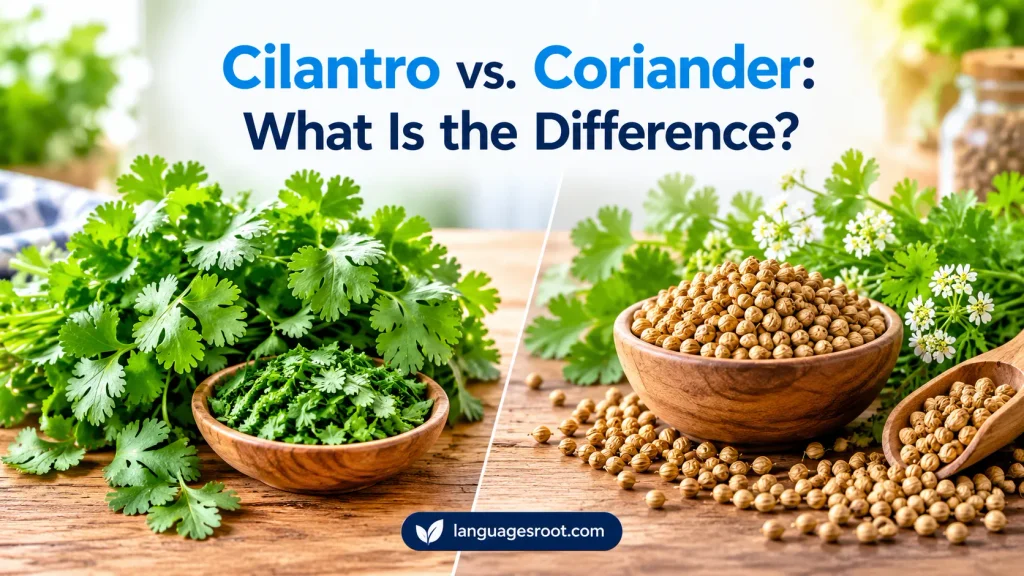
One of the most common questions about this herb is whether cilantro and coriander are the same thing. The answer depends partly on regional English usage.
In American English, cilantro normally refers to the fresh leaves and tender stems of Coriandrum sativum. The seeds are usually called coriander seeds. In British English, however, coriander commonly refers to the fresh leaves as well as the plant more generally.
This distinction is important when reading recipes. A recipe from the United States asking for “cilantro” normally means the fresh green herb. A British recipe asking for “coriander” may also mean the same fresh leaves.
The distinction can become even more interesting in other languages. Some languages have separate words for the leaves, plant, and seeds, while others use one broad word for coriander. For example, multilingual dictionary sources list different forms for the herb and seeds in languages such as Arabic, Chinese, Hindi, Korean, Persian, Thai, Turkish, and Vietnamese.
How to Pronounce “Cilantro” in English
In American English, “cilantro” is commonly pronounced approximately like sih-LAHN-troh. The stress falls on the middle syllable.
The word has a slightly different pronunciation in Spanish, where the sounds follow Spanish pronunciation rules. Spanish sources give pronunciations such as /θilantɾo/ or /silantɾo/, depending on the speaker’s region and pronunciation of the letter “c.”
When learning foreign-language vocabulary, it is usually better to listen to native speakers because spelling-based English approximations cannot perfectly represent every sound.
Common Synonyms and Related Words for Cilantro
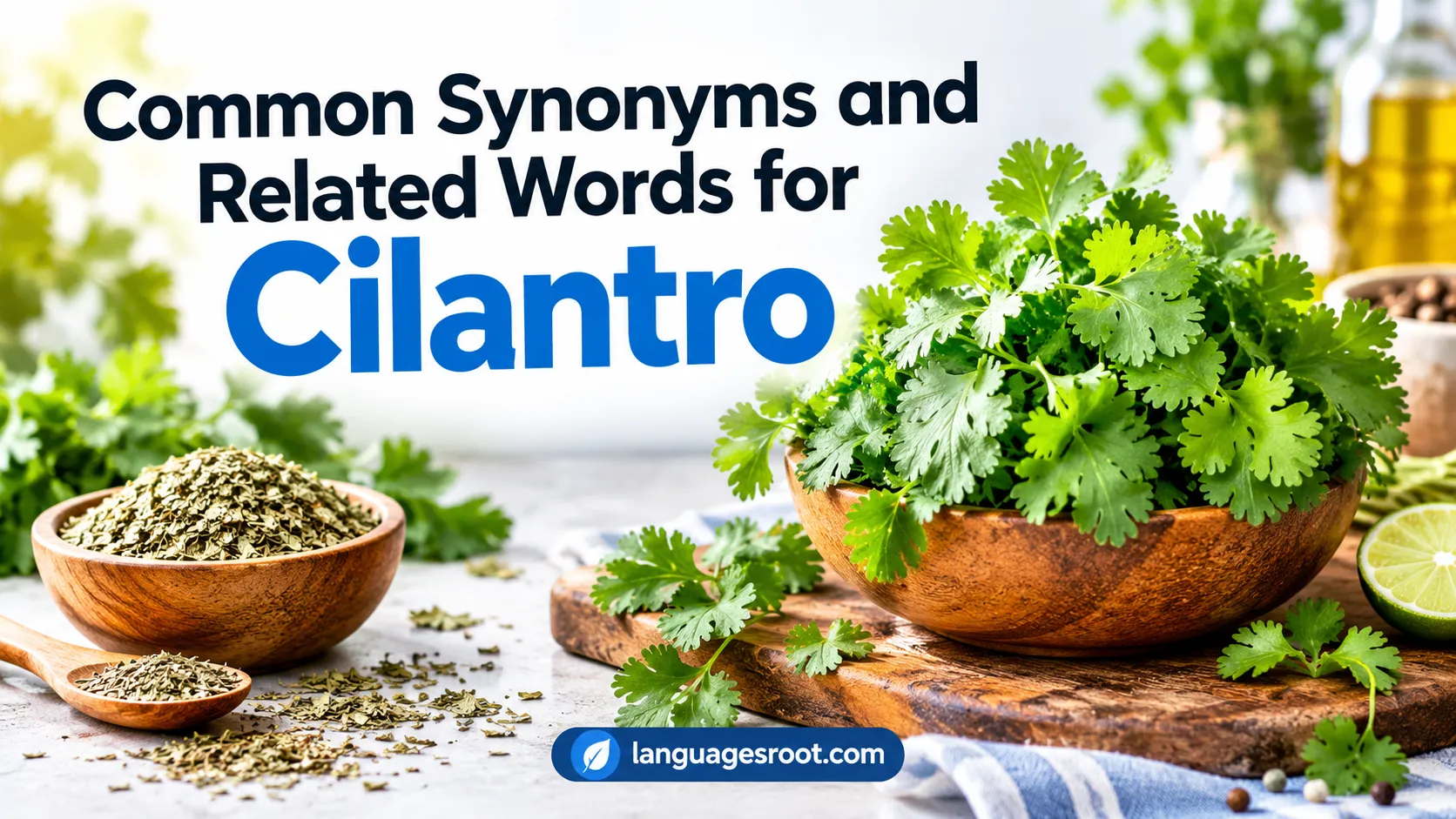
Depending on the language and region, cilantro can be connected with several related terms:
- Cilantro
- Coriander
- Fresh coriander
- Coriander leaves
- Coriander herb
- Coriander greens
- Chinese parsley
- Fresh coriander leaves
- Coriander plant
- Cilantro leaves
- Koriander
- Coriandre
- Coriandolo
- Coentro
- Kolendra
- Koriandr
- Ketumbar
- धनिया
- 香菜
- 고수
- ผักชี
- rau mùi
- كزبرة
- گشنیز
- כוסברה
- kişniş
These are not all exact synonyms in every language. Some specifically refer to the leaves, while others refer to the plant or coriander more generally.
Why Does Cilantro Have So Many Different Names?
Languages develop vocabulary based on history, geography, trade, agriculture, and cultural exchange. Cilantro has been cultivated and used for food across a very large geographic area, so different societies developed their own names for it.
Some European words are closely related to older forms of “coriander.” Other languages use completely different traditional words. For example, Chinese uses 香菜, Hindi uses धनिया, Korean uses 고수, Thai uses ผักชี, and Indonesian uses ketumbar.
Food vocabulary is especially interesting because ingredients often travel between cultures. A plant may keep an older name in one region while gaining a new name somewhere else. Borrowed words can then become part of everyday language.
How to Use “Cilantro” When Traveling
Knowing the local word for cilantro can be surprisingly useful while traveling. If you visit a local market, restaurant, or grocery store, recognizing the word can help you identify dishes and ingredients.
For example, a traveler in Mexico may hear cilantro, while someone shopping in France may see coriandre. In Germany, the ingredient may appear as Koriander, while in Thailand it can appear as ผักชี. A visitor in Korea may encounter 고수, and someone in India may see धनिया on ingredient lists or recipes.
Learning the local word is particularly helpful when you have food preferences or need to understand exactly what an ingredient is before ordering a meal.
Frequently Asked Questions
What is cilantro called in British English?
British English commonly uses coriander for the fresh herb, including its leaves and stems.
What is cilantro called in Spanish?
In Spanish, cilantro is the common word for this culinary herb, especially in many Latin American regions.
Is cilantro the same as coriander?
Yes, both come from the same coriander plant, but American English usually separates cilantro from coriander seeds.
What is cilantro called in Hindi and Urdu?
Hindi commonly uses धनिया, while Urdu uses دھنیا for cilantro and related coriander leaves.
Why does cilantro have different names in different languages?
Language differences, regional traditions, and cultural exchange create varied plant names and food vocabulary for the same ingredient.
Conclusion
Learning Cilantro in different languages reveals how food vocabulary, plant names, and culinary traditions vary across cultures. From coriander in British English to cilantro in Spanish, coriandre in French, धनिया in Hindi, and 香菜 in Chinese, these terms make traveling, cooking, and language learning easier. Understanding regional coriander terminology also helps you recognize this fresh herb when shopping, reading recipes, or exploring international food terms.