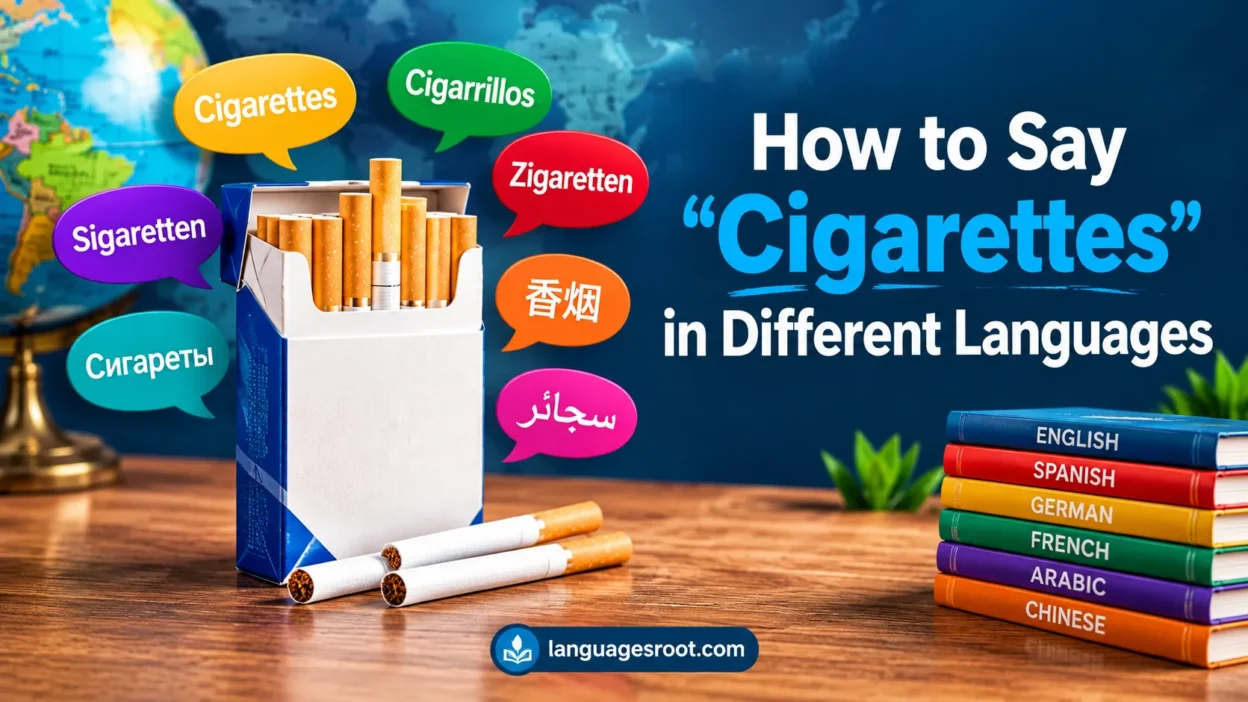
Learning how to say cigarettes in different languages can improve communication while traveling or studying. It also helps when meeting new people and learning about another culture. You may notice the word on signs, menus, packaging, or in everyday conversations. So, knowing its meaning, pronunciation, and different forms can make language learning easier.
This guide explores cigarettes in different languages, including useful translations, common expressions, and pronunciation help. You will also discover how context, formal or casual speech, and choice of words can affect translation. Along the way, examples such as the Japanese word for cigarette, tabako, show how familiar objects can vary across global languages.
Interesting Facts About Cigarettes
- The English word cigarette comes through French, ultimately relating to the Spanish word cigarro, meaning cigar.
- The word for cigarettes is often similar across European languages because many languages borrowed related vocabulary from French, Spanish, or other European languages.
- In some languages, the singular and plural forms are different, so cigarette and cigarettes may not simply be formed by adding an English-style “s.”
- In several languages, the everyday spoken word differs from the more formal or dictionary term.
- Many languages have slang expressions for cigarettes, but these can vary strongly by country and social group.
- Pronunciation can change between regions even when the written word is almost identical.
- In some countries, tobacco products are subject to strict age restrictions, advertising rules, taxes, and public smoking restrictions.
- Recognizing the local word can help travelers understand warning signs, health information, and tobacco-related regulations.
- Cigarettes are commonly associated with tobacco and nicotine, but terminology can differ between traditional cigarettes, cigars, tobacco, and other nicotine products.
- Learning vocabulary in context is often more effective than memorizing isolated words.
- The plural form is particularly useful because many conversations refer to cigarettes as a group rather than a single cigarette.
- Cultural attitudes toward smoking differ widely between countries and communities, so knowing the vocabulary does not necessarily indicate the same social meaning everywhere.
European Languages

European languages come from several major language families, including Romance, Germanic, Slavic, Celtic, and others. The word for cigarettes is often recognizable across neighboring European countries, although pronunciation and grammatical forms can differ. The examples below use common modern vocabulary suitable for basic language learning and recognition.
| Language | Country/Region | Translation | Pronunciation | Synonyms / Related Terms | Example Sentence |
| 🇬🇧 American English | United States | cigarettes | SIG-uh-rets | smokes, tobacco cigarettes | Cigarettes are sold under strict regulations. |
| 🇬🇧 British English | United Kingdom | cigarettes | sig-uh-RETS | fags, smokes | Cigarettes cannot be sold to children. |
| 🇦🇺 Australian English | Australia | cigarettes | sig-uh-RETS | ciggies, smokes | Cigarettes are subject to tobacco laws. |
| 🇫🇷 French | France, Belgium, Canada | cigarettes | see-gah-RET | clopes, cigarettes | Les cigarettes sont réglementées par la loi. |
| 🇪🇸 Spanish | Spain, Latin America | cigarrillos | see-gah-REE-yos | cigarros, tabaco | Los cigarrillos están sujetos a restricciones. |
| 🇵🇹 Portuguese | Portugal, Brazil | cigarros | see-GAH-roos | cigarros de tabaco | Os cigarros estão sujeitos a restrições. |
| 🇮🇹 Italian | Italy | sigarette | see-gah-RET-teh | sigarette, tabacco | Le sigarette sono soggette a restrizioni. |
| 🇩🇪 German | Germany, Austria | Zigaretten | tsee-gah-RET-ten | Kippen, Zigaretten | Zigaretten sind gesetzlich geregelt. |
| 🇳🇱 Dutch | Netherlands, Belgium | sigaretten | see-gah-RET-ten | peuken | Sigaretten zijn aan regels gebonden. |
| 🇸🇪 Swedish | Sweden | cigaretter | see-gah-RET-ter | cigg, cigaretter | Cigaretter är reglerade enligt lag. |
| 🇳🇴 Norwegian | Norway | sigaretter | see-gah-RET-ter | røyk | Sigaretter er regulert ved lov. |
| 🇩🇰 Danish | Denmark | cigaretter | see-gah-RET-ter | smøger | Cigaretter er reguleret ved lov. |
| 🇫🇮 Finnish | Finland | savukkeet | SAH-voo-ket | tupakat | Savukkeet ovat lain mukaan säänneltyjä. |
| 🇮🇸 Icelandic | Iceland | sígarettur | SEE-gah-ret-tur | tóbak | Sígarettur eru háðar reglum. |
| 🇮🇪 Irish | Ireland | toitíní | ti-TEEN-ee | toitín | Tá toitíní faoi réir rialacha. |
| 🏴 Welsh | Wales | sigaréts | sig-AH-rets | tybaco | Mae sigaréts yn cael eu rheoleiddio. |
| 🇵🇱 Polish | Poland | papierosy | pah-pyeh-ROH-sih | fajki | Papierosy podlegają przepisom. |
| 🇨🇿 Czech | Czech Republic | cigarety | TSI-gah-reh-tih | cigára | Cigarety podléhají regulacím. |
| 🇸🇰 Slovak | Slovakia | cigarety | TSI-gah-reh-tih | cigy | Cigarety podliehajú pravidlám. |
| 🇸🇮 Slovenian | Slovenia | cigarete | tsee-gah-REH-teh | cigareti | Cigarete so zakonsko urejene. |
| 🇭🇷 Croatian | Croatia | cigarete | tsee-gah-REH-teh | cigarete | Cigarete su zakonski regulirane. |
| 🇷🇸 Serbian | Serbia | цигарете | tsee-gah-REH-teh | цигаре | Цигарете су регулисане законом. |
| 🇧🇦 Bosnian | Bosnia and Herzegovina | cigarete | tsee-gah-REH-teh | cigare | Cigarete su regulisane zakonom. |
| 🇧🇬 Bulgarian | Bulgaria | цигари | tsee-GAH-ree | тютюн | Цигарите са регулирани със закон. |
| 🇷🇴 Romanian | Romania | țigări | TSEE-gər | țigarete | Țigările sunt reglementate prin lege. |
| 🇭🇺 Hungarian | Hungary | cigaretták | TSI-gah-ret-taak | cigi | A cigaretták szabályozott termékek. |
| 🇬🇷 Greek | Greece | τσιγάρα | tsee-GAH-ra | τσιγάρο | Τα τσιγάρα υπόκεινται σε κανονισμούς. |
| 🇷🇺 Russian | Russia | сигареты | see-gah-REH-ty | папиросы | Сигареты регулируются законом. |
| 🇺🇦 Ukrainian | Ukraine | сигарети | see-gah-REH-ty | тютюн | Сигарети регулюються законом. |
| 🇧🇾 Belarusian | Belarus | цыгарэты | tsi-gah-REH-ty | тытунь | Цыгарэты рэгулююцца законам. |
| 🇱🇹 Lithuanian | Lithuania | cigaretės | tsee-gah-REH-tes | tabakas | Cigaretės yra reguliuojamos įstatymais. |
| 🇱🇻 Latvian | Latvia | cigaretes | tsee-gah-REH-tes | tabaka izstrādājumi | Cigaretes regulē likums. |
| 🇪🇪 Estonian | Estonia | sigaretid | see-gah-REH-tid | tubakas | Sigaretid on seadusega reguleeritud. |
| 🇲🇹 Maltese | Malta | sigaretti | see-gah-RET-tee | tabakk | Is-sigaretti huma regolati bil-liġi. |
| 🇦🇱 Albanian | Albania, Kosovo | cigarete | tsee-gah-REH-teh | duhan | Cigaretet janë të rregulluara me ligj. |
| 🇲🇰 Macedonian | North Macedonia | цигари | tsee-GAH-ree | тутун | Цигарите се регулирани со закон. |
Also Read: How to Say “Cilantro” in Different Languages
A Note About English Varieties
English is spoken differently across countries, but cigarettes remains widely understood. In American English, “cigarettes” is the standard neutral term, while “smokes” can be informal. British English has additional informal vocabulary, including “fags,” while Australian English commonly uses “ciggies” in casual speech. These informal expressions can be regional, so learners should generally use cigarettes when they want a neutral expression.
Asian Languages
Asia contains thousands of languages and many different writing systems. Words connected with everyday objects can look and sound very different from one language to another. Some Asian languages use alphabetic scripts, while others use writing systems such as Chinese characters, Japanese kana, Korean Hangul, Arabic-derived scripts, or Indic scripts.
| Language | Country/Region | Translation | Pronunciation | Synonyms / Related Terms | Example Sentence |
| 🇨🇳 Chinese | China, Taiwan | 香烟 | xiāng yān | 烟, 香烟 | 香烟受到法律监管。 |
| 🇯🇵 Japanese | Japan | タバコ / 煙草 | ta-ba-ko | たばこ | タバコは法律で規制されています。 |
| 🇰🇷 Korean | South Korea | 담배 | dam-bae | 궐련 | 담배는 법으로 규제됩니다. |
| 🇻🇳 Vietnamese | Vietnam | thuốc lá | took lah | điếu thuốc | Thuốc lá được pháp luật quản lý. |
| 🇹🇭 Thai | Thailand | บุหรี่ | boo-ree | ยาสูบ | บุหรี่ถูกควบคุมตามกฎหมาย |
| 🇱🇦 Lao | Laos | ຢາສູບ | ya-soop | ຢາສູບ | ຢາສູບຖືກຄວບຄຸມຕາມກົດໝາຍ. |
| 🇰🇭 Khmer | Cambodia | បារី | ba-ree | ថ្នាំជក់ | បារីត្រូវបានគ្រប់គ្រងដោយច្បាប់។ |
| 🇲🇲 Burmese | Myanmar | စီးကရက် | see-ga-yet | ဆေးလိပ် | စီးကရက်များကို ဥပဒေအရ ထိန်းချုပ်ထားသည်။ |
| 🇮🇩 Indonesian | Indonesia | rokok | ROH-kok | sigaret | Rokok diatur oleh undang-undang. |
| 🇲🇾 Malay | Malaysia, Brunei | rokok | ROH-kok | sigaret | Rokok dikawal oleh undang-undang. |
| 🇵🇭 Filipino | Philippines | sigarilyo | see-gah-RIL-yoh | yosi | Ang sigarilyo ay kinokontrol ng batas. |
| 🇮🇳 Hindi | India | सिगरेटें | sig-RET-en | सिगरेट, तंबाकू | सिगरेटें कानून द्वारा नियंत्रित हैं। |
| 🇵🇰 Urdu | Pakistan, India | سگریٹیں | sig-RAY-ten | سگریٹ, تمباکو | سگریٹیں قانون کے تحت regulated ہیں۔ |
| 🇧🇩 Bengali | Bangladesh, India | সিগারেট | shi-gah-ret | তামাক | সিগারেট আইন দ্বারা নিয়ন্ত্রিত। |
| 🇳🇵 Nepali | Nepal | चुरोट | chu-rot | सिगरेट | चुरोट कानुनद्वारा नियन्त्रित छन्। |
| 🇱🇰 Sinhala | Sri Lanka | සිගරට් | sig-a-ret | දුම්වැටි | සිගරට් නීතියෙන් පාලනය වේ. |
| 🇮🇳 Tamil | India, Sri Lanka | சிகரெட்டுகள் | sig-a-ret-tu-gal | புகையிலை | சிகரெட்டுகள் சட்டத்தால் கட்டுப்படுத்தப்படுகின்றன. |
| 🇮🇳 Telugu | India | సిగరెట్లు | sig-a-ret-lu | పొగాకు | సిగరెట్లు చట్టం ద్వారా నియంత్రించబడతాయి. |
| 🇮🇳 Marathi | India | सिगारेट्स | sig-a-rets | तंबाखू | सिगारेट्स कायद्याने नियंत्रित आहेत. |
| 🇮🇳 Gujarati | India | સિગારેટ | si-ga-ret | તમાકુ | સિગારેટ કાયદા દ્વારા નિયંત્રિત છે. |
| 🇮🇳 Punjabi | India, Pakistan | ਸਿਗਰਟਾਂ | sig-ra-taan | ਤੰਬਾਕੂ | ਸਿਗਰਟਾਂ ਕਾਨੂੰਨ ਦੁਆਰਾ ਨਿਯੰਤ੍ਰਿਤ ਹਨ। |
| 🇮🇳 Kannada | India | ಸಿಗರೇಟುಗಳು | sig-a-ray-tu-ga-lu | ತಂಬಾಕು | ಸಿಗರೇಟುಗಳು ಕಾನೂನಿನಿಂದ ನಿಯಂತ್ರಿಸಲ್ಪಡುತ್ತವೆ. |
| 🇮🇳 Malayalam | India | സിഗരറ്റുകൾ | sig-a-ret-tu-kal | പുകയില | സിഗരറ്റുകൾ നിയമപ്രകാരം നിയന്ത്രിക്കപ്പെടുന്നു. |
| 🇮🇷 Persian | Iran | سیگار | see-GAAR | سیگارها, تنباکو | سیگارها تحت مقررات قانونی هستند. |
| 🇲🇳 Mongolian | Mongolia | тамхи | TAM-khee | янжуур | Тамхи хуулиар зохицуулагддаг. |
| 🇮🇱 Hebrew | Israel | סיגריות | see-gah-ree-YOT | סיגריה | סיגריות מוסדרות בחוק. |
| 🇬🇪 Georgian | Georgia | სიგარეტი | see-gah-REH-tee | თამბაქო | სიგარეტი კანონით რეგულირდება. |
| 🇦🇲 Armenian | Armenia | ծխախոտ | ts-kha-khot | սիգարետ | Ծխախոտը կարգավորվում է օրենքով. |
| 🇦🇿 Azerbaijani | Azerbaijan | siqaretlər | see-gah-RET-ler | tütün | Siqaretlər qanunla tənzimlənir. |
| 🇰🇿 Kazakh | Kazakhstan | темекі | teh-meh-KEE | сигарет | Темекі заңмен реттеледі. |
| 🇺🇿 Uzbek | Uzbekistan | sigaretalar | see-gah-reh-TAH-lar | tamaki | Sigaretalar qonun bilan tartibga solinadi. |
The examples above demonstrate why pronunciation is useful. A learner may recognize the written form of cigarettes in one language but still struggle to say it naturally. Learning both the local spelling and an approximate pronunciation makes everyday communication easier.
African Languages

Africa is home to an exceptionally rich range of languages, including Niger-Congo, Afroasiatic, Nilo-Saharan, and several other language families. Vocabulary can vary significantly even between neighboring countries. The following examples cover widely spoken African languages and provide useful starting points for learners.
| Language | Country/Region | Translation | Pronunciation | Synonyms / Related Terms | Example Sentence |
| 🇿🇦 Zulu | South Africa | osikilidi | oh-see-kee-LEE-dee | ugwayi | Osikilidi balawulwa ngumthetho. |
| 🇿🇦 Xhosa | South Africa | imidiza | ee-mee-DEE-zah | icuba | Imidiza ilawulwa ngumthetho. |
| 🇿🇦 Afrikaans | South Africa, Namibia | sigarette | see-gah-RET-teh | rookgoed | Sigarette word deur die wet gereguleer. |
| 🇰🇪 Swahili | East Africa | sigara | see-GAH-rah | tumbaku | Sigara inadhibitiwa na sheria. |
| 🇪🇹 Amharic | Ethiopia | ሲጋራዎች | see-gah-RAH-woch | ትምባሆ | ሲጋራዎች በሕግ ይቆጣጠራሉ። |
| 🇸🇴 Somali | Somalia | sigaarka | see-GAAR-ka | tubaako | Sigaarka waxaa nidaamiya sharciga. |
| 🇲🇬 Malagasy | Madagascar | sigara | see-GAH-rah | paraky | Voafehin’ny lalàna ny sigara. |
| 🇳🇬 Hausa | Nigeria, Niger | sigari | see-GAH-ree | taba | Ana tsara sigari ta doka. |
| 🇳🇬 Yoruba | Nigeria | sìgá | see-GAH | taba | Ofin ni o n ṣakoso sìgá. |
| 🇳🇬 Igbo | Nigeria | sịga | see-gah | ụtaba | Iwu na-achịkwa sịga. |
| 🇿🇦 Sesotho | Lesotho, South Africa | lisakerete | lee-sah-keh-REH-teh | koae | Lisakerete li laoloa ke molao. |
| 🇧🇼 Setswana | Botswana, South Africa | disekerete | dee-seh-keh-REH-teh | motsoko | Disekerete di laolwa ke molao. |
| 🇰🇪 Kikuyu | Kenya | sigara | see-GAH-rah | itaba | Sigara igĩrĩirwo nĩ mĩtugo ya watho. |
| 🇨🇲 Lingala | Democratic Republic of Congo | makaya | mah-KAH-yah | likaya | Makaya mazali na mibeko. |
African language vocabulary often has regional variations, so learners should remember that a word used in one country may not be the most natural choice everywhere the language is spoken. Local speakers can also use borrowed words, especially for modern products.
Middle Eastern Languages
The Middle East contains several major language traditions, including Arabic, Persian, Hebrew, Turkish, and Kurdish. Arabic itself has many regional varieties, meaning that pronunciation and everyday vocabulary can differ between countries. The following table uses broadly recognizable terms where possible.
| Language | Country/Region | Translation | Pronunciation | Synonyms / Related Terms | Example Sentence |
| 🇸🇦 Arabic | Saudi Arabia, Gulf | سجائر | sa-GHA-ir | دخان, تبغ | السجائر تخضع للقوانين. |
| 🇪🇬 Egyptian Arabic | Egypt | سجاير | sa-GA-yer | دخان | السجاير خاضعة للقوانين. |
| 🇱🇧 Lebanese Arabic | Lebanon | سجاير | sa-GA-yer | دخان | السجاير خاضعة للقوانين. |
| 🇮🇶 Iraqi Arabic | Iraq | سكائر | sa-KA-ir | تبغ | السكائر تخضع للقانون. |
| 🇹🇷 Turkish | Turkey | sigaralar | see-gah-rah-LAR | sigara | Sigaralar yasalarla düzenlenir. |
| 🇮🇷 Persian | Iran | سیگارها | see-GAAR-ha | دخانیات | سیگارها تحت قوانین هستند. |
| 🇮🇱 Hebrew | Israel | סיגריות | see-gah-ree-YOT | טבק | סיגריות מוסדרות בחוק. |
| 🇮🇶 Kurdish Kurmanji | Kurdistan regions | cixare | chee-kha-REH | tutin | Cixare bi qanûnê tê kontrolkirin. |
| 🇮🇶 Kurdish Sorani | Iraq, Kurdistan | جگەرە | jeh-GAH-rah | توتون | جگەرە بە یاسا ڕێکدەخرێت. |
Arabic deserves special attention because there is no single pronunciation used by every Arabic-speaking community. A word heard in Egypt may sound noticeably different from the equivalent word in Saudi Arabia, Lebanon, Iraq, Morocco, or another Arabic-speaking region.
Additional Languages Around the World
The word for cigarettes becomes even more interesting when we look beyond the major European, Asian, African, and Middle Eastern language groups. Languages in the Americas, Pacific, Central Asia, and other regions often have their own vocabulary or have borrowed terms from neighboring languages.
| Language | Country/Region | Translation | Pronunciation | Synonyms / Related Terms | Example Sentence |
| 🇧🇷 Brazilian Portuguese | Brazil | cigarros | see-GAH-roos | cigarro | Os cigarros são regulamentados. |
| 🇲🇽 Mexican Spanish | Mexico | cigarros | see-GAH-rros | cigarrillos | Los cigarros están regulados. |
| 🇦🇷 Rioplatense Spanish | Argentina, Uruguay | cigarrillos | see-gah-REE-yos | puchos | Los cigarrillos están regulados. |
| 🇨🇱 Chilean Spanish | Chile | cigarrillos | see-gah-REE-yos | cigarros | Los cigarrillos están regulados. |
| 🇵🇪 Peruvian Spanish | Peru | cigarrillos | see-gah-REE-yos | cigarros | Los cigarrillos están regulados. |
| 🇨🇴 Colombian Spanish | Colombia | cigarrillos | see-gah-REE-yos | cigarros | Los cigarrillos están regulados. |
| 🇳🇿 Māori | New Zealand | hikareti | hee-kah-reh-tee | tupeka | Ka whakahaerehia ngā hikareti e te ture. |
| 🇼🇸 Samoan | Samoa | sikaleti | see-kah-LEH-tee | tapaa | E faatonutonuina sikaleti e le tulafono. |
| 🇹🇴 Tongan | Tonga | sikaleti | see-kah-LEH-tee | tapaka | ʻOku puleʻi ʻe he lao ʻa e sikaleti. |
| 🇫🇯 Fijian | Fiji | sikareti | see-kah-REH-tee | tavako | Sauni na sikareti ena lawa. |
| 🇭🇹 Haitian Creole | Haiti | sigarèt | see-gah-RET | tabak | Sigarèt yo reglemante pa lalwa. |
| 🇬🇹 K’iche’ | Guatemala | cigarros | see-GAH-rros | tabak | Cigarros are regulated by law. |
| 🇱🇺 Luxembourgish | Luxembourg | Zigaretten | tsee-gah-RET-ten | Tubak | Zigaretten si gesetzlech gereegelt. |
| 🇧🇷 Guarani | Paraguay | sigarríllo | see-gah-REE-yoh | petỹ | Sigarríllo kuéra oñemoĩ tekoporãme. |
| 🇦🇲 Western Armenian | Armenian communities | ծխախոտներ | ts-kha-khot-NER | սիգարետներ | Ծխախոտները օրենքով կարգավորվում են։ |
How to Pronounce “Cigarettes” in Different Languages
Pronunciation is one of the most useful parts of learning a new word. Written translations can look familiar while sounding completely different when spoken aloud. For example, the French cigarettes, German Zigaretten, Italian sigarette, and Spanish cigarrillos share related historical roots, but their pronunciation patterns are different.
English pronunciation is approximately SIG-uh-rets. In French, cigarettes has a softer rhythm, approximately see-gah-RET. Italian sigarette can be pronounced approximately see-gah-RET-teh, while German Zigaretten is roughly tsee-gah-RET-ten.
Pronunciation guides in this article are intentionally approximate. They help English speakers get close to the sound, but they cannot fully represent every sound in another language. For accurate pronunciation, listening to native speakers is always preferable.
Common Synonyms and Informal Words for Cigarettes
Many languages have informal words for cigarettes. However, slang is often strongly connected to a particular country, generation, or social group. A word that sounds ordinary in one location can sound unusual somewhere else.
In American English, smokes is a common informal expression. British English has several informal expressions, including fags, while Australian English commonly uses ciggies. In French, clopes is informal. In Dutch, peuken can be used colloquially, while German speakers may use Kippen informally.
Spanish also varies by region. Some speakers commonly use cigarros, while cigarrillos is a more specific standard term. In Latin American countries, local slang can differ substantially.
For language learners, the safest approach is to learn the standard dictionary term first. Informal vocabulary can be learned later after understanding the regional context.
Useful Sentences With the Word “Cigarettes”

Here are a few neutral sentences that can help learners understand how the word appears in everyday language:
- English: Cigarettes are regulated by law.
- French: Les cigarettes sont réglementées par la loi.
- Spanish: Los cigarrillos están regulados por la ley.
- German: Zigaretten sind gesetzlich geregelt.
- Italian: Le sigarette sono regolamentate dalla legge.
- Portuguese: Os cigarros são regulamentados por lei.
- Dutch: Sigaretten zijn bij wet gereguleerd.
- Polish: Papierosy są regulowane prawem.
- Turkish: Sigaralar yasalarla düzenlenir.
- Japanese: タバコは法律で規制されています。
- Korean: 담배는 법으로 규제됩니다.
- Chinese: 香烟受到法律监管。
- Swahili: Sigara inadhibitiwa na sheria.
These sentences are useful because they show how the vocabulary works naturally in context rather than presenting the translation as an isolated word.
Frequently Asked Questions
How do you say cigarettes in Spanish?
In Spanish, cigarrillos means cigarettes, while cigarros is also common in some regions. The pronunciation of cigarrillos is approximately see-gah-REE-yos.
How do you say cigarettes in Japanese?
The common Japanese word for cigarette is タバコ, written as tabako. It is pronounced ta-ba-ko and can also refer to tobacco depending on context.
How do you say cigarettes in Arabic?
A widely recognized Arabic term is سجائر, meaning cigarettes. However, pronunciation and everyday vocabulary can vary across Arabic-speaking regions.
Why are there different translations for cigarettes?
Different languages develop unique translations through local history, borrowing, and grammar. Some languages also use different forms for singular and plural words.
Are cigarette slang words the same in every country?
No. Cigarette slang varies by country, region, generation, and social context. Therefore, standard cigarette vocabulary is usually easier for international communication.
Conclusion
Learning cigarettes in different languages offers a useful way to expand vocabulary, understand translations, and improve communication across cultures. From French cigarettes and Italian sigarette to Japanese tabako and Korean dam-bae, each word shows how languages develop different forms. Understanding pronunciation, regional context, and everyday usage makes language learning more practical and memorable.