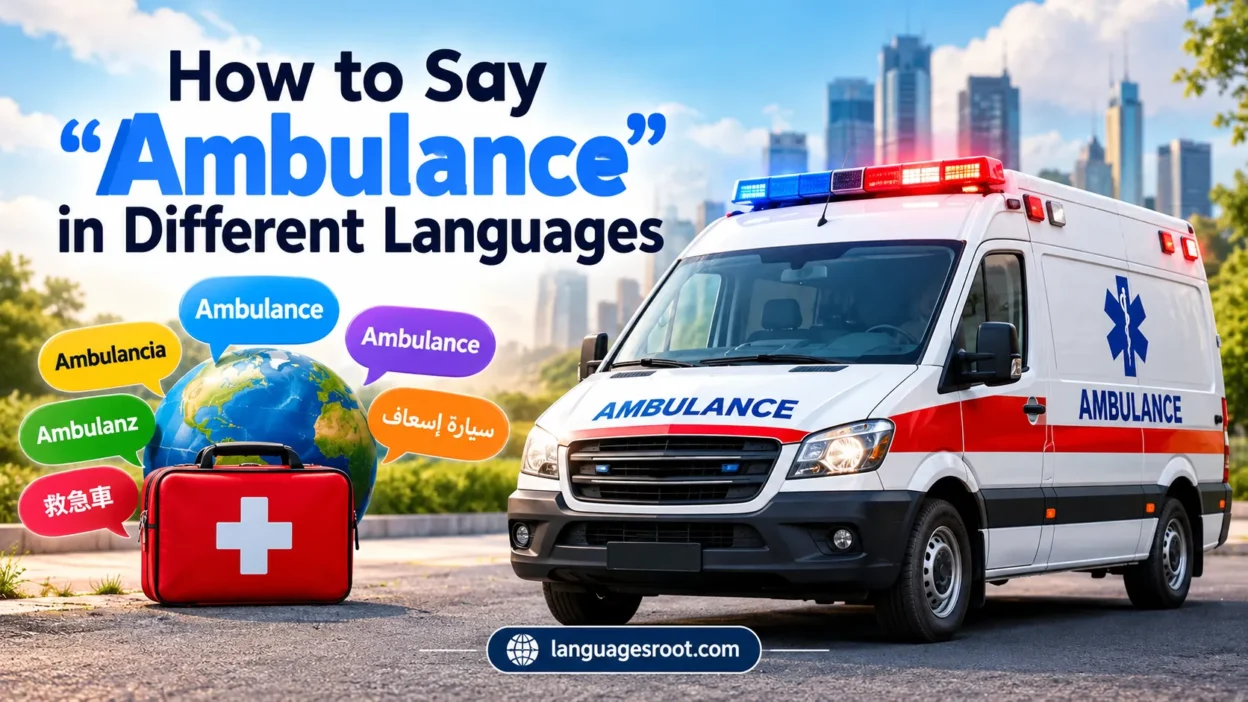
An ambulance is an emergency vehicle that provides urgent medical care during an emergency situation. Learning how to say ambulance can help travelers, families, and healthcare workers communicate during stressful moments. This guide explains ambulance translation across many world languages with clear meanings and pronunciation. It also introduces useful emergency vocabulary for everyday medical care and communication.
Whether you need practical emergency vocabulary or want to improve language learning, these translations can help. You will find learner-friendly pronunciation, local variations, and common terms for patient transport and emergency transport. This resource also supports emergency communication and cross-cultural communication when clear language matters most.
Interesting Facts About Ambulance
- 🚑 The word ambulance has French and Latin roots. Its earlier history was connected with mobile or field hospitals before the modern vehicle meaning became established.
- 🚑 Many European languages use a form that closely resembles English, such as ambulanza in Italian, ambulância in Portuguese, ambulancia in Spanish, and ambulans in Swedish.
- 🚑 Other languages describe the function of the vehicle. For example, German Krankenwagen is associated with a vehicle for sick people, while Swedish and Norwegian forms also connect with patient transport.
- 🚑 Some languages use a completely different everyday word. Hungarian commonly uses mentő, Polish uses karetka pogotowia, and Bulgarian commonly uses линейка.
- 🚑 Chinese, Japanese, Korean, and Thai use terms that are structurally different from the English word. Mandarin uses 救护车, Japanese uses 救急車, Korean uses 구급차, and Thai uses รถพยาบาล.
- 🚑 In many countries, you may hear both a native term and a borrowed form. This is especially common when international medical vocabulary enters a local language.
- 🚑 Swahili has both ambulensi and gari la wagonjwa, showing how one language can have a borrowed form and a descriptive expression.
- 🚑 Yoruba commonly uses ọkọ̀ aláìsàn, while Zulu uses i-ambulensi.
- 🚑 Amharic uses አምቡላንስ, while Somali sources give forms including ambalaas and amblaanis.
- 🚑 In Australia, ambulance services also provide multilingual resources so people from different language backgrounds can access important health information.
- 🚑 Japanese emergency services use multilingual interpretation and translation support, reflecting the practical importance of communicating medical needs across languages.
- 🚑 Learning a word such as “ambulance” is useful because emergency conversations often happen under stress, when simple, familiar vocabulary can make communication easier.
How to Say “Ambulance” in Different Languages
The tables below provide the language, country or region, common translation, an easy pronunciation guide, synonyms or related terms, and a simple example sentence. The examples are written naturally for learners, while the translations focus on common everyday forms rather than highly technical medical terminology.
European Languages
European languages show a fascinating mix of shared vocabulary and local expressions. Because many European languages have borrowed medical and scientific terms from French, Latin, or neighboring languages, some translations look very similar to English. Others use words connected with rescue, patients, hospitals, or emergency care. The forms below reflect common usage, with regional differences noted where useful.
| Language | Country/Region | Translation | Pronunciation | Synonyms | Example sentence |
| 🇺🇸 American English | United States | ambulance | AM-byuh-luhns | emergency vehicle | The ambulance is on its way. |
| 🇬🇧 British English | United Kingdom | ambulance | AM-byoo-luhns | emergency vehicle | The ambulance has arrived. |
| 🇦🇺 Australian English | Australia | ambulance | AM-byoo-luhns | emergency vehicle | The ambulance is coming. |
| 🇫🇷 French | France, Belgium, Switzerland | ambulance | ahn-byu-LAHNSS | véhicule sanitaire | L’ambulance arrive. |
| 🇪🇸 Spanish | Spain, Latin America | ambulancia | am-boo-LAN-syah | vehículo sanitario | La ambulancia está en camino. |
| 🇧🇷 Portuguese | Brazil | ambulância | am-boo-LAN-see-ah | veículo de emergência | A ambulância está a caminho. |
| 🇵🇹 Portuguese | Portugal | ambulância | am-boo-LAN-see-ah | viatura de emergência | A ambulância está a caminho. |
| 🇮🇹 Italian | Italy | ambulanza | am-boo-LANT-sah | autoambulanza | L’ambulanza sta arrivando. |
| 🇩🇪 German | Germany, Austria | Krankenwagen | KRANK-en-vah-gen | Rettungswagen | Der Krankenwagen kommt. |
| 🇳🇱 Dutch | Netherlands, Belgium | ambulance | am-bu-LAHN-suh | ziekenwagen, ziekenauto | De ambulance komt. |
| 🇩🇰 Danish | Denmark | ambulance | am-boo-LAHN-suh | redningskøretøj | Ambulancen kommer. |
| 🇸🇪 Swedish | Sweden | ambulans | am-boo-LAHNS | sjuktransport | Ambulansen kommer. |
| 🇳🇴 Norwegian | Norway | ambulanse | am-boo-LAHN-seh | sykebil | Ambulansen kommer. |
| 🇮🇸 Icelandic | Iceland | sjúkrabíll | SYOOK-ra-beetl | neyðarbíll | Sjúkrabíllinn er á leiðinni. |
| 🇫🇮 Finnish | Finland | ambulanssi | am-boo-LAHN-see | sairaankuljetusauto, lanssi | Ambulanssi on tulossa. |
| 🇪🇪 Estonian | Estonia | kiirabi | KEE-ra-bee | kiirabiauto | Kiirabi on teel. |
| 🇱🇻 Latvian | Latvia | ātrā palīdzība | AH-trah pah-LID-zee-bah | ātrās palīdzības mašīna | Ātrā palīdzība ir ceļā. |
| 🇱🇹 Lithuanian | Lithuania | greitoji pagalba | GRAY-toy-yee pah-GAL-bah | greitosios pagalbos automobilis | Greitoji pagalba jau atvyksta. |
| 🇵🇱 Polish | Poland | karetka pogotowia | kah-RET-kah poh-goh-TOH-vyah | karetka, pogotowie | Karetka pogotowia jedzie. |
| 🇨🇿 Czech | Czech Republic | sanitka | sah-NEET-kah | záchranka, ambulance | Sanitka přijíždí. |
| 🇸🇰 Slovak | Slovakia | záchranka | ZAH-khran-kah | sanitka | Záchranka prichádza. |
| 🇸🇮 Slovenian | Slovenia | reševalno vozilo | reh-sheh-VAL-no vo-ZEE-lo | rešilni avto | Reševalno vozilo prihaja. |
| 🇭🇷 Croatian | Croatia | hitna pomoć | HEET-nah poh-MOCH | hitna, vozilo hitne pomoći | Hitna pomoć dolazi. |
| 🇷🇸 Serbian | Serbia | хитна помоћ | HEET-na po-MOCH | хитна | Хитна помоћ долази. |
| 🇧🇬 Bulgarian | Bulgaria | линейка | lee-NAY-kah | Спешна помощ | Линейката идва. |
| 🇷🇴 Romanian | Romania, Moldova | ambulanță | am-boo-LANT-suh | salvare | Ambulanța vine. |
| 🇭🇺 Hungarian | Hungary | mentő | MEN-toe | mentőautó | A mentő úton van. |
| 🇬🇷 Greek | Greece, Cyprus | ασθενοφόρο | as-theh-no-FO-ro | όχημα πρώτων βοηθειών | Το ασθενοφόρο έρχεται. |
| 🇦🇱 Albanian | Albania, Kosovo | ambulancë | am-boo-LANTS | autoambulancë | Ambulanca po vjen. |
| 🇮🇪 Irish | Ireland | otharcharr | OH-har-kar | feithicil leighis | Tá an t-otharcharr ag teacht. |
| 🏴 Welsh | Wales | ambiwlans | am-BIW-lans | cerbyd ambiwlans | Mae’r ambiwlans yn dod. |
The European group demonstrates how related languages can treat the same object very differently. French, Spanish, Portuguese, and Italian retain recognizable forms related to the international word, while German, Hungarian, Bulgarian, Polish, and several Slavic languages use their own established vocabulary. This is one reason a literal word-for-word assumption does not always work when learning emergency language.
Also Read: How to Say “Cigarettes” in Different Languages
Asian Languages
Asian languages contain some of the most interesting translations for “ambulance.” Several languages use international loanwords, especially where the modern medical term entered through English or another European language. Others use descriptive expressions centered on rescue, patients, medical care, or urgent transportation. Major multilingual emergency services also provide support for several Asian languages, showing how important clear communication is during urgent situations.
| Language | Country/Region | Translation | Pronunciation | Synonyms | Example sentence |
| 🇨🇳 Mandarin Chinese | China, Taiwan, Singapore | 救护车 / 救護車 | jyoh-hoo-chuh | 急救车 | 救护车来了。 |
| 🇭🇰 Cantonese | Hong Kong, southern China | 救護車 | gau-huht-che | 急救車 | 救護車嚟喇。 |
| 🇯🇵 Japanese | Japan | 救急車 | kyūkyūsha | 救急自動車 | 救急車が来ています。 |
| 🇰🇷 Korean | South Korea | 구급차 | gu-geup-cha | 응급차 | 구급차가 오고 있어요. |
| 🇻🇳 Vietnamese | Vietnam | xe cứu thương | seh koo-thuong | xe cấp cứu | Xe cứu thương đang đến. |
| 🇹🇭 Thai | Thailand | รถพยาบาล | rot pha-yaa-baan | รถฉุกเฉิน | รถพยาบาลกำลังมา |
| 🇱🇦 Lao | Laos | ລົດສຸກເສີນ | lot souk-soen | ລົດໂຮງໝໍ | ລົດສຸກເສີນກຳລັງມາ. |
| 🇰🇭 Khmer | Cambodia | រថយន្តសង្គ្រោះបន្ទាន់ | roth-yohn sang-kroh ban-teun | រថយន្តពេទ្យ | រថយន្តសង្គ្រោះបន្ទាន់កំពុងមក។ |
| 🇲🇲 Burmese | Myanmar | လူနာတင်ယာဉ် | lu-na-tin-yan | အရေးပေါ်ယာဉ် | လူနာတင်ယာဉ် လာနေပါတယ်။ |
| 🇮🇩 Indonesian | Indonesia | ambulans | am-boo-lans | mobil darurat | Ambulans sedang datang. |
| 🇲🇾 Malay | Malaysia, Brunei | ambulans | am-boo-lans | kereta sakit | Ambulans sedang datang. |
| 🇵🇭 Filipino | Philippines | ambulansya | am-boo-LAN-sha | sasakyang pang-emerhensiya | Darating na ang ambulansya. |
| 🇮🇳 Hindi | India | एम्बुलेंस | em-boo-lens | रोगी वाहन | एम्बुलेंस आ रही है। |
| 🇵🇰 Urdu | Pakistan, India | ایمبولینس | em-boo-lens | مریضوں کی گاڑی | ایمبولینس آ رہی ہے۔ |
| 🇧🇩 Bengali | Bangladesh, India | অ্যাম্বুলেন্স | am-boo-lens | রোগীবাহী গাড়ি | অ্যাম্বুলেন্স আসছে। |
| 🇮🇳 Punjabi | India, Pakistan | ਐਂਬੂਲੈਂਸ | aim-boo-lens | ਮਰੀਜ਼ਾਂ ਦੀ ਗੱਡੀ | ਐਂਬੂਲੈਂਸ ਆ ਰਹੀ ਹੈ। |
| 🇮🇳 Gujarati | India | એમ્બ્યુલન્સ | em-byoo-lans | દર્દી વાહન | એમ્બ્યુલન્સ આવી રહી છે. |
| 🇮🇳 Marathi | India | रुग्णवाहिका | roog-na-vaa-hee-ka | रुग्णवाहन | रुग्णवाहिका येत आहे. |
| 🇮🇳 Tamil | India, Sri Lanka | ஆம்புலன்ஸ் | aam-boo-lans | மருத்துவ அவசர ஊர்தி | ஆம்புலன்ஸ் வருகிறது. |
| 🇮🇳 Telugu | India | అంబులెన్స్ | am-boo-lens | అత్యవసర వైద్య వాహనం | అంబులెన్స్ వస్తోంది. |
| 🇮🇳 Kannada | India | ಆಂಬ್ಯುಲೆನ್ಸ್ | aam-byoo-lens | ತುರ್ತು ರೋಗಿ ವಾಹನ | ಆಂಬ್ಯುಲೆನ್ಸ್ ಬರುತ್ತಿದೆ. |
| 🇮🇳 Malayalam | India | ആംബുലൻസ് | aam-boo-lans | രോഗി വാഹനം | ആംബുലൻസ് വരുന്നു. |
Many Asian languages make an interesting distinction between a standard everyday loanword and a more descriptive native expression. For example, Indonesian and Malay use a form related to “ambulance,” while Vietnamese describes a vehicle used for rescuing or transporting patients. Japanese and Korean similarly use specialized emergency terms rather than simply copying the English spelling.
African Languages
African languages often show the influence of both local vocabulary and international medical terminology. Some use a form closely related to the English or French word “ambulance,” while others describe the vehicle as something that carries sick people or provides emergency transport. The examples below include widely spoken African languages from eastern, western, southern, and central parts of the continent.
| Language | Country/Region | Translation | Pronunciation | Synonyms | Example sentence |
| 🇹🇿 Swahili | Tanzania, Kenya, East Africa | ambulensi | am-boo-LEN-see | gari la wagonjwa | Ambulensi inakuja. |
| 🇿🇦 Zulu | South Africa | i-ambulensi | ee-am-boo-LEN-see | imoto yeziguli | I-ambulensi iyeza. |
| 🇿🇦 Xhosa | South Africa | inqwelo yezigulana | een-KWEH-loh zeh-zee-goo-LAH-nah | i-ambulensi | Inqwelo yezigulana iyeza. |
| 🇿🇦 Afrikaans | South Africa, Namibia | ambulans | am-boo-LAHNS | noodvoertuig | Die ambulans kom. |
| 🇪🇹 Amharic | Ethiopia | አምቡላንስ | am-boo-LANS | መጓዓዝያ ሕሙማት | አምቡላንስ እየመጣ ነው። |
| 🇸🇴 Somali | Somalia, Somaliland | ambalaas | am-ba-LAAS | amblaanis | Ambalaasku wuu imanayaa. |
| 🇳🇬 Hausa | Nigeria, Niger, West Africa | motar asibiti | mo-tar a-see-BEE-tee | ambulans | Motar asibiti tana zuwa. |
| 🇳🇬 Yoruba | Nigeria, Benin | ọkọ̀ aláìsàn | aw-KAW ah-lah-ee-SAHN | ambulansi | Ọkọ̀ aláìsàn ń bọ̀. |
| 🇳🇬 Igbo | Nigeria | ụgbọ ihe mberede | gvoo-oh ee-heh mmbeh-reh-deh | ụgbọ ala mberede | Ụgbọ ihe mberede na-abịa. |
| 🇲🇼 Chichewa | Malawi, Zambia | ambulansi | am-boo-LAN-see | galimoto yonyamula odwala | Ambulansi ikubwera. |
Swahili provides a particularly useful example of linguistic variation because both ambulensi and gari la wagonjwa appear in language-learning and dictionary resources. The latter is descriptive and refers to a vehicle for patients. Likewise, Yoruba commonly uses ọkọ̀ aláìsàn, which directly describes a vehicle associated with a sick person or patient.
Middle Eastern Languages
Middle Eastern languages include several different language families, so the word for ambulance can vary widely. Arabic often uses a descriptive phrase involving rescue or emergency service, Persian commonly uses a form close to the international medical term, and Hebrew uses a loanword. Turkish also has a highly recognizable form. Pashto and Dari similarly use forms related to “ambulance.”
| Language | Country/Region | Translation | Pronunciation | Synonyms | Example sentence |
| 🇸🇦 Arabic | Middle East, North Africa | سيارة إسعاف | say-YAR-at is-AHF | عربة إسعاف | سيارة الإسعاف قادمة. |
| 🇮🇷 Persian | Iran | آمبولانس | am-boo-LANS | خودروی اورژانس | آمبولانس در راه است. |
| 🇮🇱 Hebrew | Israel | אמבולנס | am-boo-LANS | רכב חירום רפואי | האמבולנס מגיע. |
| 🇹🇷 Turkish | Turkey, Cyprus | ambulans | am-boo-LANS | acil yardım aracı | Ambulans geliyor. |
| 🇦🇫 Pashto | Afghanistan, Pakistan | امبولانس | am-boo-LANS | ژغورګاډی | امبولانس راځي. |
| 🇦🇫 Dari | Afghanistan | امبولانس | am-boo-LANS | موتر آمبولانس | امبولانس در راه است. |
| Kurdistan regions | Kurmanji Kurdish | ambûlans | am-boo-LANS | ereba nexweşan | Ambûlans tê. |
| 🇦🇲 Armenian | Armenia | շտապօգնության մեքենա | shta-po-gnoot-YOON ma-keh-NA | շտապօգնություն | Շտապօգնության մեքենան գալիս է։ |
| 🇬🇪 Georgian | Georgia, Caucasus | სასწრაფო დახმარების მანქანა | sas-tsra-po da-khma-re-BEES man-ka-na | სასწრაფო დახმარება | სასწრაფო დახმარების მანქანა მოდის. |
| 🇦🇿 Azerbaijani | Azerbaijan | təcili tibbi yardım maşını | teh-JEE-lee tee-BEE yar-dum ma-SHUH-nuh | ambulans | Təcili yardım maşını gəlir. |
Arabic is especially interesting because سيارة إسعاف literally centers on the idea of an emergency or rescue vehicle. Persian, Hebrew, Turkish, Dari, and Pashto often preserve a recognizable international form.
Additional Languages Around the World

The final group expands the list beyond the main regional categories. It includes languages from South Asia, Central Asia, Oceania, and the international constructed-language tradition. Some of these terms are borrowed directly, while others have developed descriptive expressions that fit the structure of the language.
| Language | Country/Region | Translation | Pronunciation | Synonyms | Example sentence |
| 🇳🇵 Nepali | Nepal | एम्बुलेन्स | em-boo-lens | रोगी वाहन | एम्बुलेन्स आउँदैछ। |
| 🇱🇰 Sinhala | Sri Lanka | ගිලන් රථය | gee-lan ra-tha-ya | රෝගී රථය | ගිලන් රථය එනවා. |
| 🇰🇿 Kazakh | Kazakhstan | жедел жәрдем | zhe-del zhar-dem | жедел жәрдем машинасы | Жедел жәрдем келе жатыр. |
| 🇰🇬 Kyrgyz | Kyrgyzstan | тез жардам | tez zhar-dam | тез жардам унаасы | Тез жардам келе жатат. |
| 🇺🇿 Uzbek | Uzbekistan | tez yordam mashinasi | tez yah-dam ma-shee-na-see | tez yordam | Tez yordam mashinasi kelmoqda. |
| 🇲🇳 Mongolian | Mongolia | түргэн тусламжийн машин | toor-gen toos-lam-jin ma-sheen | эмнэлгийн машин | Түргэн тусламжийн машин ирж байна. |
| 🇳🇿 Māori | New Zealand | waka tūroro | wah-kah too-ROH-roh | waka hauora | Kei te haere mai te waka tūroro. |
| 🇺🇸 Hawaiian | Hawaii | kaʻa lawe maʻi | ka-a LAH-veh my | kaʻa lapaʻau | Ke hele mai nei ka kaʻa lawe maʻi. |
| 🇼🇸 Samoan | Samoa | ta’avale falema’i | tah-ah-vah-leh fah-leh-MY | ta’avale fesoasoani | O lo’o sau le ta’avale falema’i. |
| 🌍 Esperanto | International | ambulanco | am-boo-LAN-tso | urĝa medicina veturilo | La ambulanco venas. |
Why “Ambulance” Looks Similar in So Many Languages
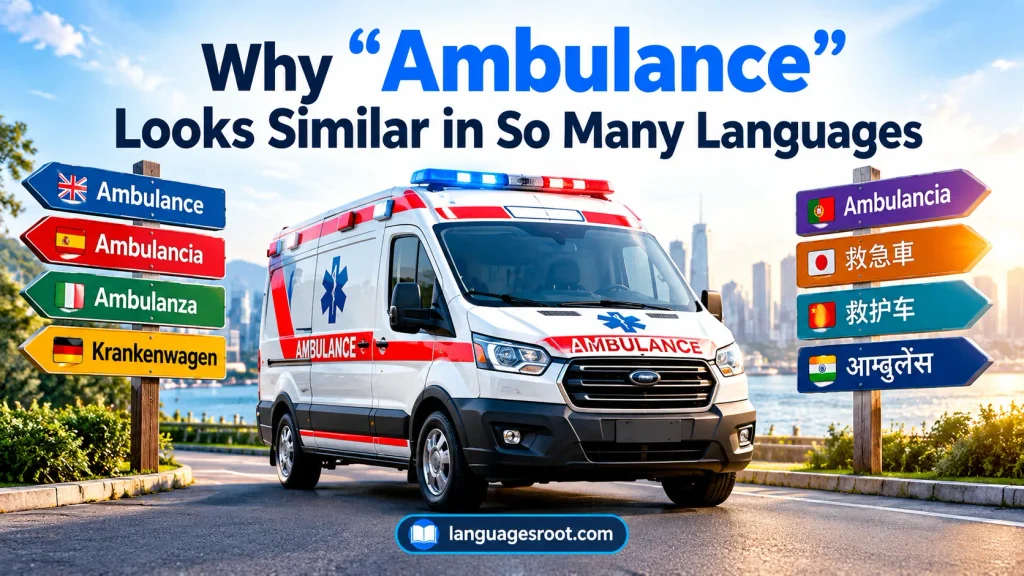
One of the most noticeable patterns in this list is the large number of languages that use a word related to the international form ambulance. This happens because modern medical vocabulary has traveled between languages through French, English, Latin, scientific terminology, colonial history, international trade, education, and modern healthcare systems.
For example, Italian ambulanza, Spanish ambulancia, Portuguese ambulância, and French ambulance are immediately recognizable to an English speaker. Indonesian ambulans, Turkish ambulans, Swedish ambulans, and Afrikaans ambulans show the same broad international family.
However, not every language follows this pattern. Polish uses karetka pogotowia, Bulgarian commonly uses линейка, Hungarian uses mentő, German commonly uses Krankenwagen or Rettungswagen, and Japanese uses 救急車. These differences remind learners that international vocabulary is only one part of language development.
How to Use the Word “Ambulance” in an Emergency
Knowing the local word is useful, but it is even better to understand a few connected phrases. In an emergency, simple language is usually more practical than a long sentence.
You may need to communicate these basic ideas:
Call an ambulance.
This is one of the most useful emergency phrases to learn alongside the word itself.
There is an injured person.
This quickly tells someone why medical help is needed.
Someone is unconscious.
This can communicate a serious emergency even when you do not know detailed medical vocabulary.
The ambulance is on the way.
This can reassure people that help has already been contacted.
Where is the hospital?
This can be useful when an emergency occurs while traveling.
I need medical help.
This is a useful phrase for travelers who may not know the local healthcare system.
Wiktionary’s multilingual entry for “call an ambulance” includes forms in Arabic, Armenian, Azerbaijani, Basque, Bulgarian, Catalan, Chinese, Czech, Russian, Slovak, Spanish, Swedish, Tagalog, Thai, Turkish, Ukrainian, Welsh, and other languages.
Ambulance Vocabulary You May See With It
Understanding related words can make the main term easier to remember. These words are useful for travelers, language students, and anyone studying healthcare vocabulary.
Hospital: The place where many patients are taken for further medical care.
Paramedic: A trained medical professional who may provide emergency treatment before or during transportation.
Emergency: A situation requiring immediate action or medical attention.
Patient: A person receiving medical assessment or treatment.
Injury: Physical harm caused by an accident, fall, impact, or another event.
Doctor: A medical professional who diagnoses and treats illness and injury.
Nurse: A healthcare professional involved in patient care and treatment.
Stretcher: A device used to move a person who cannot walk safely.
Emergency room: A hospital department that treats urgent medical problems.
First aid: Immediate basic care given before more complete medical treatment is available.
Learning these words together creates a much stronger vocabulary set than memorizing “ambulance” by itself.
Easy Ways to Remember “Ambulance” in Another Language
A useful memory trick is to look for similarities first. Words such as ambulans, ambulanza, ambulância, and ambulancia are easy to connect because they share a recognizable structure.
Next, pay attention to descriptive words. German Krankenwagen, for example, is built around the idea of a vehicle for sick people. Swahili gari la wagonjwa also uses a descriptive structure connected with patients. Japanese 救急車 and Mandarin 救护车 use characters associated with emergency or rescue services and vehicles.
Another useful technique is to learn the pronunciation with a short sentence. Rather than memorizing one isolated word, practice a phrase such as “The ambulance is coming” or “Call an ambulance.” Context makes unfamiliar vocabulary easier to recall.
You can also group languages geographically. For instance, learning French ambulance, Spanish ambulancia, and Portuguese ambulância together makes their similarities easier to notice. Then compare them with German Krankenwagen or Hungarian mentő to see how different language families create their own terminology.
Is “Ambulance” the Same in Every English-Speaking Country?
The word ambulance is used in American English, British English, and Australian English. The pronunciation can vary by accent, but the spelling and basic meaning remain recognizable.
In everyday English, you may hear expressions such as “call an ambulance,” “the ambulance is coming,” “the ambulance has arrived,” and “ambulance service.” British and Australian usage may also include terminology connected with the organized ambulance service, emergency medical services, or paramedics.
The important point is that the core word ambulance is widely understood throughout English-speaking regions.
Is “Ambulance” a Loanword in Many Languages?
Yes. A large number of languages use forms historically related to French ambulance or the wider international medical vocabulary surrounding it. The deeper origin goes back to Latin ambulare, meaning to walk or move, through French terminology associated with a mobile or field hospital.
This history explains why similar forms occur in many modern languages. International medicine, education, military terminology, and global communication have also helped spread standardized medical vocabulary.
At the same time, borrowed vocabulary does not replace local terminology everywhere. Many languages have developed descriptive terms that emphasize the vehicle’s purpose instead of preserving the international word.
What Is the Most Common Translation of Ambulance in Europe?
There is no single European translation because Europe contains many languages and language families. Several languages use close forms of ambulance, while others have completely different words.
Examples include French ambulance, Spanish ambulancia, Portuguese ambulância, Italian ambulanza, Swedish ambulans, and Norwegian ambulanse. In contrast, German commonly uses Krankenwagen, Hungarian uses mentő, Polish uses karetka pogotowia, and Bulgarian commonly uses линейка.
What Is “Ambulance” in Asian Languages?
Asian languages use many different terms. Some are international loanwords, while others use descriptive expressions.
A few especially useful examples are:
Mandarin Chinese: 救护车
Japanese: 救急車
Korean: 구급차
Vietnamese: xe cứu thương
Thai: รถพยาบาล
Indonesian: ambulans
Malay: ambulans
Hindi: एम्बुलेंस
Urdu: ایمبولینس
Bengali: অ্যাম্বুলেন্স
These forms are documented across multilingual dictionaries and language-learning references.
What Is “Ambulance” in African Languages?
African languages also have several different patterns.
Swahili commonly uses ambulensi and gari la wagonjwa. Zulu uses i-ambulensi, Xhosa uses inqwelo yezigulana, Yoruba uses ọkọ̀ aláìsàn, Hausa uses motar asibiti, and Amharic uses አምቡላንስ.
These differences are a good reminder that the easiest word to recognize visually is not necessarily the most natural word for a native speaker.
What Is “Ambulance” in Arabic?
In Arabic, a widely used term is سيارة إسعاف, commonly pronounced approximately say-YAR-at is-AHF. It refers to an ambulance or emergency medical vehicle.
The Arabic expression is more descriptive than English, which shows how languages can organize the same concept differently. Related emergency vocabulary may vary between countries and regional varieties of Arabic.
What Is “Ambulance” in Urdu?
In Urdu, the common word is ایمبولینس, pronounced approximately em-boo-lens.
Urdu uses many international medical terms, especially in modern healthcare settings. You may also encounter descriptive phrases related to transporting patients, but ایمبولینس is the recognizable everyday term.
What Is “Ambulance” in Hindi?
Hindi commonly uses एम्बुलेंस, pronounced approximately em-boo-lens. A more descriptive expression such as रोगी वाहन can also be encountered in terminology resources.
The familiar international form is particularly easy for learners because its pronunciation is close to the English word.
What Is “Ambulance” in Japanese?
Japanese uses 救急車, written in kanji and commonly romanized as kyūkyūsha.
The term is especially memorable because it is structurally Japanese rather than a direct spelling of the English word. Japan also provides multilingual support for emergency communication, including Chinese, Korean, Portuguese, Spanish, English, and several other languages.
What Is “Ambulance” in Chinese?
In Mandarin Chinese, the common term is 救护车 in simplified Chinese and 救護車 in traditional Chinese. It is pronounced approximately jiùhùchē.
The same concept can look different depending on whether simplified or traditional Chinese characters are used. Cantonese commonly uses 救護車 as well, with a Cantonese pronunciation.
What Is “Ambulance” in Korean?
Korean uses 구급차, romanized gugeupcha.
It is an everyday emergency-services term and is widely recognizable in South Korean contexts. A related word such as 응급차 may also appear in some contexts, especially when discussing emergency transportation.
FAQs About
How do you say “ambulance” in different languages?
The word ambulance has many forms across world languages, including ambulance in French, ambulanza in Italian, ambulancia in Spanish, and ambulans in Swedish. Some languages use different terms, such as German Krankenwagen, Japanese 救急車, and Hungarian mentő.
Why are ambulance translations different across languages?
Some languages borrow international medical vocabulary, while others create descriptive terms linked to emergency transport, patients, or rescue. For example, Krankenwagen relates to transporting sick people, while Arabic سيارة إسعاف describes an emergency or rescue vehicle.
What is “ambulance” in Urdu?
In Urdu, ambulance is commonly written as ایمبولینس and pronounced approximately “em-boo-lens.” This familiar term is widely used in modern medical care and emergency communication.
What is “ambulance” in Hindi?
Hindi commonly uses एम्बुलेंस, pronounced approximately “em-boo-lens.” The term is common in emergency vocabulary, while रोगी वाहन may also appear as a more descriptive expression for patient transport.
Should I learn “call an ambulance” in another language?
Yes. Learning call an ambulance can be more useful than knowing the noun alone during an emergency situation. It gives you a practical phrase for requesting urgent medical care when traveling or communicating across languages.
Conclusion
Learning how to say ambulance in different languages builds useful emergency vocabulary and supports clear emergency communication across cultures. While words such as ambulans, ambulanza, and ambulancia share familiar roots, other languages use unique terms linked to rescue, patients, or medical care. By learning local translations, pronunciation, and phrases like call an ambulance, travelers and language learners can communicate more clearly during an emergency situation.