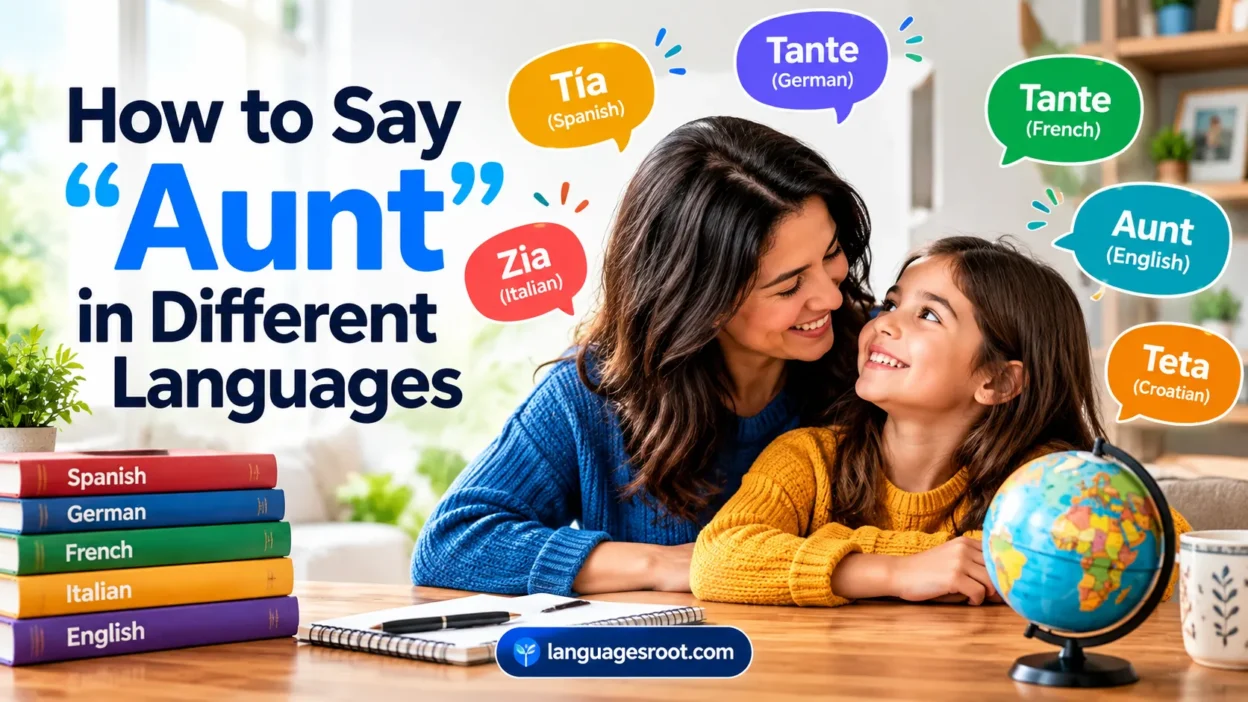
Learning the word for aunt can reveal how family relationships vary across cultures. In different languages, people may use different terms for a maternal aunt or paternal aunt. Also, age, formality, and region can shape how families address their family members. Therefore, knowing the right term helps you communicate naturally when traveling or learning a language.
This guide explores how to say aunt in different languages, including common European languages and other regions. You will discover forms such as tante and tia, along with terms for your mother’s side or father’s side. These ways to say aunt can make speaking with relatives easier and help you understand cultural variation around the world.
Interesting Facts About “Aunt”
- The English word aunt can refer to your mother’s sister, father’s sister, or an uncle’s wife.
- Many languages have separate words for a maternal aunt and a paternal aunt.
- Some languages also distinguish an aunt by age or family position.
- In several Asian cultures, family vocabulary can identify exactly how a relative is connected to you.
- In some cultures, older women who are not biological relatives may also be addressed using an aunt-like family term.
- English has regional pronunciation differences, especially between American and British English.
- In informal English, children may use forms such as Auntie or Aunty.
- “Auntie” is especially common as an affectionate form in British, Australian, South Asian, and other varieties of English.
- In many languages, the word for aunt changes depending on whether she is related through the mother or father.
- Family terms often reveal how a culture traditionally organizes relationships and generations.
- Translation depends on context. A dictionary may provide a general word even when native speakers normally use a more specific family term.
- Some languages have different terms for a biological aunt and an aunt by marriage.
- Learning family vocabulary is one of the easiest ways to build useful everyday language skills.
- Knowing the correct family term can make conversations with native speakers feel more natural and respectful.
- The English plural form is aunts.
- The affectionate forms Auntie and Aunty can sound warmer and more personal than “aunt.”
- In some cultures, an aunt can have a social role similar to a second mother, particularly in extended families.
- Family titles may also change depending on whether the speaker is a child or an adult.
- Some languages use a general word for aunt in everyday speech but more precise terms in formal family descriptions.
- When speaking to someone directly, the term used may differ from the term used when describing that person to somebody else.
How to Say “Aunt” in Different Languages
The following tables include more than 70 languages from Europe, Asia, Africa, the Middle East, and other parts of the world. Where a language has important distinctions between maternal and paternal aunts, those differences are noted.
European Languages
European languages offer a wide variety of family terms. Romance languages such as Spanish, French, Italian, and Portuguese generally have a broad word for “aunt,” while some Slavic languages make more detailed family distinctions. Germanic languages also have familiar and affectionate forms that can be used with children or close relatives.
| Language | Country/Region | Translation | Pronunciation | Synonyms | Example sentence |
| 🇺🇸 American English | United States | Aunt | ant | Auntie | My aunt lives nearby. |
| 🇬🇧 British English | UK | Aunt | ahnt / ant | Auntie | My aunt is visiting today. |
| 🇦🇺 Australian English | Australia | Aunty / Aunt | ahn-tee | Aunt | My aunty made dinner. |
| 🇪🇸 Spanish | Spain, Latin America | Tía | TEE-ah | Tía | Mi tía vive en Madrid. |
| 🇫🇷 French | France | Tante | tahnt | Tata, tante | Ma tante habite à Paris. |
| 🇮🇹 Italian | Italy | Zia | TSEE-ah | Zietta | Mia zia vive a Roma. |
| 🇵🇹 Portuguese | Portugal, Brazil | Tia | TEE-ah | Titia | Minha tia mora aqui. |
| 🇩🇪 German | Germany, Austria | Tante | TAHN-tuh | Tantchen | Meine Tante kommt morgen. |
| 🇳🇱 Dutch | Netherlands, Belgium | Tante | TAHN-tuh | Tantetje | Mijn tante woont hier. |
| 🇸🇪 Swedish | Sweden | Moster / Faster | MOOS-ter / FAHS-ter | Tant | Min moster bor i Stockholm. |
| 🇳🇴 Norwegian | Norway | Tante | TAHN-teh | Tant | Tanten min kommer i morgen. |
| 🇩🇰 Danish | Denmark | Tante | TAHN-teh | Tant | Min tante bor i Aarhus. |
| 🇫🇮 Finnish | Finland | Täti | TAE-tee | Täti | Tätini asuu Helsingissä. |
| 🇮🇸 Icelandic | Iceland | Frænka | FRAIN-ka | Frænka | Frænka mín býr hér. |
| 🇮🇪 Irish | Ireland | Aintín | AN-tseen | Aintín | Tá m’aintín anseo. |
| 🏴 Welsh | Wales | Modryb | MOD-rib | Modryb | Mae fy modryb yma. |
| 🇵🇱 Polish | Poland | Ciocia | CHO-cha | Ciotka | Moja ciocia mieszka tutaj. |
| 🇨🇿 Czech | Czech Republic | Teta | TEH-ta | Tetička | Moje teta bydlí tady. |
| 🇸🇰 Slovak | Slovakia | Teta | TEH-ta | Tetička | Moja teta býva tu. |
| 🇺🇦 Ukrainian | Ukraine | Тітка | TEET-ka | Тітонька | Моя тітка живе тут. |
| 🇷🇺 Russian | Russia | Тётя | TYOH-tya | Тётушка | Моя тётя живёт здесь. |
| 🇧🇾 Belarusian | Belarus | Цётка | TSYOT-ka | Цёця | Мая цётка жыве тут. |
| 🇧🇬 Bulgarian | Bulgaria | Леля | LEH-lya | Леличка | Моята леля живее тук. |
| 🇷🇸 Serbian | Serbia | Tetka | TEHT-ka | Tetkica | Moja tetka živi ovde. |
| 🇭🇷 Croatian | Croatia | Teta | TEH-ta | Tetica | Moja teta živi ovdje. |
| 🇸🇮 Slovenian | Slovenia | Teta | TEH-ta | Tetica | Moja teta živi tukaj. |
| 🇷🇴 Romanian | Romania | Mătușă | muh-TOOSH-uh | Mătușica | Mătușa mea locuiește aici. |
| 🇬🇷 Greek | Greece | Θεία | THEE-ah | Θεία μου | Η θεία μου μένει εδώ. |
| 🇭🇺 Hungarian | Hungary | Néni | NAY-nee | Nénike | A néném itt lakik. |
| 🇦🇱 Albanian | Albania, Kosovo | Hallë / Teze | HAH-luh / TEH-zeh | Teze | Halla ime jeton këtu. |
| 🇱🇹 Lithuanian | Lithuania | Teta | TEH-ta | Tetulė | Mano teta gyvena čia. |
| 🇱🇻 Latvian | Latvia | Tante | TAHN-teh | Tantiņa | Mana tante dzīvo šeit. |
| 🇪🇪 Estonian | Estonia | Tädi | TAE-dee | Tädi | Minu tädi elab siin. |
| 🇲🇹 Maltese | Malta | Zija | ZEE-ya | Zija | Iz-zija tiegħi tgħix hawn. |
In several European languages, the exact family relationship can matter. For example, Swedish distinguishes moster, the sister of your mother, from faster, the sister of your father. Albanian also traditionally distinguishes different kinds of aunts. These distinctions show why a single English word does not always have one perfect equivalent in another language.
Asian Languages
Asian languages often provide especially interesting examples of family terminology. In Mandarin Chinese, Korean, Japanese, Hindi, and several other languages, the relationship between the speaker and the aunt may influence the word used. Age, maternal or paternal connection, and sometimes whether the relative is related by blood or marriage can all matter.
| Language | Country/Region | Translation | Pronunciation | Synonyms | Example sentence |
| 🇨🇳 Mandarin Chinese | China, Taiwan | 阿姨 / 姑姑 | āyí / gūgu | 姨妈 | 我的阿姨住在北京。 |
| 🇯🇵 Japanese | Japan | おば / 伯母 / 叔母 | oba | おばさん | 私のおばは東京に住んでいます。 |
| 🇰🇷 Korean | South Korea | 이모 / 고모 | imo / gomo | 이모님 | 이모가 오늘 오세요. |
| 🇮🇳 Hindi | India | मौसी / बुआ | mausī / buā | चाची, मामी | मेरी मौसी यहाँ रहती हैं। |
| 🇵🇰 Urdu | Pakistan, India | خالہ / پھوپھی | khālah / phūphī | چچی, ممانی | میری خالہ یہاں رہتی ہیں۔ |
| 🇧🇩 Bengali | Bangladesh, India | খালা / পিসি | khālā / pisi | মাসি | আমার খালা এখানে থাকেন। |
| 🇵🇳 Punjabi | Pakistan, India | ਮਾਸੀ / ਭੂਆ | māsī / bhūā | ਚਾਚੀ | ਮੇਰੀ ਮਾਸੀ ਇੱਥੇ ਰਹਿੰਦੀ ਹੈ। |
| 🇮🇳 Gujarati | India | માસી / ફોઈ | māsī / phōī | કાકી | મારી માસી અહીં રહે છે. |
| 🇮🇳 Marathi | India | मावशी / आत्या | māvaśī / ātyā | काकू | माझी मावशी इथे राहते. |
| 🇳🇵 Nepali | Nepal | माइजू / फुपू | māiju / phupū | काकी | मेरी फुपू यहाँ बस्नुहुन्छ। |
| 🇱🇰 Sinhala | Sri Lanka | නැන්දා | nændā | නැන්දා | මගේ නැන්දා මෙහි ජීවත් වෙනවා. |
| 🇮🇩 Indonesian | Indonesia | Bibi / Tante | BEE-bee / TAHN-teh | Bude | Bibi saya tinggal di sini. |
| 🇲🇾 Malay | Malaysia, Brunei | Mak saudara | mak sow-dah-rah | Aunty | Mak saudara saya tinggal di sini. |
| 🇵🇭 Filipino | Philippines | Tiya | TEE-ya | Tita | Ang tiya ko ay nakatira rito. |
| 🇻🇳 Vietnamese | Vietnam | Cô / Dì | koh / zee | Thím | Dì tôi sống ở đây. |
| 🇹🇭 Thai | Thailand | ป้า / น้า / อา | bpâa / náa / aa | ป้าจ๋า | ป้าของฉันอยู่ที่นี่ |
| 🇰🇭 Khmer | Cambodia | មីង / មា | ming / maa | អ៊ំ | មីងរបស់ខ្ញុំនៅទីនេះ។ |
| 🇱🇦 Lao | Laos | ປ້າ / ນ້າ | paa / naa | ອາ | ປ້າຂອງຂ້ອຍຢູ່ນີ້. |
| 🇲🇲 Burmese | Myanmar | အဒေါ် | uh-daw | ဒေါ် | အဒေါ်က ဒီမှာနေတယ်။ |
| 🇲🇳 Mongolian | Mongolia | Авга эгч / Нагац эгч | avga egch / nagats egch | Эгч | Миний авга эгч энд амьдардаг. |
| 🇮🇷 Persian | Iran, Afghanistan | خاله / عمه | khāleh / ammeh | عمه جان | خاله من اینجا زندگی میکند. |
| 🇦🇫 Pashto | Afghanistan, Pakistan | ترور / ماما | trur / māma | ترور جان | زما ترور دلته اوسیږي. |
| 🇦🇲 Armenian | Armenia | Մորաքույր / Հորաքույր | morakuyr / horakuyr | քույրիկ | Իմ մորաքույրը այստեղ է ապրում։ |
| 🇬🇪 Georgian | Georgia | დეიდა | DEY-da | დეიდიკო | ჩემი დეიდა აქ ცხოვრობს. |
| 🇮🇱 Hebrew | Israel | דודה | doo-DAH | דודה שלי | דודה שלי גרה כאן. |
| 🇹🇷 Turkish | Turkey | Teyze / Hala | TAY-zeh / HAH-lah | Teyzem | Teyzem burada yaşıyor. |
| 🇮🇩 Javanese | Indonesia | Bulik / Bibi | BOO-leek / BEE-bee | Budhe | Bulik kula manggon ing kéné. |
| 🇰🇿 Kazakh | Kazakhstan | Тәте / Әпке | TAH-teh / AP-keh | Нағашы апа | Менің тәтем осында тұрады. |
| 🇺🇿 Uzbek | Uzbekistan | Amma / Xola | AM-ma / kho-LA | Amma | Mening xolam shu yerda yashaydi. |
One important point is that Asian family vocabulary cannot always be translated word-for-word. Mandarin Chinese, Korean, Hindi, Urdu, Persian, and Turkish can distinguish different sides of the family. Therefore, the correct word for “aunt” depends on exactly which relative you mean.
Also Read: How to Say “Amen” in Different Languages
African Languages
Africa is home to thousands of languages, so there is no single African word for “aunt.” Family terminology varies greatly between regions and language families. Many African cultures place strong importance on extended family, and some languages have specific terms for relatives on the mother’s and father’s sides.
| Language | Country/Region | Translation | Pronunciation | Synonyms | Example sentence |
| 🇿🇦 Zulu | South Africa | Umalumekazi | oo-ma-loo-meh-KAH-zee | U-anti | Umalumekazi wami uhlala lapha. |
| 🇿🇦 Xhosa | South Africa | Umakazi | oo-mah-KAH-zee | U-anti | Umakazi wam uhlala apha. |
| 🇿🇦 Afrikaans | South Africa, Namibia | Tannie | TAH-nee | Tante | My tannie woon hier. |
| 🇰🇪 Swahili | East Africa | Shangazi | shan-GAH-zee | Mama mdogo | Shangazi yangu anaishi hapa. |
| 🇪🇹 Amharic | Ethiopia | አክስት | ak-ist | እህት | አክስቴ እዚህ ትኖራለች። |
| 🇸🇴 Somali | Somalia | Eedo / Habaryar | AY-do / ha-ba-YAR | Eedo | Eeddaday halkan ayay degan tahay. |
| 🇳🇬 Yoruba | Nigeria | Àbúrò ìyá / Àbúrò bàbá | ah-boo-ROH ee-YAH / ah-boo-ROH bah-BAH | Àǹtì | Àbúrò ìyá mi ń gbé níbí. |
| 🇳🇬 Igbo | Nigeria | Nne nne | neh neh | Anti | Nne nne m bi ebe a. |
| 🇳🇬 Hausa | West Africa | Goggo | GOHG-goh | Anti | Goggo ta tana nan. |
| 🇬🇭 Akan | Ghana | Wɔfa | woh-FAH | Auntie | Me wɔfa te ha. |
| 🇬🇭 Twi | Ghana | Wɔfa | woh-FAH | Auntie | Me wɔfa te ha. |
| 🇲🇬 Malagasy | Madagascar | Nenitoa | neh-nee-TOO-ah | Tia | Mipetraka eto ny nenitoako. |
| 🇷🇼 Kinyarwanda | Rwanda | Nyirasenge / Nyinawacu | nyee-ra-SENG-geh / nyee-na-wa-choo | Tante | Nyirasenge wanjye aba hano. |
| 🇧🇼 Setswana | Botswana | Rakgadi | rah-KHA-dee | Mmangwane | Rakgadi o nna fano. |
| 🇱🇸 Sesotho | Lesotho, South Africa | Rakgadi | rah-KHA-dee | Mmangwane | Rakgadi wa ka o dula mona. |
| 🇿🇲 Bemba | Zambia | Ba mayo | bah MY-oh | Mayo | Ba mayo baleele pano. |
| 🇨🇩 Lingala | Congo region | Tante | TAHNT | Mama | Tante na ngai azali awa. |
| 🇲🇿 Chichewa | Malawi, Zambia | Amai aang’ono | ah-MY ahn-GOH-noh | Auntie | Amai anga aang’ono amakhala pano. |
| 🇸🇳 Wolof | Senegal | Ndey | nday | Yaay | Ndey sama dafa fi dëkk. |
African languages demonstrate particularly well why family words should be learned within cultural context. In many communities, kinship terms can extend beyond the nuclear family. An older woman may receive a respectful family-style title even when she is not a biological aunt.
Middle Eastern Languages
Middle Eastern languages include several major language families, including Arabic, Persian, Hebrew, Turkish, Kurdish, and others. Some languages make a clear distinction between a father’s sister and a mother’s sister. Arabic is a particularly useful example because ʿamma traditionally means a paternal aunt, while khāla means a maternal aunt.
| Language | Country/Region | Translation | Pronunciation | Synonyms | Example sentence |
| 🇸🇦 Arabic | Middle East, North Africa | عمة / خالة | ʿammah / khālah | عمتي / خالتي | عمتي تعيش هنا. |
| 🇪🇬 Egyptian Arabic | Egypt | عمة / خالة | ʿamma / khāla | طنط | خالتي تعيش هنا. |
| 🇱🇧 Lebanese Arabic | Lebanon | عمة / خالة | ʿammeh / khaleh | Tante | خالتي هون. |
| 🇮🇷 Persian | Iran | عمه / خاله | ammeh / khāleh | خاله جان | خاله من اینجا زندگی میکند. |
| 🇮🇱 Hebrew | Israel | דודה | doo-DAH | דודתי | דודתי גרה כאן. |
| 🇹🇷 Turkish | Turkey | Hala / Teyze | HAH-lah / TAY-zeh | Teyze | Teyzem burada yaşıyor. |
| 🇮🇶 Kurdish Kurmanji | Kurdistan regions | Met / Xaltî | met / khal-TEE | Xaltî | Xaltîya min li vir dijî. |
| 🇮🇶 Kurdish Sorani | Kurdistan region | پوور / مام | poor / maam | Xaltî | پوورەکەم لێرە دەژیێت. |
| 🇦🇫 Dari | Afghanistan | خاله / عمه | khāla / amma | خاله جان | خالهام اینجا زندگی میکند. |
| 🇾🇪 Yemeni Arabic | Yemen | عمة / خالة | ʿamma / khāla | Auntie | خالتي هنا. |
Arabic provides a useful lesson in family vocabulary. If you know whether the aunt is your mother’s sister or father’s sister, you can choose a more precise term. Persian and Turkish have similar distinctions, although the exact terms and usage differ.
Additional Languages Around the World
The rest of the world contains many languages with fascinating ways to express family relationships. The terms below include languages from the Americas, Pacific, Central Asia, and other regions. Some have one broad term for aunt, while others use more specific kinship terminology.
| Language | Country/Region | Translation | Pronunciation | Synonyms | Example sentence |
| 🇧🇷 Brazilian Portuguese | Brazil | Tia | TEE-ah | Titia | Minha tia mora aqui. |
| 🇲🇽 Mexican Spanish | Mexico | Tía | TEE-ah | Tía | Mi tía vive aquí. |
| 🇨🇺 Cuban Spanish | Cuba | Tía | TEE-ah | Titi | Mi tía vive aquí. |
| 🇭🇹 Haitian Creole | Haiti | Matant | mah-TAHN | Tant | Matant mwen rete isit. |
| 🇯🇲 Jamaican Patois | Jamaica | Auntie | AHN-tee | Aunty | Mi auntie deh yah. |
| 🇨🇦 Canadian French | Canada | Tante | tahnt | Matante | Ma tante habite ici. |
| 🇺🇸 Navajo | United States | Ashį́į́h | varies by dialect | Aunt | Ashį́į́h yá’át’ééh. |
| 🇦🇷 Spanish | Argentina | Tía | TEE-ah | Tía | Mi tía vive aquí. |
| 🇨🇱 Spanish | Chile | Tía | TEE-ah | Tía | Mi tía está aquí. |
| 🇵🇪 Spanish | Peru | Tía | TEE-ah | Tía | Mi tía vive aquí. |
| 🇧🇴 Quechua | Andes | Kachun | ka-CHOON | Tía | Kachuyqa kaypi kawsan. |
| 🇧🇸 Haitian Creole | Caribbean | Matant | mah-TAHN | Tant | Matant mwen la. |
| 🇳🇿 Māori | New Zealand | Whaea kēkē | why-ah keh-keh | Whaea | Kei konei taku whaea kēkē. |
| 🇼🇸 Samoan | Samoa | Auntie / Tinā | AHN-tee / tee-NAH | Aunty | O lo’u auntie lea. |
| 🇹🇴 Tongan | Tonga | Tehina | teh-HEE-na | Mehekitanga | Ko hoku tehinā ia. |
| 🇫🇯 Fijian | Fiji | Nei | nay | Nei | Na noqu nei oqo. |
| 🇵🇬 Tok Pisin | Papua New Guinea | Anti | AHN-tee | Auntie | Anti bilong mi i stap hia. |
| 🇵🇭 Cebuano | Philippines | Tiya | TEE-ya | Tita | Ang akong tiya naa diri. |
| 🇧🇳 Indonesian | Indonesia | Tante / Bibi | TAHN-teh / BEE-bee | Bude | Tante saya tinggal di sini. |
| 🇲🇾 Malay | Malaysia | Mak saudara | mak sow-DAH-rah | Aunty | Mak saudara saya ada di sini. |
Because family structures differ around the world, these translations should be understood as practical equivalents rather than perfectly identical linguistic concepts. For some languages, a general “aunt” translation is perfectly natural. For others, speakers normally choose a term based on the exact family connection.
How to Say “Auntie” in Different Languages
If you are speaking affectionately to an aunt, “Auntie” or “Aunty” may be more appropriate than the formal word “aunt.” English-speaking children commonly use these forms when addressing close relatives.
In other languages, affectionate forms may be created through diminutives, respectful suffixes, nicknames, or changes in pronunciation. The appropriate form depends heavily on the language and family culture. When speaking to somebody’s aunt for the first time, using the standard family term is generally safer than inventing an affectionate form.
Maternal Aunt vs. Paternal Aunt
One of the most important differences between languages is whether they distinguish a mother’s sister from a father’s sister.
For example:
- Spanish: Tía generally covers both.
- French: Tante generally covers both.
- English: Aunt generally covers both.
- Mandarin Chinese: different terms can identify maternal and paternal aunts.
- Korean: 이모 and 고모 distinguish maternal and paternal aunts.
- Hindi: मौसी and बुआ distinguish different sides of the family.
- Urdu: خالہ and پھوپھی distinguish maternal and paternal aunts.
- Arabic: خالة generally means maternal aunt, while عمة means paternal aunt.
- Persian: خاله and عمه distinguish maternal and paternal aunts.
- Turkish: teyze and hala distinguish maternal and paternal aunts.
This is an important reason why simply copying the first translation found in a dictionary can sometimes produce an inaccurate result. Before translating “aunt,” ask which side of the family the person belongs to.
How to Pronounce “Aunt” in English
The pronunciation of aunt differs between English-speaking regions.
In much of American English, it commonly sounds like “ant.” In some British varieties, it is pronounced more like “ahnt.” Australian English commonly uses the same general pronunciation patterns found across varieties of English, with regional differences possible.
The affectionate forms Auntie and Aunty are usually pronounced with two syllables. The spelling varies by region, but the meaning is essentially the same.
When Should You Use “Aunt” or “Auntie”?
The choice depends on the relationship and setting.
Aunt is neutral and works well when describing a family member. For example, “My aunt lives in London” is natural and widely understood.
Auntie or Aunty can sound warmer and more affectionate. Children often use these forms when speaking directly to a beloved aunt. In some communities, these terms may also be used respectfully for older women who are close to the family.
If you are learning another language, listen to how native speakers address relatives in everyday conversations. Family terminology can have social rules that are not obvious from a direct dictionary translation.
Why Family Words Are Different Across Languages
Family vocabulary reflects the way societies describe relationships. English often uses broad words such as “uncle,” “aunt,” and “cousin,” while other languages divide these relationships into more specific categories.
For example, a language may distinguish your mother’s brother from your father’s brother. It may also distinguish an older sibling from a younger sibling or a blood relative from a relative by marriage.
These differences do not mean that one language has a better family system than another. They simply show that languages develop vocabulary around the relationships that are important in their communities.
Tips for Learning “Aunt” in Another Language
When learning the word “aunt,” do not focus only on memorizing the translation. Try to learn how native speakers actually use it.
First, determine whether the language distinguishes maternal and paternal aunts. Next, listen to the pronunciation and notice the stress or tones. Then learn whether an affectionate version is commonly used with children.
It is also helpful to memorize the word inside a complete sentence. Instead of remembering only the translation, practice a sentence such as “My aunt lives here.” This makes it easier to use the word naturally during real conversations.
Finally, remember that regional differences can exist within the same language. A word used in Spain may not always be the most common expression in Mexico, just as British English and American English can use different family expressions.
Frequently Asked Questions
What is “aunt” in Spanish?
The Spanish word for aunt is tía. It usually refers to both a maternal and paternal aunt.
What is “aunt” in Chinese?
Mandarin Chinese uses different terms based on the family relationship. 阿姨 (āyí) can refer to a maternal aunt, while 姑姑 (gūgu) traditionally means a father’s sister.
What is “aunt” in Korean?
Korean distinguishes aunts by family side. 이모 (imo) generally means a mother’s sister, while 고모 (gomo) means a father’s sister.
What is “aunt” in Urdu?
Urdu has separate terms for maternal and paternal aunts. خالہ (khālah) means maternal aunt, while پھوپھی (phūphī) means paternal aunt.
Is “Auntie” the same as “Aunt”?
Generally, both describe the same family relationship. However, Auntie and Aunty often sound warmer or more affectionate, especially when children address a close relative.
Conclusion
Learning how to say aunt in different languages shows how family relationships and family members can vary across cultures. From tía, tante, and zia to distinct terms for a maternal aunt and paternal aunt, each language offers a unique view of family. Understanding these ways to say aunt helps you communicate naturally while traveling, learning a language, or speaking with relatives.