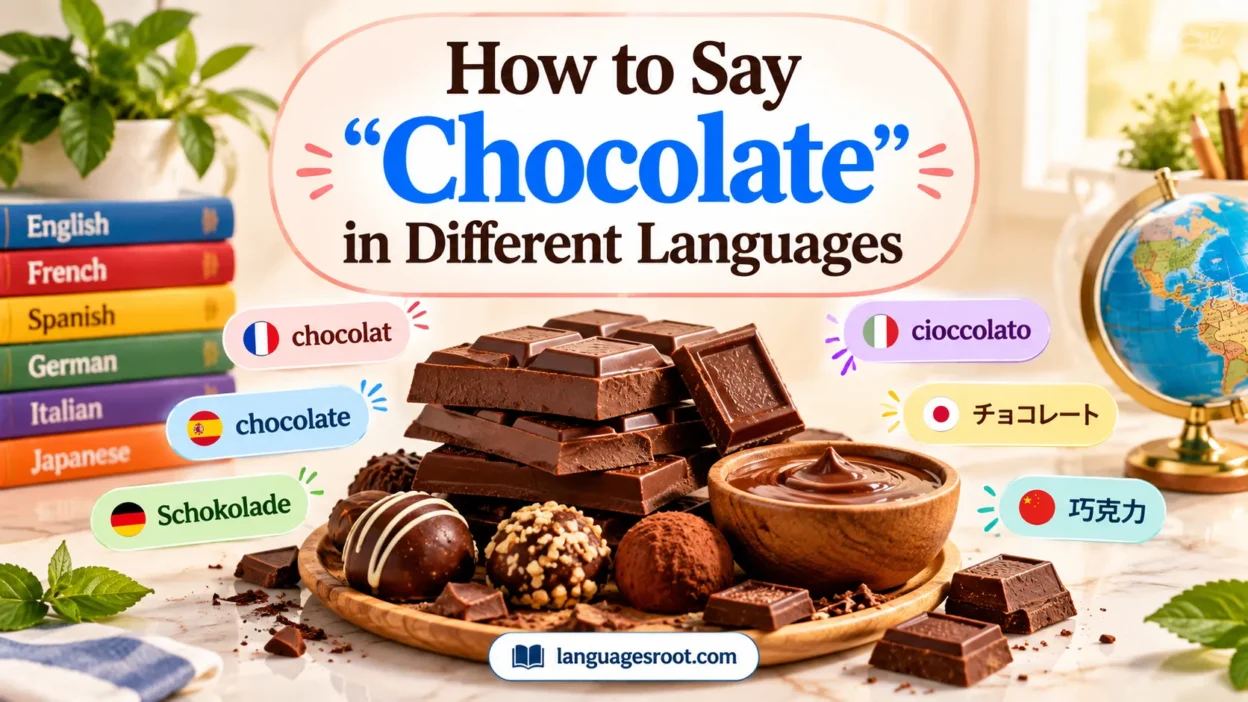
Learning how to say chocolate in different languages makes everyday conversations more fun and meaningful. From chocolate in Spanish to chocolate in French, each language offers a unique way to name this beloved treat. Moreover, exploring chocolate translations helps language learners, travelers, and students discover new words. It also makes ordering dessert abroad, reading foreign menus, and shopping for sweets much easier.
This chocolate translation guide explores chocolate pronunciation, chocolate in native scripts, and chocolate vocabulary across world languages. You will discover chocolate in German, chocolate in Italian, chocolate in Japanese, and chocolate in Arabic, along with useful chocolate example sentences. Additionally, learn interesting chocolate word history and chocolate linguistic facts while exploring chocolate around the world. These translations make language learning more enjoyable and support better multilingual communication across cultures.
Interesting Facts About Chocolate
- Chocolate has a recognizable international vocabulary. Words for chocolate in Spanish, French, Italian, Portuguese, and German have similarities to the English term, making them easier for some learners to recognize.
- The word has historical roots in the Americas. The English word chocolate came through Spanish chocolate, which is associated with the history of cacao in Mesoamerica. The word’s deeper origin is debated.
- Not every language uses the same writing system. Japanese commonly writes chocolate as チョコレート, while Korean uses 초콜릿 and Arabic uses شوكولاتة.
- Pronunciation can differ even when spelling looks familiar. Spanish chocolate, French chocolat, and German Schokolade share a recognizable form but have different sounds.
- Chocolate and cocoa are related but not interchangeable in every context. Chocolate generally refers to a food made from cacao ingredients and other components, while cocoa often refers to the powder or a drink made from it.
- Food vocabulary reflects everyday life. Learning the word for chocolate can help you understand menus, recipes, product labels, and conversations about desserts.
- Compound words often describe specific chocolate products. A language may combine its word for chocolate with words for cake, milk, ice cream, or drink to identify a particular food.
What Does Chocolate Mean?
Chocolate is a food made from ingredients derived from cacao beans, usually combined with ingredients such as sugar and, depending on the product, cocoa butter or milk. It comes in several forms, including dark chocolate, milk chocolate, white chocolate, chocolate bars, desserts, and drinking chocolate.
The word can also bring to mind comfort, celebration, affection, and sharing. For example, someone might give a box of chocolates as a gift, serve chocolate cake at a birthday party, or enjoy a warm chocolate drink on a cold evening. These associations depend on personal experience and cultural context rather than having one universal emotional meaning.
When translating chocolate, the intended meaning is usually straightforward because most languages have an established word for the food. However, a more specific expression may be necessary when discussing chocolate powder, chocolate sauce, a chocolate bar, or hot chocolate. Choosing the correct term helps make conversations about food clearer and more natural.
Why Can Chocolate Have Different Translations?
The word chocolate usually refers to the same food across languages, but its spelling, pronunciation, and grammatical use can differ. Some languages borrow a word that resembles the English term, while others adapt it to their own sounds and writing systems.
Several factors influence the correct translation:
- Pronunciation: A familiar spelling may sound different in another language. French chocolat, for example, has a silent final t in standard pronunciation.
- Writing system: Japanese, Korean, Arabic, Hindi, and other languages use writing systems different from the Latin alphabet.
- Regional usage: Speakers may use different everyday terms for chocolate drinks, sweets, or particular products.
- Context: The word for chocolate itself may differ from the expression used for a chocolate bar, chocolate cake, or hot chocolate.
- Grammar: Some languages require different word forms or grammatical markers depending on how chocolate is used in a sentence.
- Spoken versus written language: Informal speech may use shortened forms, while product labels and formal writing may use more standardized terms.
For this reason, a useful translation guide should provide the actual word, an understandable pronunciation guide, and a natural example sentence rather than relying on spelling alone.
European Languages
European languages belong to several language families, including Romance, Germanic, Slavic, and Uralic. Their words for chocolate often look similar, but their pronunciation and spelling can differ considerably.
The following table includes standard language forms and selected English varieties. The pronunciation guides are simplified for English-speaking learners rather than substitutes for phonetic transcription.
Chocolate in European Languages
| Language | Country/Region | Translation | Pronunciation | Example sentence |
| English | International | Chocolate | CHOK-lit | I love chocolate. |
| American English 🇺🇸 | United States | Chocolate | CHAWK-lit | I bought some chocolate. |
| British English 🇬🇧 | United Kingdom | Chocolate | CHOK-lit | Would you like some chocolate? |
| Australian English 🇦🇺 | Australia | Chocolate | CHOK-lit | This chocolate tastes delicious. |
| Spanish | Spain, Mexico, much of Latin America | Chocolate | cho-ko-LAH-teh | Me gusta el chocolate. Meaning: I like chocolate. |
| French | France, Belgium, parts of Canada and Africa | Chocolat | shoh-koh-LAH | J’aime le chocolat. Meaning: I like chocolate. |
| German | Germany, Austria, Switzerland | Schokolade | shoh-koh-LAH-duh | Ich mag Schokolade. Meaning: I like chocolate. |
| Italian | Italy, Switzerland | Cioccolato | chok-koh-LAH-toh | Mi piace il cioccolato. Meaning: I like chocolate. |
| Portuguese | Portugal, Brazil, other Portuguese-speaking regions | Chocolate | shoh-koh-LAH-tuh (Portugal); shoh-koh-LAH-chee (Brazil, approximate) | Eu gosto de chocolate. Meaning: I like chocolate. |
| Dutch | Netherlands, Belgium | Chocolade | shoh-koh-LAH-duh | Ik hou van chocolade. Meaning: I like chocolate. |
| Swedish | Sweden, Finland | Choklad | SHOOK-lahd | Jag gillar choklad. Meaning: I like chocolate. |
| Norwegian | Norway | Sjokolade | shoo-koo-LAH-duh (approximate) | Jeg liker sjokolade. Meaning: I like chocolate. |
| Danish | Denmark | Chokolade | shoh-koh-LAH-thuh (approximate) | Jeg kan lide chokolade. Meaning: I like chocolate. |
| Finnish | Finland | Suklaa | SOOK-lah | Pidän suklaasta. Meaning: I like chocolate. |
| Icelandic | Iceland | Súkkulaði | SOOK-koo-lah-thi (approximate) | Mér finnst súkkulaði gott. Meaning: I like chocolate. |
| Irish | Ireland | Seacláid | shak-LAWD (approximate) | Is maith liom seacláid. Meaning: I like chocolate. |
| Welsh | Wales | Siocled | SHOK-led | Dw i’n hoffi siocled. Meaning: I like chocolate. |
| Polish | Poland | Czekolada | cheh-koh-LAH-dah | Lubię czekoladę. Meaning: I like chocolate. |
| Czech | Czechia | Čokoláda | cho-koh-LAH-dah | Mám rád čokoládu. Meaning: I like chocolate. |
| Slovak | Slovakia | Čokoláda | cho-koh-LAH-dah | Mám rád čokoládu. Meaning: I like chocolate. |
| Ukrainian | Ukraine | Шоколад | shoh-koh-LAHD | Я люблю шоколад. Meaning: I love chocolate. |
| Russian | Russia and other Russian-speaking communities | Шоколад | shuh-koh-LAHT | Я люблю шоколад. Meaning: I love chocolate. |
| Romanian | Romania, Moldova | Ciocolată | cho-koh-LAH-tuh | Îmi place ciocolata. Meaning: I like chocolate. |
| Hungarian | Hungary | Csokoládé | CHOH-koh-lah-day | Szeretem a csokoládét. Meaning: I like chocolate. |
| Greek | Greece, Cyprus | Σοκολάτα | soh-koh-LAH-tah | Μου αρέσει η σοκολάτα. Meaning: I like chocolate. |
| Bulgarian | Bulgaria | Шоколад | shoh-koh-LAHT | Обичам шоколад. Meaning: I love chocolate. |
| Croatian | Croatia | Čokolada | cho-koh-LAH-dah | Volim čokoladu. Meaning: I love chocolate. |
| Serbian | Serbia and neighboring communities | Чоколада | cho-koh-LAH-dah | Волим чоколаду. Meaning: I love chocolate. |
| Slovenian | Slovenia | Čokolada | cho-koh-LAH-dah | Rad imam čokolado. Meaning: I like chocolate. |
| Lithuanian | Lithuania | Šokoladas | shoh-koh-LAH-dahs | Aš mėgstu šokoladą. Meaning: I like chocolate. |
| Latvian | Latvia | Šokolāde | shoh-koh-LAH-deh | Man garšo šokolāde. Meaning: I like chocolate. |
| Estonian | Estonia | Šokolaad | SHOH-koh-laad | Mulle meeldib šokolaad. Meaning: I like chocolate. |
Cultural and Language Notes for Europe
Many European languages have recognizable forms of chocolate, but similarity does not mean that pronunciation is identical. In French, the final t in chocolat is normally silent. In Finnish, the common word is suklaa, which looks quite different from its English equivalent.
English varieties: American, British, and Australian English all use the word chocolate. The pronunciation can vary by accent, but there is no need to learn three separate translations. In everyday conversation, context distinguishes chocolate itself from chocolate-flavored foods and drinks.
Asian Languages
Asia contains a wide range of language families, writing systems, and pronunciation patterns. Some languages use borrowed words for chocolate, while others adapt those words to their own scripts and sound systems.
The table below includes examples from East Asia, South Asia, Southeast Asia, and Central Asia. Pronunciation guides are approximate, and tonal information is included where useful.
Chocolate in Asian Languages
| Language | Country/Region | Translation | Pronunciation | Example sentence |
| Mandarin Chinese | China, Taiwan, Singapore | 巧克力 | qiǎokèlì, approximately chyaow-khuh-lee; tones 3-4-4 | 我喜欢巧克力。Meaning: I like chocolate. |
| Cantonese | Hong Kong, Guangdong | 朱古力 | zyu1 gu2 lik6, Jyutping | 我鍾意朱古力。Meaning: I like chocolate. |
| Japanese | Japan | チョコレート | chokorēto | チョコレートが好きです。Meaning: I like chocolate. |
| Korean | South Korea, North Korea | 초콜릿 | chokollit | 저는 초콜릿을 좋아해요. Meaning: I like chocolate. |
| Hindi | India | चॉकलेट | chॉकलेट, commonly chॉक-let; often rendered chॉकलेट | मुझे चॉकलेट पसंद है।Meaning: I like chocolate. |
| Urdu | Pakistan, India | چاکلیٹ | chaak-lit | مجھے چاکلیٹ پسند ہے۔Meaning: I like chocolate. |
| Bengali | Bangladesh, India | চকোলেট | cho-ko-let | আমি চকোলেট পছন্দ করি।Meaning: I like chocolate. |
| Punjabi | Punjab in Pakistan and India | ਚਾਕਲੇਟ / چاکلیٹ | chaak-let | ਮੈਨੂੰ ਚਾਕਲੇਟ ਪਸੰਦ ਹੈ۔Meaning: I like chocolate. |
| Gujarati | India | ચોકલેટ | chok-let | મને ચોકલેટ ગમે છે. Meaning: I like chocolate. |
| Marathi | India | चॉकलेट | chok-let | मला चॉकलेट आवडते. Meaning: I like chocolate. |
| Tamil | India, Sri Lanka, Singapore | சாக்லேட் | saak-lēṭ | எனக்கு சாக்லேட் பிடிக்கும். Meaning: I like chocolate. |
| Telugu | India | చాక్లెట్ | chaak-let | నాకు చాక్లెట్ ఇష్టం. Meaning: I like chocolate. |
| Kannada | India | ಚಾಕೊಲೇಟ್ | chaa-ko-lēṭ | ನನಗೆ ಚಾಕೊಲೇಟ್ ಇಷ್ಟ. Meaning: I like chocolate. |
| Malayalam | India | ചോക്ലേറ്റ് | chok-lēṭ | എനിക്ക് ചോക്ലേറ്റ് ഇഷ്ടമാണ്. Meaning: I like chocolate. |
| Nepali | Nepal | चकलेट | cha-ka-let | मलाई चकलेट मन पर्छ।Meaning: I like chocolate. |
| Sinhala | Sri Lanka | චොකලට් | chok-a-lat | මම චොකලට්වලට කැමතියි. Meaning: I like chocolate. |
| Thai | Thailand | ช็อกโกแลต | chók-go-laet, approximate; falling tone on ช็อก | ฉันชอบช็อกโกแลต Meaning: I like chocolate. |
| Vietnamese | Vietnam | Sô cô la | soh koh lah | Tôi thích sô cô la. Meaning: I like chocolate. |
| Indonesian | Indonesia | Cokelat | cho-ke-lat | Saya suka cokelat. Meaning: I like chocolate. |
| Malay | Malaysia, Brunei, Singapore | Coklat | chok-lat | Saya suka coklat. Meaning: I like chocolate. |
| Filipino (Tagalog) | Philippines | Tsokolate | cho-ko-LAH-teh | Gusto ko ang tsokolate. Meaning: I like chocolate. |
| Burmese | Myanmar | ချောကလက် | chау-ka-let (approximate) | ချောကလက်ကို ကြိုက်တယ်။Meaning: I like chocolate. |
| Khmer | Cambodia | សូកូឡា | soh-koh-laa | ខ្ញុំចូលចិត្តសូកូឡា។Meaning: I like chocolate. |
| Lao | Laos | ຊັອກໂກແລັດ | chok-ko-laet (approximate) | ຂ້ອຍມັກຊັອກໂກແລັດ. Meaning: I like chocolate. |
| Mongolian | Mongolia | Шоколад | shoh-koh-laht | Би шоколаданд дуртай. Meaning: I like chocolate. |
| Kazakh | Kazakhstan | Шоколад | shoh-koh-LAHD | Мен шоколадты жақсы көремін. Meaning: I love chocolate. |
| Uzbek | Uzbekistan and Uzbek-speaking communities | Shokolad | shoh-koh-LAHD | Men shokoladni yaxshi ko‘raman. Meaning: I love chocolate. |
Cultural and Language Notes for Asia
Writing systems matter. A learner may recognize the sound of chocolate in Japanese or Korean but still need practice reading the native script. Mandarin uses tones, so the marks in qiǎokèlì are important pronunciation information rather than decoration.
In India and neighboring regions, borrowed food words often appear in local scripts with spelling variations. Urdu is written from right to left, while Hindi uses Devanagari. Punjabi is written in Gurmukhi in much of India and Shahmukhi in much of Pakistan.
Regional note: Cantonese 朱古力 differs from Mandarin 巧克力. They are both valid within their respective language communities and should not be treated as interchangeable pronunciations of a single written form.
African Languages
Africa is home to extensive linguistic diversity, with languages belonging to several major families and many local communities. Words for chocolate may reflect borrowing, local spelling conventions, and the ways speakers adapt international food vocabulary.
The examples below represent languages used across different African regions. Country names indicate places where each language is spoken, not exclusive ownership of the language.
Chocolate in African Languages
| Language | Country/Region | Translation | Pronunciation | Example sentence |
| Swahili | Tanzania, Kenya, Uganda, East Africa | Chokoleti | cho-ko-LEH-tee | Ninapenda chokoleti. Meaning: I like chocolate. |
| Afrikaans | South Africa, Namibia | Sjokolade | shoh-koh-LAH-duh | Ek hou van sjokolade. Meaning: I like chocolate. |
| Zulu | South Africa | Ushokoledi | oo-sho-ko-LEH-dee | Ngithanda ushokoledi. Meaning: I like chocolate. |
| Xhosa | South Africa | Itshokolethi | ee-tsho-ko-LEH-tee | Ndiyayithanda itshokolethi. Meaning: I like chocolate. |
| Amharic | Ethiopia | ቸኮሌት | che-ko-let | ቸኮሌት እወዳለሁ። Meaning: I like chocolate. |
| Yoruba | Nigeria, Benin | Ṣọkọleti | shọ-kọ-le-tee, approximate | Mo fẹ́ràn ṣọkọleti. Meaning: I like chocolate. |
| Igbo | Nigeria | Chọkọletị | chọ-kọ-le-tee, approximate | Ahụrụ m chọkọletị n’anya. Meaning: I love chocolate. |
| Hausa | Nigeria, Niger, West Africa | Cakulan | cha-ku-lan | Ina son cakulan. Meaning: I like chocolate. |
| Somali | Somalia, Djibouti, Horn of Africa | Shukulaato | shoo-koo-LAA-toh | Waxaan jeclahay shukulaato. Meaning: I like chocolate. |
| Shona | Zimbabwe | Chokoreti | cho-ko-REH-tee | Ndinoda chokoreti. Meaning: I like chocolate. |
| Sesotho | Lesotho, South Africa | Chokolete | cho-ko-LEH-teh | Ke rata chokolete. Meaning: I like chocolate. |
| Setswana | Botswana, South Africa | Tšhokolete | tsho-ko-LEH-teh | Ke rata tšhokolete. Meaning: I like chocolate. |
| Kinyarwanda | Rwanda | Shokola | sho-ko-la, approximate | Nkunda shokola. Meaning: I like chocolate. |
| Malagasy | Madagascar | Sôkôla | SOO-koo-la, approximate | Tiako ny sôkôla. Meaning: I like chocolate. |
Cultural and Language Notes for Africa
Many languages adapt international food terms to their own spelling and pronunciation patterns. For example, the Swahili word chokoleti and the Shona word chokoreti resemble the English term while following local language conventions.
Some languages also have regional variations in spelling or everyday usage. When speaking with someone from a particular community, it is helpful to listen to their pronunciation and use the wording familiar to them. A translation should represent the specific language, not stand in for the many different languages spoken across an entire country.
Also Read: How to Say Coffee in Different Languages
Middle Eastern Languages
The Middle East includes Arabic-speaking communities as well as speakers of Persian, Hebrew, Kurdish, Armenian, and Turkish. These languages use different scripts and belong to distinct linguistic traditions, so their chocolate vocabulary should be learned individually.
Chocolate in Middle Eastern Languages
| Language | Country/Region | Translation | Pronunciation | Example sentence |
| Modern Standard Arabic | Used across Arabic-speaking countries in formal contexts | شوكولاتة | shaw-kuh-LAA-tah | أحب الشوكولاتة. Meaning: I like chocolate. |
| Persian (Farsi) | Iran and Persian-speaking communities | شکلات | shek-o-LAAT | من شکلات دوست دارم. Meaning: I like chocolate. |
| Hebrew | Israel | שוקולד | shoh-koh-LAHD | אני אוהב שוקולד. Meaning: I like chocolate. A male speaker is using the verb form here. |
| Kurdish (Kurmanji) | Kurdish-speaking regions of Türkiye, Syria, Iraq, and elsewhere | Çîkolata | chee-ko-LA-ta, approximate | Ez çîkolata hez dikim. Meaning: I like chocolate. |
| Turkish | Türkiye, Cyprus, other Turkish-speaking communities | Çikolata | chee-koh-LAH-tah | Çikolatayı seviyorum. Meaning: I like chocolate. |
| Armenian | Armenia and Armenian-speaking communities | Շոկոլադ | shoh-koh-LAHD | Ես շոկոլադ եմ սիրում։ Meaning: I like chocolate. |
Cultural and Language Notes for the Middle East
Arabic varies by context and region. The table uses the widely understood Modern Standard Arabic word شوكولاتة. Spoken Arabic varieties can differ in pronunciation and everyday phrasing, even when speakers recognize the same word.
Persian and Arabic use different vocabulary and grammar despite sharing some regional history and influences. Hebrew also has its own grammatical patterns. In Hebrew, the example sentence uses a masculine first-person form; a female speaker would normally say אני אוהבת שוקולד (ani ohevet shokolad).
In Kurdish, vocabulary and spelling can vary between Kurmanji and other varieties, including Sorani. The form shown here is intended specifically for Kurmanji, not every Kurdish-speaking community.
Other World Languages
Chocolate is also discussed in languages spoken in the Pacific, the Americas, and international learning communities. Some use words influenced by European languages, while others have established local forms.
Chocolate in Other World Languages
| Language | Country/Region | Translation | Pronunciation | Example sentence |
| Māori | New Zealand | Tiakarete | tee-ah-kah-REH-teh | He pai ki ahau te tiakarete. Meaning: I like chocolate. |
| Samoan | Samoa and Samoan-speaking communities | Sukalati | soo-kah-LAH-tee | Ou te fiafia i sukalati. Meaning: I like chocolate. |
| Tongan | Tonga | Sikaleti | see-kah-LEH-tee | ʻOku ou saiʻia ʻi he sikaleti. Meaning: I like chocolate. |
| Hawaiian | Hawaiʻi | Kokoleka | koh-koh-LEH-kah | Makemake au i ke kokoleka. Meaning: I like chocolate. |
| Quechua | Andean regions of Peru, Bolivia, Ecuador, and neighboring areas | Chukulati | choo-koo-LAH-tee, approximate borrowed form | The word and spelling can vary by Quechua variety. |
| Guarani | Paraguay and neighboring regions | Xokoláte | sho-koh-LAH-teh, approximate | Che gusta xokoláte. Meaning: I like chocolate. This example reflects a colloquial mixed form rather than a universal standard. |
| Haitian Creole | Haiti and Haitian communities abroad | Chokola | sho-koh-LAH | Mwen renmen chokola. Meaning: I like chocolate. |
| Esperanto | International constructed language | Ĉokolado | cho-koh-LAH-doh | Mi ŝatas ĉokoladon. Meaning: I like chocolate. |
Important note about regional forms: Quechua and Guarani each have varieties, and spelling conventions can differ. The examples above should not be treated as the only forms used by every speaker. For formal writing, educational materials, or publication, checking a variety-specific dictionary or a knowledgeable speaker is especially helpful.
Quick Reference: Chocolate in Different Languages
Use this compact table to find the word for chocolate quickly. English regional varieties share the same spelling, although accents may affect pronunciation. The regional and constructed languages listed below are represented by the forms given in their respective sections.
| Language | Translation |
| English | Chocolate |
| American English | Chocolate |
| British English | Chocolate |
| Australian English | Chocolate |
| Spanish | Chocolate |
| French | Chocolat |
| German | Schokolade |
| Italian | Cioccolato |
| Portuguese | Chocolate |
| Dutch | Chocolade |
| Swedish | Choklad |
| Norwegian | Sjokolade |
| Danish | Chokolade |
| Finnish | Suklaa |
| Icelandic | Súkkulaði |
| Irish | Seacláid |
| Welsh | Siocled |
| Polish | Czekolada |
| Czech | Čokoláda |
| Slovak | Čokoláda |
| Ukrainian | Шоколад |
| Russian | Шоколад |
| Romanian | Ciocolată |
| Hungarian | Csokoládé |
| Greek | Σοκολάτα |
| Bulgarian | Шоколад |
| Croatian | Čokolada |
| Serbian | Чоколада |
| Slovenian | Čokolada |
| Lithuanian | Šokoladas |
| Latvian | Šokolāde |
| Estonian | Šokolaad |
| Mandarin Chinese | 巧克力 |
| Cantonese | 朱古力 |
| Japanese | チョコレート |
| Korean | 초콜릿 |
| Hindi | चॉकलेट |
| Urdu | چاکلیٹ |
| Bengali | চকোলেট |
| Punjabi | ਚਾਕਲੇਟ / چاکلیਟ |
| Gujarati | ચોકલેટ |
| Marathi | चॉकलेट |
| Tamil | சாக்லேட் |
| Telugu | చాక్లెట్ |
| Kannada | ಚಾಕೊಲೇಟ್ |
| Malayalam | ചോക്ലേറ്റ് |
| Nepali | चकलेट |
| Sinhala | චොකලට් |
| Thai | ช็อกโกแลต |
| Vietnamese | Sô cô la |
| Indonesian | Cokelat |
| Malay | Coklat |
| Filipino (Tagalog) | Tsokolate |
| Burmese | ချောကလက် |
| Khmer | សូកូឡា |
| Lao | ຊັອກໂກແລັດ |
| Mongolian | Шоколад |
| Kazakh | Шоколад |
| Uzbek | Shokolad |
| Swahili | Chokoleti |
| Afrikaans | Sjokolade |
| Zulu | Ushokoledi |
| Xhosa | Itshokolethi |
| Amharic | ቸኮሌት |
| Yoruba | Ṣọkọleti |
| Igbo | Chọkọletị |
| Hausa | Cakulan |
| Somali | Shukulaato |
| Shona | Chokoreti |
| Sesotho | Chokolete |
| Setswana | Tšhokolete |
| Kinyarwanda | Shokola |
| Malagasy | Sôkôla |
| Modern Standard Arabic | شوكولاتة |
| Persian (Farsi) | شکلات |
| Hebrew | שוקולד |
| Kurdish (Kurmanji) | Çîkolata |
| Turkish | Çikolata |
| Armenian | Շոկոլադ |
| Māori | Tiakarete |
| Samoan | Sukalati |
| Tongan | Sikaleti |
| Hawaiian | Kokoleka |
| Quechua | Chukulati |
| Guarani | Xokoláte |
| Haitian Creole | Chokola |
| Esperanto | Ĉokolado |
How to Choose the Right Translation
The best translation depends on where you are, who you are speaking with, and what kind of chocolate you mean. For everyday conversation, start with the standard word used in the relevant language. If you are ordering a dessert, reading a menu, or shopping abroad, learn the complete expression rather than relying on the word for chocolate alone.
Follow these practical tips:
- Match the language to the audience. Use Mandarin with Mandarin-speaking audiences or Cantonese with Cantonese-speaking audiences when appropriate.
- Check the product. A chocolate bar, cocoa powder, chocolate syrup, and hot chocolate may have different names.
- Pay attention to pronunciation. Read the romanization carefully and, when possible, listen to a reliable audio example.
- Use the right regional form. A word used in one country may differ from the everyday term used elsewhere.
- Check grammatical forms. Some languages change a noun’s ending or add grammatical markers depending on its role in a sentence.
- Ask when uncertain. A native speaker or a reliable language-learning dictionary can help confirm an unfamiliar expression.
For written messages, menus, or educational content, use the standard spelling and preserve the correct accents or native characters. This makes your translation easier to understand and more respectful of the language.
Common Mistakes When Translating Chocolate
Even though chocolate is a familiar international food, a few translation mistakes can make communication confusing.
- Assuming similar spelling means identical pronunciation. Spanish chocolate and French chocolat look alike, but they do not sound the same.
- Confusing chocolate with cocoa. Chocolate and cocoa are related products, but their names may refer to different ingredients or preparations.
- Ignoring regional vocabulary. Mandarin 巧克力 and Cantonese 朱古力 are different established terms in their respective language contexts.
- Using the wrong writing system. If a translation is intended for a Japanese reader, use the appropriate Japanese form rather than a Chinese character sequence simply because both languages use characters.
- Forgetting grammatical agreement. In some languages, the surrounding words must change to fit the sentence. A noun alone may not be enough to create a correct expression.
- Trusting rough pronunciation spellings too much. English-style guides are only approximations, especially for unfamiliar sounds and tonal languages.
- Treating regional examples as universal. A word used by one community may not represent every dialect or language variety.
- Translating food names word for word. Terms such as hot chocolate and chocolate cake should be checked as complete expressions because natural wording differs between languages.
The safest approach is to learn the word in a sentence, check its pronunciation, and confirm that it describes the intended product.
Why Learn Chocolate in Different Languages?
Learning food vocabulary is a practical way to build language skills. Chocolate is particularly useful because it appears in cafés, bakeries, restaurants, supermarkets, recipes, and casual conversations. Recognizing its name can help travelers understand menus and communicate preferences when buying snacks or desserts.
This vocabulary also introduces learners to different writing systems and sound patterns. Comparing Spanish chocolate, Finnish suklaa, Japanese チョコレート, and Arabic شوكولاتة reveals how languages can express the same basic concept in different ways.
Learning the word can also make small interactions more personal. You might ask a friend about a favorite chocolate dessert, describe a gift, or read a recipe in another language. Over time, these small vocabulary connections can support broader language learning, cultural awareness, and cross-cultural communication.
The goal is not simply to memorize a long list. It is to understand how a word works in real situations and to use it naturally when speaking or writing.
Frequently Asked Questions
How do you say chocolate in different languages?
You can say chocolate in Spanish, chocolat in French, Schokolade in German, and cioccolato in Italian. In Japanese, it is チョコレート, while Mandarin Chinese uses 巧克力.
How do you say chocolate in Japanese and Chinese?
In Japanese, chocolate is チョコレート, pronounced approximately chokorēto. In Mandarin Chinese, it is 巧克力 (qiǎokèlì), while Cantonese uses 朱古力 (zyu1 gu2 lik6).
What is chocolate called in Arabic?
In Modern Standard Arabic, chocolate is شوكولاتة, pronounced approximately shaw-kuh-LAA-tah. However, pronunciation and everyday expressions can vary across Arabic-speaking regions.
Why do chocolate translations differ between languages?
Chocolate translations differ because languages have unique sounds, writing systems, and histories. For example, French uses chocolat, Finnish uses suklaa, and Japanese uses チョコレート. Although some words look similar, their pronunciation may differ.
How can I pronounce chocolate correctly when traveling abroad?
Start with the chocolate pronunciation guide for your target language, then practice the word in a complete sentence. Also, listen to reliable audio examples and learn useful food vocabulary for travelers to make ordering desserts and shopping for sweets easier.
Conclusion
Learning how to say chocolate in different languages is a fun way to explore world languages and chocolate vocabulary. From chocolate in Spanish and chocolate in French to chocolate in Japanese and chocolate in Arabic, each word reveals unique sounds and writing systems. By practicing chocolate pronunciation and useful example sentences, you can build confidence in everyday conversation, enjoy travel, and understand foreign menus. Most importantly, these simple chocolate translations make language learning more enjoyable while connecting people through multilingual communication and cultural discovery.