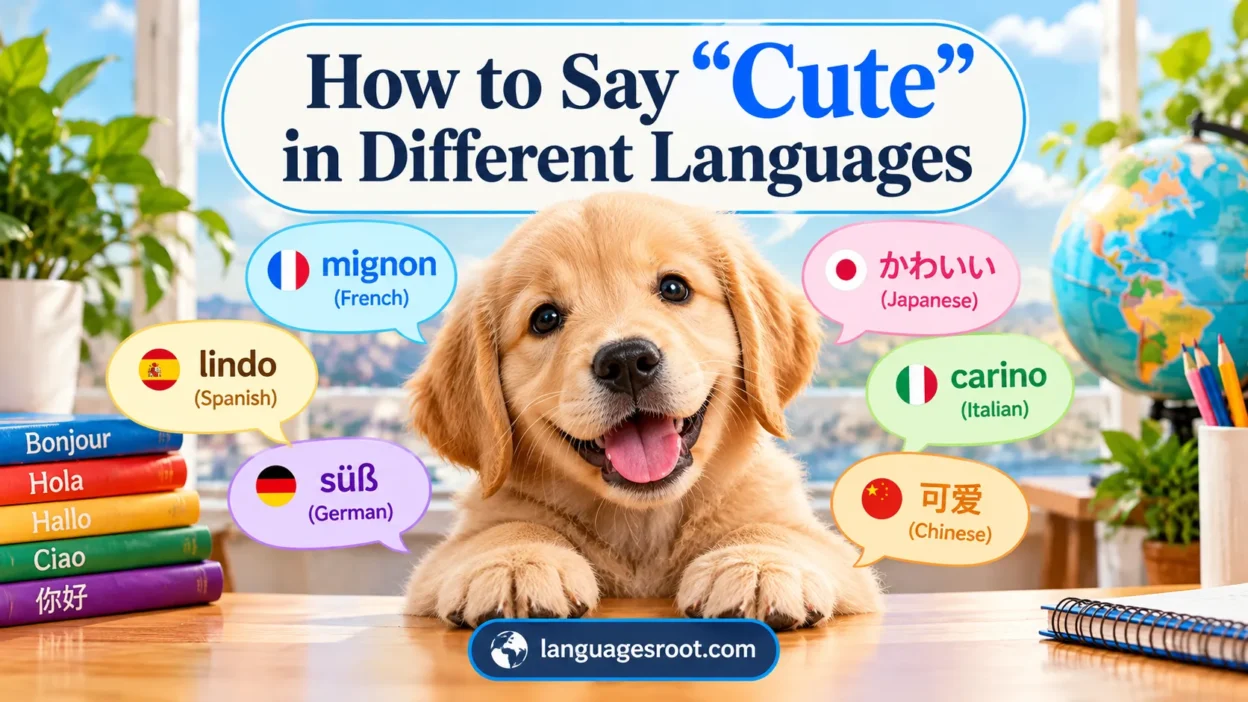
Learning cute in different languages helps you share warmth and affection across cultures. This guide explores how to say cute in different languages, with useful cute translations and simple pronunciation tips. Whether describing adorable animals, cute puppies, cute kittens, or attractive outfits, the right words make compliments feel more personal. Moreover, understanding cute meaning helps you choose words that sound natural and kind.
Explore cute words, affectionate expressions, and sweet messages across world languages, including European languages, Asian languages, African languages, and Middle Eastern languages. Each language offers unique ways to express adorable, charming, lovely, and endearing feelings. Therefore, this translation guide includes pronunciation guide tips, example sentences, and cultural context to help you communicate naturally. Discover ways to say cute and ways to say cutie for friends, loved ones, and everyday conversations.
Interesting Facts About Cute
- Cute can describe more than appearance. People use it for behavior, thoughtful gestures, funny reactions, appealing designs, and affectionate messages.
- Cute and beautiful are not always interchangeable. A language may use one expression for something adorable and another for something elegant or conventionally attractive.
- Grammatical gender can affect translations. In languages such as French, Spanish, and Italian, some adjectives change according to the gender and number of the noun they describe.
- Some languages have several words for cuteness. The best choice may depend on whether you mean adorable, pretty, charming, sweet, or lovable.
- The relationship between speakers matters. A compliment that sounds friendly between close friends might sound flirtatious in another situation.
- Writing systems influence pronunciation guides. Languages such as Japanese, Korean, Arabic, and Mandarin often need romanization alongside their native scripts to help English readers pronounce expressions.
- Informal speech can differ from dictionary wording. Everyday conversations may use shortened expressions, affectionate forms, or local vocabulary that differs from formal writing.
What Does Cute Mean?
Cute means attractive in an endearing, charming, or adorable way. It often describes something that makes a person feel fond, happy, amused, or affectionate.
The word has several related meanings depending on the context. A cute puppy may look adorable, a cute outfit may look stylish and appealing, and a cute gesture may feel thoughtful or sweet. When describing a person, cute can refer to appearance, personality, mannerisms, or a combination of these qualities.
People commonly use the word in everyday conversations, social media captions, friendly compliments, romantic messages, and descriptions of animals or objects. It can communicate affection without necessarily expressing romantic interest.
When translating cute, consider the intended meaning first. If you mean adorable, choose a word with that sense. If you mean pretty or charming, another expression may sound more natural.
Why Can Cute Have Different Translations?
There is no single word that expresses every meaning of cute perfectly in all languages. Translation depends on the person or object being described, the relationship between speakers, and the tone of the conversation.
Context is especially important. A word used for a baby or animal may not be the most natural choice for an adult. Likewise, describing a fashionable outfit may call for a word closer to pretty or stylish than adorable.
Grammar also affects the translation. Spanish, French, Italian, Portuguese, and other languages may change adjective endings to match grammatical gender or number. Some languages use separate words for people, animals, and objects, while others rely on the surrounding sentence.
Regional variation matters, too. Speakers of the same language may prefer different expressions across countries or communities. Informal compliments can also differ from formal descriptions in writing.
For this article, the main translation is generally the natural equivalent of cute or adorable, not a literal translation of every English word. Where a language has several useful alternatives, the tables prioritize a common expression and explain important differences when necessary.
European Languages
European languages express cuteness through words associated with sweetness, charm, prettiness, and affection. Some use adjectives that change with grammatical gender, while others keep the same form across different nouns. The examples below show practical expressions for describing something adorable in everyday conversation.
English Varieties
| Language | Country/Region | Translation | Pronunciation | Example Sentence |
| English 🇬🇧 | United Kingdom and other English-speaking regions | Cute | Kyoot | That kitten is so cute. |
| American English 🇺🇸 | United States | Cute | Kyoot | Your dog is really cute. |
| British English 🇬🇧 | United Kingdom | Cute | Kyoot | What a cute little puppy! |
| Australian English 🇦🇺 | Australia | Cute | Kyoot | That koala is so cute. |
The word cute is the same across these English varieties. Differences usually involve accent, intonation, and conversational style rather than the basic meaning.
European Translation Table
| Language | Country/Region | Translation | Pronunciation | Example Sentence |
| Spanish 🇪🇸 | Spain and Latin America | Lindo / linda | LEEN-doh / LEEN-dah | ¡Qué gatito tan lindo! (What a cute kitten!) |
| French 🇫🇷 | France, Belgium, Switzerland, and other Francophone regions | Mignon / mignonne | Mee-nyon / mee-nyon | Ce chat est mignon. (This cat is cute.) |
| German 🇩🇪 | Germany, Austria, and parts of Switzerland | Süß | Züüs, approximately | Das Baby ist süß. (The baby is cute.) |
| Italian 🇮🇹 | Italy and Italian-speaking Switzerland | Carino / carina | Kah-REE-noh / kah-REE-nah | Che cane carino! (What a cute dog!) |
| Portuguese 🇵🇹 | Portugal and Brazil | Fofo / fofa | FOH-foh / FOH-fah | Que cachorro fofo! (What a cute dog!) |
| Dutch 🇳🇱 | Netherlands and Belgium | Schattig | SKHAH-tikh, approximately | Wat een schattige kat! (What a cute cat!) |
| Swedish 🇸🇪 | Sweden and parts of Finland | Söt | Suht, approximately | Vilken söt katt! (What a cute cat!) |
| Norwegian 🇳🇴 | Norway | Søt | Suht, approximately | For en søt hund! (What a cute dog!) |
| Danish 🇩🇰 | Denmark | Sød | Suhth, approximately | Sikke en sød hund! (What a cute dog!) |
| Finnish 🇫🇮 | Finland | Söpö | SUH-puh | Tuo kissa on söpö. (That cat is cute.) |
| Icelandic 🇮🇸 | Iceland | Sætur / sæt | SAI-tur / SAIT | Þessi kettlingur er sætur. (This kitten is cute.) |
| Irish 🇮🇪 | Ireland | Álainn / gleoite | AW-lin / GLYOH-chuh | Tá an madra gleoite. (The dog is cute.) |
| Welsh 🏴 | Wales | Ciwt / pert | Kyoot / pehrt | Mae’r gath yn giwt. (The cat is cute.) |
| Polish 🇵🇱 | Poland | Uroczy / urocza | Oo-ROH-chih / oo-ROH-chah | Ten kot jest uroczy. (This cat is cute.) |
| Czech 🇨🇿 | Czechia | Roztomilý / roztomilá | Roz-toh-MEE-lee / roz-toh-MEE-lah | To kotě je roztomilé. (This kitten is cute.) |
| Slovak 🇸🇰 | Slovakia | Roztomilý / roztomilá | Roz-toh-MEE-lee / roz-toh-MEE-lah | To mačiatko je roztomilé. (This kitten is cute.) |
| Ukrainian 🇺🇦 | Ukraine | Милий / мила | MY-liy / MY-lah | Яке миле кошеня! (What a cute kitten!) |
| Russian 🇷🇺 | Russia and Russian-speaking communities | Милый / милая | MEE-liy / MEE-luh-yuh | Какой милый котёнок! (What a cute kitten!) |
| Romanian 🇷🇴 | Romania and Moldova | Drăguț / drăguță | Druh-GOOTS / druh-GOOTS-uh | Ce pisoi drăguț! (What a cute kitten!) |
| Hungarian 🇭🇺 | Hungary | Aranyos | AH-rah-nyosh | Milyen aranyos ez a cica! (What a cute kitty!) |
| Greek 🇬🇷 | Greece and Cyprus | Χαριτωμένος / χαριτωμένη | Kha-ree-toh-MEH-nos / kha-ree-toh-MEH-nee | Τι χαριτωμένο γατάκι! (What a cute kitten!) |
| Bulgarian 🇧🇬 | Bulgaria | Сладък / сладка | SLAH-duhk / SLAH-duh-kah | Колко сладко коте! (What a cute kitten!) |
| Croatian 🇭🇷 | Croatia | Sladak / slatka | SLAH-dahk / SLAHT-kah | Kako sladak pas! (What a cute dog!) |
| Serbian 🇷🇸 | Serbia and neighboring regions | Сладак / слатка | SLAH-dahk / SLAHT-kah | Како сладак пас! (What a cute dog!) |
| Slovenian 🇸🇮 | Slovenia | Lušten / luštna | LOOSH-ten / LOOSH-nah | Kako lušten kuža! (What a cute dog!) |
| Lithuanian 🇱🇹 | Lithuania | Mielas / miela | MYEH-las / MYEH-lah | Koks mielas kačiukas! (What a cute kitten!) |
| Latvian 🇱🇻 | Latvia | Mīļš / mīļa | MEELSH / MEE-lya | Cik mīļš kaķēns! (What a cute kitten!) |
| Estonian 🇪🇪 | Estonia | Armas | AHR-mahs | Kui armas kass! (What a cute cat!) |
| Albanian 🇦🇱 | Albania and Kosovo | I lezetshëm / e lezetshme | Ee leh-ZET-shuhm / eh leh-ZET-shmeh | Sa mace e lezetshme! (What a cute cat!) |
| Catalan 🇦🇩 | Catalonia, Andorra, and nearby regions | Maco / maca; bonic / bonica | MAH-koo / MAH-kah; boh-NEEK / boh-NEE-kah | Quin gatet tan maco! (What a cute kitten!) |
Cultural and Usage Notes
- Spanish: Lindo and linda are useful for cute or lovely. Mono and mona can also mean cute in Spain, particularly in casual contexts.
- French: Mignon and mignonne are common for adorable people, animals, and things. The adjective changes form with the noun.
- German: Süß literally means sweet and often describes something cute. Niedlich is another option, especially for an adorable appearance.
- Italian and Portuguese: The forms carino/carino and fofo/fofa require attention to grammatical gender; the Italian feminine form is carina.
- Nordic languages: Words such as Swedish söt, Norwegian søt, and Danish sød can express both sweetness and cuteness.
- Irish and Welsh: Several adjectives may fit depending on whether you mean beautiful, charming, or adorable. The examples use everyday expressions rather than claiming one universal equivalent.
Asian Languages
Asia contains many language families and writing systems, from tonal Chinese languages to Japanese, Korean, Indo-Aryan, Dravidian, and Turkic languages. Expressions for cute may refer to adorableness, sweetness, beauty, or charm, so the intended meaning is important. Native scripts are included alongside romanization wherever useful.
| Language | Country/Region | Translation | Pronunciation | Example Sentence |
| Mandarin Chinese 🇨🇳 | China, Taiwan, and Chinese-speaking communities | 可爱 | Kě’ài, roughly kuh-eye with tones | 这只猫很可爱。 (Zhè zhī māo hěn kě’ài.) (This cat is cute.) |
| Cantonese 🇭🇰 | Hong Kong and Guangdong | 可愛 | Ho2 oi3 | 呢隻貓好可愛。 (Ni1 zek3 maau1 hou2 ho2 oi3.) (This cat is very cute.) |
| Japanese 🇯🇵 | Japan | かわいい | Kawaii, kah-wah-ee | この猫はかわいいです。 (Kono neko wa kawaii desu.) (This cat is cute.) |
| Korean 🇰🇷 | South Korea and Korean-speaking communities | 귀엽다 | Gwiyeopda, roughly gwee-yup-tta | 이 강아지는 정말 귀여워요. (I gang-ajineun jeongmal gwiyeowoyo.) (This puppy is really cute.) |
| Hindi 🇮🇳 | India | प्यारा / प्यारी | Pyaara / pyaari | यह बिल्ली बहुत प्यारी है। (Yah billi bahut pyaari hai.) (This cat is very cute.) |
| Urdu 🇵🇰 | Pakistan and Urdu-speaking communities | پیارا / پیاری | Pyaara / pyaari | یہ بلی بہت پیاری ہے۔ (Yeh billi bohat pyaari hai.) (This cat is very cute.) |
| Bengali 🇧🇩 | Bangladesh and eastern India | মিষ্টি | Mishṭi, roughly MISH-tee | বিড়ালছানাটি খুব মিষ্টি। (Birālchhānāṭi khub miṣṭi.) (The kitten is very cute.) |
| Punjabi 🇮🇳 🇵🇰 | Punjab in India and Pakistan | ਪਿਆਰਾ / ਪਿਆਰੀ; پیارا / پیاری | Pyaara / pyaari | ਇਹ ਬਿੱਲੀ ਬਹੁਤ ਪਿਆਰੀ ਹੈ। (Eh billi bahut pyaari hai.) (This cat is very cute.) |
| Gujarati 🇮🇳 | Gujarat, India | વહાલું / સુંદર | Vahālũ / sundar | આ બિલાડીનું બચ્ચું બહુ વહાલું છે. (Ā bilāḍīnuṃ bachchuṃ bahu vahāluṃ chhe.) (This kitten is very cute.) |
| Marathi 🇮🇳 | Maharashtra, India | गोंडस | Goṇḍas, roughly GON-dus | हे मांजराचे पिल्लू खूप गोंडस आहे. (He mānjarāche pillū khūp goṇḍas āhe.) (This kitten is very cute.) |
| Tamil 🇮🇳 🇱🇰 | Tamil Nadu, Sri Lanka, and Tamil-speaking communities | அழகான / செல்லமான | Aḻagāna / chellamāna | இந்தப் பூனைக்குட்டி மிகவும் அழகாக இருக்கிறது. (Indap pūnaikkuṭṭi migavum aḻagāga irukkiṟatu.) (This kitten is very cute.) |
| Telugu 🇮🇳 | Andhra Pradesh and Telangana | ముద్దుగా | Muddugā | ఈ పిల్లి చాలా ముద్దుగా ఉంది. (Ī pilli chālā muddugā undi.) (This cat is very cute.) |
| Kannada 🇮🇳 | Karnataka, India | ಮುದ್ದಾದ | Muddāda | ಈ ಬೆಕ್ಕಿನ ಮರಿ ತುಂಬಾ ಮುದ್ದಾಗಿದೆ. (Ī bekkina mari tumbā muddāgide.) (This kitten is very cute.) |
| Malayalam 🇮🇳 | Kerala, India | ഓമനത്തമുള്ള | Ōmanattamuḷḷa | ഈ പൂച്ചക്കുട്ടി വളരെ ഓമനത്തമുള്ളതാണ്. (Ī pūccakkuṭṭi vaḷare ōmanattamuḷḷatāṇ.) (This kitten is very cute.) |
| Nepali 🇳🇵 | Nepal | प्यारो / प्यारी | Pyāro / pyārī | यो बिरालोको बच्चा धेरै प्यारो छ। (Yo birāloko bachchā dherai pyāro chha.) (This kitten is very cute.) |
| Sinhala 🇱🇰 | Sri Lanka | හුරතල් | Hurathal | මේ පූස් පැටියා හරි හුරතල්. (Mē pūs pæṭiyā hari hurathal.) (This kitten is very cute.) |
| Thai 🇹🇭 | Thailand | น่ารัก | Nâa-rák | แมวตัวนี้น่ารักมาก (Maew tua níi nâa-rák mâak.) (This cat is very cute.) |
| Vietnamese 🇻🇳 | Vietnam | Dễ thương | Yeh thuong, approximately | Chú mèo này dễ thương quá! (This cat is so cute!) |
| Indonesian 🇮🇩 | Indonesia | Lucu | LOO-choo | Anak kucing itu lucu sekali. (That kitten is very cute.) |
| Malay 🇲🇾 | Malaysia, Brunei, and Singapore | Comel | CHO-mel | Anak kucing itu sangat comel. (That kitten is very cute.) |
| Filipino / Tagalog 🇵🇭 | Philippines | Cute / kyut; kaibig-ibig | Kyoot / kah-ee-beeg-ee-beeg | Ang cute ng kuting na iyan! (That kitten is so cute!) |
| Burmese 🇲🇲 | Myanmar | ချစ်စရာကောင်းသော | Chit-sa-yā kaung-thaw, approximate | ဒီကြောင်လေးက ချစ်စရာကောင်းတယ်။ (This little cat is cute.) |
| Khmer 🇰🇭 | Cambodia | គួរឱ្យស្រឡាញ់ | Kuor aoy sralanh, approximate | កូនឆ្មានេះគួរឱ្យស្រឡាញ់ណាស់។ (This kitten is very cute.) |
| Lao 🇱🇦 | Laos | ໜ້າຮັກ | Nā hak | ແມວນ້ອຍໂຕນີ້ໜ້າຮັກຫຼາຍ. (This kitten is very cute.) |
| Mongolian 🇲🇳 | Mongolia | Хөөрхөн | Khöörkhön | Энэ муурын зулзага хөөрхөн. (This kitten is cute.) |
| Kazakh 🇰🇿 | Kazakhstan | Сүйкімді | Süikimdi | Бұл мысықтың күшігі сүйкімді. (This kitten is cute.) |
| Uzbek 🇺🇿 | Uzbekistan | Yoqimtoy | Yoh-keem-toy | Bu mushukcha juda yoqimtoy. (This kitten is very cute.) |
Cultural and Usage Notes
In Japanese, かわいい (kawaii) is widely used for adorable objects, animals, clothes, and people. Korean 귀엽다 (gwiyeopda) is the dictionary form, while 귀여워요 (gwiyeowoyo) is a common polite conversational form.
In Mandarin, 可爱 (kě’ài) is a widely understood word for cute or adorable. The tones matter, and the pinyin marks them for a reason. Cantonese uses the same characters in this example, but its pronunciation and tone system differ from Mandarin.
In Hindi, Urdu, and Punjabi, forms such as प्यारा / پیارا change according to grammatical gender and sentence structure. In Indonesian, lucu can mean cute or funny, depending on context, while Malay comel is a particularly useful everyday word for cute.
African Languages
Africa is home to a remarkable range of languages, including Niger-Congo, Afroasiatic, and other language families. The words used for cute can emphasize loveliness, sweetness, affection, or an appealing appearance. The examples below represent specific languages and regions rather than suggesting that one expression applies across the continent.
| Language | Country/Region | Translation | Pronunciation | Example Sentence |
| Swahili 🇹🇿 🇰🇪 | Tanzania, Kenya, and East Africa | Mzuri / wa kupendeza | M-zoo-ree / wah koo-pen-DEH-zah | Paka huyu anapendeza sana. (This cat is very cute.) |
| Afrikaans 🇿🇦 | South Africa and Namibia | Oulik | OW-lik | Daardie katjie is baie oulik. (That kitten is very cute.) |
| Zulu 🇿🇦 | South Africa | Muhle / omuhle | MOO-hleh / oh-MOO-hleh | Ikati elincane lihle kakhulu. (The little cat is very cute.) |
| Xhosa 🇿🇦 | South Africa | Intle / mhle | EEN-tleh / m-hleh | Ikati elincinci lihle kakhulu. (The little cat is very cute.) |
| Amharic 🇪🇹 | Ethiopia | ቆንጆ | Konjo | ይህ ድመት በጣም ቆንጆ ነው። (This cat is very cute.) |
| Yoruba 🇳🇬 | Southwestern Nigeria and neighboring communities | Fẹ́wà | Feh-wah, with tones | Ọmọ ológbò yìí lẹ́wà. (This kitten is cute.) |
| Igbo 🇳🇬 | Southeastern Nigeria | Mara mma | Mah-rah mmah | Nwa nwamba a mara mma. (This kitten is cute.) |
| Hausa 🇳🇬 🇳🇪 | Northern Nigeria and Niger | Kyakkyawa | Chyah-chyah-wah | Wannan kyanwa tana da kyau. (This cat is lovely.) |
| Somali 🇸🇴 | Somalia and Somali-speaking regions | Qurux badan | Koo-rookh bah-dahn | Bisaddan yar waa qurux badan tahay. (This little cat is lovely.) |
| Shona 🇿🇼 | Zimbabwe | Akanaka | Ah-kah-NAH-kah | Katsi iyi yakanaka. (This cat is lovely.) |
| Sesotho 🇱🇸 🇿🇦 | Lesotho and South Africa | Motle | MOH-tleh | Katse ena e ntle. (This cat is lovely.) |
| Setswana 🇧🇼 🇿🇦 | Botswana and South Africa | Montle | MOHN-tleh | Katse eno e ntle. (This cat is lovely.) |
| Kinyarwanda 🇷🇼 | Rwanda | Cyiza / cyiza cyane | Chee-zah / chee-zah chah-nyeh | Aka kanyamaswa ni keza cyane. (This little animal is very cute.) |
| Malagasy 🇲🇬 | Madagascar | Mahafatifaty | Mah-hah-fah-tee-FAH-tee | Mahafatifaty ity saka kely ity. (This little cat is cute.) |
Cultural and Usage Notes
Some African languages use words closer to beautiful, good-looking, or lovely rather than a direct equivalent of English cute. In Swahili, kupendeza conveys being pleasing or attractive. In Southern African languages, adjective forms can depend on the noun class, so a word may change with the thing being described.
Pronunciation guides in this section are simplified for English readers. For a public speech, formal publication, or permanent inscription, check the precise spelling and grammar with a proficient speaker, especially where tone, vowel length, or noun-class agreement matters.
Also Read: How to Say Curious in Different Languages
Middle Eastern Languages
The Middle East includes Arabic, Persian, Hebrew, Kurdish, Turkish, and Armenian language traditions. These languages differ in their grammar, writing systems, and everyday expressions of affection. Arabic also varies by region, so Modern Standard Arabic and local conversational expressions should not be treated as identical.
| Language | Country/Region | Translation | Pronunciation | Example Sentence |
| Modern Standard Arabic 🇸🇦 | Across Arabic-speaking countries | لطيف / لطيفة | Laṭīf / laṭīfa | هذه القطة لطيفة جدًا. (Hādhihi al-qiṭṭatu laṭīfatun jiddan.) (This cat is very cute.) |
| Egyptian Arabic 🇪🇬 | Egypt | قمر / كيوت | Amar / kyoot | القطة دي كيوت أوي. (El-ʾoṭṭa di kyoot awi.) (This cat is really cute.) |
| Persian 🇮🇷 | Iran and Persian-speaking communities | بامزه | Bāmazeh | این گربه خیلی بامزه است. (In gorbeh kheili bāmaze ast.) (This cat is very cute.) |
| Hebrew 🇮🇱 | Israel | חמוד / חמודה | Khamud / khamuda | החתול הזה חמוד. (Ha-khatul ha-ze khamud.) (This cat is cute.) |
| Kurdish, Kurmanji | Türkiye, Iraq, Syria, and diaspora communities | Xweşik | Khweh-sheek, approximately | Ev pisîk xweşik e. (This cat is cute.) |
| Turkish 🇹🇷 | Türkiye and Turkish-speaking communities | Sevimli | Seh-VEEM-lee | Bu kedi çok sevimli. (This cat is very cute.) |
| Armenian 🇦🇲 | Armenia and Armenian-speaking communities | Սիրուն | See-roon | Այս կատուն շատ սիրուն է։ (Ays katun shat sirun e.) (This cat is very cute.) |
Cultural and Usage Notes
In Modern Standard Arabic, laṭīf and laṭīfa can convey pleasantness, gentleness, or charm. Local expressions differ: Egyptian speakers may use ʾamar, literally “moon,” as an affectionate compliment, or borrow the informal word kyoot.
Persian bāmazeh is often used for something cute, amusing, or charming. Turkish sevimli conveys likability or adorableness, while Hebrew khamud and khamuda are everyday expressions for cute. The right choice still depends on the person, object, and tone.
Other World Languages
The idea of cuteness is also expressed in Indigenous languages, creoles, and constructed languages. The examples below extend the guide beyond the four main regions while recognizing that local vocabulary and grammatical forms may vary.
| Language | Country/Region | Translation | Pronunciation | Example Sentence |
| Māori 🇳🇿 | Aotearoa New Zealand | Ātaahua / orotika | Ah-tah-HOO-ah / oh-roh-TEE-kah | He ātaahua tēnei ngeru. (This cat is lovely.) |
| Samoan 🇼🇸 | Samoa and Samoan-speaking communities | Aulelei | Ow-leh-LEH-ee | E aulelei lenei pusi. (This cat is lovely.) |
| Hawaiian 🇺🇸 | Hawaiʻi | Nani | NAH-nee | Nani kēia pōpoki. (This cat is beautiful.) |
| Quechua 🇵🇪 | Andean regions of Peru and neighboring countries | Sumaq | SOO-mahk | Kay misiqa sumaqmi. (This cat is lovely.) |
| Haitian Creole 🇭🇹 | Haiti and Haitian communities abroad | Mignon / bèl | Meen-yon / bel | Ti chat sa a bèl anpil. (This kitten is very cute.) |
| Esperanto 🌍 | International constructed language | Ĉarma | CHAR-mah | Tiu katido estas ĉarma. (That kitten is charming.) |
Cultural and Usage Notes
Some entries use words closer to beautiful, lovely, or charming than to cute in every possible context. Māori ātaahua and Hawaiian nani, for example, can emphasize beauty. Esperanto ĉarma is closer to charming. These are useful related expressions, but the most precise word can change depending on whether you mean an adorable pet, an attractive object, or an affectionate compliment.
Quick Reference: Cute in Different Languages
Use this compact reference to find a translation quickly. Forms separated by a slash indicate alternatives, often for grammatical gender or meaning. English pronunciations are approximations, so consult the pronunciation column in the regional tables for more guidance.
| Language | Translation |
| English | Cute |
| American English | Cute |
| British English | Cute |
| Australian English | Cute |
| Spanish | Lindo / linda |
| French | Mignon / mignonne |
| German | Süß |
| Italian | Carino / carina |
| Portuguese | Fofo / fofa |
| Dutch | Schattig |
| Swedish | Söt |
| Norwegian | Søt |
| Danish | Sød |
| Finnish | Söpö |
| Icelandic | Sætur / sæt |
| Irish | Gleoite |
| Welsh | Ciwt |
| Polish | Uroczy / urocza |
| Czech | Roztomilý / roztomilá |
| Slovak | Roztomilý / roztomilá |
| Ukrainian | Милий / мила |
| Russian | Милый / милая |
| Romanian | Drăguț / drăguță |
| Hungarian | Aranyos |
| Greek | Χαριτωμένος / χαριτωμένη |
| Bulgarian | Сладък / сладка |
| Croatian | Sladak / slatka |
| Serbian | Сладак / слатка |
| Slovenian | Lušten / luštna |
| Lithuanian | Mielas / miela |
| Latvian | Mīļš / mīļa |
| Estonian | Armas |
| Albanian | I lezetshëm / e lezetshme |
| Catalan | Maco / maca |
| Mandarin Chinese | 可爱 |
| Cantonese | 可愛 |
| Japanese | かわいい |
| Korean | 귀엽다 |
| Hindi | प्यारा / प्यारी |
| Urdu | پیارا / پیاری |
| Bengali | মিষ্টি |
| Punjabi | ਪਿਆਰਾ / ਪਿਆਰੀ |
| Gujarati | વહાલું |
| Marathi | गोंडस |
| Tamil | அழகான |
| Telugu | ముద్దుగా |
| Kannada | ಮುದ್ದಾದ |
| Malayalam | ഓമനത്തമുള്ള |
| Nepali | प्यारो / प्यारी |
| Sinhala | හුරතල් |
| Thai | น่ารัก |
| Vietnamese | Dễ thương |
| Indonesian | Lucu |
| Malay | Comel |
| Filipino / Tagalog | Cute / kyut |
| Burmese | ချစ်စရာကောင်းသော |
| Khmer | គួរឱ្យស្រឡាញ់ |
| Lao | ໜ້າຮັກ |
| Mongolian | Хөөрхөн |
| Kazakh | Сүйкімді |
| Uzbek | Yoqimtoy |
| Swahili | Wa kupendeza |
| Afrikaans | Oulik |
| Zulu | Muhle |
| Xhosa | Mhle |
| Amharic | ቆንጆ |
| Yoruba | Fẹ́wà |
| Igbo | Mara mma |
| Hausa | Kyakkyawa |
| Somali | Qurux badan |
| Shona | Akanaka |
| Sesotho | Motle |
| Setswana | Montle |
| Kinyarwanda | Cyiza |
| Malagasy | Mahafatifaty |
| Modern Standard Arabic | لطيف / لطيفة |
| Egyptian Arabic | كيوت / قمر |
| Persian | بامزه |
| Hebrew | חמוד / חמודה |
| Kurdish, Kurmanji | Xweşik |
| Turkish | Sevimli |
| Armenian | Սիրուն |
| Māori | Ātaahua |
| Samoan | Aulelei |
| Hawaiian | Nani |
| Quechua | Sumaq |
| Haitian Creole | Bèl |
| Esperanto | Ĉarma |
How to Choose the Right Translation
The best translation of cute depends on what you are describing, who you are speaking to, and the impression you want to create. A word that describes an adorable kitten may not be the most natural choice for an outfit, a friendly compliment, or a romantic message.
Follow these practical tips when choosing an expression:
- Identify the meaning: Decide whether you mean adorable, pretty, sweet, lovely, or charming.
- Check grammatical agreement: In languages such as Spanish, French, and Italian, the adjective may change according to the noun.
- Consider your relationship: A casual expression may work well with friends but feel too familiar in a formal situation.
- Check regional usage: Speakers in different countries may prefer different words, even when they share a language.
- Learn a complete sentence: An example helps you understand how the adjective fits naturally into conversation.
- Practice pronunciation: Pay attention to tones, stress, vowel sounds, and unfamiliar consonants.
For a casual compliment, choose a familiar everyday expression. For a formal message or permanent inscription, verify the wording with a reliable language resource or proficient speaker.
Common Mistakes When Translating Cute
Translating cute can seem simple, but several common mistakes can make a compliment sound unnatural.
Translating word for word is a frequent problem. The English word may cover several meanings that another language expresses with different adjectives. A word meaning beautiful may work for an attractive outfit but may not convey the same affectionate feeling as adorable.
Ignoring grammatical gender and agreement can also lead to errors. In Spanish, for example, lindo and linda are different forms. French and Italian have similar distinctions, and some languages require additional changes depending on the noun.
Another mistake is mixing regional expressions without understanding where they are used. A phrase familiar in one country might sound unusual elsewhere. Pronunciation can also change the meaning in tonal languages, so romanization should not replace listening practice.
Finally, remember that a compliment depends on context. A word that feels affectionate between close friends may sound flirtatious in another situation. Learn the meaning, grammar, and example sentence together rather than memorizing an isolated word.
Why Learn Cute in Different Languages?
Learning how to express cute in different languages is a useful way to build everyday vocabulary and understand how people communicate affection. This simple adjective appears in conversations about pets, children, clothing, gifts, decorations, and memorable moments.
For travelers, knowing a few local expressions can make casual interactions more engaging. Language learners can use these words to practice adjective agreement, pronunciation, sentence structure, and common conversational patterns. They can also help people understand compliments when watching international films, reading messages, or communicating with friends abroad.
Learning these translations also highlights an important part of language: similar feelings do not always require identical words. Some expressions emphasize sweetness, others emphasize beauty, and others suggest charm or affection. Understanding those differences helps you choose words more thoughtfully.
You do not need to memorize every translation at once. Start with a few languages that interest you, practice the example sentences aloud, and pay attention to how speakers use the words in real situations. Small vocabulary lessons can gradually support broader language learning and cross-cultural understanding.
Frequently Asked Questions
How do you say cute in different languages?
You can say cute in different languages using words like lindo in Spanish, mignon in French, süß in German, kawaii in Japanese, and 可爱 (kě’ài) in Mandarin Chinese. However, the best translation depends on the context and intended meaning.
What is the difference between cute, adorable, pretty, and charming?
Cute suggests endearing appeal, while adorable often expresses stronger affection. Pretty focuses on appearance, whereas charming describes an appealing quality or personality.
Can cute translations change depending on the country or region?
Yes, cute translations can vary across regions, even within the same language. Therefore, consider cultural context, local expressions, and everyday usage to make your compliment sound natural.
Does the word cute change according to gender in other languages?
Yes, some languages use grammatical forms that change with gender or number. For example, Spanish uses lindo and linda, while French uses mignon and mignonne.
How can I pronounce cute words correctly in different languages?
Use a pronunciation guide and practice complete example sentences to learn each word naturally. For languages with different writing systems, romanization and audio examples can help you improve your pronunciation.
Conclusion
Learning cute in different languages helps you express affection, charm, and appreciation across cultures. From Spanish lindo to Japanese kawaii, each language offers unique cute translations and meaningful ways to share warm compliments. By practicing pronunciation, understanding cultural context, and choosing words that fit each situation, you can communicate more naturally.