
Learning how to say please in different languages makes daily conversations more respectful. The English word please is a simple magic word that softens requests. Across world languages, polite expressions help people show care and respect. However, each culture has its own words of politeness and social etiquette. Understanding please meaning and please translation helps you choose natural expressions. It also makes everyday communication easier when traveling or meeting others.
Whether asking for help, ordering food, or asking directions, politeness matters. Therefore, this language guide explores please in different languages with translation examples and a helpful pronunciation guide. You can discover useful phrases across European languages, Asian languages, African languages, and Middle Eastern languages. Additionally, learn how cultural differences, formal speech, and informal speech shape polite requests. These expressions can help travelers, students, and language learners communicate with confidence.
Interesting Facts About Please
- Politeness is expressed differently across languages. Some languages use a separate word equivalent to “please,” while others communicate politeness through verb forms, honorifics, or sentence structure.
- English uses “please” in many situations. It can soften a request, make an invitation more courteous, or help a question sound less demanding.
- One translation may not fit every situation. A phrase used when asking for an object may differ from the expression used when ordering food or requesting assistance.
- Formal and informal speech can differ. Languages such as French, German, Spanish, and Japanese have ways to adjust speech according to the relationship between speakers.
- Word order matters. The position of a polite expression can change depending on the language, sentence structure, and conversational context.
- Some languages use indirect requests. Rather than adding a direct equivalent of “please,” speakers may use a question or a more respectful grammatical construction.
- Pronunciation contributes to politeness. A courteous word can sound abrupt if delivered with an impatient tone, while a warm voice can help make a request feel considerate.
What Does Please Mean?
Global Word Explorer
Discover everyday English words and explore how people express them in languages around the world.
Translations in 8 Global Languages
“Please” is a polite expression used when asking someone to do something or requesting assistance. It helps communicate that a request is intended to be considerate rather than demanding. For example, saying “Please open the window” usually sounds more courteous than simply saying “Open the window.”
The word can also appear when ordering food, asking someone to repeat information, requesting permission, or inviting another person to participate. Its meaning depends on the situation. In some contexts, “please” expresses courtesy; in others, it can communicate urgency, insistence, or even frustration.
In multilingual communication, the equivalent of “please” may be a single word, a short phrase, or a grammatical form that makes the request more respectful. Some expressions also change according to the speaker’s relationship with the listener. Therefore, understanding the meaning, tone, and appropriate usage is just as important as learning the translation.
Why Can Please Have Different Translations?
The English word “please” does not have one universal equivalent in every language. Translators must consider what the speaker wants to communicate and how the listener is likely to interpret the request.
Several factors influence the most natural translation:
- Context: Asking for water, requesting directions, and asking someone to wait may call for different expressions.
- Formality: A phrase suitable for a friend may sound too casual when addressing a teacher, customer, or older person.
- Relationship: Close friends and family members may use shorter, more relaxed expressions than strangers do.
- Gender and grammar: Some languages change related words, adjectives, or sentence structures according to grammatical gender or the person being addressed.
- Regional dialects: Speakers in different countries or regions may prefer different polite expressions.
- Cultural conventions: Politeness can depend on word choice, indirect requests, honorifics, and tone of voice.
- Literal versus natural translation: A dictionary equivalent may be grammatically correct but less natural in a particular conversation.
- Written versus spoken language: A formal written request may use a different expression from a quick spoken request.
For the tables below, each translation represents a useful everyday equivalent of “please”, rather than a claim that one word works in every situation. Examples show how the expression can be used naturally in a request.
European Languages
European languages belong to several language families, including Romance, Germanic, Slavic, and Uralic languages. Although many have a direct equivalent of “please,” their placement and level of formality can vary. The examples below illustrate practical expressions for everyday communication.
European language translations
| 🌍 Language | Country/Region | Translation | Pronunciation | Example Sentence |
| English | 🇬🇧 United Kingdom, 🇺🇸 United States, and elsewhere | Please | pleez | Please pass me the salt. |
| Spanish | 🇪🇸 Spain, 🇲🇽 Mexico, and Latin America | Por favor | por fah-VOR | Por favor, abre la ventana. (Please open the window.) |
| French | 🇫🇷 France, 🇧🇪 Belgium, and other French-speaking regions | S’il vous plaît | seel voo pleh | Un café, s’il vous plaît. (A coffee, please.) |
| German | 🇩🇪 Germany, 🇦🇹 Austria, 🇨🇭 Switzerland | Bitte | BIT-uh | Bitte, helfen Sie mir. (Please help me.) |
| Italian | 🇮🇹 Italy, 🇨🇭 Switzerland | Per favore | pehr fah-VOH-reh | Per favore, aspetta un momento. (Please wait a moment.) |
| Portuguese | 🇵🇹 Portugal, 🇧🇷 Brazil | Por favor | por fah-VOR | Por favor, feche a porta. (Please close the door.) |
| Dutch | 🇳🇱 Netherlands, 🇧🇪 Belgium | Alstublieft / Alsjeblieft | al-stoo-BLEEFT / al-shuh-BLEEFT | Kunt u mij helpen, alstublieft? (Could you help me, please?) |
| Swedish | 🇸🇪 Sweden | Snälla | SNEL-lah | Snälla, vänta lite. (Please wait a little.) |
| Norwegian | 🇳🇴 Norway | Vær så snill | vair soh sneel | Vær så snill, hjelp meg. (Please help me.) |
| Danish | 🇩🇰 Denmark | Vær venlig | vair VEN-lee | Vær venlig at vente. (Please wait.) |
| Finnish | 🇫🇮 Finland | Ole hyvä | OH-leh HÜ-vä | Ole hyvä, istu tähän. (Please sit here.) |
| Icelandic | 🇮🇸 Iceland | Vinsamlegast | VIN-sam-leh-gast | Vinsamlegast lokaðu hurðinni. (Please close the door.) |
| Irish | 🇮🇪 Ireland | Le do thoil | leh duh hull | Suigh síos, le do thoil. (Please sit down.) |
| Welsh | 🏴 Wales | Os gwelwch yn dda | os GWEL-ooch un thah | Arhoswch yma, os gwelwch yn dda. (Please wait here.) |
| Polish | 🇵🇱 Poland | Proszę | PROH-sheh | Proszę, usiądź. (Please sit down.) |
| Czech | 🇨🇿 Czechia | Prosím | PROH-seem | Prosím, pomozte mi. (Please help me.) |
| Slovak | 🇸🇰 Slovakia | Prosím | PROH-seem | Prosím, počkajte chvíľu. (Please wait a moment.) |
| Ukrainian | 🇺🇦 Ukraine | Будь ласка | boodʹ LAS-kah | Будь ласка, зачекайте. (Please wait.) |
| Russian | 🇷🇺 Russia and Russian-speaking communities | Пожалуйста | pah-ZHAH-loo-stah | Пожалуйста, помогите мне. (Please help me.) |
| Romanian | 🇷🇴 Romania, 🇲🇩 Moldova | Vă rog | vuh rohg | Vă rog, închideți ușa. (Please close the door.) |
| Hungarian | 🇭🇺 Hungary | Kérem | KAY-rem | Kérem, várjon egy percet. (Please wait a minute.) |
| Greek | 🇬🇷 Greece, 🇨🇾 Cyprus | Παρακαλώ | pah-rah-kah-LOH | Παρακαλώ, καθίστε. (Please sit down.) |
| Bulgarian | 🇧🇬 Bulgaria | Моля | moh-LYAH | Моля, изчакайте. (Please wait.) |
| Croatian | 🇭🇷 Croatia | Molim | MOH-leem | Molim, zatvorite prozor. (Please close the window.) |
| Serbian | 🇷🇸 Serbia and neighboring communities | Молим / Molim | MOH-leem | Молим, сачекајте. (Please wait.) |
| Slovenian | 🇸🇮 Slovenia | Prosim | proh-SEEM | Prosim, pomagajte mi. (Please help me.) |
| Lithuanian | 🇱🇹 Lithuania | Prašau | prah-SHOW | Prašau, palaukite. (Please wait.) |
| Latvian | 🇱🇻 Latvia | Lūdzu | LOO-dzoo | Lūdzu, palīdziet man. (Please help me.) |
| Estonian | 🇪🇪 Estonia | Palun | PAH-loon | Palun, oodake siin. (Please wait here.) |
| Albanian | 🇦🇱 Albania, 🇽🇰 Kosovo | Ju lutem | yoo LOO-tem | Ju lutem, më ndihmoni. (Please help me.) |
| Catalan | 🇪🇸 Catalonia and other Catalan-speaking regions | Si us plau | see oos PLOW | Si us plau, espera aquí. (Please wait here.) |
American English 🇺🇸
American English uses “please” in the same basic way as other English varieties. Differences are more likely to involve pronunciation, intonation, and conversational style than the word itself.
| 🌍 Language | Country/Region | Translation | Pronunciation | Example Sentence |
| American English | 🇺🇸 United States | Please | pleez | Could you send me the address, please? |
British English 🇬🇧
British English also uses “please.” Speakers may place it at the beginning or end of a request, depending on emphasis and sentence structure.
| 🌍 Language | Country/Region | Translation | Pronunciation | Example Sentence |
| British English | 🇬🇧 United Kingdom | Please | pleez | Could I have a cup of tea, please? |
Australian English 🇦🇺
Australian English uses the same standard word, “please.” Casual expressions may differ by speaker and situation, but the polite word itself remains the same.
| 🌍 Language | Country/Region | Translation | Pronunciation | Example Sentence |
| Australian English | 🇦🇺 Australia | Please | pleez | Could you give me a hand, please? |
Cultural notes for Europe
In French, s’il vous plaît is a standard polite expression, while s’il te plaît is used informally with one person. German bitte serves several functions, including “please” and “you’re welcome.” Spanish por favor is widely useful in requests, while Italian per favore is a common way to soften them. In Dutch, alstublieft is generally more formal than alsjeblieft. These distinctions are practical starting points, not rigid rules for every conversation.
Asian Languages

Asia includes a wide range of language families, writing systems, and traditions of polite speech. Some languages have a direct word for “please,” while others often communicate courtesy through respectful verb endings or sentence patterns. The following examples use recognizable everyday expressions and include native scripts where appropriate.
Asian language translations
| 🌍 Language | Country/Region | Translation | Pronunciation | Example Sentence |
| Mandarin Chinese | 🇨🇳 China, 🇸🇬 Singapore | 请 | qǐng | 请坐。 (Qǐng zuò. Please sit down.) |
| Cantonese | 🇭🇰 Hong Kong, 🇲🇴 Macau, southern China | 唔該 / 請 | m̀h goi / cing² | 唔該,畀杯水我。 (M̀h goi, bei béui séui ngóh. Please give me a glass of water.) |
| Japanese | 🇯🇵 Japan | お願いします | onegai shimasu | もう一度お願いします。 (Mō ichido onegai shimasu. Once more, please.) |
| Korean | 🇰🇷 South Korea, 🇰🇵 North Korea | 부탁합니다 | butakhamnida | 천천히 말씀해 주세요. (Cheoncheonhi malsseumhae juseyo. Please speak slowly.) |
| Hindi | 🇮🇳 India | कृपया | kripayā | कृपया यहाँ बैठिए। (Kripayā yahā̃ baiṭhiye. Please sit here.) |
| Urdu | 🇵🇰 Pakistan, 🇮🇳 India | براہِ کرم | barāh-e-karam | براہِ کرم دروازہ بند کریں۔ (Barāh-e-karam darwāzah band karein. Please close the door.) |
| Bengali | 🇧🇩 Bangladesh, 🇮🇳 West Bengal | অনুগ্রহ করে | onugroho kore | অনুগ্রহ করে একটু অপেক্ষা করুন। (Please wait a little.) |
| Punjabi | 🇵🇰 Punjab, 🇮🇳 Punjab | ਕਿਰਪਾ ਕਰਕੇ / کرپا کرکے | kirpā karke | ਕਿਰਪਾ ਕਰਕੇ ਬੈਠੋ। (Kirpā karke baiṭho. Please sit down.) |
| Gujarati | 🇮🇳 Gujarat | કૃપા કરીને | krupā karīne | કૃપા કરીને મને મદદ કરો. (Please help me.) |
| Marathi | 🇮🇳 Maharashtra | कृपया | krupayā | कृपया थोडा वेळ थांबा. (Please wait a little.) |
| Tamil | 🇮🇳 Tamil Nadu, 🇱🇰 Sri Lanka | தயவுசெய்து | thayavuseythu | தயவுசெய்து இங்கே உட்காருங்கள். (Please sit here.) |
| Telugu | 🇮🇳 Andhra Pradesh, Telangana | దయచేసి | dayachēsi | దయచేసి తలుపు మూయండి. (Please close the door.) |
| Kannada | 🇮🇳 Karnataka | ದಯವಿಟ್ಟು | dayaviṭṭu | ದಯವಿಟ್ಟು ಇಲ್ಲಿ ಕಾಯಿರಿ. (Please wait here.) |
| Malayalam | 🇮🇳 Kerala | ദയവായി | dayavāyi | ദയവായി അകത്ത് വരൂ. (Please come inside.) |
| Nepali | 🇳🇵 Nepal | कृपया | kripayā | कृपया यहाँ बस्नुहोस्। (Please sit here.) |
| Sinhala | 🇱🇰 Sri Lanka | කරුණාකර | karuṇākara | කරුණාකර මෙහි ඉන්න. (Please stay here.) |
| Thai | 🇹🇭 Thailand | กรุณา | karunā | กรุณารอสักครู่ (Karunā rɔɔ sàk khrûu. Please wait a moment.) |
| Vietnamese | 🇻🇳 Vietnam | Làm ơn | lam uhn | Làm ơn giúp tôi. (Please help me.) |
| Indonesian | 🇮🇩 Indonesia | Tolong | TOH-long | Tolong tutup pintunya. (Please close the door.) |
| Malay | 🇲🇾 Malaysia, 🇧🇳 Brunei, 🇸🇬 Singapore | Tolong / Sila | toh-long / SEE-lah | Sila duduk di sini. (Please sit here.) |
| Filipino (Tagalog) | 🇵🇭 Philippines | Paki- / Pakisuyo | pah-kee / pah-kee-SOO-yoh | Pakisara ang pinto. (Please close the door.) |
| Burmese | 🇲🇲 Myanmar | ကျေးဇူးပြု၍ | kyei-zu pyu-ywe | ကျေးဇူးပြု၍ ထိုင်ပါ။ (Please sit down.) |
| Khmer | 🇰🇭 Cambodia | សូម | sohm | សូមអង្គុយ។ (Please sit down.) |
| Lao | 🇱🇦 Laos | ກະລຸນາ | ka-lu-na | ກະລຸນາລໍຖ້າ. (Please wait.) |
| Mongolian | 🇲🇳 Mongolia | Гуйя | guiya | Гуйя, түр хүлээнэ үү. (Please wait a moment.) |
| Kazakh | 🇰🇿 Kazakhstan | Өтінемін | ö-ti-ne-min | Өтінемін, күте тұрыңыз. (Please wait.) |
| Uzbek | 🇺🇿 Uzbekistan | Iltimos | il-ti-MOS | Iltimos, yordam bering. (Please help me.) |
Cultural notes for Asia
In Japanese, お願いします (onegai shimasu) is a useful polite expression when making requests, while ください (kudasai) commonly follows a requested action or item. Korean often uses 주세요 (juseyo) after a verb or noun to make a request politely. In Mandarin, 请 (qǐng) can introduce a polite request, but natural wording depends on the sentence. Indonesian tolong commonly introduces requests for help or action, whereas Malay sila is useful for polite invitations and instructions. These words overlap in meaning but are not interchangeable in every context.
African Languages
Africa is home to hundreds of languages from several distinct language families. Polite requests can involve a direct equivalent of “please,” a verb meaning “help,” or a phrase that expresses consideration. The examples below represent individual languages and regions rather than entire countries.
African language translations
| 🌍 Language | Country/Region | Translation | Pronunciation | Example Sentence |
| Swahili | 🇹🇿 Tanzania, 🇰🇪 Kenya, East Africa | Tafadhali | tah-fah-DHAH-lee | Tafadhali, nisaidie. (Please help me.) |
| Afrikaans | 🇿🇦 South Africa, 🇳🇦 Namibia | Asseblief | ah-suh-BLEEF | Maak asseblief die deur toe. (Please close the door.) |
| Zulu | 🇿🇦 South Africa | Ngiyacela | ng-ee-yah-KEH-lah | Ngiyacela, ngisize. (Please help me.) |
| Xhosa | 🇿🇦 South Africa | Ndicela | n-dee-KEH-lah | Ndicela undincede. (Please help me.) |
| Amharic | 🇪🇹 Ethiopia | እባክዎ | əbakəwo | እባክዎ ይጠብቁ። (Please wait.) |
| Yoruba | 🇳🇬 Nigeria, neighboring communities | Jọ̀ọ́ | jaw | Jọ̀ọ́, ràn mí lọ́wọ́. (Please help me.) |
| Igbo | 🇳🇬 Nigeria | Biko | BEE-koh | Biko, nyere m aka. (Please help me.) |
| Hausa | 🇳🇬 Nigeria, 🇳🇪 Niger, West Africa | Don Allah | don ah-LAH | Don Allah, taimake ni. (Please help me.) |
| Somali | 🇸🇴 Somalia, 🇩🇯 Djibouti, Horn of Africa | Fadlan | FAD-lan | Fadlan, i caawi. (Please help me.) |
| Shona | 🇿🇼 Zimbabwe | Ndapota | n-dah-POH-tah | Ndapota, ndibatsirei. (Please help me.) |
| Sesotho | 🇱🇸 Lesotho, 🇿🇦 South Africa | Ka kopo | kah KOH-poh | Ka kopo, nthuse. (Please help me.) |
| Setswana | 🇧🇼 Botswana, 🇿🇦 South Africa | Tsweetswee | tsweh-TSWEH | Tsweetswee, nthuse. (Please help me.) |
| Kinyarwanda | 🇷🇼 Rwanda | Nyabuneka | nya-boo-NEH-kah | Nyabuneka, mpa amazi. (Please give me water.) |
| Malagasy | 🇲🇬 Madagascar | Azafady | ah-zah-fah-DEE | Azafady, ampio aho. (Please help me.) |
Cultural notes for Africa
Tafadhali is a broadly useful polite expression in Swahili. In Yoruba, jọ̀ọ́ can soften a request, while Hausa don Allah literally invokes God and is commonly used as a polite expression. In Zulu and Xhosa, request forms such as ngiyacela and ndicela are connected to the verb “ask” or “request.” The precise form can vary with sentence structure, dialect, and the relationship between speakers.
Middle Eastern Languages
The Middle East includes several distinct linguistic traditions, including Arabic, Persian, Kurdish, Turkish, and Armenian. Arabic in particular has both a formal standard variety and many regional dialects. The expressions below identify their intended context so readers can avoid treating one regional form as universal.
Middle Eastern language translations
| 🌍 Language | Country/Region | Translation | Pronunciation | Example Sentence |
| Modern Standard Arabic | 🇵🇸 Palestine and Arabic-speaking regions | من فضلك | min faḍlik (to a man), min faḍliki (to a woman) | من فضلك، ساعدني. (Min faḍlik, sāʿidnī. Please help me.) |
| Levantine Arabic | 🇵🇸 Palestine, 🇯🇴 Jordan, 🇱🇧 Lebanon | لو سمحت | law samaḥt (to a man), law samaḥti (to a woman) | لو سمحت، وين المحطة؟ (Law samaḥt, wēn il-maḥaṭṭa? Excuse me, where is the station?) |
| Persian (Farsi) | 🇮🇷 Iran, Persian-speaking communities | لطفاً | lotfan | لطفاً اینجا بنشینید. (Lotfan injā benešinid. Please sit here.) |
| Kurdish (Kurmanji) | 🇹🇷 Türkiye, 🇮🇶 Iraq, 🇸🇾 Syria, 🇮🇷 Iran | Ji kerema xwe | zhee keh-REH-mah khweh | Ji kerema xwe, alîkariya min bike. (Please help me.) |
| Turkish | 🇹🇷 Türkiye, Cyprus, Turkish-speaking communities | Lütfen | LÜT-fen | Lütfen burada bekleyin. (Please wait here.) |
| Armenian | 🇦🇲 Armenia and Armenian-speaking communities | Խնդրում եմ | khndroom yem | Խնդրում եմ, օգնեք ինձ։ (Khndrum yem, ognek indz. Please help me.) |
Cultural notes for the Middle East
In Arabic, من فضلك (min faḍlik) is a useful standard expression, with pronunciation changing according to the gender of the person addressed. In Levantine Arabic, لو سمحت (law samaḥt) is commonly used in everyday requests and can also function like “excuse me.” Persian لطفاً (lotfan) is a direct and practical polite expression. Kurdish varies by dialect, so the Kurmanji example should not be assumed to represent every Kurdish-speaking community.
Other World Languages
Many languages outside the main regional groups have their own ways of expressing polite requests. Island languages, Indigenous languages, and constructed languages can offer additional insight into how courtesy is communicated. The following examples provide useful starting points, although local usage and formality may differ.
See Also: How to Say Queen in Different Languages
Additional language translations
| 🌍 Language | Country/Region | Translation | Pronunciation | Example Sentence |
| Māori | 🇳🇿 New Zealand | Tēnā koa | teh-NAH KOH-ah | Tēnā koa, noho mai. (Please sit down.) |
| Samoan | 🇼🇸 Samoa, 🇦🇸 American Samoa | Fa’amolemole | fah-ah-moh-leh-MOH-leh | Fa’amolemole, fesoasoani mai. (Please help me.) |
| Tongan | 🇹🇴 Tonga | Kataki | kah-TAH-kee | Kataki, tokoni mai. (Please help me.) |
| Hawaiian | 🇺🇸 Hawaiʻi | E ʻoluʻolu | eh oh-loo-OH-loo | E ʻoluʻolu, e noho. (Please sit down.) |
| Quechua | 🇵🇪 Peru, 🇧🇴 Bolivia, Andes | Ama hina | AH-mah HEE-nah | Ama hina kaypi suyay. (Please do not wait here.) |
| Guarani | 🇵🇾 Paraguay | Mína | MEE-nah | Eju, mína. (Please come.) |
| Haitian Creole | 🇭🇹 Haiti | Tanpri | tahn-PREE | Tanpri, ede m. (Please help me.) |
| Esperanto | 🌍 International constructed language | Bonvolu | bon-VOH-loo | Bonvolu fermi la pordon. (Please close the door.) |
Note on regional usage: Māori tēnā koa, Samoan fa’amolemole, Hawaiian e ʻoluʻolu, Haitian Creole tanpri, and Esperanto bonvolu are useful polite expressions. Quechua and Guarani have regional varieties, and the best wording can depend on the specific community and grammatical context. The Quechua example above is not a general-purpose translation of “please”; for practical communication, confirm the requested expression with a reliable speaker or reference for the particular Quechua variety.
Quick Reference: Please in Different Languages
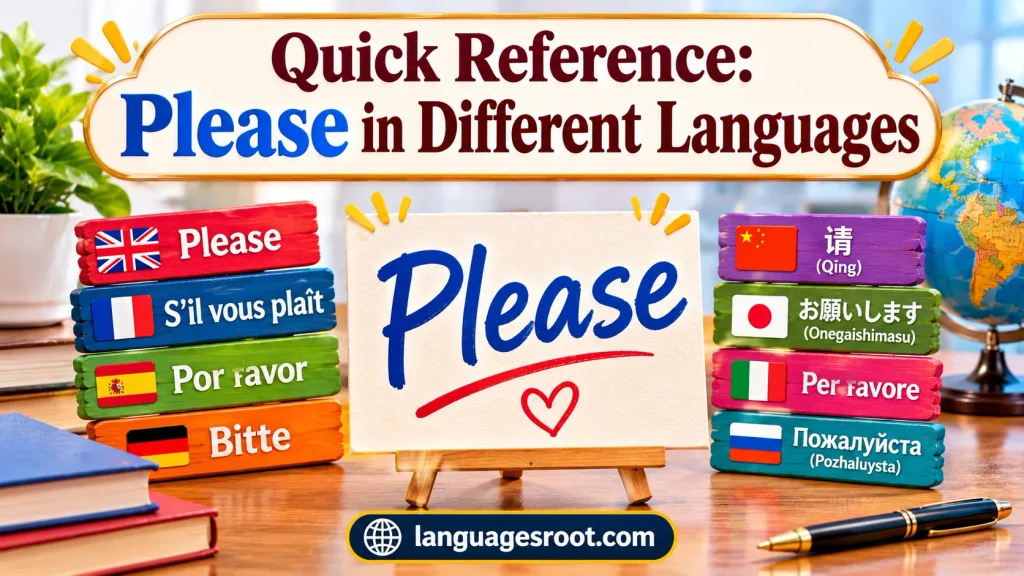
Use this compact table to find a polite expression quickly. The entries summarize the main forms presented above. For languages with formal and informal variants, choose according to the situation and the person you are addressing.
| Language | Translation |
| English | Please |
| Spanish | Por favor |
| French | S’il vous plaît |
| German | Bitte |
| Italian | Per favore |
| Portuguese | Por favor |
| Dutch | Alstublieft / Alsjeblieft |
| Swedish | Snälla |
| Norwegian | Vær så snill |
| Danish | Vær venlig |
| Finnish | Ole hyvä |
| Icelandic | Vinsamlegast |
| Irish | Le do thoil |
| Welsh | Os gwelwch yn dda |
| Polish | Proszę |
| Czech | Prosím |
| Slovak | Prosím |
| Ukrainian | Будь ласка |
| Russian | Пожалуйста |
| Romanian | Vă rog |
| Hungarian | Kérem |
| Greek | Παρακαλώ |
| Bulgarian | Моля |
| Croatian | Molim |
| Serbian | Молим / Molim |
| Slovenian | Prosim |
| Lithuanian | Prašau |
| Latvian | Lūdzu |
| Estonian | Palun |
| Albanian | Ju lutem |
| Catalan | Si us plau |
| American English | Please |
| British English | Please |
| Australian English | Please |
| Mandarin Chinese | 请 |
| Cantonese | 唔該 / 請 |
| Japanese | お願いします |
| Korean | 부탁합니다 |
| Hindi | कृपया |
| Urdu | براہِ کرم |
| Bengali | অনুগ্রহ করে |
| Punjabi | ਕਿਰਪਾ ਕਰਕੇ / کرپا کرکے |
| Gujarati | કૃપા કરીને |
| Marathi | कृपया |
| Tamil | தயவுசெய்து |
| Telugu | దయచేసి |
| Kannada | ದಯವಿಟ್ಟು |
| Malayalam | ദയവായി |
| Nepali | कृपया |
| Sinhala | කරුණාකර |
| Thai | กรุณา |
| Vietnamese | Làm ơn |
| Indonesian | Tolong |
| Malay | Tolong / Sila |
| Filipino (Tagalog) | Paki- / Pakisuyo |
| Burmese | ကျေးဇူးပြု၍ |
| Khmer | សូម |
| Lao | ກະລຸນາ |
| Mongolian | Гуйя |
| Kazakh | Өтінемін |
| Uzbek | Iltimos |
| Swahili | Tafadhali |
| Afrikaans | Asseblief |
| Zulu | Ngiyacela |
| Xhosa | Ndicela |
| Amharic | እባክዎ |
| Yoruba | Jọ̀ọ́ |
| Igbo | Biko |
| Hausa | Don Allah |
| Somali | Fadlan |
| Shona | Ndapota |
| Sesotho | Ka kopo |
| Setswana | Tsweetswee |
| Kinyarwanda | Nyabuneka |
| Malagasy | Azafady |
| Modern Standard Arabic | من فضلك |
| Levantine Arabic | لو سمحت |
| Persian (Farsi) | لطفاً |
| Kurdish (Kurmanji) | Ji kerema xwe |
| Turkish | Lütfen |
| Armenian | Խնդրում եմ |
| Māori | Tēnā koa |
| Samoan | Fa’amolemole |
| Tongan | Kataki |
| Hawaiian | E ʻoluʻolu |
| Quechua | Varies by dialect and context |
| Guarani | Mína |
| Haitian Creole | Tanpri |
| Esperanto | Bonvolu |
How to Choose the Right Translation
The best translation of “please” depends on what you are asking, whom you are addressing, and where the conversation takes place. A word that works well in a restaurant may not be the best choice for a formal letter or an important professional request.
Use these practical tips to choose a suitable expression:
- Consider your relationship with the listener. Choose a more formal expression when speaking to someone you do not know well, unless local conventions suggest otherwise.
- Think about the request. Asking for help may require a different phrase from ordering a drink or inviting someone to sit down.
- Check regional usage. Spanish, Arabic, Chinese, and other widely spoken languages have regional differences worth learning.
- Pay attention to grammar. In some languages, the polite expression belongs at the beginning or end of a sentence. In others, it follows the requested action.
- Learn the pronunciation. A reasonable pronunciation helps listeners understand your request and can make communication smoother.
- Follow local examples. Listen to how speakers phrase similar requests in real conversations, lessons, or reliable language-learning resources.
When in doubt, a short, respectful sentence is usually a good starting point. If the request is important, confirm the exact wording with a reliable speaker of the relevant language or dialect.
See Also: Billion in 110+ Global Languages: Translations & Pronunciation
Common Mistakes When Translating Please
Learning the equivalent of “please” is useful, but translating it word for word can sometimes create awkward or overly formal sentences. Avoid these common mistakes when speaking or writing in another language.
- Translating every word literally: A dictionary equivalent may not fit the grammatical structure of the target language. Learn the complete request, not just the polite word.
- Ignoring formality: Using an informal expression with a stranger or a formal expression with a close friend may sound unusual in some situations.
- Mixing regional varieties: A phrase from one dialect may be understood elsewhere but may not sound natural locally.
- Overlooking grammatical agreement: Some languages change a form according to the person being addressed, gender, number, or level of respect.
- Mispronouncing important sounds: Incorrect stress, tones, or vowel sounds can make a phrase harder to understand.
- Assuming one expression fits every request: Ordering food, asking for help, requesting permission, and inviting someone may require different wording.
- Forgetting tone of voice: A polite word cannot always compensate for a demanding or impatient tone.
- Using unfamiliar expressions without checking: Regional or literary forms may be less suitable for ordinary conversation than a common everyday expression.
The most reliable approach is to learn a complete, natural request alongside the polite expression. This helps you understand how the words work together.
Why Learn Please in Different Languages?
Learning how to say “please” in different languages can make everyday communication more thoughtful. A simple polite expression can help travelers ask for directions, order meals, request assistance, and interact more comfortably with people in unfamiliar settings. For students, it provides a practical way to expand vocabulary and understand how grammar and social conventions shape conversation.
It can also deepen cultural awareness. Comparing expressions across languages reveals that politeness is not always communicated through the same word or sentence pattern. Some languages rely on a direct equivalent of “please,” while others use respectful verb forms or indirect requests. Recognizing these differences helps learners avoid assuming that their native language provides a universal model for courtesy.
For families, friends, and international colleagues, learning a polite expression can also make messages feel more personal. Even a small effort to use another person’s language may help create a warmer interaction, especially when paired with respectful listening and appropriate behavior.
Most importantly, language learning is an ongoing process. Practicing pronunciation, context, and natural sentence patterns will help you use polite expressions with greater confidence and appreciation for linguistic diversity.
Frequently Asked Questions
“Please” has many translations around the world. For example, Spanish uses por favor, French uses s’il vous plaît, German uses bitte, and Hindi uses कृपया (kripayā).
Some languages use different expressions for formal and informal situations. For example, French uses s’il vous plaît formally and s’il te plaît informally..
Conclusion
Learning how to say please in different languages helps make everyday communication more polite and respectful. From por favor and s’il vous plaît to onegai shimasu and min faḍlik, each expression reflects unique cultural differences and polite communication styles. However, choosing the right please translation means considering context, formality, regional variations, and pronunciation. Keep practicing these useful phrases and embrace language learning with curiosity and respect to make conversations more natural around the world.
Check Out Our Latest Post
- How to Say Namaste in Different Languages
- Boss in 120+ Global Languages: Translations & Pronunciation
- How to Say Night in Different Languages
- Big Feet in 100+ Global Languages: Translations & Pronunciation
- How to Say Number 1 in Different Languages
How Did You Like This Article?
Share your feedback with a simple reaction.

Mafia Mukhtar is a passionate language enthusiast and experienced writer with multiple years of experience exploring global languages, vocabulary, and communication. Through her work at LanguagesRoot.com, she makes language learning more approachable, enjoyable, and meaningful for readers from different backgrounds. She enjoys sharing practical language insights that help people communicate with confidence. Explore LanguagesRoot.com for more language inspiration, helpful resources, and engaging learning content.