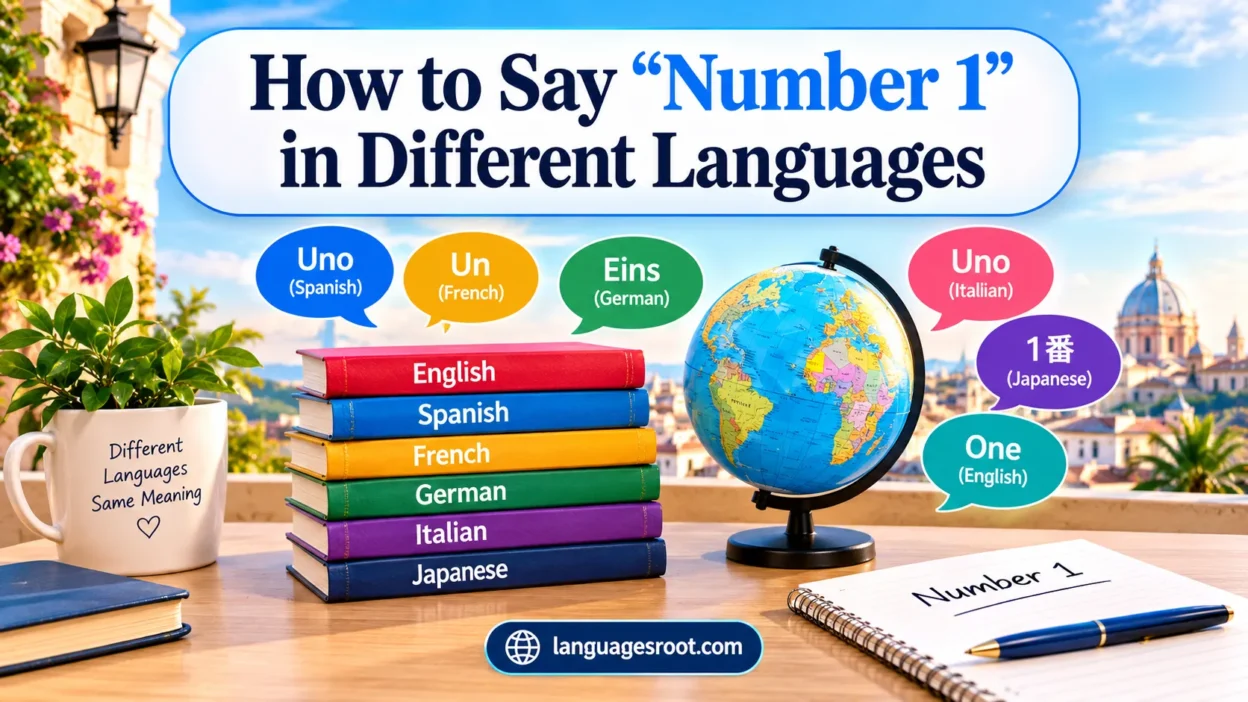
Learning Number 1 in different languages makes basic communication easier worldwide. The word one starts counting and helps express simple numerical values. However, languages use different number words, number forms, and pronunciation patterns. This guide explores how to say number one through useful number translations. You will also discover number one pronunciation and common language variations.
From European languages to Asian languages, each region offers unique expressions. Explore African languages, Middle Eastern languages, and other global languages. These translations of one include written numbers, spoken forms, and practical example sentences. Moreover, a helpful pronunciation guide supports language learners and travelers. Whether studying foreign language numbers or counting in different languages, this guide makes learning simple.
Interesting Facts About Number 1
- One is the first positive integer: It comes immediately after zero and before two in the standard counting sequence.
- Different writing systems represent one differently: Examples include 1, १, 一, and ١.
- Some languages have gendered number forms: For example, Spanish uses uno, una, and un depending on grammatical context.
- Pronunciation varies considerably: The English word one sounds very different from French un or Japanese ichi.
- The number has mathematical importance: One is the multiplicative identity because multiplying a number by one leaves it unchanged.
- Some languages use classifiers: Mandarin, for example, commonly places a measure word between one and a countable noun.
- Number symbols are not universal: Different numeral systems have developed different written forms for representing the same value.
What Does Number 1 Mean?
Global Word Explorer
Discover everyday English words and explore how people express them in languages around the world.
Translations in 8 Global Languages
Number 1 means one single unit, person, object, or quantity. It represents the smallest positive whole number and is commonly used to count individual things.
The number can also identify the first position in a sequence, such as the first student, first chapter, or first day. In everyday speech, people use it to express quantities, rankings, measurements, and instructions.
Depending on context, the word one can function as a number, a pronoun, or part of an expression. For example, saying “I have one book” identifies a quantity, while “number one” may refer to a ranking or the first item.
Why Can Number 1 Have Different Translations?
Although the mathematical value remains the same, languages do not always use the same grammatical form for the number.
Several factors influence its translation:
- Gender: Some languages change the form depending on whether a noun is masculine or feminine.
- Grammar: The number may change when used before a noun or independently.
- Pronunciation: Different sound systems affect how speakers pronounce the word.
- Writing systems: Languages represent the number through different scripts and spelling conventions.
- Classifiers: Some languages require special counting words with particular nouns.
- Formality and context: Everyday counting and formal mathematical language may use different expressions.
For this article, the main translation is the natural standalone counting form of one, with important grammatical variations explained where needed.
European Languages
European languages belong to several different language families, including Romance, Germanic, Slavic, and Celtic languages. Although many share historical influences, their words for one have distinct pronunciations and grammatical patterns. The following examples include standard forms and useful regional English varieties.
| 🌍 Language | Country/Region | Translation | Pronunciation | Example Sentence |
| 🇬🇧 English | UK, Ireland, worldwide | One | Wun | I have one brother. |
| 🇺🇸 American English | United States | One | Wun | There is one chair. |
| 🇬🇧 British English | United Kingdom | One | Wun | I need one ticket. |
| 🇦🇺 Australian English | Australia | One | Wun | We bought one apple. |
| 🇪🇸 Spanish | Spain, Latin America | Uno / Una | OO-noh / OO-nah | Tengo un libro. (I have one book.) |
| 🇫🇷 French | France, Belgium, Switzerland | Un / Une | Uhn / Ewn | J’ai un frère. (I have one brother.) |
| 🇩🇪 German | Germany, Austria | Eins | Ayns | Ich habe ein Auto. (I have one car.) |
| 🇮🇹 Italian | Italy, Switzerland | Uno / Una | OO-noh / OO-nah | Ho un cane. (I have one dog.) |
| 🇵🇹 Portuguese | Portugal, Brazil | Um / Uma | Oong / OO-mah | Tenho um livro. (I have one book.) |
| 🇳🇱 Dutch | Netherlands, Belgium | Eén | Ayn | Ik heb één zus. (I have one sister.) |
| 🇸🇪 Swedish | Sweden, Finland | Ett / En | Ett / Ehn | Jag har en katt. (I have one cat.) |
| 🇳🇴 Norwegian | Norway | Én / Ei / Ett | Ayn / Ay / Ett | Jeg har én hund. (I have one dog.) |
| 🇩🇰 Danish | Denmark | Én / Et | Ayn / Et | Jeg har én cykel. (I have one bicycle.) |
| 🇫🇮 Finnish | Finland | Yksi | ÜK-see | Minulla on yksi kirja. (I have one book.) |
| 🇮🇸 Icelandic | Iceland | Einn / Ein / Eitt | Ayt-n / Ayn / Ayt | Ég á einn hest. (I have one horse.) |
| 🇮🇪 Irish | Ireland | Aon | Een | Tá aon úll agam. (I have one apple.) |
| 🏴 Welsh | Wales | Un / Un (masculine form) | Een | Mae gen i un llyfr. (I have one book.) |
| 🇵🇱 Polish | Poland | Jeden / Jedna / Jedno | YEH-den / YED-nah / YED-noh | Mam jeden bilet. (I have one ticket.) |
| 🇨🇿 Czech | Czechia | Jeden / Jedna / Jedno | YEH-den / YED-nah / YED-noh | Mám jednu sestru. (I have one sister.) |
| 🇸🇰 Slovak | Slovakia | Jeden / Jedna / Jedno | YEH-den / YED-nah / YED-noh | Mám jednu knihu. (I have one book.) |
| 🇺🇦 Ukrainian | Ukraine | Один / Одна / Одне | Oh-DIN / Oh-DNAH / Oh-DNEH | У мене один брат. (I have one brother.) |
| 🇷🇺 Russian | Russia and surrounding regions | Один / Одна / Одно | Ah-DEEN / Ah-DNAH / Ahd-NO | У меня один билет. (I have one ticket.) |
| 🇷🇴 Romanian | Romania, Moldova | Unu / Una | OO-noo / OO-nah | Am un câine. (I have one dog.) |
| 🇭🇺 Hungarian | Hungary | Egy | Edj | Van egy könyvem. (I have one book.) |
| 🇬🇷 Greek | Greece, Cyprus | Ένα | EH-nah | Έχω ένα βιβλίο. (I have one book.) |
| 🇧🇬 Bulgarian | Bulgaria | Един / Една / Едно | Eh-DEEN / Eh-DNAH / Eh-DNO | Имам един брат. (I have one brother.) |
| 🇭🇷 Croatian | Croatia, Bosnia and Herzegovina | Jedan / Jedna / Jedno | YEH-dahn / YED-nah / YED-noh | Imam jednu knjigu. (I have one book.) |
| 🇷🇸 Serbian | Serbia, Bosnia and Herzegovina | Један / Једна / Једно | YEH-dahn / YED-nah / YED-noh | Имам једног брата. (I have one brother.) |
| 🇸🇮 Slovenian | Slovenia | En / Ena / Eno | Ehn / EH-nah / EH-noh | Imam eno knjigo. (I have one book.) |
| 🇱🇹 Lithuanian | Lithuania | Vienas / Viena | VYEH-nahs / VYEH-nah | Turiu vieną knygą. (I have one book.) |
| 🇱🇻 Latvian | Latvia | Viens / Viena | VYEHNS / VYEH-nah | Man ir viena grāmata. (I have one book.) |
| 🇪🇪 Estonian | Estonia | Üks | Üks | Mul on üks raamat. (I have one book.) |
English Varieties
English uses the same written and spoken word, one, in American, British, and Australian English. Differences are mainly related to accent, rhythm, and surrounding vocabulary rather than the number itself.
The pronunciation guide “wun” is a simplified English approximation. It does not represent every regional accent.
European Translation Notes
- Spanish, Italian, and Portuguese: The form of one often changes according to grammatical gender and its position before a noun.
- French: Un and une distinguish masculine and feminine nouns.
- German: Eins is used independently, while ein and eine are common before nouns.
- Slavic languages: Forms such as jeden, jedna, and jedno reflect grammatical gender.
- Finnish and Estonian: Their number words are quite different from those of neighboring Indo-European languages.
Take Note:How to Say Now in Different Languages
Asian Languages
Asia has an especially wide variety of languages, writing systems, and numerical expressions. Some languages use alphabetic scripts, while others use characters or syllabic writing systems. The following table provides standalone forms of one, together with examples showing how the number is used naturally.
| 🌍 Language | Country/Region | Translation | Pronunciation | Example Sentence |
| 🇨🇳 Mandarin Chinese | China, Taiwan, Singapore | 一 | Yī (high tone) | 我有一本书。 (I have one book.) |
| 🇭🇰 Cantonese | Hong Kong, Guangdong | 一 | Yāt (high level) | 我有一本書。 (I have one book.) |
| 🇯🇵 Japanese | Japan | 一 | Ichi | 本を一冊持っています。 (I have one book.) |
| 🇰🇷 Korean | South Korea, North Korea | 하나 | Hana | 사과 하나 주세요. (Please give me one apple.) |
| 🇮🇳 Hindi | India | एक | Ek | मेरे पास एक किताब है। (I have one book.) |
| 🇵🇰 Urdu | Pakistan, India | ایک | Aik | میرے پاس ایک کتاب ہے۔ (I have one book.) |
| 🇧🇩 Bengali | Bangladesh, India | এক | Ek | আমার একটি বই আছে। (I have one book.) |
| 🇮🇳 Punjabi | India, Pakistan | ਇੱਕ | Ikk | ਮੇਰੇ ਕੋਲ ਇੱਕ ਕਿਤਾਬ ਹੈ। (I have one book.) |
| 🇮🇳 Gujarati | India | એક | Ek | મારી પાસે એક પુસ્તક છે। (I have one book.) |
| 🇮🇳 Marathi | India | एक | Ek | माझ्याकडे एक पुस्तक आहे. (I have one book.) |
| 🇮🇳 Tamil | India, Sri Lanka | ஒன்று | Ondru | என்னிடம் ஒரு புத்தகம் உள்ளது. (I have one book.) |
| 🇮🇳 Telugu | India | ఒకటి | Okati | నా దగ్గర ఒక పుస్తకం ఉంది. (I have one book.) |
| 🇮🇳 Kannada | India | ಒಂದು | Ondu | ನನ್ನ ಬಳಿ ಒಂದು ಪುಸ್ತಕವಿದೆ. (I have one book.) |
| 🇮🇳 Malayalam | India | ഒന്ന് | Onnu | എന്റെ കൈയിൽ ഒരു പുസ്തകമുണ്ട്. (I have one book.) |
| 🇳🇵 Nepali | Nepal | एक | Ek | मसँग एउटा किताब छ। (I have one book.) |
| 🇱🇰 Sinhala | Sri Lanka | එක | Eka | මට එක පොතක් තියෙනවා. (I have one book.) |
| 🇹🇭 Thai | Thailand | หนึ่ง | Nùeng | ฉันมีหนังสือหนึ่งเล่ม (I have one book.) |
| 🇻🇳 Vietnamese | Vietnam | Một | Moht | Tôi có một quyển sách. (I have one book.) |
| 🇮🇩 Indonesian | Indonesia | Satu | SAH-too | Saya punya satu buku. (I have one book.) |
| 🇲🇾 Malay | Malaysia, Brunei, Singapore | Satu | SAH-too | Saya ada satu buku. (I have one book.) |
| 🇵🇭 Filipino (Tagalog) | Philippines | Isa | EE-sah | Mayroon akong isang libro. (I have one book.) |
| 🇲🇲 Burmese | Myanmar | တစ် | Thit | ကျွန်တော့်မှာ စာအုပ်တစ်အုပ်ရှိတယ်။ (I have one book.) |
| 🇰🇭 Khmer | Cambodia | មួយ | Muoy | ខ្ញុំមានសៀវភៅមួយក្បាល។ (I have one book.) |
| 🇱🇦 Lao | Laos | ໜຶ່ງ | Nùng | ຂ້ອຍມີປຶ້ມໜຶ່ງຫົວ. (I have one book.) |
| 🇲🇳 Mongolian | Mongolia | Нэг | Neg | Надад нэг ном бий. (I have one book.) |
| 🇰🇿 Kazakh | Kazakhstan | Бір | Bir | Менде бір кітап бар. (I have one book.) |
| 🇺🇿 Uzbek | Uzbekistan | Bir | Beer | Menda bir kitob bor. (I have one book.) |
Asian Translation Notes
Some Asian languages have important distinctions between counting independently and counting objects.
- Mandarin Chinese: Yī is the standalone number. In everyday counting, it can change tone depending on the following word. Classifiers such as běn are used with books.
- Cantonese: Yāt is the standalone form, while tones are important for accurate pronunciation.
- Japanese: Ichi is the independent number, but counters such as -satsu are used when counting books.
- Korean: Hana belongs to the native Korean number system. Korean also uses the Sino-Korean number il in dates, mathematics, and other contexts.
- Hindi and Urdu: The word ek is used in counting and before nouns, although surrounding grammar may influence the sentence.
- Thai: Nùeng is the basic number. Classifiers are commonly used when counting objects.
- Vietnamese: Một includes a distinctive tone that should be preserved when speaking.
African Languages
Africa is home to hundreds of languages belonging to several major language families. Many African languages have their own distinctive sounds, grammatical structures, and counting traditions. Here are examples of how one is expressed in different African languages.
| 🌍 Language | Country/Region | Translation | Pronunciation | Example Sentence |
| 🇹🇿 Swahili | Tanzania, Kenya, Uganda | Moja | MOH-jah | Nina kitabu kimoja. (I have one book.) |
| 🇿🇦 Afrikaans | South Africa, Namibia | Een | Ayn | Ek het een boek. (I have one book.) |
| 🇿🇦 Zulu | South Africa | Kunye | KOO-nyeh | Nginebhuku elilodwa. (I have one book.) |
| 🇿🇦 Xhosa | South Africa | Nye | N-yeh | Ndineencwadi enye. (I have one book.) |
| 🇪🇹 Amharic | Ethiopia | አንድ | And | አንድ መጽሐፍ አለኝ። (I have one book.) |
| 🇳🇬 Yoruba | Nigeria, Benin | Ọ̀kan | AW-kahn | Mo ní ìwé kan. (I have one book.) |
| 🇳🇬 Igbo | Nigeria | Otu | OH-too | Enwere m otu akwụkwọ. (I have one book.) |
| 🇳🇬 Hausa | Nigeria, Niger | Ɗaya | DAA-yah | Ina da littafi ɗaya. (I have one book.) |
| 🇸🇴 Somali | Somalia, Djibouti | Kow | Kow | Waxaan haystaa hal buug. (I have one book.) |
| 🇿🇼 Shona | Zimbabwe | Imwe | EEM-weh | Ndine bhuku rimwe. (I have one book.) |
| 🇱🇸 Sesotho | Lesotho, South Africa | Nngoe | N-ngweh | Ke na le buka e le ‘ngoe. (I have one book.) |
| 🇧🇼 Setswana | Botswana, South Africa | Nngwe | N-ngweh | Ke na le buka e le nngwe. (I have one book.) |
| 🇷🇼 Kinyarwanda | Rwanda | Rimwe | REEM-weh | Mfite igitabo kimwe. (I have one book.) |
| 🇲🇬 Malagasy | Madagascar | Iray | EE-ray | Manana boky iray aho. (I have one book.) |
African Translation Notes
- Swahili: Moja is the basic form of one, but noun-class agreement affects how numbers appear in complete sentences.
- Zulu and Xhosa: Number expressions can change according to noun classes and sentence structure.
- Yoruba: Tone marks are important. Ọ̀kan should not be confused with other words that have similar spellings.
- Hausa: Ɗaya is a common standalone form of one.
- Amharic: The word አንድ is pronounced approximately and.
- Sesotho and Setswana: Their counting expressions are related in some ways, but they are distinct languages with their own grammatical patterns.
Middle Eastern Languages
The Middle East contains several different language families and writing traditions. Arabic, Persian, Kurdish, and Armenian have distinct numerical vocabulary and pronunciation. Arabic also has important differences between Modern Standard Arabic and regional spoken varieties.
| 🌍 Language | Country/Region | Translation | Pronunciation | Example Sentence |
| 🇵🇸 Arabic (Modern Standard Arabic) | Palestine and the wider Arabic-speaking world | واحد | Wāḥid | لدي كتاب واحد. (I have one book.) |
| 🇮🇷 Persian (Farsi) | Iran, Afghanistan, Tajikistan | یک | Yek | من یک کتاب دارم. (I have one book.) |
| 🇹🇷 Turkish | Türkiye, Cyprus | Bir | Beer | Bir kitabım var. (I have one book.) |
| 🇮🇶 Kurdish (Kurmanji) | Kurdistan regions, Türkiye, Iraq, Syria | Yek | Yehk | Min yek pirtûk heye. (I have one book.) |
| 🇦🇲 Armenian | Armenia and Armenian communities worldwide | Մեկ | Mek | Ես մեկ գիրք ունեմ։ (I have one book.) |
Middle Eastern Translation Notes
- Arabic: Wāḥid is the masculine standalone form, while wāḥida is feminine. The number also has different grammatical uses when placed before nouns. Regional dialects may use different pronunciations.
- Persian: Yek is the standard word for one and is widely understood across Persian-speaking communities.
- Turkish: Bir can mean one and can also function as an indefinite article, depending on context.
- Kurdish: Yek is used in Kurmanji. Other Kurdish varieties may have different pronunciation and vocabulary.
- Armenian: Mek is the standard standalone counting form.
Other World Languages
Beyond Europe, Asia, Africa, and the Middle East, many Indigenous and island languages have their own ways of expressing numbers. These examples offer an additional look at the diversity of global numerical vocabulary.
| 🌍 Language | Country/Region | Translation | Pronunciation | Example Sentence |
| 🇳🇿 Māori | New Zealand | Tahi | TAH-hee | Kotahi taku pukapuka. (I have one book.) |
| 🇼🇸 Samoan | Samoa | Tasi | TAH-see | E tasi la’u tusi. (I have one book.) |
| 🇹🇴 Tongan | Tonga | Taha | TAH-hah | ‘Oku ou ma’u ha tohi ‘e taha. (I have one book.) |
| 🇺🇸 Hawaiian | Hawaii | ʻEkahi | Eh-KAH-hee | Hoʻokahi kaʻu puke. (I have one book.) |
| 🇵🇪 Quechua | Peru, Bolivia, Ecuador | Huk | Hook | Ñuqaqa huk wasiypi kani. (I am in one house.) |
| 🇵🇾 Guarani | Paraguay and neighboring regions | Peteĩ | Peh-TAY | Peteĩ aranduka areko. (I have one book.) |
| 🇭🇹 Haitian Creole | Haiti | Youn | Yoon | Mwen gen yon liv. (I have one book.) |
| 🌍 Esperanto | International constructed language | Unu | OO-noo | Mi havas unu libron. (I have one book.) |
Other World Language Notes
- Māori: Tahi is the basic number, while kotahi is commonly used in counting expressions.
- Samoan: Tasi is a common form for one.
- Hawaiian: ʻEkahi represents one, with the ʻokina marking a glottal stop.
- Quechua: Huk is a common form, although spelling and pronunciation can vary among Quechuan varieties.
- Guarani: Peteĩ is the standard word for one.
- Haitian Creole: Youn is commonly used as the number one and also appears in the indefinite expression yon before a noun.
Quick Reference: Number 1 in Different Languages
The following table brings together the translations from all the regional sections. It is designed for readers who want to find the word for one quickly without reviewing every pronunciation and example.
| Language | Translation |
| English | One |
| American English | One |
| British English | One |
| Australian English | One |
| Spanish | Uno / Una |
| French | Un / Une |
| German | Eins |
| Italian | Uno / Una |
| Portuguese | Um / Uma |
| Dutch | Eén |
| Swedish | Ett / En |
| Norwegian | Én / Ei / Ett |
| Danish | Én / Et |
| Finnish | Yksi |
| Icelandic | Einn / Ein / Eitt |
| Irish | Aon |
| Welsh | Un |
| Polish | Jeden / Jedna / Jedno |
| Czech | Jeden / Jedna / Jedno |
| Slovak | Jeden / Jedna / Jedno |
| Ukrainian | Один / Одна / Одне |
| Russian | Один / Одна / Одно |
| Romanian | Unu / Una |
| Hungarian | Egy |
| Greek | Ένα |
| Bulgarian | Един / Една / Едно |
| Croatian | Jedan / Jedna / Jedno |
| Serbian | Један / Једна / Једно |
| Slovenian | En / Ena / Eno |
| Lithuanian | Vienas / Viena |
| Latvian | Viens / Viena |
| Estonian | Üks |
| Mandarin Chinese | 一 (Yī) |
| Cantonese | 一 (Yāt) |
| Japanese | 一 (Ichi) |
| Korean | 하나 (Hana) |
| Hindi | एक (Ek) |
| Urdu | ایک (Aik) |
| Bengali | এক (Ek) |
| Punjabi | ਇੱਕ (Ikk) |
| Gujarati | એક (Ek) |
| Marathi | एक (Ek) |
| Tamil | ஒன்று (Ondru) |
| Telugu | ఒకటి (Okati) |
| Kannada | ಒಂದು (Ondu) |
| Malayalam | ഒന്ന് (Onnu) |
| Nepali | एक (Ek) |
| Sinhala | එක (Eka) |
| Thai | หนึ่ง (Nùeng) |
| Vietnamese | Một |
| Indonesian | Satu |
| Malay | Satu |
| Filipino | Isa |
| Burmese | တစ် (Thit) |
| Khmer | មួយ (Muoy) |
| Lao | ໜຶ່ງ (Nùng) |
| Mongolian | Нэг (Neg) |
| Kazakh | Бір (Bir) |
| Uzbek | Bir |
| Swahili | Moja |
| Afrikaans | Een |
| Zulu | Kunye |
| Xhosa | Nye |
| Amharic | አንድ (And) |
| Yoruba | Ọ̀kan |
| Igbo | Otu |
| Hausa | Ɗaya |
| Somali | Kow |
| Shona | Imwe |
| Sesotho | Nngoe |
| Setswana | Nngwe |
| Kinyarwanda | Rimwe |
| Malagasy | Iray |
| Arabic | واحد (Wāḥid) |
| Persian | یک (Yek) |
| Turkish | Bir |
| Kurdish | Yek |
| Armenian | Մեկ (Mek) |
| Māori | Tahi |
| Samoan | Tasi |
| Tongan | Taha |
| Hawaiian | ʻEkahi |
| Quechua | Huk |
| Guarani | Peteĩ |
| Haitian Creole | Youn |
| Esperanto | Unu |
How to Choose the Right Translation
Choosing the correct translation of number 1 depends on how you intend to use it. A standalone number may have a different form when it appears before a noun or inside a sentence. For example, Spanish uses uno independently, but un before many masculine singular nouns. French similarly distinguishes un and une according to grammatical gender.
Consider these practical tips:
- Check the context: Decide whether you are counting, identifying a position, or describing a quantity.
- Understand grammatical gender: Languages such as Spanish, French, and German have gender-related number forms.
- Consider regional differences: Some languages have different expressions across countries and dialects.
- Learn the pronunciation: Listen to the correct sounds, especially in tonal languages.
- Use natural examples: Learn how the number appears in complete sentences rather than memorizing it alone.
- Check the writing system: Make sure you recognize the appropriate native characters and spelling.
Take Note:Billionaire in 110 Global Languages: Translations & Pronunciation
Common Mistakes When Translating Number 1
Translating numbers seems simple, but some common mistakes can affect accuracy and natural communication.
- Using only one grammatical form: Some languages change the word for one according to gender or the noun it describes.
- Ignoring pronunciation: Similar-looking words can have different sounds across languages.
- Confusing number systems: Korean, for example, has native Korean and Sino-Korean counting systems.
- Ignoring classifiers: Mandarin, Japanese, and Thai commonly use counting words with particular objects.
- Mixing regional variations: A word from one dialect should not automatically be treated as universal.
- Using incorrect spelling: Missing accent marks, tone marks, or special characters can change pronunciation or meaning.
- Assuming literal translation works everywhere: Natural grammatical structures often differ from English.
Why Learn Number 1 in Different Languages?
Learning the number one in different languages is a simple but valuable step toward multilingual communication. Numbers appear in everyday situations, including shopping, traveling, studying, counting objects, and exchanging information.
Understanding different number systems can also introduce learners to new writing systems and pronunciation patterns. For students, it provides a useful foundation for learning additional numbers and basic mathematics vocabulary. Travelers may find it helpful when reading signs, understanding prices, or asking about quantities.
Exploring international number words also encourages appreciation for linguistic diversity. Even a basic number can reveal interesting differences in grammar, sounds, and cultural traditions. Learning these expressions is an accessible way to begin exploring a new language and communicating more confidently with people from different backgrounds.
Frequently Asked Questions
How do you say Number 1 in different languages?
Number 1 has different translations around the world. Examples include One in English, Uno in Spanish, Un in French, Eins in German, Yī in Mandarin, Ichi in Japanese, and Satu in Indonesian.
What is the difference between one and first?
One describes a single person or object, while first shows position in a sequence. For example, one book means a single book, while the first book identifies its place.
Conclusion
Learning Number 1 in different languages reveals how global languages express the same basic value through unique words, sounds, and writing systems. From One, Uno, and Yī to Moja, these number translations show fascinating language variations. Understanding pronunciation patterns, grammatical gender, and classifiers helps you use each expression correctly. Whether you are traveling or studying, keep exploring foreign language numbers and enjoy discovering the beauty of counting in different languages.
How Did You Like This Article?
Share your feedback with a simple reaction.

Alyan Ashraf is a passionate language enthusiast and experienced writer with multiple years of experience exploring global languages, linguistic diversity, and effective communication. Through LanguagesRoot.com, he shares engaging, informative, and easy-to-understand content that helps readers discover languages, expand their vocabulary, and appreciate different cultures. Alyan is dedicated to making language learning more accessible and enjoyable. Explore LanguagesRoot.com for more language insights and stay connected!