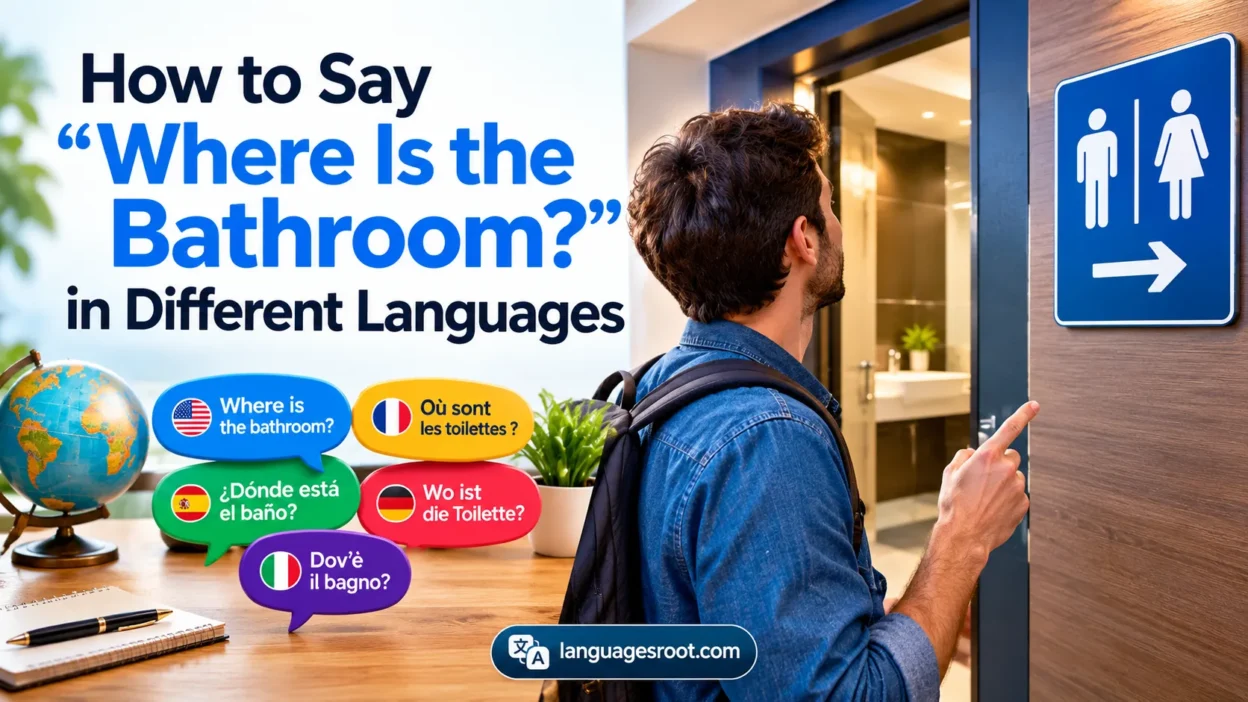
Knowing Where Is the Bathroom can make travel much easier in another country. This useful phrase helps you ask for the bathroom at a restaurant, airport, hotel, or train station. You may also hear restroom, toilet, washroom, lavatory, or loo, depending on the country. Learning the local language can help international travelers communicate clearly and respectfully.
This guide covers more than 70 languages with pronunciation, natural translation, and an example sentence. You will also learn how formality, context, and dialect can change preferred expressions. For language learners and students studying abroad, these practical sentences can build confidence. Whether you visit a museum, shopping mall, or someone’s home, the right phrase makes communication easier.
Interesting Facts About “Where Is the Bathroom?”
- “Bathroom” is not translated literally in every language. Many languages use a word closer to “toilet,” “restroom,” “washroom,” or “WC.”
- British and American English differ. American English commonly uses “bathroom” and “restroom,” while British English commonly uses “toilet” and “loo.”
- Some languages use a plural form. French commonly says “Où sont les toilettes?”, which literally refers to “the toilets.”
- Japanese has several polite choices. Otearai is a polite term for a restroom, while toire is a very common everyday word.
- Signs may use WC internationally. In many countries, “WC” is recognizable even when travelers do not speak the local language.
- Politeness matters. Adding “excuse me” or the local equivalent can make a simple question sound much more courteous.
- The same country may have regional vocabulary. Spanish, Arabic, Portuguese, Chinese, and English all have important regional differences.
- You do not always need perfect pronunciation. Speaking slowly, showing the written phrase, or combining the phrase with a pointing gesture can help.
- Learning one practical phrase can build travel confidence. Small expressions often make everyday communication less stressful.
- Bathroom vocabulary can reveal cultural differences. Words for private facilities often reflect local ideas about politeness, formality, and everyday conversation.
European Languages
European languages belong to several different language families, including Romance, Germanic, Slavic, Celtic, and Uralic languages. Even when countries are geographically close, the most natural word for a bathroom can differ considerably.
For travelers, the key is to learn the everyday expression rather than translating “bathroom” word for word. In France, for example, “toilettes” is standard, while in Germany “Toilette” is common. In Britain, “toilet” and “loo” are natural everyday choices. The following table gives practical expressions that travelers can recognize and use.
| Language | Country/Region | Translation | Pronunciation | Synonyms | Example sentence |
| 🇺🇸 American English | United States | Where is the bathroom? | Wair iz thuh bathroom? | restroom, bathroom, lavatory | Excuse me, where is the bathroom? |
| 🇬🇧 British English | UK | Where is the toilet? | Wair iz thuh toy-let? | loo, toilet, lavatory | Excuse me, where is the toilet? |
| 🇦🇺 Australian English | Australia | Where is the toilet? | Wair iz thuh toy-let? | toilet, loo, bathroom | Where is the toilet, please? |
| 🇪🇸 Spanish | Spain, Latin America | ¿Dónde está el baño? | DON-deh es-TA el BAN-yo? | baño, aseo, sanitario | Disculpe, ¿dónde está el baño? |
| 🇫🇷 French | France, Francophone regions | Où sont les toilettes ? | Oo son lay twa-LET? | toilettes, WC, sanitaires | Excusez-moi, où sont les toilettes ? |
| 🇩🇪 German | Germany, Austria | Wo ist die Toilette? | Vo ist dee toy-LET-uh? | Toilette, WC, Bad | Entschuldigung, wo ist die Toilette? |
| 🇮🇹 Italian | Italy | Dov’è il bagno? | Doh-VEH eel BAN-yo? | bagno, toilette, servizi | Scusi, dov’è il bagno? |
| 🇵🇹 Portuguese | Portugal | Onde é a casa de banho? | ON-deh eh ah KAH-zah deh BAN-yoo? | casa de banho, WC, lavabos | Desculpe, onde é a casa de banho? |
| 🇧🇷 Brazilian Portuguese | Brazil | Onde fica o banheiro? | ON-jee FEE-kah oo ban-YAY-roo? | banheiro, sanitário, lavabo | Onde fica o banheiro, por favor? |
| 🇳🇱 Dutch | Netherlands | Waar is het toilet? | Vahr is ut toy-LET? | toilet, WC, wc-ruimte | Waar is het toilet, alstublieft? |
| 🇸🇪 Swedish | Sweden | Var är toaletten? | Vahr air too-ah-LET-ten? | toalett, WC | Ursäkta, var är toaletten? |
| 🇩🇰 Danish | Denmark | Hvor er toilettet? | Voh-er air toy-LET-et? | toilet, WC | Undskyld, hvor er toilettet? |
| 🇳🇴 Norwegian | Norway | Hvor er toalettet? | Voo-er air too-ah-LET-et? | toalett, WC | Unnskyld, hvor er toalettet? |
| 🇫🇮 Finnish | Finland | Missä on vessa? | MIS-sah on VESS-sah? | vessa, WC | Anteeksi, missä on vessa? |
| 🇮🇸 Icelandic | Iceland | Hvar er klósettið? | Kvar air KLOH-set-tith? | klósett, salerni | Afsakið, hvar er klósettið? |
| 🇮🇪 Irish | Ireland | Cá bhfuil an leithreas? | Kaw will un LEH-hras? | leithreas, seomra folctha | Cá bhfuil an leithreas, le do thoil? |
| 🏴 Scottish Gaelic | Scotland | Càite bheil an taigh beag? | KAH-cheh vel un tie bek? | taigh beag, seòmar-ionnlaid | Càite bheil an taigh beag? |
| 🏴 Welsh | Wales | Ble mae’r toiled? | Bleh myr TOY-led? | toiled, ystafell ymolchi | Esgusodwch fi, ble mae’r toiled? |
| 🇵🇱 Polish | Poland | Gdzie jest toaleta? | Gdjeh yest twa-LE-ta? | toaleta, WC | Przepraszam, gdzie jest toaleta? |
| 🇨🇿 Czech | Czech Republic | Kde je prosím záchod? | Gdeh yeh PRO-seem ZA-khod? | záchod, toaleta, WC | Promiňte, kde je prosím záchod? |
| 🇸🇰 Slovak | Slovakia | Kde je záchod? | Gdeh yeh ZA-khod? | záchod, WC | Prepáčte, kde je záchod? |
| 🇸🇮 Slovenian | Slovenia | Kje je stranišče? | Kyeh yeh strah-NEESH-cheh? | stranišče, WC | Oprostite, kje je stranišče? |
| 🇭🇷 Croatian | Croatia | Gdje je zahod? | Gdyeh yeh ZA-hod? | zahod, WC, toalet | Oprostite, gdje je zahod? |
| 🇷🇸 Serbian | Serbia | Gde je toalet? | Gdeh yeh twa-LET? | toalet, kupatilo, WC | Izvinite, gde je toalet? |
| 🇧🇬 Bulgarian | Bulgaria | Къде е тоалетната? | Kuh-DEH eh twa-let-NA-ta? | тоалетна, WC | Извинете, къде е тоалетната? |
| 🇷🇴 Romanian | Romania | Unde este toaleta? | OON-deh YES-teh twa-LE-ta? | toaletă, WC, baie | Scuzați-mă, unde este toaleta? |
| 🇭🇺 Hungarian | Hungary | Hol van a mosdó? | Hol von uh MOSH-doh? | mosdó, vécé, toalett | Elnézést, hol van a mosdó? |
| 🇬🇷 Greek | Greece, Cyprus | Πού είναι η τουαλέτα; | Poo EE-neh ee too-ah-LE-ta? | τουαλέτα, μπάνιο, WC | Συγγνώμη, πού είναι η τουαλέτα; |
| 🇦🇱 Albanian | Albania, Kosovo | Ku është banjoja? | Koo UHSH-teh ban-YO-ya? | banjo, tualet | Më falni, ku është banjoja? |
| 🇺🇦 Ukrainian | Ukraine | Де туалет? | Deh too-ah-LET? | туалет, вбиральня | Вибачте, де туалет? |
These European expressions show why direct translation is not always the best strategy. For example, the natural French expression uses “toilettes,” while Italian commonly uses “bagno.” The important goal is not to reproduce the exact English structure, but to use an expression a local speaker will immediately understand. Omniglot lists these types of regional alternatives across European languages.
Asian Languages
Asia is home to thousands of languages and many distinct writing systems. You may encounter Arabic-derived scripts, Chinese characters, Devanagari, Hangul, Japanese kana, Cyrillic, and numerous regional writing systems.
For travelers, pronunciation is particularly useful because you may not be able to read the local script. Learning the written form can also be helpful because you can show it to someone if your pronunciation is uncertain.
Also Read: How to Say “What Is Your Name?” in Different Languages
| Language | Country/Region | Translation | Pronunciation | Synonyms | Example sentence |
| 🇨🇳 Mandarin Chinese | China, Taiwan, Singapore | 洗手间在哪里? | Xǐshǒujiān zài nǎlǐ? | 厕所, 洗手间, 卫生间 | 请问,洗手间在哪里? |
| 🇭🇰 Cantonese | Hong Kong, Guangdong | 洗手間喺邊度呀? | Sai-sau-gaan hai bin-dou aa? | 廁所, 洗手間 | 唔該,洗手間喺邊度呀? |
| 🇯🇵 Japanese | Japan | お手洗いはどこですか? | O-te-arai wa doko desu ka? | トイレ, お手洗い, 化粧室 | すみません、お手洗いはどこですか? |
| 🇰🇷 Korean | South Korea | 화장실이 어디예요? | Hwa-jang-shi-ri eo-di-ye-yo? | 화장실, 변소 | 실례합니다, 화장실이 어디예요? |
| 🇮🇳 Hindi | India | शौचालय कहाँ है? | Shauch-a-lay kahaan hai? | टॉयलेट, शौचालय, बाथरूम | माफ़ कीजिए, शौचालय कहाँ है? |
| 🇵🇰 Urdu | Pakistan, India | باتھ روم کہاں ہے؟ | Bathroom kahan hai? | باتھ روم, بیت الخلا, واش روم | معاف کیجیے، باتھ روم کہاں ہے؟ |
| 🇧🇩 Bengali | Bangladesh, India | বাথরুম কোথায়? | Bathroom kothay? | শৌচাগার, বাথরুম | মাফ করবেন, বাথরুম কোথায়? |
| 🇮🇳 Punjabi | Punjab regions | ٹوائلٹ کتھے اے؟ | Toilet kithe ae? | ٹوائلٹ, باتھ روم | معاف کرنا، ٹوائلٹ کتھے اے؟ |
| 🇮🇳 Gujarati | India | શૌચાલય ક્યાં છે? | Shauchalay kyaan chhe? | શૌચાલય, ટોયલેટ | માફ કરશો, શૌચાલય ક્યાં છે? |
| 🇮🇳 Marathi | India | शौचालय कुठे आहे? | Shauchalay kuthe aahe? | शौचालय, प्रसाधनगृह | माफ करा, शौचालय कुठे आहे? |
| 🇳🇵 Nepali | Nepal | शौचालय कहाँ छ? | Shauchalay kahaan chha? | शौचालय, ट्वाइलेट | माफ गर्नुहोस्, शौचालय कहाँ छ? |
| 🇱🇰 Sinhala | Sri Lanka | වැසිකිළිය කොහෙද? | Wasikiliya koheda? | වැසිකිළිය, ටොයිලට් | සමාවන්න, වැසිකිළිය කොහෙද? |
| 🇮🇳 Tamil | India, Sri Lanka | கழிப்பறை எங்கே இருக்கிறது? | Kazhipparai enge irukkiradhu? | கழிப்பறை, குளியலறை | மன்னிக்கவும், கழிப்பறை எங்கே இருக்கிறது? |
| 🇮🇳 Telugu | India | మరుగుదొడ్డి ఎక్కడ ఉంది? | Marugudoddi ekkada undi? | మరుగుదొడ్డి, టాయిలెట్ | క్షమించండి, మరుగుదొడ్డి ఎక్కడ ఉంది? |
| 🇮🇳 Malayalam | India | കക്കൂസ് എവിടെയാണ്? | Kakkoos evideyaan? | കക്കൂസ്, ശൗചാലയം | ക്ഷമിക്കണം, കക്കൂസ് എവിടെയാണ്? |
| 🇹🇭 Thai | Thailand | ห้องน้ำอยู่ที่ไหน? | Hong naam yoo tee nai? | ห้องน้ำ, สุขา | ขอโทษครับ/ค่ะ ห้องน้ำอยู่ที่ไหน? |
| 🇻🇳 Vietnamese | Vietnam | Nhà vệ sinh ở đâu? | Nha ve sinh o dau? | nhà vệ sinh, toilet | Xin lỗi, nhà vệ sinh ở đâu? |
| 🇮🇩 Indonesian | Indonesia | Di mana kamar mandi? | Dee MA-na KAH-mar MAN-dee? | kamar mandi, toilet, WC | Permisi, di mana kamar mandi? |
| 🇲🇾 Malay | Malaysia, Brunei | Di mana tandas? | Dee MA-na TAN-das? | tandas, tandas awam, WC | Maaf, di mana tandas? |
| 🇵🇭 Filipino | Philippines | Nasaan ang banyo? | Na-sa-AN ang BAN-yo? | banyo, CR, kasilyas | Excuse me, nasaan ang banyo? |
| 🇲🇲 Burmese | Myanmar | အိမ်သာ ဘယ်မှာလဲ? | Eain-tha beh-ma-leh? | အိမ်သာ, toilet | ခင်ဗျား၊ အိမ်သာ ဘယ်မှာလဲ? |
| 🇰🇭 Khmer | Cambodia | បន្ទប់ទឹកនៅឯណា? | Bon-tup tuk nov ae-na? | បន្ទប់ទឹក, បង្គន់ | សុំទោស បន្ទប់ទឹកនៅឯណា? |
| 🇱🇦 Lao | Laos | ຫ້ອງນ້ຳຢູ່ໃສ? | Hong nam yoo sai? | ຫ້ອງນ້ຳ | ຂໍໂທດ, ຫ້ອງນ້ຳຢູ່ໃສ? |
| 🇲🇳 Mongolian | Mongolia | Бие засах газар хаана байдаг вэ? | Biye zasakh gazar khaana baidag ve? | ариун цэврийн өрөө | Уучлаарай, бие засах газар хаана байдаг вэ? |
| 🇰🇿 Kazakh | Kazakhstan | Дәретхана қайда? | Daretkhana qaida? | дәретхана, туалет | Кешіріңіз, дәретхана қайда? |
| 🇰🇬 Kyrgyz | Kyrgyzstan | Даараткана кайда? | Daaratkana kayda? | даараткана, туалет | Кечиресиз, даараткана кайда? |
| 🇺🇿 Uzbek | Uzbekistan | Hojatxona qayerda? | Hojatkhona qayerda? | hojatxona, tualet | Kechirasiz, hojatxona qayerda? |
| 🇬🇪 Georgian | Georgia | ტუალეტი სად არის? | Tualeti sad aris? | ტუალეტი, საპირფარეშო | უკაცრავად, ტუალეტი სად არის? |
| 🇦🇲 Armenian | Armenia | Որտե՞ղ է զուգարանը։ | Vortekh e zugarany? | զուգարան, լոգարան | Ներեցեք, որտե՞ղ է զուգարանը։ |
| 🇦🇿 Azerbaijani | Azerbaijan | Tualet haradadır? | Too-ah-let ha-ra-da-dur? | tualet, ayaqyolu | Bağışlayın, tualet haradadır? |
| 🇹🇯 Tajik | Tajikistan | Ҳоҷатхона куҷост? | Hojatkhona kujost? | ҳоҷатхона, туалет | Бубахшед, ҳоҷатхона куҷост? |
| 🇹🇷 Turkish | Turkey | Banyo nerede? | BAHN-yo neh-reh-deh? | banyo, tuvalet | Affedersiniz, banyo nerede? |
| 🇹🇼 Taiwanese Hokkien | Taiwan | 便所佇佗位? | Pān-so tī tó-uī? | 便所, 廁所 | Pāi-se, pān-so tī tó-uī? |
The Asian examples demonstrate that “bathroom” can have several natural equivalents within one language. For instance, Japanese uses otearai as a polite restroom expression, while toire is also common. Mandarin Chinese commonly uses xǐshǒujiān and cèsuǒ depending on context.
African Languages
Africa contains an extraordinary range of languages, including major lingua francas and languages spoken across multiple countries. Swahili, Arabic, Hausa, Amharic, Afrikaans, Yoruba, Igbo, Zulu, Xhosa, and many others are used by millions of speakers.
Because many African countries are multilingual, the most appropriate phrase may depend on the country, region, and community. The expressions below provide practical starting points for travelers and language learners.
| Language | Country/Region | Translation | Pronunciation | Synonyms | Example sentence |
| 🇰🇪 Swahili | Kenya, Tanzania, East Africa | Choo kiko wapi? | Choh KEE-koh WAH-pee? | choo, choo cha umma | Samahani, choo kiko wapi? |
| 🇪🇹 Amharic | Ethiopia | ሽንት ቤት የት ነው? | Shint bet yet new? | ሽንት ቤት, መጸዳጃ | ይቅርታ፣ ሽንት ቤት የት ነው? |
| 🇸🇴 Somali | Somalia, Somaliland | Musqusha aawey? | Moos-koo-sha AA-way? | musqul, musqusha | Raalli ahow, musqusha aawey? |
| 🇳🇬 Hausa | Nigeria, Niger | Ina makewayi yake? | Ee-na ma-kay-wa-yee ya-keh? | makewayi, bandaki | Don Allah, ina makewayi yake? |
| 🇳🇬 Yoruba | Nigeria | Ibo ni ile-igbọnsẹ wa? | Ee-bo nee ee-leh eeg-bon-sheh wa? | ile-igbọnsẹ, baluwe | Jọ̀wọ́, ibo ni ile-igbọnsẹ wa? |
| 🇳🇬 Igbo | Nigeria | Ebee ka ụlọ mposi dị? | Eh-beh ka oo-loh mpo-see dee? | ụlọ mposi, WC | Biko, ebee ka ụlọ mposi dị? |
| 🇿🇦 Zulu | South Africa | Ikuphi indlu yangasese? | Ee-koo-pee in-dloo yan-ga-seh-seh? | indlu yangasese | Uxolo, ikuphi indlu yangasese? |
| 🇿🇦 Xhosa | South Africa | Ingaba indlu yangasese iphi? | In-ga-ba in-dloo yan-ga-seh-seh ee-pee? | indlu yangasese | Uxolo, ingaba indlu yangasese iphi? |
| 🇱🇸 Sesotho | Lesotho, South Africa | Ntloana e kae? | N-tlo-A-na eh kae? | ntloana, batekamore | Ntšoarele, ntloana e kae? |
| 🇧🇼 Setswana | Botswana, South Africa | Ntlo ya boithomelo e kae? | N-tlo ya boy-to-heh-meh-loh eh kae? | ntloana, boithomelo | Intshwarele, ntloana e kae? |
| 🇿🇼 Shona | Zimbabwe | Chimbuzi chiripi? | Chim-boo-zee chee-ree-pee? | chimbuzi, toilet | Pamusoroi, chimbuzi chiripi? |
| 🇿🇦 Afrikaans | South Africa, Namibia | Waar is die toilet? | Vahr is dee toy-let? | toilet, badkamer | Verskoon my, waar is die toilet? |
The Swahili phrase “Choo kiko wapi?” is particularly useful in East Africa. Omniglot also records practical bathroom expressions in Amharic, Somali, Hausa, Igbo, Zulu, Sesotho, Shona, and Afrikaans.
Middle Eastern Languages
The Middle East is linguistically diverse, and even closely related languages can use very different everyday vocabulary. Arabic alone has many regional varieties, so an expression heard in Egypt may differ from one used in Lebanon, the Gulf, Morocco, or another Arabic-speaking region.
Persian, Hebrew, Turkish, Kurdish, Pashto, and Dari also have their own natural expressions. When traveling, learning the local form can sound more natural than relying on a literal translation.
| Language | Country/Region | Translation | Pronunciation | Synonyms | Example sentence |
| 🇸🇦 Modern Standard Arabic | Arab world | أين الحمّام؟ | Ayn al-ham-MAAM? | الحمّام, دورة المياه | عفواً، أين الحمّام؟ |
| 🇪🇬 Egyptian Arabic | Egypt | الحمام فين؟ | El-ham-MAAM fein? | حمام, دورة مياه | لو سمحت، الحمام فين؟ |
| 🇱🇧 Lebanese Arabic | Lebanon | وين الحمّام؟ | Wayn el-ham-MAAM? | حمام, مرحاض | عفواً، وين الحمّام؟ |
| 🇦🇪 Gulf Arabic | Gulf countries | وين الحمّام؟ | Wayn il-ham-MAAM? | حمام, دورة مياه | لو سمحت، وين الحمّام؟ |
| 🇮🇷 Persian | Iran | دستشویی کجاست؟ | Dast-shoo-ee ko-jast? | دستشویی, سرویس بهداشتی | ببخشید، دستشویی کجاست؟ |
| 🇮🇱 Hebrew | Israel | איפה השירותים? | Eifo ha-sheiru-tim? | שירותים, בית שימוש | סליחה, איפה השירותים? |
| 🇹🇷 Turkish | Turkey | Tuvalet nerede? | Too-va-let neh-reh-deh? | tuvalet, banyo | Affedersiniz, tuvalet nerede? |
| 🇮🇶 Kurdish Sorani | Iraqi Kurdistan, Kurdish regions | ئاودەستخانەکە لە کوێیە؟ | Aw-dast-khanaka la kweya? | ئاودەستخانە, توالێت | ببورە، ئاودەستخانەکە لە کوێیە؟ |
| 🇦🇫 Pashto | Afghanistan, Pakistan | تشناب چېرې دی؟ | Tashnaab cherta de? | تشناب, بیت الخلا | وبخښئ، تشناب چېرې دی؟ |
| 🇦🇫 Dari | Afghanistan | دستشویی کجاست؟ | Dast-shoo-ee ko-jast? | دستشویی, تشناب | ببخشید، دستشویی کجاست؟ |
Arabic is a particularly good example of why regional context matters. Modern Standard Arabic may be understood widely, but travelers will often hear local expressions such as Egyptian Arabic “الحمام فين؟” or Gulf and Levantine forms using وين for “where.” Omniglot lists several of these regional forms separately.
Additional Languages Around the World
The world contains many languages outside the major European, Asian, African, and Middle Eastern groups. Learning a phrase in Māori, Hawaiian, Samoan, Haitian Creole, Quechua, or another less commonly studied language can be a respectful way to engage with local communities.
The following examples are especially useful for travelers visiting island nations, Indigenous-language communities, or multilingual regions.
| Language | Country/Region | Translation | Pronunciation | Synonyms | Example sentence |
| 🇳🇿 Māori | New Zealand | Kei hea te wharepaku? | Kay hay teh fah-reh-PAH-koo? | wharepaku, wharepaku tūmatanui | Tēnā koa, kei hea te wharepaku? |
| 🇼🇸 Samoan | Samoa | O fea le fale ta’ele? | Oh feh-ah leh fah-leh ta-eh-leh? | fale ta’ele | Fa’amolemole, o fea le fale ta’ele? |
| 🇺🇸 Hawaiian | Hawaii | Aia i hea i ka lua? | Eye-ah ee HEH-ah ee kah LOO-ah? | lua, hale lua | E kala mai, aia i hea i ka lua? |
| 🇭🇹 Haitian Creole | Haiti | Kote twalèt la? | Koh-teh twa-LET lah? | twalèt, twalèt piblik | Eskize m, kote twalèt la? |
| 🇵🇪 Quechua | Andes, South America | Maypi bañu? | My-pee BAH-nyoo? | bañu, wasi | Maypi bañu kachkan? |
| 🌍 Esperanto | International | Kie estas la necesejo? | Kee-eh ES-tas lah neh-tseh-SAY-yo? | necesejo, WC | Pardonu, kie estas la necesejo? |
| 🏛️ Latin | Historical/classical use | Ubi est latrina? | Oo-bee est la-TREE-na? | latrina, lavacrum | Dic mihi, ubi est latrina? |
| 🇲🇬 Malagasy | Madagascar | Aiza ny toilety? | Eye-zah nee twa-LET? | toilety, kabone | Azafady, aiza ny toilety? |
| 🇫🇯 Fijian | Fiji | E vei na vale-lailai? | Eh vay nah vah-leh lie-lie? | vale-lailai | Vosoti au, e vei na vale-lailai? |
| 🇵🇼 Palauan | Palau | Ngar ker a benjo? | Ngar ker ah ben-jo? | benjo | Ngesech, ngar ker a benjo? |
How to Use “Where Is the Bathroom?” Politely
Knowing the translation is only part of communicating successfully. Your tone and body language can also make a difference.
A simple way to sound polite is to begin with the local equivalent of “Excuse me.” For example, English speakers might say “Excuse me, where is the bathroom?” In Spanish, you can say “Disculpe” before the question. In French, “Excusez-moi” is a useful polite opening. In Japanese, “Sumimasen” is commonly used to get someone’s attention politely.
If you are in a restaurant, hotel, airport, or store, a polite question is generally better than simply saying “Bathroom?” A complete sentence shows courtesy and is easier to understand.
Another useful strategy is to learn both the local phrase and the international abbreviation WC. In many countries, bathroom signs use “WC,” making it a useful visual clue even when you do not know the local language.
You can also combine speech with a gesture. If pronunciation is difficult, say the phrase slowly and then show the written phrase on your phone. This is especially helpful when traveling in countries that use writing systems unfamiliar to you.
Bathroom, Restroom, Toilet, Washroom, or WC?
English itself has several words for these facilities.
In American English, “bathroom” is extremely common, especially in homes and everyday conversation. “Restroom” is also common in public places such as restaurants, stores, airports, and shopping centers.
In British English, “toilet” is the ordinary word in many situations. “Loo” is an informal and friendly alternative. “Bathroom” can refer specifically to a room containing a bath or shower, although usage varies.
In Australian English, “toilet” is widely understood and commonly used. “Bathroom” and “loo” are also heard depending on the setting and speaker.
In other countries, the word “WC” may appear on signs. This abbreviation comes from “water closet” and is widely recognized in many parts of the world.
The important lesson is that there is no universal rule that every language must translate “bathroom” as one particular word. Natural language follows local habits.
Useful Travel Tips for Asking About the Bathroom
Before traveling, write the phrase “Where is the bathroom?” in the local language and save it on your phone.
Practice the pronunciation several times before your trip. You do not need a perfect accent. Your goal is to make the question understandable.
Listen for the word used on bathroom signs. Learning just one word such as toilet, WC, baño, toilette, toilette, or the local equivalent can help you recognize signs.
If you are unsure about formality, use a polite version. Adding “excuse me” and “please” is usually a safe approach.
Remember that dialects matter. Spanish in Spain and Spanish in Mexico may use slightly different vocabulary. Portuguese in Portugal and Brazil also differs. Arabic has particularly strong regional variation.
If someone gives you directions, learn a few simple responses such as “thank you,” “okay,” or “I understand.” A little local language can make the interaction friendlier.
Why Learning “Where Is the Bathroom?” Is Useful for Travelers
Travel communication does not require fluency. A handful of practical phrases can solve many everyday problems.
“Where is the bathroom?” is particularly useful because it applies to almost every destination. You might need it at an airport after a long flight, at a train station between connections, at a restaurant during dinner, at a hotel, or while sightseeing.
It is also a good beginner phrase because it teaches useful grammatical structures. You can often reuse the pattern to ask other questions, such as “Where is the station?” “Where is the hotel?” or “Where is the entrance?”
In this way, learning one practical sentence can become a starting point for learning an entire language.
Frequently Asked Questions
How do you say Where Is the Bathroom in different languages?
You can say Where Is the Bathroom differently across many languages. Common examples include Spanish “¿Dónde está el baño?”, French “Où sont les toilettes?”, and Japanese “お手洗いはどこですか?” for polite situations.
What is the difference between bathroom, restroom, toilet, and washroom?
The words bathroom, restroom, toilet, and washroom vary by country and context. American English often uses bathroom or restroom, while British English commonly uses toilet or loo.
How can I politely ask for the bathroom while traveling?
Start with a polite expression such as “excuse me,” then use the local phrase for the bathroom. This approach works well in a restaurant, hotel, airport, or other public place.
What should I do if I cannot pronounce the local bathroom phrase?
Use the pronunciation guide, speak slowly, or show the written sentence on your phone. You can also look for WC signs when asking for directions feels difficult.
Why do bathroom translations differ across languages and regions?
Different languages use different words based on culture, dialect, and formality. For example, Japanese uses otearai as a polite term, while toire is also common in everyday speech.
Conclusion
Learning Where Is the Bathroom in different languages gives international travelers a simple way to communicate with confidence. By learning the local translation, pronunciation, and polite expressions, you can ask for the bathroom, restroom, or toilet naturally. The right phrase can help in an airport, hotel, restaurant, or other travel situation. Most importantly, these practical words offer a friendly way to connect with culture while traveling.