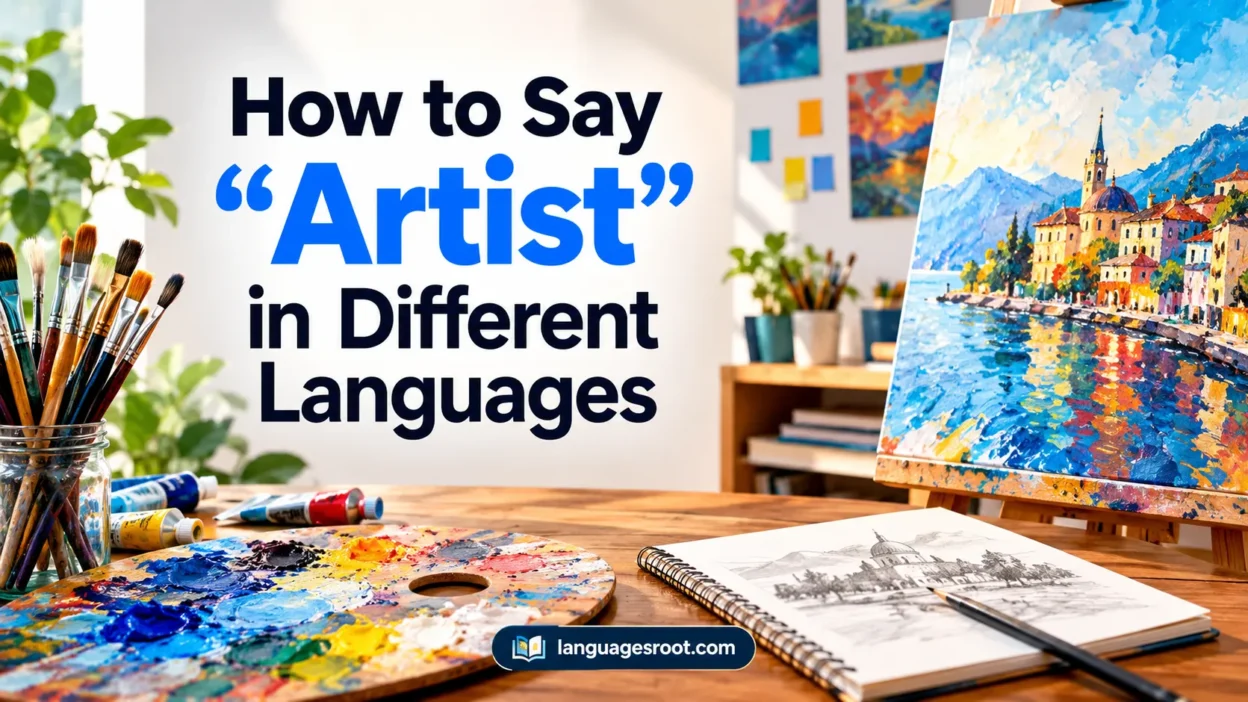
Learning how to say artist in different languages helps you explore art and culture through words. Whether you enjoy drawing, painting, music, or creative expression, each language offers unique ways to describe talent. This guide shares artist translations with artist pronunciation, example sentences, and helpful cultural notes. You will also discover how language differences shape the word for artist across regions.
Whether you are exploring multilingual vocabulary, learning foreign language words, or meeting international friends, these translations offer practical help. Moreover, this language guide supports language learners who want to describe artistic skills, creative talent, and artistic expression with confidence. Explore artist in European languages, artist in Asian languages, artist in African languages, and artist in Middle Eastern languages to discover how people express creativity worldwide.
Interesting Facts About Artist
- Artist has a broad meaning. In English, the word can describe someone who paints, creates sculptures, performs music, acts, or produces other creative work.
- Some languages distinguish artistic professions. A painter and a musician may have different everyday titles, even when English speakers might describe both as artists.
- Gender can affect the word. Languages such as Spanish, French, Italian, and Arabic may use different grammatical forms for male and female artists.
- Writing systems vary widely. The word artist can be written using Latin, Cyrillic, Arabic, Devanagari, Chinese, Japanese, Korean, and other scripts.
- Pronunciation is not universal. Even when two languages use similar-looking words, their vowel sounds, stress patterns, and consonants may differ.
- Context helps determine the best translation. A general term for an artist may not be the most precise choice when discussing a painter, singer, actor, or traditional craftsperson.
- Loanwords are common in modern vocabulary. Some languages use words related to the English or international term artist, while others have their own established words.
What Does Artist Mean?
An artist is a person who creates, interprets, or performs work using artistic skill and imagination. The word can refer to someone who makes visual artwork, such as paintings and sculptures, as well as someone who expresses creativity through music, theater, dance, photography, or digital media.
The meaning depends on the situation. For example, a person who paints portraits may be called a visual artist or painter, while someone who performs songs may be called a musical artist or musician. In some contexts, artist also describes a person with exceptional creative ability, even when art is not their main profession.
The word can carry a personal and emotional meaning, too. Calling someone an artist may recognize their originality, dedication, imagination, or distinctive way of seeing the world. In multilingual communication, the most suitable translation depends on whether you mean an artist in general or a particular kind of creative professional.
Why Can Artist Have Different Translations?
The word artist does not have one identical translation in every language because languages organize creative professions differently. Some use a broad term for creative people, while others distinguish between painters, musicians, performers, and artisans. The right translation therefore depends on what kind of artist you mean.
Several factors can influence the choice:
- Context: A visual artist may need a more specific word than a recording artist.
- Gender: Some languages have masculine and feminine forms, while others use one form for everyone.
- Formality: A professional title may differ from an informal description of someone’s talent.
- Region: Speakers may prefer different terms across countries or dialects.
- Cultural conventions: Traditional arts and crafts may have their own established names.
- Written and spoken language: A formal written expression may differ from everyday conversation.
The tables below give a useful general translation of artist as a person involved in artistic or creative work. Where gender, pronunciation, or meaning requires clarification, the notes explain the distinction.
European Languages
Europe includes languages from several different language families, including Germanic, Romance, Slavic, and Uralic languages. Many have a general word for an artist, although the term can also refer specifically to a visual artist or performer. The following translations focus on common, recognizable terms for an artist in a general creative context.
| Language | Country/Region | Translation | Pronunciation | Example sentence |
| English | International | Artist | AR-tist | The artist creates beautiful paintings. |
| American English 🇺🇸 | United States | Artist | AR-tist | She is a talented artist. |
| British English 🇬🇧 | United Kingdom | Artist | AH-tist | The artist works in a small studio. |
| Australian English 🇦🇺 | Australia | Artist | AH-tist | He is a local artist. |
| Spanish | Spain, Mexico, Latin America | Artista | ar-TEES-ta | El artista crea obras hermosas. (The artist creates beautiful works.) |
| French | France, Belgium, Canada | Artiste | ar-TEEST | L’artiste peint un paysage. (The artist paints a landscape.) |
| German | Germany, Austria, Switzerland | Künstler / Künstlerin | KÜNST-ler / KÜNST-le-rin | Der Künstler malt ein Bild. (The artist paints a picture.) |
| Italian | Italy, Switzerland | Artista | ar-TEES-ta | L’artista crea qualcosa di speciale. (The artist creates something special.) |
| Portuguese | Portugal, Brazil | Artista | ar-TEES-ta | O artista pinta todos os dias. (The artist paints every day.) |
| Dutch | Netherlands, Belgium | Kunstenaar / kunstenares | KÜNST-e-naar / KÜNST-e-na-res | De kunstenaar maakt een schilderij. (The artist makes a painting.) |
| Swedish | Sweden, Finland | Konstnär | KONST-nair | Konstnären målar ett porträtt. (The artist paints a portrait.) |
| Norwegian | Norway | Kunstner | KOONST-ner | Kunstneren lager et bilde. (The artist creates an image.) |
| Danish | Denmark | Kunstner | KOONST-ner | Kunstneren maler et landskab. (The artist paints a landscape.) |
| Finnish | Finland | Taiteilija | TAI-tei-li-ya | Taiteilija maalaa maiseman. (The artist paints a landscape.) |
| Icelandic | Iceland | Listamaður / listakona | LIS-ta-ma-thur / LIS-ta-ko-na | Listamaðurinn málar mynd. (The artist paints a picture.) |
| Irish | Ireland | Ealaíontóir | al-EE-un-tohr | Is ealaíontóir í Síle. (Síle is an artist.) |
| Welsh | Wales | Artist | AR-tist | Mae’r artist yn peintio. (The artist is painting.) |
| Polish | Poland | Artysta / artystka | ar-TIS-ta / ar-TIS-tka | Artysta tworzy piękne obrazy. (The artist creates beautiful paintings.) |
| Czech | Czechia | Umělec / umělkyně | OO-mye-lets / OO-myel-ki-nye | Umělec maluje obraz. (The artist paints a picture.) |
| Slovak | Slovakia | Umelec / umelkyňa | OO-me-lets / OO-mel-kee-nya | Umelec tvorí nové dielo. (The artist creates a new work.) |
| Ukrainian | Ukraine | Митець / мисткиня | my-TETS / myst-KY-nya | Митець створює картини. (The artist creates paintings.) |
| Russian | Russia and Russian-speaking communities | Художник / художница | khu-DOZH-nik / khu-DOZH-ni-tsa | Художник пишет картину. (The artist paints a picture.) |
| Romanian | Romania, Moldova | Artist / artistă | ar-TEEST / ar-TEES-tuh | Artistul pictează un peisaj. (The artist paints a landscape.) |
| Hungarian | Hungary | Művész | MÜÜ-vaysh | A művész képet fest. (The artist paints a picture.) |
| Greek | Greece, Cyprus | Καλλιτέχνης / καλλιτέχνιδα | ka-lee-TEKH-nees / ka-lee-TEKH-nee-tha | Ο καλλιτέχνης ζωγραφίζει. (The artist is painting.) |
| Bulgarian | Bulgaria | Художник / художничка | khu-DOZH-nik / khu-DOZH-nich-ka | Художникът рисува картина. (The artist paints a picture.) |
| Croatian | Croatia | Umjetnik / umjetnica | oom-YET-nik / oom-YET-nee-tsa | Umjetnik stvara novo djelo. (The artist creates a new work.) |
| Serbian | Serbia and neighboring communities | Уметник / уметница | oo-MET-nik / oo-MET-nee-tsa | Уметник ствара нову слику. (The artist creates a new painting.) |
| Slovenian | Slovenia | Umetnik / umetnica | oo-MET-nik / oo-MET-nee-tsa | Umetnik ustvarja slike. (The artist creates paintings.) |
| Lithuanian | Lithuania | Menininkas / menininkė | meh-nee-NIN-kas / meh-nee-NIN-keh | Menininkas kuria paveikslą. (The artist creates a painting.) |
| Latvian | Latvia | Mākslinieks / māksliniece | MAHKS-lee-nieks / MAHKS-lee-nee-e-tse | Mākslinieks glezno ainavu. (The artist paints a landscape.) |
| Estonian | Estonia | Kunstnik | KOONST-nik | Kunstnik maalib pilti. (The artist paints a picture.) |
English Varieties: American, British, and Australian
The word artist is the same in American, British, and Australian English. The spelling does not change, and all three varieties use it for people who create or perform art.
Pronunciation differs slightly by accent. British and Australian English often use a non-rhotic pronunciation, meaning the final r in artist is not pronounced in the same way as in most American accents. The surrounding context determines whether the word means a visual artist, musician, performer, or another creative professional.
Cultural Notes for European Languages
- In Spanish, Italian, and Portuguese, artista can refer to people of different genders, although articles and other words may indicate gender.
- German, Polish, Russian, Czech, and several other languages commonly distinguish masculine and feminine forms.
- In French, artiste is used for different genders, with surrounding words often showing grammatical gender.
- Some words have a narrower everyday meaning. For example, Russian художник often refers to a visual artist or painter rather than every type of performer.
Asian Languages
Asia contains a wide range of language families and writing systems. Some languages use a broad word for an artist, while others commonly distinguish visual artists from musicians, actors, or craftspeople. The translations below represent general artistic work unless a more specific meaning is noted.
| Language | Country/Region | Translation | Pronunciation | Example sentence |
| Mandarin Chinese | China, Taiwan, Singapore | 艺术家 (藝術家) | yìshùjiā | 这位艺术家很有创意。 (This artist is very creative.) |
| Cantonese | Hong Kong, Guangdong | 藝術家 | ngai⁶ seot⁶ gaa¹ | 佢係一位藝術家。 (They are an artist.) |
| Japanese | Japan | 芸術家 | geijutsuka | 彼は芸術家です。 (He is an artist.) |
| Korean | South Korea, North Korea | 예술가 | yesulga | 그 예술가는 그림을 그려요. (That artist paints pictures.) |
| Hindi | India | कलाकार | kalākār | वह एक प्रतिभाशाली कलाकार है। (That person is a talented artist.) |
| Urdu | Pakistan, India | فنکار | fankār | وہ ایک باصلاحیت فنکار ہے۔ (That person is a talented artist.) |
| Bengali | Bangladesh, India | শিল্পী | shilpi | শিল্পী একটি সুন্দর ছবি আঁকেন। (The artist paints a beautiful picture.) |
| Punjabi | Pakistan, India | ਕਲਾਕਾਰ / فنکار | kalākār / fankār | ਉਹ ਇੱਕ ਵਧੀਆ ਕਲਾਕਾਰ ਹੈ। (That person is a good artist.) |
| Gujarati | India | કલાકાર | kalākār | તે એક પ્રતિભાશાળી કલાકાર છે. (That person is a talented artist.) |
| Marathi | India | कलाकार | kalākār | तो एक कुशल कलाकार आहे. (He is a skilled artist.) |
| Tamil | India, Sri Lanka, Singapore | கலைஞர் | kalaignar | அந்தக் கலைஞர் அழகான ஓவியம் வரைகிறார். (That artist paints a beautiful picture.) |
| Telugu | India | కళాకారుడు / కళాకారిణి | kalākāruḍu / kalākāriṇi | ఆ కళాకారుడు అందమైన చిత్రాన్ని గీశాడు. (That artist drew a beautiful picture.) |
| Kannada | India | ಕಲಾವಿದ / ಕಲಾವಿದೆ | kalāvida / kalāvide | ಆ ಕಲಾವಿದ ಸುಂದರ ಚಿತ್ರವನ್ನು ಬಿಡಿಸುತ್ತಾನೆ. (That artist draws a beautiful picture.) |
| Malayalam | India | കലാകാരൻ / കലാകാരി | kalākāran / kalākāri | ആ കലാകാരി മനോഹരമായ ചിത്രം വരയ്ക്കുന്നു. (That artist is drawing a beautiful picture.) |
| Nepali | Nepal, India | कलाकार | kalākār | उनी एक प्रतिभाशाली कलाकार हुन्। (They are a talented artist.) |
| Sinhala | Sri Lanka | කලාකරුවා / කලාකාරිය | kalākaruwā / kalākāriya | ඇය දක්ෂ කලාකාරියකි. (She is a skilled artist.) |
| Thai | Thailand | ศิลปิน | sin-lá-pin | ศิลปินคนนี้วาดภาพสวยมาก (This artist paints very beautiful pictures.) |
| Vietnamese | Vietnam | Nghệ sĩ | ngee see | Người nghệ sĩ này rất sáng tạo. (This artist is very creative.) |
| Indonesian | Indonesia | Seniman | sə-ni-man | Seniman itu membuat karya yang indah. (That artist creates beautiful work.) |
| Malay | Malaysia, Brunei, Singapore | Seniman | sə-ni-man | Seniman itu menghasilkan karya seni. (That artist produces artwork.) |
| Filipino/Tagalog | Philippines | Alagad ng sining / artista | a-la-gad ng si-ning / ar-tis-ta | Ang alagad ng sining ay gumagawa ng magagandang obra. (The artist creates beautiful works.) |
| Burmese | Myanmar | အနုပညာရှင် | a-nu-pyin-yin | သူသည် အနုပညာရှင်တစ်ဦးဖြစ်သည်။ (That person is an artist.) |
| Khmer | Cambodia | សិល្បករ / សិល្បការិនី | sel-pa-ka / sel-pa-ka-re-nee | សិល្បកររូបនេះមានទេពកោសល្យ។ (This artist is talented.) |
| Lao | Laos | ສິນລະປິນ | sin-la-pin | ສິນລະປິນຄົນນີ້ມີພອນສະຫວັນ. (This artist is talented.) |
| Mongolian | Mongolia | Уран бүтээлч | oo-ran bü-teelch | Тэр бол авьяаслаг уран бүтээлч. (That person is a talented artist.) |
| Kazakh | Kazakhstan | Өнерпаз / суретші | ö-ner-paz / sü-ret-shi | Суретші әдемі сурет салады. (The artist paints a beautiful picture.) |
| Uzbek | Uzbekistan | San’atkor / rassom | san-at-kor / ras-som | Rassom chiroyli rasm chizadi. (The artist paints a beautiful picture.) |
Cultural Notes for Asian Languages
- In Mandarin Chinese, 艺术家 (yìshùjiā) is a broad term for an artist, while 画家 (huàjiā) specifically means a painter.
- Japanese 芸術家 (geijutsuka) refers broadly to an artist, while 画家 (gaka) is more specific to painting.
- Korean 예술가 (yesulga) is a general term for an artist, and 화가 (hwaga) means a painter.
- In Hindi and Urdu, कलाकार / فنکار can cover different kinds of creative work. More specific words may be preferred when discussing a particular profession.
- In Filipino, artista often refers to an actor or celebrity in everyday usage. Alagad ng sining more explicitly describes a person devoted to the arts.
African Languages
Africa has extraordinary linguistic diversity, with languages belonging to several major language families. Words for artists can refer to visual creators, performers, musicians, or people who practice traditional arts. The translations below use common general terms where possible, with more specific alternatives included when useful.
| Language | Country/Region | Translation | Pronunciation | Example sentence |
| Swahili | Tanzania, Kenya, East Africa | Msanii | m-sa-NEE | Msanii huyu anatengeneza kazi nzuri za sanaa. (This artist creates beautiful works of art.) |
| Afrikaans | South Africa, Namibia | Kunstenaar | KÜNST-e-naar | Die kunstenaar maak ‘n pragtige skildery. (The artist makes a beautiful painting.) |
| Zulu | South Africa | Umdwebi / iciko | oom-DWEH-bee / ee-SEE-ko | Umdwebi udweba isithombe esihle. (The artist draws a beautiful picture.) |
| Xhosa | South Africa | Igcisa / umzobi | ee-GSEE-sa / oom-ZOH-bee | Igcisa lenza umsebenzi omhle wobugcisa. (The artist creates beautiful artwork.) |
| Amharic | Ethiopia | አርቲስት / አርቲስታ | ar-tist / ar-tis-ta | ይህ አርቲስት ቆንጆ ሥዕሎችን ይሠራል። (This artist creates beautiful pictures.) |
| Yoruba | Nigeria, Benin | Oṣ ಕಲ ಕಲ / òṣèré | oh-she-reh | Oṣèré náà ń ṣẹ̀dá iṣẹ́ ọnà tó lẹ́wà. (The artist creates beautiful art.) |
| Igbo | Nigeria | Ọka nka | aw-ka nka | Ọka nka a na-emepụta ọrụ nka mara mma. (The artist creates beautiful artwork.) |
| Hausa | Nigeria, Niger, West Africa | Mai fasaha | mai fa-sa-ha | Mai fasaha ya ƙirƙiri zane mai kyau. (The artist created a beautiful drawing.) |
| Somali | Somalia, Djibouti, Horn of Africa | Farshaxanle | far-shakh-an-le | Farshaxanluhu wuxuu sameeyaa farshaxan qurux badan. (The artist creates beautiful artwork.) |
| Shona | Zimbabwe | Nyanzvi yemifananidzo | nyan-zvee ye-mee-fa-na-nee-dzo | Nyanzvi yemifananidzo inogadzira mifananidzo yakanaka. (The visual artist creates beautiful pictures.) |
| Sesotho | Lesotho, South Africa | Setaki | seh-TAH-kee | Setaki se taka setšoantšo se setle. (The artist paints a beautiful picture.) |
| Setswana | Botswana, South Africa | Motaki | mo-TAH-kee | Motaki o taka setshwantsho se sentle. (The artist paints a beautiful picture.) |
| Kinyarwanda | Rwanda | Umuhanzi | oo-mu-HAN-zee | Umuhanzi akora ibihangano byiza. (The artist creates beautiful works.) |
| Malagasy | Madagascar | Mpanakanto | m-pa-na-KAN-too | Mpanakanto mamorona asa kanto tsara. (The artist creates beautiful artwork.) |
Cultural Notes for African Languages
- In Swahili, msanii is a broad word for an artist or creative practitioner. A more specific term can be used for a painter, musician, or performer.
- In Zulu and Xhosa, words associated with drawing, painting, or visual art may be more precise than a general word for an artist.
- In Yoruba, ọ̀ṣèré is often associated with a performer or actor, so the best term depends on the intended artistic field. The phrase ẹni tó ń ṣe iṣẹ́ ọnà can describe someone who makes art more broadly.
- In Hausa, mai fasaha can refer to a skilled or creative person, while a more specific expression may be needed for a particular art form.
- In Malagasy, mpanakanto is a general term for an artist or creative practitioner.
Also Read: How to Say Armor in Different Languages
Middle Eastern Languages
The Middle East includes several distinct language traditions, including Arabic, Hebrew, Persian, Kurdish, Turkish, and Armenian. Some words are broad enough to describe different kinds of artists, while others more commonly refer to painters or performers. Arabic also varies by region, so the examples below distinguish general written usage from dialect-specific expressions where relevant.
| Language | Country/Region | Translation | Pronunciation | Example sentence |
| Modern Standard Arabic | Across the Arab world | فنان / فنانة | fannān / fannāna | هذا الفنان يرسم لوحة جميلة. (This artist paints a beautiful picture.) |
| Egyptian Arabic | Egypt | فنان / فنانة | fannān / fannāna | الفنان ده موهوب جدًا. (This artist is very talented.) |
| Persian (Farsi) | Iran, Persian-speaking communities | هنرمند | honar-mand | این هنرمند اثر زیبایی خلق میکند. (This artist creates a beautiful work.) |
| Hebrew | Israel | אמן / אמנית | aman / omanít | האמן יוצר ציורים יפים. (The artist creates beautiful paintings.) |
| Kurdish (Kurmanji) | Türkiye, Syria, Iraq, diaspora | Hunermend | hoo-ner-mend | Ew hunermendekî jêhatî ye. (That person is a talented artist.) |
| Turkish | Türkiye, Cyprus | Sanatçı | sa-nat-chuh | Sanatçı güzel bir eser yaratıyor. (The artist is creating a beautiful work.) |
| Armenian | Armenia, Armenian-speaking communities | Արվեստագետ | ar-ves-ta-get | Արվեստագետը գեղեցիկ նկար է ստեղծում։ (The artist creates a beautiful picture.) |
Cultural Notes for Middle Eastern Languages
- In Modern Standard Arabic, فنان (fannān) is a masculine form and فنانة (fannāna) is a feminine form. These are widely understood, although dialectal pronunciation and everyday usage can vary.
- Persian هنرمند (honarmand) is a broad term for an artist or person skilled in the arts. A painter can also be called نقاش (naqqāsh).
- Hebrew uses אמן (aman) and אמנית (omanit) for male and female artists, respectively.
- Turkish sanatçı can describe a wide range of creative professionals, including visual artists and performers.
- Kurdish has regional varieties, so spelling and pronunciation may differ between Kurmanji and Sorani.
Other World Languages
The following languages extend the list to other parts of the world. These examples include Pacific languages, Indigenous languages of the Americas, a creole language, and an international auxiliary language. Some have more than one suitable expression depending on whether the person creates visual art or practices the arts more generally.
| Language | Country/Region | Translation | Pronunciation | Example sentence |
| Māori | New Zealand | Kaitoi / ringatoi | kai-TOI / rin-ga-TOI | He kaitoi ia. (They are an artist.) |
| Samoan | Samoa, Pacific communities | Tufuga | too-FOO-nga | O ia o se tufuga talenia. (That person is a talented artist or craftsperson.) |
| Tongan | Tonga | Tufunga / tokotaha tufunga | too-FOO-nga / to-ko-ta-ha too-FOO-nga | Ko e tufunga ko ʻeni ʻoku poto. (This craftsperson or artist is skilled.) |
| Hawaiian | Hawaiʻi | Mea hana noʻeau | meh-ah ha-na no-eh-ow | He mea hana noʻeau ʻo ia. (They are an artist.) |
| Quechua | Andean regions of Peru, Bolivia, Ecuador | Kamachiq / ruwaq | ka-ma-cheek / roo-waq | Payqa sumaq ruraykunata ruwan. (That person creates beautiful works.) |
| Guarani | Paraguay, surrounding regions | Tembiapo apoha | tem-bee-a-po a-po-ha | Haʼe peteĩ tembiapo apoha ikatupyrýva. (That person is a skilled creator.) |
| Haitian Creole | Haiti, Haitian communities | Atis | a-TEES | Atis la kreye yon bèl penti. (The artist creates a beautiful painting.) |
| Esperanto | International language community | Artisto | ar-TEES-to | La artisto kreas belan pentraĵon. (The artist creates a beautiful painting.) |
Cultural Notes for Other World Languages
In Māori, kaitoi is associated with an artist or creator, while ringatoi is often used for a visual artist. In Samoan and Tongan, tufuga can refer to a skilled craftsperson or practitioner of a traditional art, so it does not always match the full modern English meaning of artist. Hawaiian mea hana noʻeau describes a person engaged in skilled or artistic creation. For Quechua and Guarani, terminology varies across communities and varieties, so a local speaker should confirm the most suitable term for formal publication or specialized use.
Quick Reference: Artist in Different Languages
Use this compact multilingual vocabulary table to find the word for artist quickly. The translations represent general usage unless the entry specifies a painter, visual artist, or another particular type of creative professional.
| Language | Translation |
| English | Artist |
| American English | Artist |
| British English | Artist |
| Australian English | Artist |
| Spanish | Artista |
| French | Artiste |
| German | Künstler / Künstlerin |
| Italian | Artista |
| Portuguese | Artista |
| Dutch | Kunstenaar / kunstenares |
| Swedish | Konstnär |
| Norwegian | Kunstner |
| Danish | Kunstner |
| Finnish | Taiteilija |
| Icelandic | Listamaður / listakona |
| Irish | Ealaíontóir |
| Welsh | Artist |
| Polish | Artysta / artystka |
| Czech | Umělec / umělkyně |
| Slovak | Umelec / umelkyňa |
| Ukrainian | Митець / мисткиня |
| Russian | Художник / художница |
| Romanian | Artist / artistă |
| Hungarian | Művész |
| Greek | Καλλιτέχνης / καλλιτέχνιδα |
| Bulgarian | Художник / художничка |
| Croatian | Umjetnik / umjetnica |
| Serbian | Уметник / уметница |
| Slovenian | Umetnik / umetnica |
| Lithuanian | Menininkas / menininkė |
| Latvian | Mākslinieks / māksliniece |
| Estonian | Kunstnik |
| Mandarin Chinese | 艺术家 |
| Cantonese | 藝術家 |
| Japanese | 芸術家 |
| Korean | 예술가 |
| Hindi | कलाकार |
| Urdu | فنکار |
| Bengali | শিল্পী |
| Punjabi | ਕਲਾਕਾਰ / فنکار |
| Gujarati | કલાકાર |
| Marathi | कलाकार |
| Tamil | கலைஞர் |
| Telugu | కళాకారుడు / కళాకారిణి |
| Kannada | ಕಲಾವಿದ / ಕಲಾವಿದೆ |
| Malayalam | കലാകാരൻ / കലാകാരി |
| Nepali | कलाकार |
| Sinhala | කලාකරුවා / කලාකාරිය |
| Thai | ศิลปิน |
| Vietnamese | Nghệ sĩ |
| Indonesian | Seniman |
| Malay | Seniman |
| Filipino/Tagalog | Alagad ng sining |
| Burmese | အနုပညာရှင် |
| Khmer | សិល្បករ / សិល្បការិនី |
| Lao | ສິນລະປິນ |
| Mongolian | Уран бүтээлч |
| Kazakh | Өнерпаз / суретші |
| Uzbek | San’atkor / rassom |
| Swahili | Msanii |
| Afrikaans | Kunstenaar |
| Zulu | Umdwebi |
| Xhosa | Igcisa / umzobi |
| Amharic | አርቲስት |
| Yoruba | Ọ̀ṣèré or a descriptive phrase for an art creator |
| Igbo | Ọka nka |
| Hausa | Mai fasaha |
| Somali | Farshaxanle |
| Shona | Nyanzvi yemifananidzo |
| Sesotho | Setaki |
| Setswana | Motaki |
| Kinyarwanda | Umuhanzi |
| Malagasy | Mpanakanto |
| Modern Standard Arabic | فنان / فنانة |
| Egyptian Arabic | فنان / فنانة |
| Persian | هنرمند |
| Hebrew | אמן / אמנית |
| Kurdish (Kurmanji) | Hunermend |
| Turkish | Sanatçı |
| Armenian | Արվեստագետ |
| Māori | Kaitoi / ringatoi |
| Samoan | Tufuga |
| Tongan | Tufunga |
| Hawaiian | Mea hana noʻeau |
| Quechua | Kamachiq / ruwaq, depending on variety and context |
| Guarani | Tembiapo apoha |
| Haitian Creole | Atis |
| Esperanto | Artisto |
How to Choose the Right Translation
The best translation of artist depends on the person you are describing, the language you are using, and the situation in which you need the word. If you are talking about someone who paints, a word meaning painter may be more precise. If you mean a musician, actor, or creative professional more broadly, a general term for artist is usually a better starting point.
Consider these practical tips when selecting a translation:
- Identify the art form. Decide whether you mean a visual artist, musician, actor, dancer, or craftsperson.
- Check grammatical gender. In languages such as French, Spanish, German, and Arabic, the form or surrounding grammar may change according to gender.
- Consider the audience. A word used naturally in one country may be less familiar in another region where the same language is spoken.
- Use the right level of formality. A professional biography may call for a more precise title than a casual conversation.
- Learn the pronunciation. Reading a translation correctly can make it easier for other speakers to understand you.
- Ask a fluent speaker when precision matters. This is particularly useful for tattoos, published materials, professional titles, and culturally specific art forms.
Best tip: Start with the general word for artist, then choose a more specific expression if the person’s profession or cultural context calls for it.
Common Mistakes When Translating Artist
Translating artist may seem simple, but several common mistakes can lead to awkward or misleading expressions.
- Translating word for word: A dictionary equivalent may not communicate the same meaning in a real conversation. Check how the word is actually used.
- Confusing an artist with a painter: Some languages commonly use a word associated with visual art where English speakers might use artist more broadly.
- Ignoring gender and grammar: Choosing the wrong grammatical form can make an otherwise correct sentence sound unnatural.
- Mixing regional varieties: A term from one dialect may not be the most suitable choice in another region.
- Overlooking pronunciation: Similar spellings do not guarantee similar sounds. Follow the language’s normal pronunciation rules.
- Assuming a title covers every art form: Traditional crafts, performing arts, and visual arts can have distinct vocabulary.
- Treating every alternative as interchangeable: Two valid words may differ in formality, meaning, or professional context.
To avoid these problems, learn the translation alongside a complete example sentence. This helps you understand how the word works in everyday communication rather than memorizing it in isolation.
Why Learn Artist in Different Languages?
Learning the word artist in different languages is a useful way to expand your vocabulary and understand how people describe creativity across cultures. It can help you communicate while traveling, talk with international friends, read about artists from other countries, and better understand foreign-language biographies, exhibitions, and creative projects.
Exploring these translations also introduces you to different writing systems and grammatical patterns. For example, you can see how some languages use gender-specific forms, how others use a single general term, and how certain words distinguish visual artists from performers. These differences make vocabulary learning more interesting and practical.
Knowing the right word can also make a conversation more personal. If you meet a creative professional abroad, using the appropriate term shows that you have taken an interest in their language. However, the most valuable part of language learning is not memorizing a long list. It is understanding how words are used, how they sound, and what they mean in context.
Frequently Asked Questions
How do you say artist in different languages?
The word artist translates differently across languages. For example, Spanish and Italian use artista, French uses artiste, Japanese uses 芸術家 (geijutsuka), and Mandarin Chinese uses 艺术家 (yìshùjiā).
What is the meaning of artist?
An artist is someone who creates, interprets, or performs creative work. This includes painters, musicians, actors, dancers, sculptors, photographers, and digital creators.
How do you say artist in Spanish and French?
In Spanish, artist is artista, pronounced approximately ar-TEES-ta. In French, it is artiste, pronounced approximately ar-TEEST. Both words can describe artists of different genders, although surrounding grammar may vary.
Do translations of artist change according to gender?
Yes, some languages use different grammatical forms for different genders. For example, German uses Künstler and Künstlerin, while Arabic uses فنان (fannān) and فنانة (fannāna). Other languages use one general word for artists of different genders.
What is the difference between an artist and a painter?
An artist is a broad term for someone who creates or performs art, while a painter specifically creates paintings. Depending on the language and context, a more specific word may help describe a person’s artistic profession accurately.
Conclusion
Learning how to say artist in different languages helps you explore creativity, culture, and artistic expression worldwide. From Spanish artista to French artiste and Japanese 芸術家, each word offers a new way to describe creative talent. Moreover, the right artist translation depends on context, pronunciation, gender, and regional usage. Use these translations and examples to build your multilingual vocabulary, improve language skills, and connect with people across cultures.