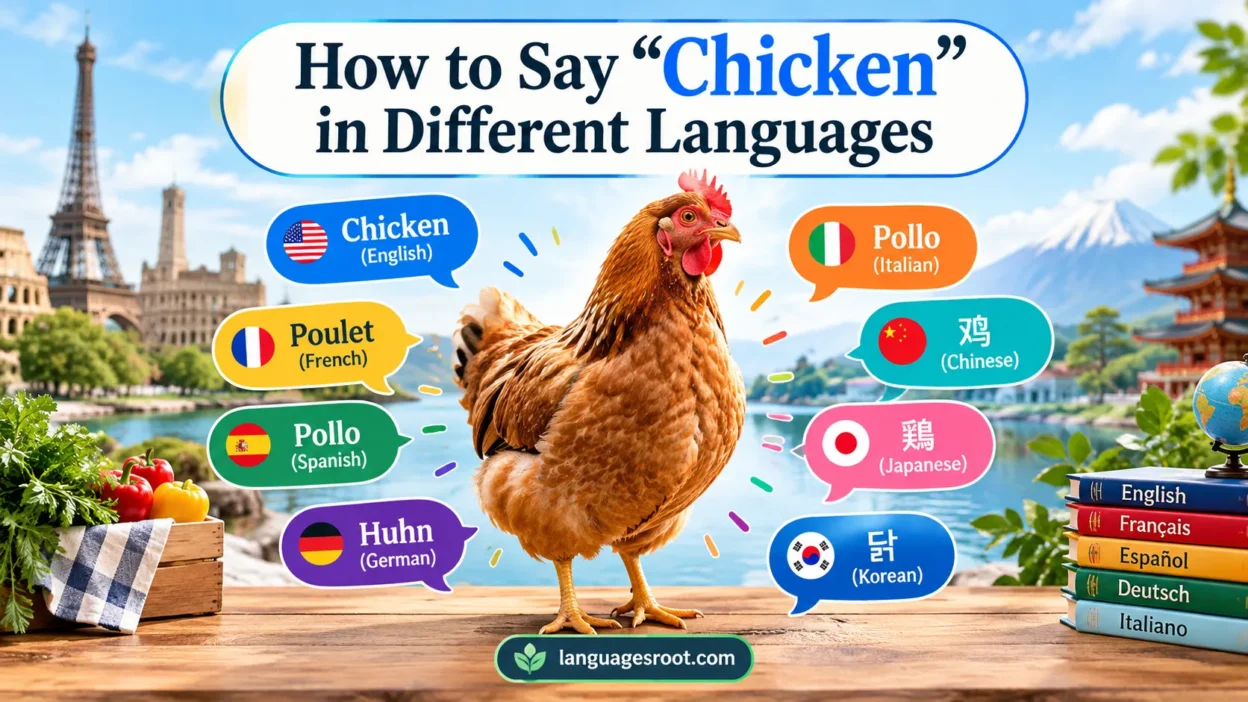
Learning chicken in different languages helps you explore new words, foods, and cultures. If you wonder how to say chicken, this guide makes learning simple and fun. Discover each chicken translation, its English meaning, and its correct pronunciation. You will also learn useful chicken vocabulary for daily conversations and travel. Plus, explore how people name this familiar domesticated bird across the world.
From pollo in Spanish to poulet in French and Huhn in German, each language has its own word. This guide explores chicken in 70 languages, including European languages, Asian languages, African languages, and Middle Eastern languages. You will find pronunciation guides, example sentences, and helpful language context along the way. Whether you enjoy language learning, explore foreign cultures, or read international menus, these translations can expand your vocabulary and make communication easier.
Interesting Facts About Chicken
- Chicken can refer to a bird or food. In English, the same word describes the domesticated bird and its meat, although other languages may use different terms for each meaning.
- Living chickens have different names by age and sex. A hen is an adult female, a rooster is an adult male, and a chick is a young bird. These distinctions are also found in many other languages.
- Food vocabulary depends on context. When ordering a meal, a word for chicken meat may be more appropriate than the term used for a living farm animal.
- Pronunciation changes across languages. The English word has one familiar pronunciation, but its equivalents may contain unfamiliar consonants, vowels, or tones.
- Writing systems differ considerably. Chicken is written with Latin letters in languages such as Spanish and French, but Mandarin Chinese uses the character 鸡 and Japanese commonly uses 鶏 or とり, depending on context.
- Some languages distinguish the bird from its meat. French, for example, commonly uses poulet for chicken as a bird or food, while poule usually refers to a hen.
- Chicken vocabulary connects language with food culture. Learning the relevant word can help you understand recipes, restaurant menus, market conversations, and discussions about farming.
What Does Chicken Mean?
Chicken is a noun that usually refers to a domesticated bird belonging to the species Gallus gallus domesticus. Chickens are raised worldwide for their eggs and meat.
The word has two common meanings in everyday English:
- The animal: A living bird found on farms, in poultry yards, or in some residential settings.
- The food: Meat prepared in dishes such as roasted chicken, chicken soup, grilled chicken, and chicken curry.
The intended meaning matters when translating the word. For example, someone asking about chickens on a farm may need the word for the animal, while a traveler ordering dinner needs the appropriate food term.
English also uses chicken informally to describe someone considered cowardly. This figurative meaning is different from the literal bird or food meaning and should not automatically be translated using the ordinary animal word.
In this article, the main focus is the literal meaning of chicken as a domesticated bird and, where appropriate, its meat.
Why Can Chicken Have Different Translations?
The word chicken does not have one universal equivalent across all languages. The most appropriate translation depends on what you are talking about and how the target language organizes its vocabulary.
Context is especially important. A word used for a living bird may differ from the word used for cooked meat. French commonly uses poulet for chicken, while poule more specifically refers to a hen. Other languages also distinguish between adult birds, young chicks, and poultry prepared for food.
Grammar and pronunciation can also affect how the word is used. Some languages have grammatical gender, different plural forms, or pronunciation features that English speakers may not recognize immediately. Regional dialects can introduce additional vocabulary differences.
Finally, written and spoken language may differ. A word may have a standard written form but a shorter or more colloquial pronunciation in everyday conversation. When learning a translation, it helps to know the standard form first and then explore regional alternatives.
The tables below prioritize commonly understandable vocabulary for the literal meaning of chicken. Where a language uses a particularly important distinction, a note explains it.
European Languages
Europe has several language families, including Romance, Germanic, Slavic, and Uralic languages. Although many languages share historical connections, their everyday vocabulary for chicken can differ significantly. The following translations focus on the bird or ordinary chicken vocabulary, with notes where food-related usage is important.
| 🌍 Language | Country/Region | Translation | Pronunciation | Example sentence |
| English | International | Chicken | CHIK-in | The chicken is in the yard. |
| American English 🇺🇸 | United States | Chicken | CHIK-in | We cooked chicken for dinner. |
| British English 🇬🇧 | United Kingdom | Chicken | CHIK-in | The chicken is in the garden. |
| Australian English 🇦🇺 | Australia | Chicken | CHIK-in | We had chicken for dinner. |
| Spanish | Spain, Mexico, Latin America | Pollo | POH-yoh | El pollo está en el patio. (The chicken is in the yard.) |
| French | France, Belgium, Canada | Poulet | poo-LAY | Le poulet est dans la cour. (The chicken is in the yard.) |
| German | Germany, Austria, Switzerland | Huhn | HOON | Das Huhn ist im Garten. (The chicken is in the garden.) |
| Italian | Italy, Switzerland | Pollo | POL-loh | Il pollo è in giardino. (The chicken is in the garden.) |
| Portuguese | Portugal, Brazil | Galinha | guh-LEEN-yah | A galinha está no quintal. (The hen is in the yard.) |
| Dutch | Netherlands, Belgium | Kip | kip | De kip loopt in de tuin. (The chicken is walking in the garden.) |
| Swedish | Sweden, Finland | Höna | HUR-nah | Hönan är i trädgården. (The hen is in the garden.) |
| Norwegian | Norway | Høne | HUR-neh | Høna er i hagen. (The hen is in the garden.) |
| Danish | Denmark | Høne | HUR-neh | Hønen er i haven. (The hen is in the garden.) |
| Finnish | Finland | Kana | KAH-nah | Kana on pihalla. (The chicken is in the yard.) |
| Icelandic | Iceland | Hæna | HAI-nah | Hænan er í garðinum. (The hen is in the garden.) |
| Irish | Ireland | Sicín | sih-KEEN | Tá an sicín sa chlós. (The chicken is in the yard.) |
| Welsh | Wales | Iâr | YAAR | Mae’r iâr yn yr ardd. (The hen is in the garden.) |
| Polish | Poland | Kura | KOO-rah | Kura jest w ogrodzie. (The hen is in the garden.) |
| Czech | Czechia | Kuře | KOO-zhyeh | Kuře je na dvoře. (The chicken is in the yard.) |
| Slovak | Slovakia | Kura | KOO-rah | Kura je na dvore. (The hen is in the yard.) |
| Ukrainian | Ukraine | Курка | KOOR-kah | Курка у дворі. (The hen is in the yard.) |
| Russian | Russia and neighboring regions | Курица | KOO-ree-tsuh | Курица во дворе. (The hen is in the yard.) |
| Romanian | Romania, Moldova | Găină | guh-EE-nuh | Găina este în curte. (The hen is in the yard.) |
| Hungarian | Hungary | Csirke | CHEER-keh | A csirke az udvaron van. (The chicken is in the yard.) |
| Greek | Greece, Cyprus | Κότα | KOH-tah | Η κότα είναι στην αυλή. (The hen is in the yard.) |
| Bulgarian | Bulgaria | Кокошка | koh-KOSH-kah | Кокошката е в двора. (The hen is in the yard.) |
| Croatian | Croatia | Piletina / kokoš | pee-leh-TEE-nah / KOH-kosh | Kokoš je u dvorištu. (The hen is in the yard.) |
| Serbian | Serbia and neighboring regions | Кокошка | KOH-kosh-kah | Кокошка је у дворишту. (The hen is in the yard.) |
| Slovenian | Slovenia | Kokoš | KOH-kosh | Kokoš je na dvorišču. (The hen is in the yard.) |
| Lithuanian | Lithuania | Višta | VEESH-tah | Višta yra kieme. (The hen is in the yard.) |
| Latvian | Latvia | Vista | VEES-tah | Vista ir pagalmā. (The hen is in the yard.) |
| Estonian | Estonia | Kana | KAH-nah | Kana on õues. (The chicken is outside.) |
English varieties
American, British, and Australian English all use chicken for the bird and its meat. The basic spelling and meaning remain the same across these varieties. Differences in accent and associated food vocabulary do not require a different translation of the word itself.
Cultural and vocabulary notes
- In French, poulet is widely used for chicken meat and can also refer to a chicken, while poule generally means a hen.
- In Spanish, pollo commonly refers to chicken as food or a young chicken. Gallina usually means a hen.
- In Portuguese, galinha refers to a hen or chicken, while frango is especially common for a young chicken or chicken meat, depending on the region.
- In German, Huhn is a general term for a chicken, Henne means hen, and Hähnchen often refers to chicken prepared as food.
- In Italian, pollo is common for chicken as food, whereas gallina refers to a hen.
- In Polish, kurczak is common for a young chicken or chicken meat, while kura refers to a hen.
Asian Languages
Asia includes many language families and writing systems, from Sino-Tibetan and Indo-Aryan languages to Dravidian, Turkic, and Austroasiatic languages. Some languages use one common term for the bird and food, while others make distinctions based on age, sex, or culinary context.
The pronunciation guides below are simplified for English-speaking readers. For languages with established romanization systems, the written forms are included where practical.
| 🌍 Language | Country/Region | Translation | Pronunciation | Example sentence |
| Mandarin Chinese | China, Taiwan, Singapore | 鸡 (雞) | jī | 鸡在院子里。 (The chicken is in the yard.) |
| Cantonese | Hong Kong, Guangdong | 雞 | gai1 | 隻雞喺院子度。 (The chicken is in the yard.) |
| Japanese | Japan | 鶏 (にわとり) | niwatori | 鶏が庭にいます。 (The chicken is in the garden.) |
| Korean | South Korea, North Korea | 닭 | dak | 닭이 마당에 있어요. (The chicken is in the yard.) |
| Hindi | India | मुर्गी | mur-gee | मुर्गी आँगन में है। (The hen is in the yard.) |
| Urdu | Pakistan, India | مرغی | mur-gee | مرغی صحن میں ہے۔ (The hen is in the courtyard.) |
| Bengali | Bangladesh, India | মুরগি | mur-gee | মুরগিটি উঠানে আছে। (The chicken is in the yard.) |
| Punjabi | Pakistan, India | ਮੁਰਗੀ / مرغی | mur-gee | ਮੁਰਗੀ ਵਿਹੜੇ ਵਿੱਚ ਹੈ। (The hen is in the yard.) |
| Gujarati | India | મરઘી | mar-ghee | મરઘી આંગણામાં છે. (The hen is in the yard.) |
| Marathi | India | कोंबडी | kom-ba-dee | कोंबडी अंगणात आहे. (The hen is in the yard.) |
| Tamil | India, Sri Lanka, Singapore | கோழி | koh-zhee | கோழி முற்றத்தில் இருக்கிறது. (The chicken is in the yard.) |
| Telugu | India | కోడి | koh-dee | కోడి పెరట్లో ఉంది. (The chicken is in the backyard.) |
| Kannada | India | ಕೋಳಿ | koh-lee | ಕೋಳಿ ಅಂಗಳದಲ್ಲಿದೆ. (The chicken is in the yard.) |
| Malayalam | India | കോഴി | koh-zhee | കോഴി മുറ്റത്തുണ്ട്. (The chicken is in the courtyard.) |
| Nepali | Nepal, India | कुखुरा | koo-khoo-rah | कुखुरा आँगनमा छ। (The chicken is in the yard.) |
| Sinhala | Sri Lanka | කුකුළා / කිකිළි | koo-koo-laa / kee-kee-lee | කිකිළිය මිදුලේ ඉන්නවා. (The hen is in the yard.) |
| Thai | Thailand | ไก่ | gài | ไก่อยู่ในสนาม (The chicken is in the yard.) |
| Vietnamese | Vietnam | Gà | gah | Con gà ở trong sân. (The chicken is in the yard.) |
| Indonesian | Indonesia | Ayam | AH-yam | Ayam itu ada di halaman. (The chicken is in the yard.) |
| Malay | Malaysia, Brunei, Singapore | Ayam | AH-yam | Ayam itu berada di halaman. (The chicken is in the yard.) |
| Filipino/Tagalog | Philippines | Manok | mah-NOK | Nasa bakuran ang manok. (The chicken is in the yard.) |
| Burmese | Myanmar | ကြက် | kyet | ကြက်က ခြံထဲမှာ ရှိတယ်။ (The chicken is in the yard.) |
| Khmer | Cambodia | មាន់ | moan | មាន់នៅក្នុងទីធ្លា។ (The chicken is in the yard.) |
| Lao | Laos | ໄກ່ | kai | ໄກ່ຢູ່ໃນເດີ່ນ. (The chicken is in the yard.) |
| Mongolian | Mongolia | Тахиа | ta-khee-ah | Тахиа хашаанд байна. (The chicken is in the yard.) |
| Kazakh | Kazakhstan | Тауық | tah-oo-uk | Тауық аулада жүр. (The chicken is in the yard.) |
| Uzbek | Uzbekistan | Tovuq | toh-vook | Tovuq hovlida. (The chicken is in the yard.) |
Cultural and vocabulary notes
- In Mandarin Chinese, 鸡 (jī) is the general word for chicken. The character 鸡 is used in simplified Chinese, while 雞 is used in traditional Chinese.
- In Japanese, 鶏 can be read in different ways. Niwatori specifically refers to the chicken bird, while tori is the broader word for bird. 鶏肉 (toriniku) means chicken meat.
- In Korean, 닭 (dak) means chicken, while 닭고기 (dakgogi) means chicken meat.
- In Hindi and Urdu, मुर्गी and مرغی commonly refer to a hen or chicken. मुर्गा and مرغا are often used for a rooster.
- In Thai, ไก่ (gài) is the basic word for chicken. Chicken meat is also commonly called เนื้อไก่ (nʉ́a gài).
- In Indonesian and Malay, ayam is used for chicken and chicken meat. Additional words clarify whether the speaker means a rooster, hen, or chick.
Also Read: How to Say Color in Different Languages
African Languages
Africa is home to a remarkable range of languages, including Niger-Congo, Afroasiatic, and other language families. Chicken vocabulary varies across regions, and some languages distinguish between a hen, a rooster, a chick, and chicken meat. The examples below use everyday wording where possible and identify representative regions rather than treating any language as universal across a country.
| 🌍 Language | Country/Region | Translation | Pronunciation | Example sentence |
| Swahili | Tanzania, Kenya, East Africa | Kuku | KOO-koo | Kuku yuko uani. (The chicken is in the yard.) |
| Afrikaans | South Africa, Namibia | Hoender | HOON-der | Die hoender is in die tuin. (The chicken is in the garden.) |
| Zulu | South Africa | Inkukhu | een-KOO-koo | Inkukhu isegcekeni. (The chicken is in the yard.) |
| Xhosa | South Africa | Inkukhu | een-KOO-koo | Inkukhu iseyadini. (The chicken is in the yard.) |
| Amharic | Ethiopia | ዶሮ | doh-roh | ዶሮዋ በግቢው ውስጥ ናት። (The hen is in the yard.) |
| Yoruba | Nigeria, West Africa | Adìẹ | ah-DEE-eh | Adìẹ náà wà ní àgbàlá. (The chicken is in the yard.) |
| Igbo | Nigeria | Ọkụkọ | aw-KOO-kaw | Ọkụkọ nọ n’ogige. (The chicken is in the yard.) |
| Hausa | Nigeria, Niger, West Africa | Kaza | KAH-zah | Kazar tana cikin fili. (The hen is in the yard.) |
| Somali | Somalia, Horn of Africa | Digaag | dee-GAAG | Digaaggu wuxuu joogaa daaradda. (The chicken is in the yard.) |
| Shona | Zimbabwe | Huku | HOO-koo | Huku iri pachivanze. (The chicken is in the yard.) |
| Sesotho | Lesotho, South Africa | Khoho | KHO-ho | Khoho e ka jareteng. (The chicken is in the yard.) |
| Setswana | Botswana, South Africa | Koko | KOH-koh | Koko e mo lolwapeng. (The chicken is in the yard.) |
| Kinyarwanda | Rwanda | Inkoko | een-KOH-koh | Inkoko iri mu rugo. (The chicken is in the yard.) |
| Malagasy | Madagascar | Akoho | ah-KOO-hoo | Ao an-tokotany ny akoho. (The chicken is in the yard.) |
Cultural and vocabulary notes
- Swahili: Kuku is the everyday word for chicken. The surrounding sentence helps show whether the speaker means a bird or chicken as food.
- Afrikaans: Hoender refers to a chicken or poultry, while hoendervleis means chicken meat.
- Zulu and Xhosa: Both use inkukhu for chicken, although pronunciation and sentence structure should be learned within each language.
- Yoruba: The tone marks in adìẹ are meaningful. Removing them can make pronunciation less precise.
- Hausa: Kaza is commonly used for a hen or chicken. Words for a rooster or meat may differ by context.
- Kinyarwanda: Inkoko is the ordinary word for chicken. As with other languages, a more specific term may be used when discussing poultry products.
Middle Eastern Languages
The Middle East includes several distinct linguistic traditions, including Arabic, Persian, Hebrew, Kurdish, Turkish, and Armenian. Shared geography does not mean these languages use the same vocabulary. Arabic also has regional dialects that may differ from Modern Standard Arabic, so the entries below identify the variety when relevant.
| 🌍 Language | Country/Region | Translation | Pronunciation | Example sentence |
| Modern Standard Arabic | Middle East and North Africa | دجاجة | da-JAA-jah | الدجاجة في الفناء. (The hen is in the yard.) |
| Egyptian Arabic | Egypt | فرخة | FARKH-ah | الفرخة في الحوش. (The chicken is in the yard.) |
| Persian (Farsi) | Iran | مرغ | morgh | مرغ در حیاط است. (The chicken is in the yard.) |
| Hebrew | Israel | תרנגולת | tar-neh-GO-let | התרנגולת בחצר. (The hen is in the yard.) |
| Kurdish (Kurmanji) | Türkiye, Syria, Iraq, Iran | Mirîşk | mee-REESH-k | Mirîşk li hewşê ye. (The chicken is in the yard.) |
| Turkish | Türkiye, Cyprus | Tavuk | tah-VUK | Tavuk bahçede. (The chicken is in the garden.) |
| Armenian | Armenia and Armenian-speaking communities | Հավ | hav | Հավը բակում է։ (The chicken is in the yard.) |
Cultural and vocabulary notes
- Arabic: دجاج (dajāj) is a general term for chicken or poultry, while دجاجة (dajāja) refers to one female chicken. In Egyptian Arabic, farkha is a common everyday word for a chicken.
- Persian: Morgh can refer to a chicken or poultry. مرغ refers to chicken in common food contexts as well, so surrounding words clarify the intended meaning.
- Hebrew: Tarnegolet means hen, while of is the broader word for bird. Chicken meat is commonly called basar of or described more specifically by context.
- Kurdish: Kurdish has several varieties. The form shown is associated with Kurmanji, and other Kurdish varieties may use different vocabulary.
- Turkish: Tavuk is widely used for chicken and chicken meat. Horoz means rooster.
- Armenian: Հավ (hav) is the common word for chicken, while հավի միս means chicken meat.
Other World Languages
Several languages from Oceania, the Americas, and international language communities provide additional useful translations. These entries broaden the guide beyond the four main regions and show how the same familiar animal is named across different linguistic traditions.
| 🌍 Language | Country/Region | Translation | Pronunciation | Example sentence |
| Māori | New Zealand | Heihei | HAY-hay | Kei te māra te heihei. (The chicken is in the garden.) |
| Samoan | Samoa and Samoan communities | Moa | MOH-ah | O lo’o i le lotoā le moa. (The chicken is in the yard.) |
| Tongan | Tonga | Moa | MOH-ah | ‘Oku ‘i he loto’a ‘a e moa. (The chicken is in the yard.) |
| Hawaiian | Hawaiʻi | Moa | MOH-ah | Aia ka moa ma ka pā. (The chicken is in the yard.) |
| Quechua | Andes, including Peru and Bolivia | Wallpa | WAHL-pah | Wallpaqa wasi punkupi kachkan. (The chicken is at the house entrance.) |
| Guarani | Paraguay and surrounding regions | Ryguasu | ruh-gwah-SOO | Pe ryguasu oĩ korapýpe. (The chicken is in the yard.) |
| Haitian Creole | Haiti | Poul | pool | Poul la nan lakou a. (The chicken is in the yard.) |
| Esperanto | International constructed language | Koko | KOH-koh | La koko estas en la korto. (The chicken is in the yard.) |
Cultural and vocabulary notes
- Māori: Heihei is the usual word for chicken. The word is also used in everyday food contexts, with context clarifying whether the bird or meat is intended.
- Samoan, Tongan, and Hawaiian: Moa is the common chicken word in all three languages. Similar vocabulary does not mean their grammar or pronunciation is interchangeable.
- Quechua: Quechua has several regional varieties. Wallpa is a commonly encountered form, but sentence construction and spelling may vary between varieties.
- Guarani: Ryguasu is used for chicken. Guarani vocabulary and spelling should be interpreted within the variety being learned.
- Haitian Creole: Poul is the common word for chicken and is also used in food contexts.
- Esperanto: Koko means chicken, while kokido means a chick. The language uses consistent word-building patterns that make related vocabulary easier to recognize.
Quick Reference: Chicken in Different Languages
This compact table collects the main chicken translations from the regional sections. For languages with different words for hens, roosters, chicks, and chicken meat, the entry gives a common general form or identifies the specific meaning where needed.
| Language | Translation |
| English | Chicken |
| American English | Chicken |
| British English | Chicken |
| Australian English | Chicken |
| Spanish | Pollo |
| French | Poulet |
| German | Huhn |
| Italian | Pollo |
| Portuguese | Galinha |
| Dutch | Kip |
| Swedish | Höna |
| Norwegian | Høne |
| Danish | Høne |
| Finnish | Kana |
| Icelandic | Hæna |
| Irish | Sicín |
| Welsh | Iâr |
| Polish | Kura |
| Czech | Kuře |
| Slovak | Kura |
| Ukrainian | Курка |
| Russian | Курица |
| Romanian | Găină |
| Hungarian | Csirke |
| Greek | Κότα |
| Bulgarian | Кокошка |
| Croatian | Kokoš |
| Serbian | Кокошка |
| Slovenian | Kokoš |
| Lithuanian | Višta |
| Latvian | Vista |
| Estonian | Kana |
| Mandarin Chinese | 鸡 / 雞 |
| Cantonese | 雞 |
| Japanese | 鶏 (にわとり) |
| Korean | 닭 |
| Hindi | मुर्गी |
| Urdu | مرغی |
| Bengali | মুরগি |
| Punjabi | ਮੁਰਗੀ / مرغی |
| Gujarati | મરઘી |
| Marathi | कोंबडी |
| Tamil | கோழி |
| Telugu | కోడి |
| Kannada | ಕೋಳಿ |
| Malayalam | കോഴി |
| Nepali | कुखुरा |
| Sinhala | කිකිළි |
| Thai | ไก่ |
| Vietnamese | Gà |
| Indonesian | Ayam |
| Malay | Ayam |
| Filipino/Tagalog | Manok |
| Burmese | ကြက် |
| Khmer | មាន់ |
| Lao | ໄກ່ |
| Mongolian | Тахиа |
| Kazakh | Тауық |
| Uzbek | Tovuq |
| Swahili | Kuku |
| Afrikaans | Hoender |
| Zulu | Inkukhu |
| Xhosa | Inkukhu |
| Amharic | ዶሮ |
| Yoruba | Adìẹ |
| Igbo | Ọkụkọ |
| Hausa | Kaza |
| Somali | Digaag |
| Shona | Huku |
| Sesotho | Khoho |
| Setswana | Koko |
| Kinyarwanda | Inkoko |
| Malagasy | Akoho |
| Modern Standard Arabic | دجاجة |
| Egyptian Arabic | فرخة |
| Persian | مرغ |
| Hebrew | תרנגולת |
| Kurdish (Kurmanji) | Mirîşk |
| Turkish | Tavuk |
| Armenian | Հավ |
| Māori | Heihei |
| Samoan | Moa |
| Tongan | Moa |
| Hawaiian | Moa |
| Quechua | Wallpa |
| Guarani | Ryguasu |
| Haitian Creole | Poul |
| Esperanto | Koko |
How to Choose the Right Translation
Choosing the correct translation for chicken depends on whether you mean the living bird, chicken meat, or a specific type of poultry. A general dictionary word may be understandable, but a more precise term can make your message sound more natural.
Use these tips when selecting a translation:
- Identify the context. For a farm animal, choose the ordinary word for the bird. When ordering food, check whether the language uses a separate term for chicken meat.
- Consider your audience. A standard form is a useful starting point when speaking with someone whose regional dialect you do not know.
- Learn the pronunciation. Pay attention to tones, stress, unfamiliar consonants, and vowel sounds.
- Check regional differences. Spanish, Arabic, Chinese, and Kurdish, among other languages, include regional variations that may affect vocabulary or usage.
- Use a complete sentence. Learning how a word works in a sentence helps you understand its grammar and everyday meaning.
For travel, restaurant visits, and language study, the best approach is to learn the basic word first, then learn related expressions for hens, roosters, chicks, and cooked chicken.
Common Mistakes When Translating Chicken
Even a familiar word can cause confusion when translated without considering its meaning. Avoid these common mistakes to improve your multilingual vocabulary.
- Confusing a hen with a rooster. Some languages use different words for male and female chickens. For example, Spanish gallina usually means hen, while gallo means rooster.
- Using the animal word when ordering food. A menu may use a specific word for chicken meat. In German, Hähnchen is often used for chicken as food, while Huhn is a general term for the bird.
- Ignoring pronunciation marks. In tonal languages such as Mandarin and Thai, tones can distinguish words or meanings. Romanized spellings should preserve them when practical.
- Assuming similar words are interchangeable. Two languages may have similar-looking words but use them differently in ordinary conversation.
- Mixing regional varieties. A word from one dialect may not be the most familiar choice in another region.
- Relying entirely on literal translation. The most natural term depends on what you want to communicate, not simply on matching each English word.
- Forgetting grammatical agreement. Some languages require nouns and accompanying words to follow grammatical gender, number, or case rules.
The most reliable habit is to learn the translation together with an example sentence and its intended meaning.
Why Learn Chicken in Different Languages?
Learning how to say chicken in different languages is a simple way to build practical vocabulary. The word appears in conversations about animals, farming, food, recipes, shopping, and travel, so it offers many opportunities to practice everyday communication.
For travelers, knowing the local word can make it easier to read menus, ask questions at markets, and understand basic conversations. For language learners, comparing words such as pollo, poulet, ayam, and kuku provides a useful introduction to pronunciation, spelling, and grammatical differences.
This vocabulary can also help readers appreciate how languages classify familiar things. Some emphasize the bird, others commonly use the same word for the bird and its meat, and many offer separate terms for hens, roosters, and chicks.
Most importantly, learning a word in another language encourages curiosity about the people who use it. Accurate vocabulary, respectful communication, and awareness of context make language learning more useful than memorizing isolated translations.
Frequently Asked Questions
How do you say chicken in different languages?
The word chicken in different languages varies by region. For example, Spanish uses pollo, French uses poulet, German uses Huhn, and Indonesian uses ayam. Other languages may use different words for the bird and its meat.
How do you say chicken in Spanish?
The Spanish word for chicken is pollo, pronounced approximately as POH-yoh. However, gallina usually means a hen, while gallo means a rooster.
How do you say chicken in French?
The French word for chicken is poulet, pronounced approximately as poo-LAY. Meanwhile, poule usually means a hen, and coq means a rooster.
What is the difference between chicken, hen, and rooster?
A chicken is the general name for the domesticated bird. A hen is an adult female, a rooster is an adult male, and a chick is a young bird.
Is the word for chicken the same as the word for chicken meat?
Not always. Some languages use the same word for both, while others have separate terms. For example, Japanese uses niwatori for the bird and toriniku for chicken meat.
Conclusion
Learning chicken in different languages helps you explore new words and cultures, from Spanish pollo and French poulet to Mandarin jī, Swahili kuku, and Turkish tavuk. However, the right chicken translation depends on context, especially when you mean the bird, its meat, a hen, or a rooster. By practicing pronunciation, reading example sentences, and learning regional differences, you can build useful vocabulary for travel, food, and daily conversations. Keep exploring foreign languages and use each new word with confidence and respect for the people who speak it.