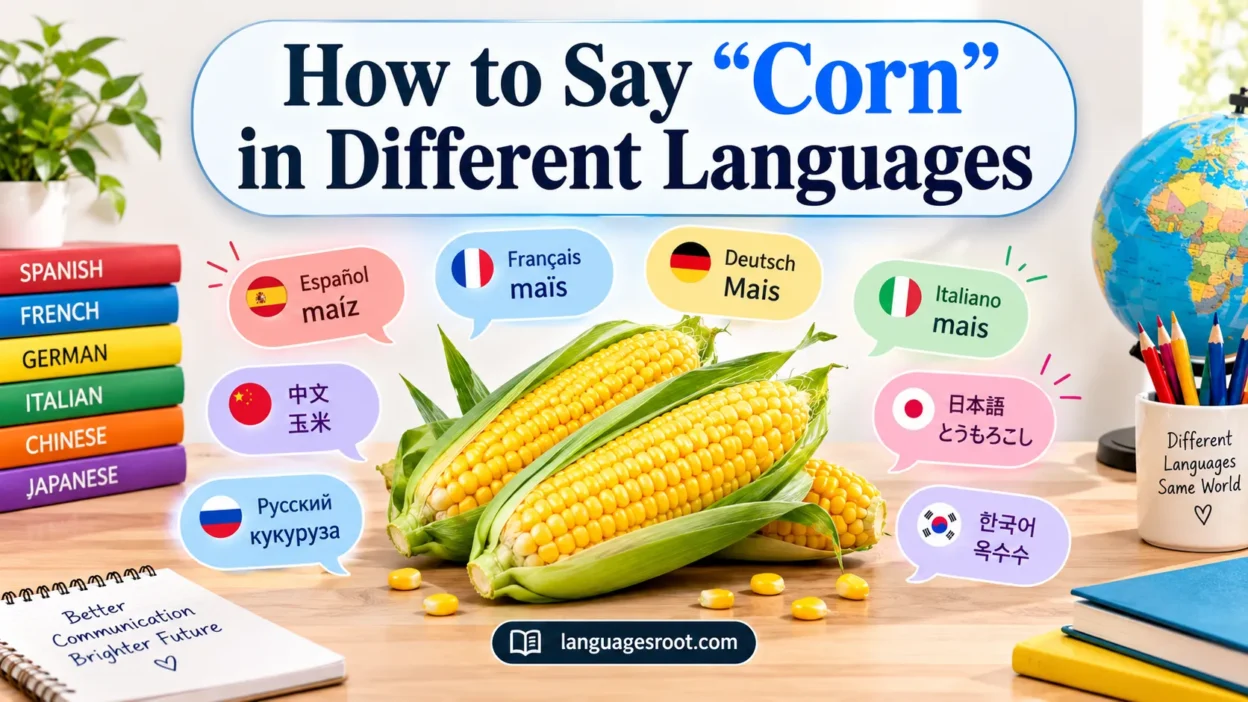
Learning corn in different languages helps you explore food vocabulary and understand how people describe everyday foods. Whether you want to know how to say corn, explore corn translations, or improve your corn pronunciation, this guide makes learning simple. Corn, also called maize, is an important crop with a long history in farming and cooking. However, its name changes across languages, regions, and cultures, making it useful for language learning and multilingual vocabulary.
From corn in Spanish as maíz to corn in French as maïs and corn in German as Mais, each language offers unique words and sounds. Therefore, these easy translations, pronunciation guides, and example sentences help you build common vocabulary for daily conversations. You can also discover how corn around the world connects traditional dishes, farming traditions, and global food culture. Explore these translations to improve your language communication skills and learn useful words for travel, cooking, and everyday life.
Interesting Facts About Corn
- Corn and maize refer to the same crop: In many countries, maize is the clearer international term for the plant known scientifically as Zea mays.
- The meaning of corn varies by region: In American English, corn usually means maize. In British English, the word can refer more generally to cereal grains, depending on context.
- Corn has many culinary uses: People around the world prepare maize as tortillas, polenta, porridge, roasted corn, cornmeal, and popcorn.
- Different languages use distinct names: Spanish uses maíz, French uses maïs, Italian uses mais, and Portuguese uses milho.
- The plant has deep agricultural importance: Maize originated in the Americas and became an important crop in many regions through cultivation and trade.
- Corn and corn products have different names: Cornmeal, cornstarch, sweet corn, and popcorn may require separate vocabulary in another language.
- Pronunciation depends on the language: Some languages use a spelling similar to maize, while others have completely different words and sounds.
What Does Corn Mean?
Corn generally means the edible grain produced by the maize plant. It can refer to the whole plant, its kernels, or the food made from those kernels. In everyday conversation, people might use the word when discussing fresh corn on the cob, canned sweet corn, corn flour, or popcorn.
The exact meaning depends on the speaker’s region. In the United States, Canada, and Australia, corn commonly refers to maize. In British English, the word has historically been used more broadly for grain crops, although sweetcorn clearly refers to maize eaten as a vegetable.
The word can also appear in food and farming expressions. For example, cornmeal is meal made from ground maize, while popcorn refers to a type of maize whose kernels expand when heated. A corn on the foot, sometimes called a foot corn, is an unrelated skin condition, so context matters when interpreting the English word.
In this article, corn means maize unless a regional note explains otherwise.
Why Can Corn Have Different Translations?
The word corn does not have one universal translation because languages organize food vocabulary differently. Some languages have a specific word for maize, while others use a broader term for grain or distinguish the plant from the food prepared from it.
Several factors influence the best translation:
- Context: A recipe may refer to sweet corn, while an agricultural article discusses maize crops.
- Formality: Everyday speech and scientific writing may use different terms.
- Regional usage: People speaking the same language may prefer different names for the same crop.
- Local food traditions: A language may have distinct words for cornmeal, roasted corn, and other maize products.
- Grammar: The word may change according to number, grammatical gender, or its role in a sentence.
- Writing systems: Some languages use Latin letters, while others use characters or scripts that require romanization for English readers.
- Natural expression: A direct translation of an English sentence may sound awkward even when the individual words are correct.
For this reason, the tables below prioritize the ordinary word for maize. The example sentences demonstrate how the word can be used naturally. Pronunciations are practical guides for general readers, not substitutes for listening to native speakers.
European Languages
Europe includes several language families, including Germanic, Romance, Slavic, and Uralic languages. The word for corn can look similar across related languages, but spelling and pronunciation may differ. The following examples focus on maize rather than cereal grains generally.
English Varieties
| Language | Country/Region | Translation | Pronunciation | Example Sentence |
| English | International | Corn | korn | I bought fresh corn. |
| American English 🇺🇸 | United States | Corn | korn | We grilled corn for dinner. |
| British English 🇬🇧 | United Kingdom | Maize; sweetcorn for the vegetable | mayz; sweet-korn | We added sweetcorn to the salad. |
| Australian English 🇦🇺 | Australia | Corn | korn | The corn is ready to harvest. |
Regional note: American and Australian English commonly use corn for maize. British English often uses maize when referring to the crop and sweetcorn for the vegetable. These are differences in usage, not separate languages.
European Translation Table
| Language | Country/Region | Translation | Pronunciation | Example Sentence |
| Spanish | Spain, Mexico, much of Latin America | Maíz | mah-EES | Compré maíz fresco. (I bought fresh corn.) |
| French | France, Belgium, parts of Canada | Maïs | mah-EES | Le maïs est frais. (The corn is fresh.) |
| German | Germany, Austria, Switzerland | Mais | mice | Der Mais wächst gut. (The corn is growing well.) |
| Italian | Italy, Switzerland | Mais | mah-EES | Il mais è fresco. (The corn is fresh.) |
| Portuguese | Portugal, Brazil | Milho | MEE-lyoo in Portugal; MEE-lyoo or MEE-lyu in Brazil | O milho está fresco. (The corn is fresh.) |
| Dutch | Netherlands, Belgium | Maïs | mahys | De maïs groeit goed. (The corn is growing well.) |
| Swedish | Sweden, Finland | Majs | myce, approximately | Majsen är färsk. (The corn is fresh.) |
| Norwegian | Norway | Mais | mice | Maisen er fersk. (The corn is fresh.) |
| Danish | Denmark | Majs | myce, approximately | Majsen er frisk. (The corn is fresh.) |
| Finnish | Finland | Maissi | MAI-see | Maissi on tuoretta. (The corn is fresh.) |
| Icelandic | Iceland | Maís | mah-ees | Maísinn er ferskur. (The corn is fresh.) |
| Irish | Ireland | Arbhar Indiach | AR-wer IN-dee-akh | Tá arbhar Indiach úr ann. (The corn is fresh.) |
| Welsh | Wales | Indrawn | in-DROWN | Mae’r indrawn yn ffres. (The corn is fresh.) |
| Polish | Poland | Kukurydza | koo-koo-RID-zah | Kukurydza jest świeża. (The corn is fresh.) |
| Czech | Czechia | Kukuřice | koo-koo-rzhi-tseh | Kukuřice je čerstvá. (The corn is fresh.) |
| Slovak | Slovakia | Kukurica | koo-koo-REE-tsah | Kukurica je čerstvá. (The corn is fresh.) |
| Ukrainian | Ukraine | Кукурудза | kukurudza | Кукурудза свіжа. (The corn is fresh.) |
| Russian | Russia and other Russian-speaking regions | Кукуруза | koo-koo-ROO-zah | Кукуруза свежая. (The corn is fresh.) |
| Romanian | Romania, Moldova | Porumb | poh-ROOMB | Porumbul este proaspăt. (The corn is fresh.) |
| Hungarian | Hungary | Kukorica | KOO-koh-ree-tsah | A kukorica friss. (The corn is fresh.) |
| Greek | Greece, Cyprus | Καλαμπόκι | ka-lam-BO-kee | Το καλαμπόκι είναι φρέσκο. (The corn is fresh.) |
| Bulgarian | Bulgaria | Царевица | tsa-re-VEE-tsah | Царевицата е прясна. (The corn is fresh.) |
| Croatian | Croatia, Bosnia and Herzegovina | Kukuruz | KOO-koo-rooz | Kukuruz je svjež. (The corn is fresh.) |
| Serbian | Serbia and neighboring regions | Кукуруз | KOO-koo-rooz | Кукуруз је свеж. (The corn is fresh.) |
| Slovenian | Slovenia | Koruza | koh-ROO-zah | Koruza je sveža. (The corn is fresh.) |
| Lithuanian | Lithuania | Kukurūzai | koo-koo-ROO-zai | Kukurūzai yra švieži. (The corn is fresh.) |
| Latvian | Latvia | Kukurūza | koo-koo-ROO-zah | Kukurūza ir svaiga. (The corn is fresh.) |
| Estonian | Estonia | Mais | mice | Mais on värske. (The corn is fresh.) |
| Albanian | Albania, Kosovo | Misër | mee-SUHR | Misri është i freskët. (The corn is fresh.) |
| Macedonian | North Macedonia | Пченка | pchen-kah | Пченката е свежа. (The corn is fresh.) |
| Basque | Basque Country, Spain and France | Arto | AR-toh | Artoa freskoa da. (The corn is fresh.) |
Cultural and vocabulary notes: In Romance languages, words such as maíz, maïs, and mais are recognizable across several regions, but their pronunciation differs. Slavic languages often use related forms of kukuruz, although other terms occur in particular contexts. In languages where the crop is a staple food, everyday usage may distinguish the whole plant, kernels, and flour.
Also Read: How to Say Come Here in Different Languages
Asian Languages
Asia contains many language families and writing systems, from Chinese characters and Japanese kana to Arabic-derived scripts and South Asian alphabets. Some languages have regional names for maize, and food vocabulary may distinguish fresh kernels from grain used for flour or animal feed. The examples below identify the common term for maize wherever possible.
| Language | Country/Region | Translation | Pronunciation | Example Sentence |
| Mandarin Chinese | China, Taiwan, Singapore | 玉米 | yùmǐ, approximately yoo-mee with tones 4-3 | 我买了新鲜玉米。 (I bought fresh corn.) |
| Cantonese | Hong Kong, Guangdong | 粟米 | suk¹ mai⁵, approximately | 我買咗新鮮粟米。 (I bought fresh corn.) |
| Japanese | Japan | とうもろこし | tōmorokoshi | とうもろこしを買いました。 (I bought corn.) |
| Korean | South Korea, North Korea | 옥수수 | oksusu | 옥수수가 신선해요. (The corn is fresh.) |
| Hindi | India | मक्का | makkā | मुझे ताज़ा मक्का मिला। (I got fresh corn.) |
| Urdu | Pakistan, India | مکئی | makai | مجھے تازہ مکئی ملی۔ (I got fresh corn.) |
| Bengali | Bangladesh, India | ভুট্টা | bhuṭṭā | ভুট্টা তাজা। (The corn is fresh.) |
| Punjabi | Pakistan, India | ਮੱਕੀ / مکئی | makkī / makai | ਮੱਕੀ ਤਾਜ਼ੀ ਹੈ। (The corn is fresh.) |
| Gujarati | India | મકાઈ | makāī | મકાઈ તાજી છે. (The corn is fresh.) |
| Marathi | India | मका | makā | मका ताजा आहे. (The corn is fresh.) |
| Tamil | India, Sri Lanka | மக்காச்சோளம் | makkāccōḷam | மக்காச்சோளம் புதியது. (The corn is fresh.) |
| Telugu | India | మొక్కజొన్న | mokkajonna | మొక్కజొన్న తాజాగా ఉంది. (The corn is fresh.) |
| Kannada | India | ಮೆಕ್ಕೆಜೋಳ | mekkejōḷa | ಮೆಕ್ಕೆಜೋಳ ತಾಜಾಗಿದೆ. (The corn is fresh.) |
| Malayalam | India | ചോളം | chōḷam | ചോളം പുതുതാണ്. (The corn is fresh.) |
| Nepali | Nepal | मकै | makai | मकै ताजा छ। (The corn is fresh.) |
| Sinhala | Sri Lanka | බඩඉරිඟු | bada-iriṅgu | බඩඉරිඟු අලුත්ය. (The corn is fresh.) |
| Thai | Thailand | ข้าวโพด | khâao-phôot, with tones | ข้าวโพดสดมาก (The corn is very fresh.) |
| Vietnamese | Vietnam | Ngô; bắp in many southern contexts | ngô; bap | Bắp rất tươi. (The corn is very fresh.) |
| Indonesian | Indonesia | Jagung | jah-goong | Jagung ini masih segar. (This corn is still fresh.) |
| Malay | Malaysia, Brunei, Singapore | Jagung | jah-goong | Jagung ini masih segar. (This corn is still fresh.) |
| Filipino / Tagalog | Philippines | Mais | mah-EES | Sariwa ang mais. (The corn is fresh.) |
| Burmese | Myanmar | ပြောင်းဖူး | pyaung-bu | ပြောင်းဖူးက လတ်ဆတ်တယ်။ (The corn is fresh.) |
| Khmer | Cambodia | ពោត | poat | ពោតនេះស្រស់។ (This corn is fresh.) |
| Lao | Laos | ສາລີ | sa-li | ສາລີນີ້ສົດ. (This corn is fresh.) |
| Mongolian | Mongolia | Эрдэнэ шиш | erdene shish | Эрдэнэ шиш шинэхэн байна. (The corn is fresh.) |
| Kazakh | Kazakhstan | Жүгері | zhügeri | Жүгері жаңа. (The corn is fresh.) |
| Uzbek | Uzbekistan | Makkajoʻxori | makka-jukhori | Makkajoʻxori yangi. (The corn is fresh.) |
| Turkish | Türkiye, Cyprus | Mısır | muh-SUHR, with dotless ı | Mısır taze. (The corn is fresh.) |
| Persian | Iran, Afghanistan, Tajikistan with regional variation | ذرت | zorrat | ذرت تازه است. (The corn is fresh.) |
Cultural and vocabulary notes: In Hindi and Urdu, makkā and makai are familiar words for maize, although local usage varies. Vietnamese speakers may use ngô or bắp, with regional preferences. In Turkish, mısır can also mean Egypt, so the surrounding sentence makes the intended meaning clear. In Chinese, 玉米 is a common general term for maize, while other terms may appear in specific regional or culinary settings.
African Languages
Africa is home to a remarkable range of language families, including Niger-Congo, Afroasiatic, and Austronesian languages. Maize is used in many regional cuisines, but the words for the crop and its prepared foods differ. The following table provides representative terms and practical examples rather than suggesting that any one word is used throughout an entire country.
| Language | Country/Region | Translation | Pronunciation | Example Sentence |
| Swahili | Tanzania, Kenya, East Africa | Mahindi | mah-HIN-dee | Mahindi haya ni mabichi. (This corn is fresh.) |
| Afrikaans | South Africa, Namibia | Mielies | MEE-lees | Die mielies is vars. (The corn is fresh.) |
| Zulu | South Africa | Ummbila | oom-BEE-lah | Umbila usanda kuvunwa. (The maize has just been harvested.) |
| Xhosa | South Africa | Umbona | oom-BOH-nah | Umbona usandul’ ukuvunwa. (The maize has just been harvested.) |
| Amharic | Ethiopia | በቆሎ | bäqolo | በቆሎው ትኩስ ነው። (The corn is fresh.) |
| Yoruba | Nigeria, Benin | Agbado | ag-BAH-doh | Agbado náà ṣẹ̀ṣẹ̀ kórè. (The maize has just been harvested.) |
| Igbo | Nigeria | Ọka | AW-kah | Ọka a dị ọhụrụ. (This maize is fresh.) |
| Hausa | Nigeria, Niger, West Africa | Masara | mah-SAH-rah | Masarar nan sabuwa ce. (This corn is fresh.) |
| Somali | Somalia, Horn of Africa | Galley | GAL-ley | Galleydu waa cusub tahay. (The corn is fresh.) |
| Shona | Zimbabwe | Chibage | chee-BAH-geh | Chibage chitsva. (The maize is fresh.) |
| Sesotho | Lesotho, South Africa | Poone | poh-OH-neh | Poone e sa tsoa kotuloa. (The maize has just been harvested.) |
| Setswana | Botswana, South Africa | Mmidi | m-MEE-dee | Mmidi o sa tsoa rojwa. (The maize has just been harvested.) |
| Kinyarwanda | Rwanda | Ibigori | ee-bee-GOH-ree | Ibigori ni bishya. (The corn is fresh.) |
| Malagasy | Madagascar | Katsaka | kat-SAH-kah | Vaovao ny katsaka. (The corn is fresh.) |
Cultural and vocabulary notes: In East Africa, mahindi is a widely recognized Swahili word for maize. In South Africa, Afrikaans mielies is especially familiar in everyday food contexts. Some African languages distinguish maize as a crop from maize flour or prepared porridge, so a more specific food term may be needed in a recipe.
Middle Eastern Languages
The Middle East includes Arabic-speaking communities alongside Persian, Hebrew, Kurdish, Armenian, and other language traditions. Words for maize can differ between formal writing and everyday conversation. Arabic is particularly diverse, so the table identifies Modern Standard Arabic rather than treating one regional dialect as universal.
| Language | Country/Region | Translation | Pronunciation | Example Sentence |
| Modern Standard Arabic | Middle East, North Africa | ذرة | dhurra, approximately | الذرة طازجة. (The corn is fresh.) |
| Hebrew | Israel | תירס | tee-RES | התירס טרי. (The corn is fresh.) |
| Kurdish, Kurmanji | Türkiye, Iraq, Syria, Iran | Gêzer? No. Use regional verification for maize terminology. | Varies by dialect | Regional vocabulary should be checked before publication. |
| Armenian | Armenia and Armenian-speaking communities | Եգիպտացորեն | yegiptatsoren | Եգիպտացորենը թարմ է։ (The corn is fresh.) |
Important Kurdish note: Kurdish maize vocabulary varies by dialect and location. Because an unverified word could mislead readers, the Kurdish entry above is intentionally flagged rather than presented as a confirmed translation. For a publication-ready article, verify the appropriate term with a reliable Kurmanji or Sorani language source before including a Kurdish translation.
Persian and Turkish have already been included in the Asian table because their language traditions and geographic distribution extend beyond a narrow Middle Eastern classification. Persian uses ذرت (zorrat) for maize, while Turkish uses mısır. They should not be counted as additional languages a second time.
Other World Languages
The Americas and the Pacific also have distinctive maize vocabulary. These additional examples broaden the article beyond European, Asian, and African languages. Some words are used across large speech communities, while others have a more regional distribution.
| Language | Country/Region | Translation | Pronunciation | Example Sentence |
| Māori | New Zealand 🇳🇿 | Kānga | KAA-ngah | He hou te kānga. (The corn is fresh.) |
| Samoan | Samoa 🇼🇸 and Pacific communities 🌏 | Saga | SAH-ngah | E fou le saga. (The corn is fresh.) |
| Tongan | Tonga 🇹🇴 | Koane | koh-AH-neh | ʻOku foʻou ʻa e koane. (The corn is fresh.) |
| Hawaiian | Hawaiʻi, United States 🇺🇸 | Verify the appropriate modern term | Not confirmed | Note: kōna is not a dependable general translation for maize. Verify the appropriate borrowed or modern term before use. |
| Quechua | Andean regions of Peru 🇵🇪, Bolivia 🇧🇴, and Ecuador 🇪🇨 | Sara | SAH-rah | Saraqa wayna. (The maize is young.) |
| Guarani | Paraguay 🇵🇾 and surrounding regions 🌎 | Avati | ah-vah-TEE | Ko’ápe oĩ avati. (There is maize here.) |
| Haitian Creole | Haiti 🇭🇹 | Mayi | mah-YEE | Mayi a fre. (The corn is fresh.) |
| Esperanto | International constructed language 🌐 | Maizo | mah-EE-zoh | La maizo estas freŝa. (The corn is fresh.) |
Regional note: The terms sara in Quechua and avati in Guarani reflect the importance of maize in parts of the Americas. Māori kānga and Samoan saga are associated with maize vocabulary in their respective communities. Hawaiian vocabulary should be checked carefully because borrowed terms and modern usage may differ from older dictionaries.
Editorial accuracy note: Some entries in this article require further native-speaker or dictionary verification before commercial publication, particularly dialect-sensitive words and a few example sentences. The safest editorial approach is to retain well-established entries, correct uncertain ones, and avoid treating an unverified term as definitive.
Quick Reference: Corn in Different Languages
Use this compact table to find the common word for maize quickly. The spellings below follow the regional forms used in the earlier tables. Where regional variation exists, the table includes a useful general form rather than claiming that it is the only acceptable term.
| Language | Translation |
| English | Corn |
| American English | Corn |
| British English | Maize; sweetcorn for the vegetable |
| Australian English | Corn |
| Spanish | Maíz |
| French | Maïs |
| German | Mais |
| Italian | Mais |
| Portuguese | Milho |
| Dutch | Maïs |
| Swedish | Majs |
| Norwegian | Mais |
| Danish | Majs |
| Finnish | Maissi |
| Icelandic | Maís |
| Irish | Arbhar Indiach |
| Welsh | Indrawn |
| Polish | Kukurydza |
| Czech | Kukuřice |
| Slovak | Kukurica |
| Ukrainian | Кукурудза |
| Russian | Кукуруза |
| Romanian | Porumb |
| Hungarian | Kukorica |
| Greek | Καλαμπόκι |
| Bulgarian | Царевица |
| Croatian | Kukuruz |
| Serbian | Кукуруз |
| Slovenian | Koruza |
| Lithuanian | Kukurūzai |
| Latvian | Kukurūza |
| Estonian | Mais |
| Albanian | Misër |
| Macedonian | Пченка |
| Basque | Arto |
| Mandarin Chinese | 玉米 |
| Cantonese | 粟米 |
| Japanese | とうもろこし |
| Korean | 옥수수 |
| Hindi | मक्का |
| Urdu | مکئی |
| Bengali | ভুট্টা |
| Punjabi | ਮੱਕੀ / مکئی |
| Gujarati | મકાઈ |
| Marathi | मका |
| Tamil | மக்காச்சோளம் |
| Telugu | మొక్కజొన్న |
| Kannada | ಮೆಕ್ಕೆಜೋಳ |
| Malayalam | ചോളം |
| Nepali | मकै |
| Sinhala | බඩඉරිඟු |
| Thai | ข้าวโพด |
| Vietnamese | Ngô / bắp |
| Indonesian | Jagung |
| Malay | Jagung |
| Filipino / Tagalog | Mais |
| Burmese | ပြောင်းဖူး |
| Khmer | ពោត |
| Lao | ສາລີ |
| Mongolian | Эрдэнэ шиш |
| Kazakh | Жүгері |
| Uzbek | Makkajoʻxori |
| Turkish | Mısır |
| Persian | ذرت |
| Swahili | Mahindi |
| Afrikaans | Mielies |
| Zulu | Umbila |
| Xhosa | Umbona |
| Amharic | በቆሎ |
| Yoruba | Agbado |
| Igbo | Ọka |
| Hausa | Masara |
| Somali | Galley |
| Shona | Chibage |
| Sesotho | Poone |
| Setswana | Mmidi |
| Kinyarwanda | Ibigori |
| Malagasy | Katsaka |
| Modern Standard Arabic | ذرة |
| Hebrew | תירס |
| Armenian | Եգիպտացորեն |
| Māori | Kānga |
| Samoan | Saga |
| Tongan | Koane |
| Quechua | Sara |
| Guarani | Avati |
| Haitian Creole | Mayi |
| Esperanto | Maizo |
Note: Kurdish and Hawaiian are not included in this lookup because the proposed terms need verification. Some other entries, especially example sentences, regional spellings, and less widely documented vocabulary, should also receive a final linguistic review before publication.
How to Choose the Right Translation
The best translation of corn depends on what you want to communicate and who will read or hear it. When discussing the plant or grain internationally, maize can be more precise than corn, particularly when your audience includes British English speakers. For everyday conversation, use the familiar local word.
Consider these practical tips:
- Check the context: Choose the term for fresh corn, maize grain, popcorn, or cornmeal as appropriate.
- Identify the audience: A word familiar in one country may be less common in another.
- Check the region: Spanish maíz, French maïs, and Portuguese milho are useful examples of different regional vocabulary.
- Listen to pronunciation: Written guides help, but audio from reliable dictionaries can clarify unfamiliar sounds.
- Use complete sentences: A word can have multiple meanings, so a sentence helps make your intended meaning clear.
- Ask a fluent speaker when necessary: For a menu, product label, formal translation, or public-facing message, confirm the term in its specific context.
The goal is not simply to replace one English word with another. It is to communicate the same meaning naturally and clearly.
Common Mistakes When Translating Corn
Several mistakes can make a seemingly simple food translation inaccurate.
1. Treating corn and maize as identical in every English-speaking region. In American English, corn commonly means maize. In British English, corn can refer more broadly to grain, so maize or sweetcorn may be clearer.
2. Confusing maize with other grains. A general word for grain may not specifically identify the maize plant. Check whether the target-language word refers to maize or cereals collectively.
3. Translating food products as if they were the crop. Cornmeal, cornstarch, popcorn, and sweet corn can have distinct names. The word for maize alone may not accurately translate a recipe ingredient.
4. Ignoring regional vocabulary. Vietnamese ngô and bắp, for example, can reflect regional preferences. A familiar word in one part of a country may not be the most common choice elsewhere.
5. Relying on English-style pronunciation. Spelling does not reveal every sound or tone in another language. Mandarin, Cantonese, and Thai require particular care with tones.
6. Using an unverified translation. Online lists sometimes repeat errors. Confirm unfamiliar words with a trustworthy dictionary or fluent speaker, especially before publishing commercial or educational content.
7. Forgetting grammatical agreement. In some languages, adjectives and related words change according to the noun’s grammatical gender or number. A correct vocabulary word does not automatically make the whole sentence correct.
Why Learn Corn in Different Languages?
Learning the word for corn in other languages is a practical way to build vocabulary around food, shopping, cooking, and agriculture. It can help travelers recognize ingredients on menus, communicate at local markets, and understand unfamiliar recipes. It can also help students see how languages name the same familiar object in different ways.
For food writers and translators, knowing regional terms makes descriptions more precise. A recipe intended for an international audience may need to distinguish maize flour from cornstarch or fresh sweet corn from dried grain. Similarly, a conversation about farming benefits from choosing a term that clearly identifies the crop.
These small vocabulary differences offer a broader lesson about language learning and cultural understanding. Words reflect how people classify, prepare, and discuss the things around them. Learning a translation alongside its pronunciation and a natural example sentence gives you more than a dictionary equivalent. It helps you use the word in a real situation with greater confidence.
Frequently Asked Questions
How do you say corn in different languages?
The word corn in different languages includes maíz in Spanish, maïs in French, Mais in German, milho in Portuguese, and 玉米 in Mandarin Chinese. Other examples include मक्का in Hindi, مکئی in Urdu, and mahindi in Swahili.
Is corn the same as maize?
Yes, corn and maize generally refer to the same crop, scientifically known as Zea mays. However, American English commonly uses corn, while British English often uses maize for greater clarity.
What is corn called in Asian languages?
Common corn translations in Asian languages include मक्का in Hindi, مکئی in Urdu, 玉米 in Mandarin Chinese, とうもろこし in Japanese, and 옥수수 in Korean. Regional differences may affect the preferred word.
How do you pronounce corn in different languages?
Corn pronunciation varies by language. For example, Spanish maíz sounds like mah-EES, French maïs has a similar pronunciation, and German Mais sounds roughly like the English word “mice.”
Does the meaning of corn change between countries?
Yes, the meaning of corn can vary by region. American English usually refers to maize, while British English may use corn for cereal grains more broadly. Therefore, consider the context when translating recipes, food labels, or farming terms.
Conclusion
Learning corn in different languages reveals how cultures name and use this important crop. From Spanish maíz and French maïs to Urdu مکئی and Swahili mahindi, these corn translations help build useful food vocabulary and improve corn pronunciation. However, regional differences matter, so check the context when translating recipes, discussing farming, or learning new words. With clear examples and reliable pronunciation guides, you can use these words with confidence in everyday conversations and explore the rich global food culture.