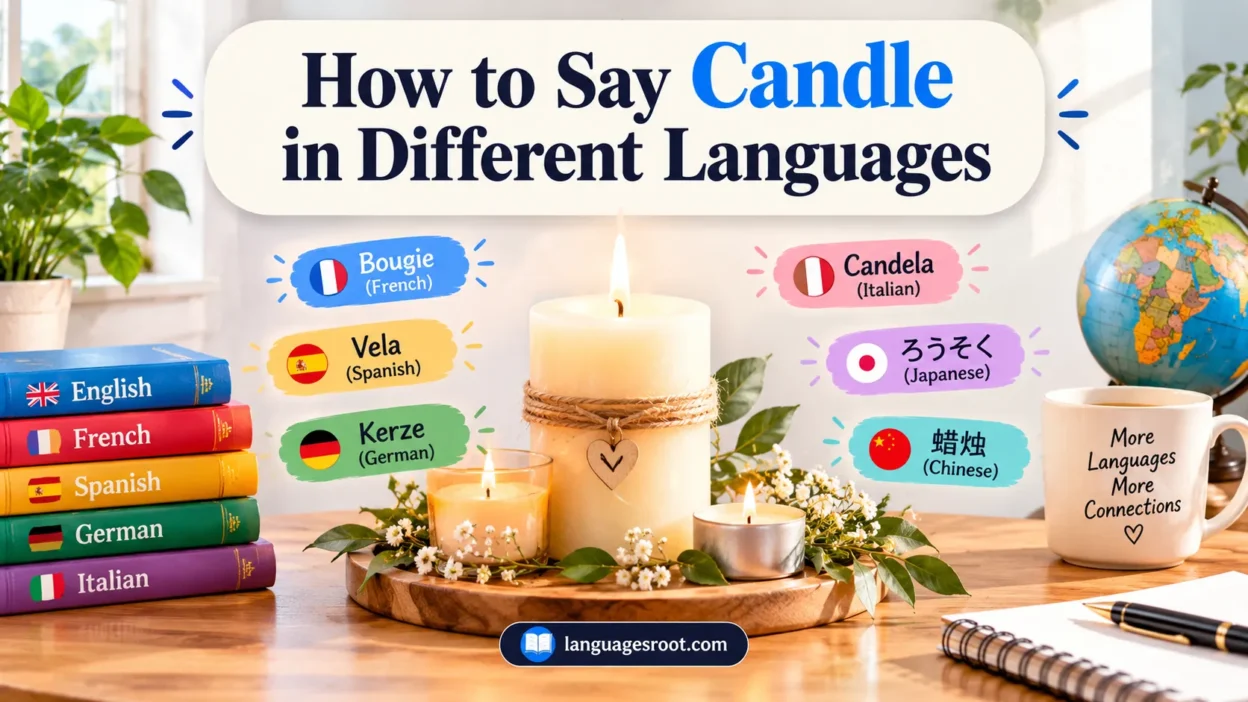
A candle brings warmth, light, and meaning to everyday life. Learning how to say candle helps you explore foreign language vocabulary and common words across languages. This guide shares candle in different languages, including Spanish vela, French bougie, German Kerze, and Italian candela. You will also discover useful candle translations around the world with natural pronunciation tips.
Whether you enjoy language learning, travel abroad, or explore other cultures, these words can help. Moreover, understanding candle meaning, candle symbolism, and candle traditions around the world adds cultural context. You will find candle pronunciation, candle example sentences, and regional variations to build confidence. From birthday celebrations to religious observances, candles hold special meanings across many cultures. Explore these translations to expand your candle vocabulary and improve everyday communication.
Interesting Facts About Candle
- Different words describe the same object: English uses candle, while Spanish uses vela and French commonly uses bougie.
- Candlelight can carry symbolic meaning: Depending on the setting, a lit candle may represent celebration, remembrance, hope, prayer, or a quiet atmosphere.
- Some languages have related words: Italian candela and Portuguese vela are both everyday terms for a candle, despite their different forms.
- A candle is not always the same as a lamp: Some languages use distinct words for wax candles, oil lamps, and electric lights.
- Context can change the translation: A birthday candle, a decorative candle, and a ceremonial candle may require additional descriptive words.
- Pronunciation varies between languages: French bougie and German Kerze have sounds that may be unfamiliar to English speakers.
- Writing systems make translations look different: Languages such as Japanese, Chinese, Korean, Arabic, and Hindi use writing systems that differ from the Latin alphabet.
What Does Candle Mean?
A candle is a usually cylindrical object made from wax, or a similar combustible material, with a wick that burns to produce light. Candles are commonly used for birthdays, decoration, relaxation, religious ceremonies, and emergency lighting.
The word can also have emotional or symbolic associations. A candle placed on a birthday cake may represent celebration, while a candle lit in memory of someone can symbolize remembrance. In other situations, candles help create a warm, calm atmosphere.
Common candle-related expressions include:
- Birthday candle: A small candle placed on a birthday cake.
- Scented candle: A candle designed to release fragrance as it burns.
- Candlelight: The light produced by one or more burning candles.
- Decorative candle: A candle used mainly for decoration.
- Prayer candle: A candle used in a religious or spiritual setting.
When translating the word candle, the simplest everyday noun is usually the best starting point. Additional words can clarify the particular type or purpose.
Why Can Candle Have Different Translations?
The word candle does not have one universal translation because languages have their own vocabulary, grammar, and naming conventions. Although the physical object remains similar, the natural word depends on the language and situation.
Several factors can affect the translation:
- Context: A candle used on a cake may need a more specific expression than a candle used for lighting.
- Formality: Everyday conversation usually favors familiar words, while religious or technical writing may use more specialized terminology.
- Regional variation: Speakers in different countries may use different words or expressions for particular kinds of candles.
- Grammar: Some languages change nouns according to gender, number, or their role in a sentence.
- Cultural conventions: Ceremonial candles may have names associated with particular traditions.
- Literal versus natural translation: A word-for-word translation of candlelight may not be the usual way to describe light from a candle in another language.
- Written versus spoken language: A translation may look different in its native script and its romanized form.
For ordinary conversation, begin with the standard word for a candle. If you need to describe a special type, add the appropriate adjective or phrase rather than assuming the basic noun covers every meaning.
European Languages
European languages belong to several language families, including Romance, Germanic, Slavic, and Uralic languages. As a result, the word for candle can sound quite different from one language to another. The following table includes everyday terms and pronunciation guides for learners.
| 🌍 Language | Country/Region | Translation | Pronunciation | Example Sentence |
| English | International | Candle | KAN-dəl | The candle is burning. |
| American English 🇺🇸 | United States | Candle | KAN-dəl | I bought a scented candle. |
| British English 🇬🇧 | United Kingdom | Candle | KAN-dəl | Please light the candle. |
| Australian English 🇦🇺 | Australia | Candle | KAN-dəl | The candle smells lovely. |
| Spanish | Spain, Mexico, Latin America | Vela | BEH-lah | La vela está encendida. (The candle is lit.) |
| French | France, Belgium, parts of Canada | Bougie | boo-ZHEE | La bougie est allumée. (The candle is lit.) |
| German | Germany, Austria, Switzerland | Kerze | KEHR-tsuh | Die Kerze brennt. (The candle is burning.) |
| Italian | Italy, Switzerland | Candela | kan-DEH-lah | La candela è accesa. (The candle is lit.) |
| Portuguese | Portugal, Brazil | Vela | VEH-lah | A vela está acesa. (The candle is lit.) |
| Dutch | Netherlands, Belgium | Kaars | KAARS | De kaars brandt. (The candle is burning.) |
| Swedish | Sweden, Finland | Ljus | YOOS | Ljuset brinner. (The candle is burning.) |
| Norwegian | Norway | Stearinlys | steh-ah-REEN-lees | Stearinlyset brenner. (The candle is burning.) |
| Danish | Denmark | Stearinlys | steh-ah-REEN-luus | Stearinlyset brænder. (The candle is burning.) |
| Finnish | Finland | Kynttilä | KUUN-tee-lah | Kynttilä palaa. (The candle is burning.) |
| Icelandic | Iceland | Kerti | KER-ti | Kertið logar. (The candle is burning.) |
| Irish | Ireland | Coinneal | KIN-yəl | Tá an choinneal ar lasadh. (The candle is lit.) |
| Welsh | Wales | Cannwyll | KAN-wɨɬ | Mae’r gannwyll yn llosgi. (The candle is burning.) |
| Polish | Poland | Świeca | SHVYEH-tsah | Świeca się pali. (The candle is burning.) |
| Czech | Czechia | Svíčka | SVEECH-kah | Svíčka hoří. (The candle is burning.) |
| Slovak | Slovakia | Sviečka | SVYECH-kah | Sviečka horí. (The candle is burning.) |
| Ukrainian | Ukraine | Свічка | svich-KAH | Свічка горить. (The candle is burning.) |
| Russian | Russia and Russian-speaking communities | Свеча | svee-CHA | Свеча горит. (The candle is burning.) |
| Romanian | Romania, Moldova | Lumânare | loo-muh-NAH-reh | Lumânarea arde. (The candle is burning.) |
| Hungarian | Hungary | Gyertya | DYER-tyah | Ég a gyertya. (The candle is burning.) |
| Greek | Greece, Cyprus | Κερί | keh-REE | Το κερί καίει. (The candle is burning.) |
| Bulgarian | Bulgaria | Свещ | svyesht | Свещта гори. (The candle is burning.) |
| Croatian | Croatia | Svijeća | SVYAY-chah | Svijeća gori. (The candle is burning.) |
| Serbian | Serbia and neighboring areas | Свећа | SVEH-chah | Свећа гори. (The candle is burning.) |
| Slovenian | Slovenia | Sveča | SVEH-chah | Sveča gori. (The candle is burning.) |
| Lithuanian | Lithuania | Žvakė | ZHVAH-keh | Žvakė dega. (The candle is burning.) |
| Latvian | Latvia | Svece | SVEH-tseh | Svece deg. (The candle is burning.) |
| Estonian | Estonia | Küünal | KÜÜ-nal | Küünal põleb. (The candle is burning.) |
English Varieties: American, British, and Australian English
The word candle is the same in American, British, and Australian English. There is no separate regional translation that needs to be memorized.
Pronunciation may vary slightly by accent, but the meaning and spelling remain consistent. Words such as tea light, birthday candle, and scented candle describe particular types rather than different national translations of the word.
Cultural Notes for European Languages
- In Spanish and Portuguese, vela is the ordinary word for a candle. In Spanish, vela can also refer to a sail, so context helps clarify the meaning.
- French bougie is common in everyday speech, while chandelle also exists and may appear in particular expressions or contexts.
- German Kerze and Dutch kaars are useful everyday terms for candles.
- Swedish ljus can mean light as well as a candle, depending on context. The compound stearinljus specifically refers to a stearin candle.
- Slavic languages have their own distinct words, even when some spellings or sounds resemble one another.
Also Read: How to Say Calm in Different Languages
Asian Languages
Asia contains a wide range of language families, scripts, and pronunciation systems. Some languages use alphabets, while others use character-based writing systems or syllabaries. The table below provides common translations of candle, with romanization or pronunciation guidance where appropriate.
| 🌍 Language | Country/Region | Translation | Pronunciation | Example Sentence |
| Mandarin Chinese | China, Taiwan, Singapore | 蜡烛 (蠟燭) | làzhú | 蜡烛点着了。 (The candle is lit.) |
| Cantonese | Hong Kong, Guangdong | 蠟燭 | laap6 zuk1 | 支蠟燭着咗。 (The candle is lit.) |
| Japanese | Japan | ろうそく (蝋燭) | rōsoku | ろうそくに火をつけました。 (I lit the candle.) |
| Korean | South Korea, North Korea | 초 | cho | 초에 불을 붙였어요. (I lit the candle.) |
| Hindi | India | मोमबत्ती | mom-bat-tee | मोमबत्ती जल रही है। (The candle is burning.) |
| Urdu | Pakistan, India | موم بتی | mom-bat-tee | موم بتی جل رہی ہے۔ (The candle is burning.) |
| Bengali | Bangladesh, India | মোমবাতি | mom-ba-ti | মোমবাতিটি জ্বলছে। (The candle is burning.) |
| Punjabi | Punjab in India and Pakistan | ਮੋਮਬੱਤੀ / موم بتی | mom-bat-tee | ਮੋਮਬੱਤੀ ਜਲ ਰਹੀ ਹੈ। (The candle is burning.) |
| Gujarati | India | મીણબત્તી | meen-bat-tee | મીણબત્તી બળી રહી છે। (The candle is burning.) |
| Marathi | India | मेणबत्ती | men-bat-tee | मेणबत्ती जळत आहे. (The candle is burning.) |
| Tamil | India, Sri Lanka, Singapore | மெழுகுவர்த்தி | mezhugu-varththi | மெழுகுவர்த்தி எரிகிறது. (The candle is burning.) |
| Telugu | India | కొవ్వొత్తి | kov-vot-ti | కొవ్వొత్తి వెలుగుతోంది. (The candle is shining.) |
| Kannada | India | ಮೇಣದಬತ್ತಿ | mēṇa-dabatti | ಮೇಣದಬತ್ತಿ ಉರಿಯುತ್ತಿದೆ. (The candle is burning.) |
| Malayalam | India | മെഴുകുതിരി | mezhuku-thiri | മെഴുകുതിരി കത്തുന്നു. (The candle is burning.) |
| Nepali | Nepal, India | मैनबत्ती | main-bat-tee | मैनबत्ती बलिरहेको छ। (The candle is burning.) |
| Sinhala | Sri Lanka | ඉටිපන්දම | iṭi-pandama | ඉටිපන්දම දැල්වෙනවා. (The candle is burning.) |
| Thai | Thailand | เทียน | thian | เทียนกำลังไหม้ (The candle is burning.) |
| Vietnamese | Vietnam | Nến | nen, with a rising tone | Cây nến đang cháy. (The candle is burning.) |
| Indonesian | Indonesia | Lilin | lee-leen | Lilin itu sedang menyala. (The candle is lit.) |
| Malay | Malaysia, Brunei, Singapore | Lilin | lee-leen | Lilin itu sedang menyala. (The candle is lit.) |
| Filipino/Tagalog | Philippines | Kandila | kan-dee-lah | Nagsisindi ako ng kandila. (I am lighting a candle.) |
| Burmese | Myanmar | ဖယောင်းတိုင် | pyaung-taing | ဖယောင်းတိုင် မီးလင်းနေတယ်။ (The candle is lit.) |
| Khmer | Cambodia | ទៀន | tien | ទៀនកំពុងឆេះ។ (The candle is burning.) |
| Lao | Laos | ທຽນ | thian | ທຽນກຳລັງໄໝ້. (The candle is burning.) |
| Mongolian | Mongolia | Лаа | laa | Лаа асаж байна. (The candle is lit.) |
| Kazakh | Kazakhstan, Central Asia | Шам | sham | Шам жанып тұр. (The candle is burning.) |
| Uzbek | Uzbekistan, Central Asia | Sham | sham | Sham yonib turibdi. (The candle is burning.) |
Cultural Notes for Asian Languages
- In Mandarin, 蜡烛 (làzhú) is the standard word for a candle. Traditional characters, 蠟燭, are used in places such as Taiwan and Hong Kong.
- In Cantonese, pronunciation and sentence structure differ from Mandarin. The Cantonese entry should not be treated as simply Mandarin spoken with another accent.
- Japanese ろうそく (rōsoku) refers to a candle. Japanese also uses other terms for specific candle types.
- In Hindi, Urdu, Bengali, and Punjabi, the words are related in everyday usage, but their scripts and pronunciation conventions differ. Urdu and some Punjabi varieties use Perso-Arabic script, while Hindi and Indian Punjabi commonly use Devanagari and Gurmukhi respectively.
- Indonesian and Malay both use lilin. Context determines whether the word refers to a candle or another wax-related object.
- Tone and vowel length matter in several Asian languages. The pronunciation guides are simplified aids, not replacements for listening to fluent speakers.
African Languages
Africa is home to hundreds of languages from several language families, including Niger-Congo, Afroasiatic, and Austronesian. Words for a candle vary across regions, and some languages use borrowed vocabulary alongside traditional terms. The examples below represent particular languages and communities, not the entire continent.
| 🌍 Language | Country/Region | Translation | Pronunciation | Example Sentence |
| Swahili | Tanzania, Kenya, East Africa | Mshumaa | m-shoo-MAH-ah | Mshumaa unawaka. (The candle is burning.) |
| Afrikaans | South Africa, Namibia | Kers | kर्स, approximately kर्स | Die kers brand. (The candle is burning.) |
| Zulu | South Africa | Ikhandlela | ee-khan-dleh-lah | Ikhandlela liyavutha. (The candle is burning.) |
| Xhosa | South Africa | Ikhandlela | ee-khan-dleh-lah | Ikhandlela liyavutha. (The candle is burning.) |
| Amharic | Ethiopia | ሻማ | shama | ሻማው እየበራ ነው። (The candle is lit.) |
| Yoruba | Nigeria, Benin | Abẹ́là | ah-BEH-lah | Abẹ́là náà ń jó. (The candle is burning.) |
| Igbo | Nigeria | Kandụl | kan-dool | Kandụl ahụ na-enwu. (The candle is lit.) |
| Hausa | Nigeria, Niger, West Africa | Kyandir | kyan-deer | Kyandir ɗin yana ci. (The candle is burning.) |
| Somali | Somalia, Horn of Africa | Shumac | shoo-mak | Shumacu wuu shidan yahay. (The candle is lit.) |
| Shona | Zimbabwe | Kenduru | ken-doo-roo | Kenduru iri kutsva. (The candle is burning.) |
| Sesotho | Lesotho, South Africa | Kerese | keh-reh-seh | Kerese ea tuka. (The candle is burning.) |
| Setswana | Botswana, South Africa | Kerese | keh-reh-seh | Kerese e a tuka. (The candle is burning.) |
| Kinyarwanda | Rwanda | Buji | boo-jee | Buji iraka. (The candle is burning.) |
| Malagasy | Madagascar | Labozia | lah-boo-ZEE-ah | Mirehitra ny labozia. (The candle is burning.) |
Cultural Notes for African Languages
- Swahili mshumaa is useful in everyday conversation across many Swahili-speaking communities.
- In Zulu and Xhosa, ikhandlela is a common word for a candle. The two languages are related, but they remain distinct languages with their own grammatical and pronunciation conventions.
- Afrikaans kers and the related forms used in some neighboring languages reflect historical language contact in the region.
- Some languages use loanwords for modern household objects. The fact that a word resembles one in another language does not necessarily mean it has exactly the same history or usage.
- Candle-related traditions differ among communities, families, and religious settings. It is best to ask about a specific custom rather than assume one practice applies throughout a country.
Middle Eastern Languages
The Middle East includes Arabic, Hebrew, Persian, Kurdish, Turkish, Armenian, and other languages with different histories and writing systems. The same everyday object may have a different name across neighboring communities. Arabic also varies between Modern Standard Arabic and regional dialects.
| 🌍 Language | Country/Region | Translation | Pronunciation | Example Sentence |
| Modern Standard Arabic | Middle East, North Africa | شمعة | sham-ah | الشمعة مشتعلة. (The candle is burning.) |
| Persian (Farsi) | Iran and Persian-speaking communities | شمع | sham’ | شمع روشن است. (The candle is lit.) |
| Hebrew | Israel | נר | ner | הנר דולק. (The candle is burning.) |
| Kurdish (Kurmanji) | Kurdish-speaking regions of Turkey, Syria, Iraq, and elsewhere | Mûm | moom | Mûm dişewite. (The candle is burning.) |
| Turkish | Turkey, Cyprus | Mum | moom | Mum yanıyor. (The candle is burning.) |
| Armenian | Armenia and Armenian-speaking communities | Մոմ | mom | Մոմը վառվում է։ (The candle is burning.) |
Arabic: Standard Language and Regional Usage
In Modern Standard Arabic, shamʿa (شمعة) is a common word for a candle. Regional speech may vary in pronunciation and in the way a sentence is phrased, but the standard noun is widely recognizable.
Cultural Notes for Middle Eastern Languages
- Arabic شمعة and Persian شمع are written in related scripts, but they are distinct words in distinct languages.
- Hebrew נר (ner) is a short everyday word. More specific terms may be used for ceremonial or religious candles.
- Turkish mum is the usual everyday noun for a candle. The same word may appear in expressions related to wax.
- Kurdish has multiple varieties. The Kurmanji term shown here should not automatically be applied to every Kurdish dialect.
- Armenian uses its own alphabet, so romanization is helpful for readers who cannot yet read the native script.
Other World Languages
Several languages outside the main regional groupings also have useful translations for candle. These examples show how the same household object is named in different parts of the Americas and the Pacific.
| 🌍 Language | Country/Region | Translation | Pronunciation | Example Sentence |
| Māori | New Zealand | Kānara | KAA-nah-rah | Kei te kānara te mura. (The candle has a flame.) |
| Samoan | Samoa and Samoan-speaking communities | Moliga’o | moh-lee-ngah-oh | Ua mū le moliga’o. (The candle is lit.) |
| Tongan | Tonga | Teʻelango | teh-eh-LANG-oh | ʻOku vela ʻa e teʻelango. (The candle is burning.) |
| Hawaiian | Hawaiʻi | Ihoiho | ee-HOY-ho | Ua ʻā ka ihoiho. (The candle is lit.) |
| Quechua | Andean regions of South America | Vela (used in some varieties) | VEH-lah | The exact wording varies by Quechua variety. |
| Guarani | Paraguay and neighboring regions | Tatapỹi | tah-tah-PUH-ee | The exact everyday wording can vary by variety and context. |
| Haitian Creole | Haiti | Balèn | bah-LEN | Balèn nan limen. (The candle is lit.) |
| Esperanto | International constructed language | Kandelo | kan-DEH-lo | La kandelo brulas. (The candle is burning.) |
Note on regional reliability: Quechua and Guarani have multiple varieties, and vocabulary may differ by community. For formal writing, educational materials, or a permanent inscription, verify the preferred local term with a speaker of the relevant variety. Do not assume a word used in one community is universal across all varieties.
Quick Reference: Candle in Different Languages
This compact table gathers the main translations so you can quickly look up the word candle. English varieties are grouped together where their wording is identical.
| Language | Translation |
| English | Candle |
| American English | Candle |
| British English | Candle |
| Australian English | Candle |
| Spanish | Vela |
| French | Bougie |
| German | Kerze |
| Italian | Candela |
| Portuguese | Vela |
| Dutch | Kaars |
| Swedish | Ljus |
| Norwegian | Stearinlys |
| Danish | Stearinlys |
| Finnish | Kynttilä |
| Icelandic | Kerti |
| Irish | Coinneal |
| Welsh | Cannwyll |
| Polish | Świeca |
| Czech | Svíčka |
| Slovak | Sviečka |
| Ukrainian | Свічка |
| Russian | Свеча |
| Romanian | Lumânare |
| Hungarian | Gyertya |
| Greek | Κερί |
| Bulgarian | Свещ |
| Croatian | Svijeća |
| Serbian | Свећа |
| Slovenian | Sveča |
| Lithuanian | Žvakė |
| Latvian | Svece |
| Estonian | Küünal |
| Mandarin Chinese | 蜡烛 / 蠟燭 |
| Cantonese | 蠟燭 |
| Japanese | ろうそく |
| Korean | 초 |
| Hindi | मोमबत्ती |
| Urdu | موم بتی |
| Bengali | মোমবাতি |
| Punjabi | ਮੋਮਬੱਤੀ / موم بتی |
| Gujarati | મીણબત્તી |
| Marathi | मेणबत्ती |
| Tamil | மெழுகுவர்த்தி |
| Telugu | కొవ్వొత్తి |
| Kannada | ಮೇಣದಬತ್ತಿ |
| Malayalam | മെഴുകുതിരി |
| Nepali | मैनबत्ती |
| Sinhala | ඉටිපන්දම |
| Thai | เทียน |
| Vietnamese | Nến |
| Indonesian | Lilin |
| Malay | Lilin |
| Filipino/Tagalog | Kandila |
| Burmese | ဖယောင်းတိုင် |
| Khmer | ទៀន |
| Lao | ທຽນ |
| Mongolian | Лаа |
| Kazakh | Шам |
| Uzbek | Sham |
| Swahili | Mshumaa |
| Afrikaans | Kers |
| Zulu | Ikhandlela |
| Xhosa | Ikhandlela |
| Amharic | ሻማ |
| Yoruba | Abẹ́là |
| Igbo | Kandụl |
| Hausa | Kyandir |
| Somali | Shumac |
| Shona | Kenduru |
| Sesotho | Kerese |
| Setswana | Kerese |
| Kinyarwanda | Buji |
| Malagasy | Labozia |
| Modern Standard Arabic | شمعة |
| Persian | شمع |
| Hebrew | נר |
| Kurdish (Kurmanji) | Mûm |
| Turkish | Mum |
| Armenian | Մոմ |
| Māori | Kānara |
| Samoan | Moliga’o |
| Tongan | Teʻelango |
| Hawaiian | Ihoiho |
| Quechua | Vela (some varieties) |
| Guarani | Tatapỹi (verify locally) |
| Haitian Creole | Balèn |
| Esperanto | Kandelo |
How to Choose the Right Translation
The best translation of candle depends on the language, situation, and person you are communicating with. For everyday conversations, start with the common noun listed in the tables above. If you are shopping, describing a decoration, or discussing a religious ceremony, you may need a more specific expression.
Use these practical tips:
- Consider the context: A birthday candle and a scented candle are different types of objects, even though both are candles.
- Check the region: Spanish vela, for example, is widely understood, but specialized vocabulary may differ between countries.
- Learn the pronunciation: Read the pronunciation guide aloud and listen to recordings from reliable language-learning resources.
- Use the native script: When writing in another language, copy the correct characters and accents rather than relying only on romanization.
- Ask for clarification: If someone uses a regional word, politely ask whether it refers to a candle or another object.
- Match the audience: For a school assignment or formal translation, consult a dictionary or a fluent speaker familiar with the relevant context.
For a simple conversation, the everyday word is usually sufficient. For a product label, ceremonial description, or permanent inscription, verify the exact wording before using it.
Common Mistakes When Translating Candle
Even a simple noun can lead to misunderstandings when translated without considering its context. Avoid these common mistakes when learning how to say candle in another language.
- Translating related words as if they were identical: A candle, candlelight, a wick, and a flame refer to different things. Choose the word that matches the intended meaning.
- Assuming one translation works everywhere: A term may be common in one language variety but less familiar in another.
- Ignoring grammatical rules: Some languages require changes to articles, adjectives, or noun endings depending on the sentence.
- Using an incorrect pronunciation: A small change in vowel length, stress, or tone can make a word sound unfamiliar.
- Confusing a candle with a lamp: A wax candle is not the same object as an oil lamp or an electric light.
- Relying only on romanization: Romanized spellings help beginners, but they may not capture every sound in the original language.
- Treating related languages as identical: Hindi and Urdu, for instance, can share vocabulary while using different writing systems and conventions.
- Assuming cultural meaning is universal: Candles may symbolize celebration, prayer, remembrance, or decoration, depending on the setting.
The easiest way to avoid these errors is to learn the word together with a natural example sentence.
Why Learn Candle in Different Languages?
Learning the word candle in different languages can help you build everyday vocabulary while discovering how languages describe familiar objects. Simple nouns are useful starting points for beginners because they can be practiced at home, in shops, while traveling, or during conversations with language partners.
This vocabulary can also help you understand product labels, ask questions about household items, and describe decorations when visiting another country. If you enjoy candles, learning words such as scented candle, candle holder, and candlelight can expand your vocabulary further.
There is also cultural value in learning the words people use for objects connected with celebrations, ceremonies, and remembrance. Such knowledge can help you ask thoughtful questions without assuming that every community uses candles in the same way.
For language learners, the best approach is to combine pronunciation, writing, meaning, and practical examples. Practice a few translations at a time, then use them in short sentences. Over time, these small vocabulary lessons can make multilingual communication more comfortable and meaningful.
Frequently Asked Questions
How do you say candle in different languages?
The word candle has different translations around the world. For example, Spanish vela, French bougie, German Kerze, and Italian candela are common terms. In Urdu, candle is موم بتی, while Mandarin Chinese uses 蜡烛.
What is the word for candle in Spanish, French, and German?
The Spanish word is vela, pronounced BEH-lah. In French, bougie sounds like boo-ZHEE, while German Kerze sounds like KEHR-tsuh. These words are useful for everyday conversations and language learning.
How do you pronounce candle in different languages?
Pronunciation varies by language, so use a candle pronunciation guide to learn each word correctly. For example, Italian candela sounds like kan-DEH-lah. Also, practice native writing, listen to fluent speakers, and repeat each word in a simple sentence.
Can candle translations vary by country or culture?
Yes, regional variations and dialect differences can affect word choice and pronunciation. However, many standard translations work across several countries. Context also matters because a birthday candle, scented candle, and ceremonial candle may need different descriptive words.
How can I use candle translations in everyday conversations?
Start with the common candle vocabulary for your target language, then practice candle example sentences. For example, learning how to ask for a candle while traveling can help you shop abroad. Also, check the native script and context to avoid translation mistakes.
Conclusion
Learning how to say candle in different languages helps you build foreign language vocabulary and explore how cultures name everyday objects. From Spanish vela and French bougie to Japanese ろうそく and Arabic شمعة, each word offers a new way to connect. For best results, practice candle pronunciation, learn candle example sentences, and consider regional differences for accurate translations.