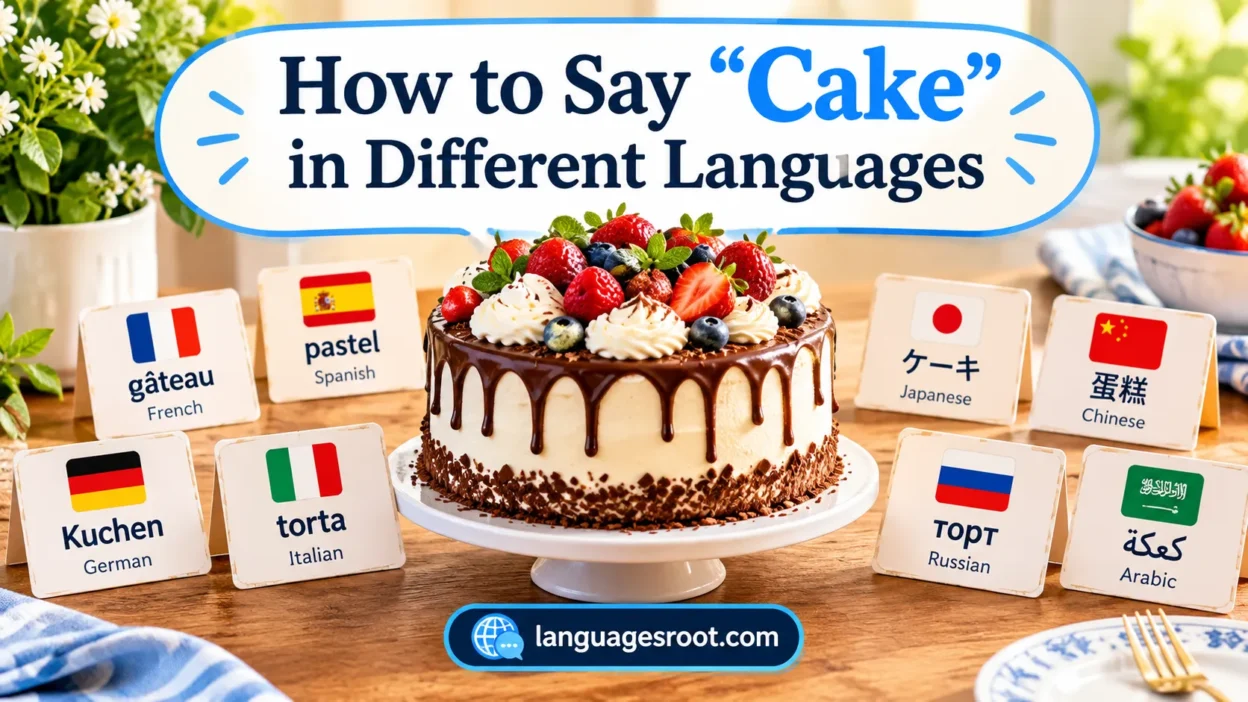
Learning how to say cake in other languages makes food conversations more fun and meaningful. This cake translation guide explores how to say cake in different languages, with useful words and simple cake pronunciation tips. Whether you love birthday cake, wedding cake, or a traditional cake, you can discover how people name this sweet dessert worldwide. Moreover, these food vocabulary in different languages examples help travelers, students, and food enthusiasts learn through everyday conversations.
From European languages to Asian languages, African languages, and Middle Eastern languages, cake names often reflect local tastes and traditions. For example, cake in Spanish may be called bizcocho, torta, or tarta, depending on the region and dessert. These regional cake names highlight fascinating cultural differences and language diversity. Explore this language reference guide to discover cake in multiple languages, understand pronunciation differences, and enjoy a richer connection between food culture and global languages.
Interesting Facts About Cake
- Cake has different names across languages. For example, Spanish uses pastel or tarta in many contexts, while French commonly uses gâteau. The best choice can depend on the kind of dessert and the region.
- Some languages distinguish cakes by type. A birthday cake, a layered celebration cake, and a small sweet pastry may have different names rather than one word covering every dessert.
- The same word can have regional differences. Spanish speakers in different countries may use different words for cakes and other baked sweets, so local context matters.
- Cake is associated with celebrations in many cultures. Birthday candles, wedding cakes, and festive desserts are familiar examples, although specific customs vary between families and communities.
- Borrowed words are common in food vocabulary. Some languages use a form of the English word cake, especially when referring to a particular international dessert.
- Writing systems affect pronunciation guides. Languages such as Japanese, Korean, Mandarin Chinese, and Arabic use writing systems different from English, so romanization helps readers approach the original word.
- Translation depends on the dessert itself. A word that describes a layered cream cake in one region may refer to a broader category of baked sweets in another.
What Does Cake Mean?
A cake is a sweet baked food usually prepared from a mixture of flour, sugar, eggs, and fat, often with flavorings, fruit, chocolate, cream, or other ingredients. Cakes can be soft and fluffy, rich and dense, decorated for celebrations, or served as everyday desserts.
The word also carries social and emotional associations. A birthday cake may represent celebration, while a homemade cake may remind someone of family traditions or childhood memories. Wedding cakes often have a special role in the celebration, and festive cakes can be connected with religious holidays or seasonal customs.
People use the word cake in many everyday situations, including ordering dessert at a restaurant, shopping at a bakery, sharing a recipe, or discussing a celebration. In other languages, however, the most natural word depends on whether the speaker means a general cake, a birthday cake, a cheesecake, or a traditional local dessert.
For this article, cake means the general sweet baked dessert, unless an example specifically identifies a particular kind.
Why Can Cake Have Different Translations?
The word cake does not have one identical equivalent in every language because food categories differ across cultures. Some languages use a broad term for many kinds of cakes, while others distinguish between sponge cakes, layered cakes, tarts, pastries, and regional specialties.
Context is important when choosing a translation. If you want to buy a chocolate cake, you may need a different expression from the one used to describe a traditional holiday cake. Similarly, a word used in a bakery may be more specific than a word used in a general conversation.
Regional variation also matters. Spanish speakers may use pastel, torta, or tarta depending on their country and the dessert they mean. Portuguese has regional differences too, with bolo widely used for cake. These words are not always interchangeable in every situation.
Unlike expressions that change according to the speaker’s gender or level of formality, the basic noun for cake usually does not require a gendered form in many languages. However, grammatical gender, plural forms, articles, and sentence structure may still affect how the word appears in a complete sentence.
The most useful translation is therefore the one that accurately describes the dessert and sounds natural in the intended language and region.
European Languages
Europe has a rich variety of languages, including Romance, Germanic, Slavic, and other language families. Many European languages have their own everyday word for cake, although some words cover a wider or narrower range of desserts. The following table includes standard forms and useful regional distinctions.
| Language | Country/Region | Translation | Pronunciation | Example sentence |
| English | International | Cake | kayk | I made a chocolate cake. |
| American English 🇺🇸 | United States | Cake | kayk | We ordered a birthday cake. |
| British English 🇬🇧 | United Kingdom | Cake | kayk | Would you like a slice of cake? |
| Australian English 🇦🇺 | Australia | Cake | kayk | She baked a cake for the party. |
| Spanish | Spain and Latin America | Pastel / tarta | pahs-TEL / TAR-tah | Quiero un pastel de chocolate. (I want a chocolate cake.) |
| French | France and other French-speaking regions | Gâteau | gah-TOH | J’aime ce gâteau au chocolat. (I like this chocolate cake.) |
| German | Germany, Austria, Switzerland | Kuchen | KOO-khen | Der Kuchen schmeckt gut. (The cake tastes good.) |
| Italian | Italy and Italian-speaking communities | Torta | TOR-tah | La torta è deliziosa. (The cake is delicious.) |
| Portuguese | Portugal, Brazil, and other Lusophone regions | Bolo | BOH-loo | O bolo está delicioso. (The cake is delicious.) |
| Dutch | Netherlands and Belgium | Taart / cake | tahrt / kayk | De taart is lekker. (The cake is tasty.) |
| Swedish | Sweden and parts of Finland | Tårta | TOR-tah | Tårtan är jättegod. (The cake is really delicious.) |
| Norwegian | Norway | Kake | KAH-keh | Kaken er veldig god. (The cake is very good.) |
| Danish | Denmark | Kage | KAY-uh | Kagen smager godt. (The cake tastes good.) |
| Finnish | Finland | Kakku | KAHK-koo | Kakku on herkullinen. (The cake is delicious.) |
| Icelandic | Iceland | Kaka | KAH-ka | Kakan er góð. (The cake is good.) |
| Irish | Ireland | Cáca | KAW-kah | Tá an cáca blasta. (The cake is tasty.) |
| Welsh | Wales | Cacen | KAH-ken | Mae’r gacen yn flasus. (The cake is delicious.) |
| Polish | Poland | Ciasto | CHYAS-toh | To ciasto jest pyszne. (This cake is delicious.) |
| Czech | Czechia | Dort / koláč | dort / koh-LAACH | Dort je výborný. (The cake is excellent.) |
| Slovak | Slovakia | Torta / koláč | TOR-tah / koh-LAACH | Torta je výborná. (The cake is excellent.) |
| Ukrainian | Ukraine | Торт (tort) | tort | Цей торт смачний. (This cake is tasty.) |
| Russian | Russia and Russian-speaking communities | Торт (tort) | tort | Этот торт очень вкусный. (This cake is very tasty.) |
| Romanian | Romania and Moldova | Tort | tort | Tortul este delicios. (The cake is delicious.) |
| Hungarian | Hungary | Torta | TOR-taw | A torta finom. (The cake is delicious.) |
| Greek | Greece and Cyprus | Κέικ (keik) | keik | Το κέικ είναι νόστιμο. (The cake is tasty.) |
| Bulgarian | Bulgaria | Торта (torta) | TOR-tah | Тортата е вкусна. (The cake is delicious.) |
| Croatian | Croatia | Torta | TOR-tah | Torta je ukusna. (The cake is tasty.) |
| Serbian | Serbia and neighboring communities | Торта (torta) | TOR-tah | Торта је укусна. (The cake is tasty.) |
| Slovenian | Slovenia | Torta | TOR-tah | Torta je okusna. (The cake is tasty.) |
| Lithuanian | Lithuania | Tortas | TOR-tahs | Tortas yra skanus. (The cake is tasty.) |
| Latvian | Latvia | Kūka | KOO-kah | Kūka ir garšīga. (The cake is tasty.) |
| Estonian | Estonia | Kook | kohk | Kook on maitsev. (The cake is tasty.) |
English Varieties: American, British, and Australian English
The word cake is essentially the same in American, British, and Australian English. There is no need to learn three separate translations. The pronunciation can vary slightly by accent, but the spelling and core meaning remain the same.
Some dessert names differ regionally. For instance, British English commonly uses fairy cake for a small individual cake, while American English often uses cupcake for a similar style of treat. These names can refer to slightly different recipes or sizes, depending on the bakery.
Cultural note: In several European languages, words such as torta, tarte, and taart can refer to particular styles of cake or tart. When ordering dessert, describing the ingredients or appearance can help avoid confusion.
Asian Languages
Asia includes a wide range of language families, scripts, and food traditions. Some languages have established words for Western-style cakes, while others use terms that can also describe traditional sweets. The pronunciation guides below are simplified for general readers, with recognized romanization used where practical.
| Language | Country/Region | Translation | Pronunciation | Example sentence |
| Mandarin Chinese | China, Taiwan, Singapore | 蛋糕 (dàngāo) | dan-gao, with tones: dàngāo | 这个蛋糕很好吃。 (This cake is delicious.) |
| Cantonese | Hong Kong, Guangdong | 蛋糕 (daan6 gou1) | daan-gou, with Cantonese tones | 呢個蛋糕好好食。 (This cake is delicious.) |
| Japanese | Japan | ケーキ (kēki) | keh-kee | このケーキはおいしいです。 (This cake is delicious.) |
| Korean | South Korea, North Korea | 케이크 (keikeu) | keh-ee-keu | 이 케이크는 맛있어요. (This cake is delicious.) |
| Hindi | India | केक (kek) | kayk | यह केक बहुत स्वादिष्ट है। (This cake is very delicious.) |
| Urdu | Pakistan, India | کیک (cake) | kayk | یہ کیک بہت مزیدار ہے۔ (This cake is very tasty.) |
| Bengali | Bangladesh, India | কেক (kek) | kek | এই কেকটি খুব সুস্বাদু। (This cake is very delicious.) |
| Punjabi | Punjab in Pakistan and India | ਕੇਕ / ਕੇਕ (kek) | kayk | ਇਹ ਕੇਕ ਬਹੁਤ ਸੁਆਦੀ ਹੈ। (This cake is very tasty.) |
| Gujarati | India | કેક (kek) | kayk | આ કેક ખૂબ સ્વાદિષ્ટ છે. (This cake is very tasty.) |
| Marathi | India | केक (kek) | kayk | हा केक खूप स्वादिष्ट आहे. (This cake is very tasty.) |
| Tamil | India, Sri Lanka, Singapore | கேக் (kēk) | kayk | இந்த கேக் மிகவும் சுவையாக இருக்கிறது. (This cake is very tasty.) |
| Telugu | India | కేక్ (kēk) | kayk | ఈ కేక్ చాలా రుచిగా ఉంది. (This cake is very tasty.) |
| Kannada | India | ಕೇಕ್ (kēk) | kayk | ಈ ಕೇಕ್ ತುಂಬಾ ರುಚಿಯಾಗಿದೆ. (This cake is very tasty.) |
| Malayalam | India | കേക്ക് (kēkkŭ) | kayk | ഈ കേക്ക് വളരെ രുചികരമാണ്. (This cake is very tasty.) |
| Nepali | Nepal | केक (kek) | kayk | यो केक धेरै मिठो छ। (This cake is very tasty.) |
| Sinhala | Sri Lanka | කේක් (kēk) | kayk | මේ කේක් එක රසයි. (This cake is tasty.) |
| Thai | Thailand | เค้ก (khêek) | khaek, falling tone | เค้กนี้อร่อยมาก (This cake is very delicious.) |
| Vietnamese | Vietnam | Bánh kem / bánh ngọt | banh kem / banh ngot | Chiếc bánh kem này rất ngon. (This cake is delicious.) |
| Indonesian | Indonesia | Kue / kue bolu | koo-eh / koo-eh boh-loo | Kue ini sangat enak. (This cake is very tasty.) |
| Malay | Malaysia, Brunei, Singapore | Kek | kehk | Kek ini sangat sedap. (This cake is very tasty.) |
| Filipino (Tagalog) | Philippines | Keyk / cake | kayk | Masarap ang keyk na ito. (This cake is delicious.) |
| Burmese | Myanmar | ကိတ်မုန့် (keik mont) | kayk-mohn | ဒီကိတ်မုန့်က အရမ်းအရသာရှိတယ်။ (This cake is very tasty.) |
| Khmer | Cambodia | នំខេក (num khaek) | noom khaek | នំខេកនេះឆ្ងាញ់ណាស់។ (This cake is very delicious.) |
| Lao | Laos | ເຄັກ (khek) | khek | ເຄັກນີ້ແຊບຫຼາຍ. (This cake is very tasty.) |
| Mongolian | Mongolia | Бялуу (byaluu) | byah-loo | Энэ бялуу амттай. (This cake is tasty.) |
| Kazakh | Kazakhstan | Торт (tort) | tort | Бұл торт дәмді. (This cake is tasty.) |
| Uzbek | Uzbekistan | Tort | tort | Bu tort juda mazali. (This cake is very tasty.) |
Cultural Notes for Asian Languages
by Mandarin Chinese, 蛋糕 (dàngāo) is a common term for cake, especially Western-style baked cake. In Japanese, ケーキ (kēki) is a loanword used for cakes such as sponge cakes and cream cakes. In Korean, 케이크 (keikeu) is similarly used for many modern cake varieties.
South and Southeast Asian languages may use borrowed forms of cake alongside broader local dessert vocabulary. In Vietnamese, bánh kem commonly refers to a cream cake, while bánh ngọt can describe sweet baked goods more generally. Indonesian kue is broader than English cake, so kue bolu is more specific when referring to sponge cake.
Useful tip: If you are ordering a particular dessert, add a flavor or style, such as chocolate, vanilla, sponge, or birthday cake. This is often clearer than relying on the general word alone.
African Languages
Africa is home to hundreds of languages with distinct grammar, pronunciation, and vocabulary. The word used for cake may be borrowed from English, French, or another language, or it may have a local equivalent. The following examples focus on recognizable terms for cake and simple sentences about the dessert.
| Language | Country/Region | Translation | Pronunciation | Example sentence |
| Swahili | Tanzania, Kenya, and East Africa | Keki | KEH-kee | Keki hii ni tamu. (This cake is sweet.) |
| Afrikaans | South Africa, Namibia | Koek | kook | Hierdie koek is lekker. (This cake is delicious.) |
| Zulu | South Africa | Ikhekhe | ee-KHE-khe | Leli khekhe limnandi. (This cake is delicious.) |
| Xhosa | South Africa | Ikeyiki | ee-keh-YEE-kee | Le keyiki imnandi. (This cake is delicious.) |
| Amharic | Ethiopia | ኬክ (kek) | kek | ይህ ኬክ ጣፋጭ ነው። (This cake is tasty.) |
| Yoruba | Nigeria and neighboring areas | Kẹ́ẹ̀kì | keh-eh-kee | Kẹ́ẹ̀kì yìí dùn. (This cake is delicious.) |
| Igbo | Nigeria | Achicha | ah-chee-cha | Achicha a dị ụtọ. (This cake is sweet.) |
| Hausa | Nigeria, Niger, and West Africa | Kek | kek | Wannan kek ɗin yana da daɗi. (This cake is tasty.) |
| Somali | Somalia and the Horn of Africa | Keeg | kayg | Keegani waa macaan. (This cake is delicious.) |
| Shona | Zimbabwe | Keke | KEH-keh | Keke iyi inonaka. (This cake is tasty.) |
| Sesotho | Lesotho and South Africa | Keke | KEH-keh | Keke ena e monate. (This cake is delicious.) |
| Setswana | Botswana and South Africa | Keke | KEH-keh | Keke eno e monate. (This cake is delicious.) |
| Kinyarwanda | Rwanda | Gato | GAH-toh | Iyi gato iraryoshye. (This cake is delicious.) |
| Malagasy | Madagascar | Mofomamy | moo-foo-MAH-mee | Matsiro ity mofomamy ity. (This cake is delicious.) |
Cultural Notes for African Languages
The word for cake can vary depending on local food traditions and language contact. during Swahili, keki is widely understood for cake, while Afrikaans uses koek. In some communities, borrowed words are common when discussing commercially produced cakes.
In Igbo, achicha can refer to food categories beyond Western-style cake, depending on context and regional usage. Therefore, it is better to clarify the type of dessert when a word has a broader meaning.
Remember: Africa is linguistically diverse, and no single language represents the continent as a whole. A translation that works in one region may not be familiar to speakers elsewhere.
Also Read: How to Say Cupcake in Different Languages
Middle Eastern Languages
The Middle East includes Arabic-speaking communities, Persian speakers, Hebrew speakers, Kurdish-speaking communities, and other language groups. Some languages use a familiar word for cake, while others distinguish between cakes, pastries, and traditional sweets. Arabic also has substantial regional variation, so the table begins with Modern Standard Arabic rather than presenting one dialect as universal.
| Language | Country/Region | Translation | Pronunciation | Example sentence |
| Modern Standard Arabic | Across Arabic-speaking countries | كعكة (kaʿkah) | KAH-kah | هذه الكعكة لذيذة. (This cake is delicious.) |
| Egyptian Arabic | Egypt | تورتة (torta) | TOR-tah | التورتة دي حلوة أوي. (This cake is very good.) |
| Persian (Farsi) | Iran and Persian-speaking communities | کیک (keyk) | kayk | این کیک خوشمزه است. (This cake is delicious.) |
| Hebrew | Israel | עוגה (וגה, ugah) | oo-GAH | העוגה הזאת טעימה. (This cake is tasty.) |
| Kurdish (Kurmanji) | Parts of Türkiye, Iraq, Syria, and Iran | Kek | kek | Ev kek xweş e. (This cake is good.) |
| Turkish | Türkiye and Turkish-speaking communities | Pasta | PAHS-tah | Bu pasta çok lezzetli. (This cake is very delicious.) |
| Armenian | Armenia and Armenian-speaking communities | Տորթ (t’ort’) | tort | Այս տորթը համեղ է։ (This cake is delicious.) |
Cultural Notes for Middle Eastern Languages
In Modern Standard Arabic, kaʿkah is a general word for cake, but regional vocabulary can differ. In Egyptian Arabic, torta is commonly used for a decorated celebration cake. Other words may be more suitable for traditional sweets or pastries.
Persian uses کیک (keyk) for cake, while Hebrew uses עוגה (ugah). Turkish is an especially important example of why context matters: pasta means cake in Turkish, unlike its usual meaning in English.
Kurdish has regional varieties, and the example above uses Kurmanji. Other Kurdish varieties may use different vocabulary or spelling conventions.
Other World Languages
Languages outside the main regional groups also have useful expressions for cake. These examples include languages from the Pacific, the Americas, and international language communities.
| Language | Country/Region | Translation | Pronunciation | Example sentence |
| Māori | New Zealand | Keke | KEH-keh | He reka tēnei keke. (This cake is delicious.) |
| Samoan | Samoa and Pacific communities | Keke | KEH-keh | E manaia lenei keke. (This cake is delicious.) |
| Tongan | Tonga | Keke | KEH-keh | ʻOku ifo ʻa e keke ni. (This cake is tasty.) |
| Hawaiian | Hawaiʻi | Keke | KEH-keh | He ʻono kēia keke. (This cake is delicious.) |
| Quechua | Andean regions of South America | Torta | TOR-tah | Kay tortaqa misk’i. (This cake is sweet.) |
| Guarani | Paraguay and neighboring regions | Torta | TOR-tah | Ko ko torta he’ẽ. (This cake is sweet.) |
| Haitian Creole | Haiti | Gato | gah-TOH | Gato sa bon anpil. (This cake is very good.) |
| Esperanto | International constructed language | Kuko | KOO-koh | Ĉi tiu kuko estas bongusta. (This cake is delicious.) |
Note on regional vocabulary: In Quechua and Guarani, the word torta may be borrowed or used in particular varieties rather than serving as a universal traditional term for every kind of cake. Local usage should be checked when accuracy is important for a specific community.
Quick Reference: Cake in Different Languages
Use this compact reference to find the word for cake without reading through every example sentence. Regional alternatives are included where they are particularly useful. The same word may describe different types of desserts depending on the country.
| Language | Translation |
| English | Cake |
| American English | Cake |
| British English | Cake |
| Australian English | Cake |
| Spanish | Pastel / tarta |
| French | Gâteau |
| German | Kuchen |
| Italian | Torta |
| Portuguese | Bolo |
| Dutch | Taart / cake |
| Swedish | Tårta |
| Norwegian | Kake |
| Danish | Kage |
| Finnish | Kakku |
| Icelandic | Kaka |
| Irish | Cáca |
| Welsh | Cacen |
| Polish | Ciasto |
| Czech | Dort / koláč |
| Slovak | Torta / koláč |
| Ukrainian | Торт |
| Russian | Торт |
| Romanian | Tort |
| Hungarian | Torta |
| Greek | Κέικ |
| Bulgarian | Торта |
| Croatian | Torta |
| Serbian | Торта |
| Slovenian | Torta |
| Lithuanian | Tortas |
| Latvian | Kūka |
| Estonian | Kook |
| Mandarin Chinese | 蛋糕 |
| Cantonese | 蛋糕 |
| Japanese | ケーキ |
| Korean | 케이크 |
| Hindi | केक |
| Urdu | کیک |
| Bengali | কেক |
| Punjabi | ਕੇਕ |
| Gujarati | કેક |
| Marathi | केक |
| Tamil | கேக் |
| Telugu | కేక్ |
| Kannada | ಕೇಕ್ |
| Malayalam | കേക്ക് |
| Nepali | केक |
| Sinhala | කේක් |
| Thai | เค้ก |
| Vietnamese | Bánh kem / bánh ngọt |
| Indonesian | Kue / kue bolu |
| Malay | Kek |
| Filipino (Tagalog) | Keyk / cake |
| Burmese | ကိတ်မုန့် |
| Khmer | នំខេក |
| Lao | ເຄັກ |
| Mongolian | Бялуу |
| Kazakh | Торт |
| Uzbek | Tort |
| Swahili | Keki |
| Afrikaans | Koek |
| Zulu | Ikhekhe |
| Xhosa | Ikeyiki |
| Amharic | ኬክ |
| Yoruba | Kẹ́ẹ̀kì |
| Igbo | Achicha |
| Hausa | Kek |
| Somali | Keeg |
| Shona | Keke |
| Sesotho | Keke |
| Setswana | Keke |
| Kinyarwanda | Gato |
| Malagasy | Mofomamy |
| Modern Standard Arabic | كعكة |
| Egyptian Arabic | تورتة |
| Persian (Farsi) | کیک |
| Hebrew | עוגה |
| Kurdish (Kurmanji) | Kek |
| Turkish | Pasta |
| Armenian | Տորթ |
| Māori | Keke |
| Samoan | Keke |
| Tongan | Keke |
| Hawaiian | Keke |
| Quechua | Torta, in some varieties |
| Guarani | Torta, in some varieties |
| Haitian Creole | Gato |
| Esperanto | Kuko |
How to Choose the Right Translation
The best translation depends on the type of cake, the region, and the situation in which you plan to use it. If you are ordering dessert at a bakery, choose the local term for the specific kind you want. For example, Spanish speakers may use pastel, tarta, or torta, depending on the country and the dessert.
For a message or conversation, consider your audience’s native language and local vocabulary. If you are speaking to someone who uses a different dialect, a familiar international word may be understood, but it is worth checking first.
Follow these practical tips:
- Identify the dessert. A birthday cake, cheesecake, and traditional sweet may have different names.
- Check regional usage. Do not assume that one Spanish or Arabic term works in every country.
- Learn the pronunciation. A correct word can be difficult to understand if the sounds or tones are misleading.
- Use complete sentences. Learning how to say “This cake is delicious” can be more useful than memorizing a noun alone.
- Ask politely when uncertain. A simple clarification can prevent misunderstandings and help you learn local vocabulary.
Common Mistakes When Translating Cake
Translating cake seems simple, but several mistakes can lead to confusion.
1. Translating word for word. A dictionary equivalent may not describe the dessert you have in mind. For instance, some words cover cakes and pastries more broadly than English cake.
2. Ignoring regional differences. Spanish tarta, pastel, and torta can differ in meaning by region. Choosing one without considering your audience may lead to an unexpected interpretation.
3. Confusing cake with bread or pastry. Some traditional foods resemble cakes but belong to different culinary categories. Check the local name for the exact dessert.
4. Overlooking pronunciation. Words written in unfamiliar scripts may contain sounds or tones that are not represented well by a simple English spelling. Use the romanization as a starting point, not as a perfect substitute for listening.
5. Mixing languages or dialects. A word used in one language may have a different meaning in another. Turkish pasta, for example, means cake, while English pasta usually refers to a food made from dough.
6. Assuming every translation is universal. Languages change across countries and communities. A word can be widely understood without being the most natural choice everywhere.
7. Forgetting grammatical details. Articles, plurals, and adjective agreement may change when you use the word in a complete sentence. Learning a natural example alongside the translation helps you avoid these errors.
Why Learn Cake in Different Languages?
Learning how to say cake in different languages is a small but useful step toward better communication. Food is part of everyday life, so its vocabulary can help you talk with people at restaurants, bakeries, family gatherings, and celebrations.
This vocabulary is also useful for language learning. Comparing words such as gâteau, kakku, keki, and bolo helps you recognize patterns, discover borrowed words, and notice how different languages organize familiar ideas. Reading the words in their original scripts can also build confidence with writing systems that may initially seem unfamiliar.
For travelers, knowing the local word for cake makes ordering dessert easier and can help when asking about ingredients or traditional specialties. For families and friends, using a familiar word in another person’s language can make a greeting, invitation, or celebration feel more personal.
Most importantly, learning food vocabulary encourages curiosity about different culinary traditions. A word is only one part of the experience, but understanding its context can lead to more thoughtful conversations and a deeper appreciation of how people describe everyday life.
Frequently Asked Questions
How do you say cake in different languages?
The word cake varies across global languages. For example, French uses gâteau, Italian uses torta, Portuguese uses bolo, and Mandarin Chinese uses 蛋糕 (dàngāo).
What is the Spanish word for cake?
The Spanish word for cake can be pastel, tarta, or torta. The best choice depends on the region and the type of dessert.
Why does cake have different translations across cultures?
Cake translation varies because languages describe desserts differently. Some distinguish between cakes, tarts, and pastries, while others use broader terms for traditional desserts and sweet baked goods.
How do you pronounce cake in different languages?
Cake pronunciation depends on each language’s sounds and stress patterns. For example, French gâteau sounds like “gah-TOH,” while Japanese ケーキ (kēki) sounds like “keh-kee.”
How can I use cake translations in everyday conversations?
You can use cake vocabulary when ordering desserts, sharing recipes, or discussing celebrations. Learn example sentences and check regional cake names to communicate more naturally with local speakers.
Conclusion
Learning how to say cake in different languages is a fun way to explore global languages, food vocabulary, and cultural traditions. From French gâteau to Italian torta, each cake translation reflects local words, tastes, and customs. By learning cake pronunciation, regional cake names, and useful example sentences, you can speak more naturally and avoid common translation mistakes.