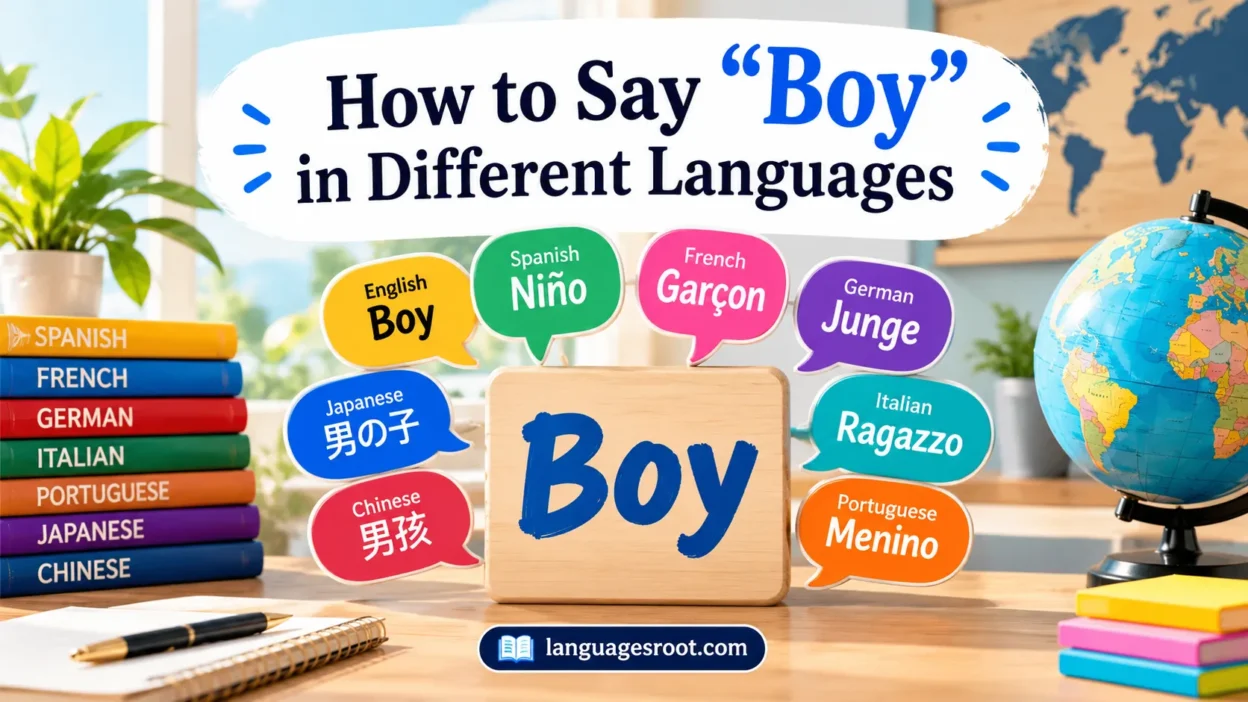
Learning boy in different languages helps you explore language diversity and cultural differences around the world. Whether you mean a male child, a young man, or a son, the right word depends on context. This vocabulary guide shares useful boy translations across many world languages. It also explains boy meaning, English pronunciation, and simple examples for everyday conversations.
Moreover, each native language may use different words based on age, relationships, and regional variations. Our translation guide covers European languages, Asian languages, African languages, and Middle Eastern languages. You will find a pronunciation guide, example sentences, and helpful notes on grammatical gender. These details support language learners and make multilingual communication easier. Explore these expressions to improve your foreign language vocabulary and avoid common translation mistakes.
Interesting Facts About Boy
- Age and meaning: The English word boy usually means a male child, but it can also describe an adolescent or, in some contexts, a young adult.
- Boy and son are different: Many languages have separate words for a boy in general and someone’s male child. The correct choice depends on the sentence.
- Grammar matters: Some languages change nouns or related words according to grammatical gender, case, number, or sentence structure.
- Different levels of formality: A word used affectionately among family members may sound unsuitable in a formal conversation or professional setting.
- Pronunciation varies: Languages such as Mandarin Chinese use tones, while Japanese and Korean have their own pronunciation conventions that cannot always be represented perfectly with English spelling.
- Regional differences exist: Arabic, Spanish, Portuguese, Chinese, and many other languages have regional vocabulary differences. A familiar word in one community may be less common elsewhere.
- Context can change the best translation: Describing a little boy, addressing a group of boys, and talking about someone’s son may require different words or expressions.
What Does Boy Mean?
Global Word Explorer
Discover everyday English words and explore how people express them in languages around the world.
Translations in 8 Global Languages
Boy is a noun that generally means a male child or young male person. It is commonly used when discussing children, describing someone’s age, identifying a student, or referring to a young person in a story.
For example, the sentence “The boy is playing outside” refers to a male child. In “That boy is my brother,” the word identifies a family member. However, if someone says “He is my son,” the relationship is more important than the person’s age, so the word son is usually more appropriate.
The word can also appear in informal expressions, friendly conversation, and cultural references. Its tone depends on the situation, the speaker, and the relationship between the people involved. In some contexts, addressing an adult male as “boy” can sound disrespectful, so it should not automatically be treated as a neutral term for every male person.
Why Can Boy Have Different Translations?
The word boy does not have one perfect equivalent for every context in every language. Translators must consider the person’s age, the intended meaning, the relationship between speakers, and the way the target language naturally expresses the idea.
For example, a word meaning male child may be more suitable than a word meaning son when describing an unfamiliar child. Likewise, a term for a teenage boy or young man may be more natural when discussing an older adolescent. Formality and regional dialects also influence word choice.
Grammar can affect the surrounding sentence even when the noun itself stays the same. Some languages change the form of a noun according to its grammatical role, while others require different articles or adjectives. In addition, spoken expressions may differ from formal written language.
The translations below focus mainly on the ordinary meaning of a male child or young boy. Where a language uses a broader term or a different form is especially useful, a short note explains the distinction. The examples demonstrate natural usage rather than forcing the English word into an identical sentence in every language.
European Languages
Europe has many languages from different language families, including Germanic, Romance, Slavic, and Uralic languages. Although several languages share historical roots, their everyday words for a boy can differ considerably. The examples below focus on common, understandable vocabulary rather than specialized or outdated expressions.
English Varieties
American, British, and Australian English use the same standard word, boy. Pronunciation and informal expressions can vary, but there is no need to invent a different translation for each variety.
| 🌍 Language | Country/Region | Translation | Pronunciation | Example Sentence |
| English 🇬🇧 | United Kingdom and worldwide | Boy | boy | The boy is reading a book. |
| American English 🇺🇸 | United States | Boy | boy | The boy plays baseball after school. |
| British English 🇬🇧 | United Kingdom | Boy | boy | The boy is waiting for his bus. |
| Australian English 🇦🇺 | Australia | Boy | boy | The boy is learning to swim. |
Other European Languages
| 🌍 Language | Country/Region | Translation | Pronunciation | Example Sentence |
| Spanish 🇪🇸 | Spain and Latin America | Niño | NEE-nyoh | El niño está leyendo. (The boy is reading.) |
| French 🇫🇷 | France and other French-speaking regions | Garçon | gar-SOHN | Le garçon joue dans le jardin. (The boy is playing in the garden.) |
| German 🇩🇪 | Germany, Austria, Switzerland | Junge | YOONG-uh | Der Junge lernt Deutsch. (The boy is learning German.) |
| Italian 🇮🇹 | Italy and Italian-speaking regions | Ragazzo | rah-GAHT-tsoh | Il ragazzo corre al parco. (The boy runs to the park.) |
| Portuguese 🇵🇹 | Portugal and Brazil | Menino | meh-NEE-noo | O menino está sorrindo. (The boy is smiling.) |
| Dutch 🇳🇱 | Netherlands and Flanders | Jongen | YONG-uhn | De jongen leest een boek. (The boy is reading a book.) |
| Swedish 🇸🇪 | Sweden | Pojke | POY-keh | Pojken spelar fotboll. (The boy is playing football.) |
| Norwegian 🇳🇴 | Norway | Gutt | goot | Gutten går til skolen. (The boy is walking to school.) |
| Danish 🇩🇰 | Denmark | Dreng | dreng, with a soft final sound | Drengen cykler hjem. (The boy is cycling home.) |
| Finnish 🇫🇮 | Finland | Poika | POY-kah | Poika lukee kirjaa. (The boy is reading a book.) |
| Icelandic 🇮🇸 | Iceland | Drengur | DRENG-gur | Drengurinn leikur sér úti. (The boy is playing outside.) |
| Irish 🇮🇪 | Ireland | Buachaill | BOO-uh-khıl | Tá an buachaill ag léamh. (The boy is reading.) |
| Welsh 🏴 | Wales | Bachgen | BAHKH-gen | Mae’r bachgen yn chwarae. (The boy is playing.) |
| Polish 🇵🇱 | Poland | Chłopiec | HWOP-yets | Chłopiec rysuje obrazek. (The boy is drawing a picture.) |
| Czech 🇨🇿 | Czechia | Chlapec | KHLAH-pets | Chlapec píše dopis. (The boy is writing a letter.) |
| Slovak 🇸🇰 | Slovakia | Chlapec | KHLAH-pets | Chlapec sa učí. (The boy is studying.) |
| Ukrainian 🇺🇦 | Ukraine | Хлопчик | khlop-chyk | Хлопчик читає книжку. (The boy is reading a book.) |
| Russian 🇷🇺 | Russia and other Russian-speaking communities | Мальчик | MAL-chik | Мальчик играет во дворе. (The boy is playing in the yard.) |
| Romanian 🇷🇴 | Romania and Moldova | Băiat | buh-YAHT | Băiatul citește o carte. (The boy is reading a book.) |
| Hungarian 🇭🇺 | Hungary | Fiú | FEE-oo | A fiú iskolába megy. (The boy is going to school.) |
| Greek 🇬🇷 | Greece and Cyprus | Αγόρι | ah-GHOH-ree | Το αγόρι διαβάζει. (The boy is reading.) |
| Bulgarian 🇧🇬 | Bulgaria | Момче | mom-CHEH | Момчето рисува. (The boy is drawing.) |
| Croatian 🇭🇷 | Croatia | Dječak | DYEH-chak | Dječak igra nogomet. (The boy is playing football.) |
| Serbian 🇷🇸 | Serbia and neighboring communities | Дечак | DEH-chak | Дечак чита књигу. (The boy is reading a book.) |
| Slovenian 🇸🇮 | Slovenia | Deček | DEH-chek | Deček se igra na vrtu. (The boy is playing in the garden.) |
| Lithuanian 🇱🇹 | Lithuania | Berniukas | ber-NYOO-kas | Berniukas skaito knygą. (The boy is reading a book.) |
| Latvian 🇱🇻 | Latvia | Zēns | zayns | Zēns spēlē futbolu. (The boy is playing football.) |
| Estonian 🇪🇪 | Estonia | Poiss | poys | Poiss loeb raamatut. (The boy is reading a book.) |
Cultural and usage notes: In Spanish, niño generally means a child or boy, while chico can mean boy or young man, depending on the region. In French, garçon means boy, but it can also mean waiter in certain restaurant contexts. German Junge and Italian ragazzo are everyday choices, although ragazzo can refer to an older young man as well.
In Welsh, bachgen is a masculine singular noun. In Slavic languages, the noun’s form can change with grammatical case or number, so the example sentence may not use the exact dictionary form shown in the translation column.
Asian Languages
Asia includes a wide variety of language families, scripts, and grammatical systems. Some languages distinguish carefully between a boy, a son, and a young man, while others use the same word in several everyday contexts. The following examples include native writing where practical and pronunciation guides to help beginners read the words.
| 🌍 Language | Country/Region | Translation | Pronunciation | Example Sentence |
| Mandarin Chinese 🇨🇳 | China, Taiwan, Singapore | 男孩 | nánhái, nan-hai | 那个男孩正在看书。 (That boy is reading.) |
| Cantonese 🇭🇰 | Hong Kong and Guangdong | 男仔 | naam4 zai2 | 個男仔喺度睇書。 (The boy is reading.) |
| Japanese 🇯🇵 | Japan | 男の子 | otoko no ko | 男の子が公園で遊んでいます。 (The boy is playing in the park.) |
| Korean 🇰🇷 | South Korea and North Korea | 소년 | so-nyeon | 소년이 책을 읽어요. (The boy is reading a book.) |
| Hindi 🇮🇳 | India | लड़का | laṛkā, LAR-kaa | लड़का स्कूल जा रहा है। (The boy is going to school.) |
| Urdu 🇵🇰 | Pakistan and South Asia | لڑکا | laṛkā, LAR-kaa | لڑکا کتاب پڑھ رہا ہے۔ (The boy is reading a book.) |
| Bengali 🇧🇩 | Bangladesh and eastern India | ছেলে | chhele, CHHE-leh | ছেলেটি বই পড়ছে। (The boy is reading a book.) |
| Punjabi 🇵🇰🇮🇳 | Punjab in Pakistan and India | ਮੁੰਡਾ / مُنڈا | muṇḍā, MOON-daa | ਮੁੰਡਾ ਸਕੂਲ ਜਾ ਰਿਹਾ ਹੈ। (The boy is going to school.) |
| Gujarati 🇮🇳 | Gujarat, India | છોકરો | chhokro, CHHO-kro | છોકરો પુસ્તક વાંચે છે. (The boy is reading a book.) |
| Marathi 🇮🇳 | Maharashtra, India | मुलगा | mulgā, MOOL-gaa | मुलगा शाळेत जात आहे. (The boy is going to school.) |
| Tamil 🇮🇳🇱🇰 | Tamil Nadu, Sri Lanka and Tamil-speaking communities | சிறுவன் | siṟuvaṉ, si-ru-van | சிறுவன் புத்தகம் படிக்கிறான். (The boy is reading a book.) |
| Telugu 🇮🇳 | Andhra Pradesh and Telangana, India | అబ్బాయి | abbāyi, ab-baa-yi | అబ్బాయి పుస్తకం చదువుతున్నాడు. (The boy is reading a book.) |
| Kannada 🇮🇳 | Karnataka, India | ಹುಡುಗ | huḍuga, hu-du-ga | ಹುಡುಗ ಪುಸ್ತಕ ಓದುತ್ತಿದ್ದಾನೆ. (The boy is reading a book.) |
| Malayalam 🇮🇳 | Kerala, India | ആൺകുട്ടി | āṇkuṭṭi, aan-koo-tti | ആൺകുട്ടി പുസ്തകം വായിക്കുന്നു. (The boy is reading a book.) |
| Nepali 🇳🇵 | Nepal | केटा | keṭā, keh-taa | केटा विद्यालय जाँदैछ। (The boy is going to school.) |
| Sinhala 🇱🇰 | Sri Lanka | පිරිමි ළමයා | pirimi lamayā | පිරිමි ළමයා පොතක් කියවනවා. (The boy is reading a book.) |
| Thai 🇹🇭 | Thailand | เด็กผู้ชาย | dèk phûu-chaai | เด็กผู้ชายกำลังอ่านหนังสือ (The boy is reading a book.) |
| Vietnamese 🇻🇳 | Vietnam | Cậu bé | kậu bé, approximately kow beh | Cậu bé đang đọc sách. (The boy is reading a book.) |
| Indonesian 🇮🇩 | Indonesia | Anak laki-laki | AH-nak LAH-kee LAH-kee | Anak laki-laki itu sedang membaca. (That boy is reading.) |
| Malay 🇲🇾 | Malaysia and Brunei | Budak lelaki | BOO-dak luh-LAH-kee | Budak lelaki itu sedang membaca buku. (The boy is reading a book.) |
| Filipino/Tagalog 🇵🇭 | Philippines | Batang lalaki | bah-tang lah-LAH-kee | Nagbabasa ng libro ang batang lalaki. (The boy is reading a book.) |
| Burmese 🇲🇲 | Myanmar | ယောက်ျားလေး | yauk-kyá-lé | ကောင်လေး စာအုပ်ဖတ်နေတယ်။ (The boy is reading a book.) |
| Khmer 🇰🇭 | Cambodia | ក្មេងប្រុស | kmeng pros | ក្មេងប្រុសកំពុងអានសៀវភៅ។ (The boy is reading a book.) |
| Lao 🇱🇦 | Laos | ເດັກຊາຍ | dek sai | ເດັກຊາຍກຳລັງອ່ານປຶ້ມ. (The boy is reading a book.) |
| Mongolian 🇲🇳 | Mongolia | Хүү | khüü, approximately khoo | Хүү ном уншиж байна. (The boy is reading a book.) |
| Kazakh 🇰🇿 | Kazakhstan | Ұл бала | ul bala | Ұл бала кітап оқып отыр. (The boy is reading a book.) |
| Uzbek 🇺🇿 | Uzbekistan | Oʻgʻil bola | o-gheel BO-la | Oʻgʻil bola kitob oʻqiyapti. (The boy is reading a book.) |
Cultural and usage notes: Mandarin 男孩 (nánhái) is a general term for a boy, while 儿子 (érzi) means son. Japanese 男の子 (otoko no ko) is a common everyday expression. Korean 소년 (sonyeon) can sound more formal or literary than some conversational alternatives.
In Hindi and Urdu, लड़का and لڑکا are closely related forms. Punjabi has different scripts depending on the region: Gurmukhi is widely used in Indian Punjab, while Shahmukhi is used in Pakistani Punjab. These scripts represent the same language, not separate languages.
The translations in the table focus on a male child. In Vietnamese, cậu bé often refers to a little boy, while other terms may fit older boys or young men better. In Malay and Indonesian, the full expressions make the male meaning clear.
See Also: How to Say Stop in Different Languages
African Languages
Africa is home to hundreds of languages and many distinct linguistic traditions. Words for boys differ across language families, and the most natural expression may depend on the country, community, or local variety. The examples below represent selected languages rather than the full linguistic diversity of the continent.
| 🌍 Language | Country/Region | Translation | Pronunciation | Example Sentence |
| Swahili 🇹🇿 | Tanzania, Kenya and East Africa | Mvulana | m-vu-LAH-nah | Mvulana anasoma kitabu. (The boy is reading a book.) |
| Afrikaans 🇿🇦 | South Africa and Namibia | Seun | sayn | Die seun lees ‘n boek. (The boy is reading a book.) |
| Zulu 🇿🇦 | South Africa | Umfana | oom-FAH-nah | Umfana ufunda incwadi. (The boy is reading a book.) |
| Xhosa 🇿🇦 | South Africa | Inkwenkwe | een-KWEN-kweh | Inkwenkwe ifunda incwadi. (The boy is reading a book.) |
| Amharic 🇪🇹 | Ethiopia | ወንድ ልጅ | wänd lij | ወንድ ልጁ መጽሐፍ ያነባል። (The boy reads a book.) |
| Yoruba 🇳🇬 | Southwestern Nigeria and neighboring communities | Ọmọkùnrin | aw-maw-KOON-reen | Ọmọkùnrin náà ń ka ìwé. (The boy is reading a book.) |
| Igbo 🇳🇬 | Southeastern Nigeria | Nwoke nta | NWO-keh nta | Nwoke nta ahụ na-agụ akwụkwọ. (The boy is reading a book.) |
| Hausa 🇳🇬🇳🇪 | Northern Nigeria, Niger and surrounding areas | Yaro | YAH-roh | Yaron yana karanta littafi. (The boy is reading a book.) |
| Somali 🇸🇴 | Somalia and the Horn of Africa | Wiil | weel | Wiilku buug buu akhrinayaa. (The boy is reading a book.) |
| Shona 🇿🇼 | Zimbabwe | Mukomana | moo-ko-MAH-nah | Mukomana ari kuverenga bhuku. (The boy is reading a book.) |
| Sesotho 🇱🇸 | Lesotho and South Africa | Moshanyana | moh-sha-NYAH-nah | Moshanyana o bala buka. (The boy is reading a book.) |
| Setswana 🇧🇼 | Botswana and South Africa | Mosimane | moh-see-MAH-neh | Mosimane o bala buka. (The boy is reading a book.) |
| Kinyarwanda 🇷🇼 | Rwanda | Umuhungu | oo-moo-HOON-goo | Umuhungu arimo gusoma igitabo. (The boy is reading a book.) |
| Malagasy 🇲🇬 | Madagascar | Zazalahy | zah-zah-LAH-hee | Mamaky boky ilay zazalahy. (The boy is reading a book.) |
Cultural and usage notes: In Swahili, mvulana is a standard word for boy, while mtoto means child and does not specify gender. Afrikaans seun can mean boy or son, depending on context. In Yoruba, ọmọkùnrin identifies a male child or male person, although context determines the most natural interpretation.
The exact form of a word can change within a sentence, particularly in languages with noun-class systems or other grammatical agreements. Pronunciation guides are approximate aids for English readers and do not capture every sound in the original language.
Middle Eastern Languages
The Middle East includes Arabic, Persian, Kurdish, Turkish, Armenian, and other language traditions. These languages are not all related, and their words for a boy differ in writing, pronunciation, and everyday usage. Arabic also has substantial regional variation, so the table identifies Modern Standard Arabic separately from colloquial forms.
| 🌍 Language | Country/Region | Translation | Pronunciation | Example Sentence |
| Modern Standard Arabic 🇵🇸 | Palestine and Arabic-speaking regions | ولد | walad | الولد يقرأ كتابًا. (The boy is reading a book.) |
| Levantine Arabic 🇵🇸 | Palestine and the Levant | صبي | ṣabi, SA-bee | الصبي عم يقرأ كتاب. (The boy is reading a book.) |
| Persian/Farsi 🇮🇷 | Iran and Persian-speaking communities | پسر | pesar, peh-SAR | پسر کتاب میخواند. (The boy is reading a book.) |
| Hebrew 🟦 | Hebrew-speaking communities | ילד | yeled, YEH-led | הילד קורא ספר. (The boy is reading a book.) |
| Kurdish 🇮🇶 | Kurdish-speaking regions of Iraq and neighboring areas | Kurik / Kurê, depending on variety and context | koo-rik / koo-ray | Kurik pirtûkê dixwîne. (The boy is reading a book.) |
| Turkish 🇹🇷 | Türkiye and Turkish-speaking communities | Erkek çocuk | er-KEK cho-JOOK | Erkek çocuk kitap okuyor. (The boy is reading a book.) |
| Armenian 🇦🇲 | Armenia and Armenian-speaking communities | Տղա | tgha, roughly tuh-GHA | Տղան գիրք է կարդում։ (The boy is reading a book.) |
Important regional notes:
- Arabic: ولد (walad) is widely understood as boy or child, depending on context. صبي (ṣabi) is another common word for a boy and is used in various colloquial Arabic varieties. The Levantine example is conversational, while the Modern Standard Arabic example is appropriate for formal writing.
- Persian: پسر (pesar) can mean boy or son. The surrounding sentence helps establish which meaning is intended.
- Kurdish: Kurdish has several major varieties, including Kurmanji and Sorani. The terms and spelling differ by variety, so a Kurdish translation should identify the dialect when precision matters.
- Turkish: Erkek çocuk literally means male child and is clear when gender needs to be specified. Oğlan is another word for boy, though its naturalness varies by context.
- Armenian: Տղա (tgha) is commonly used for boy or young man, depending on the sentence.
The Arabic examples use a Palestinian flag for regional representation, as requested. Arabic is spoken across many countries and communities, and the flag does not imply that the language belongs exclusively to one region.
Other World Languages
The following languages add perspectives from the Pacific, the Americas, and international language learning. Their translations also demonstrate why some languages use a single noun while others commonly use a short descriptive phrase.
| 🌍 Language | Country/Region | Translation | Pronunciation | Example Sentence |
| Māori 🇳🇿 | Aotearoa New Zealand | Tama | TAH-mah | Kei te pānui pukapuka te tama. (The boy is reading a book.) |
| Samoan 🇼🇸 | Samoa and Samoan-speaking communities | Tama | TAH-mah | O lo’o faitau le tama i se tusi. (The boy is reading a book.) |
| Tongan 🇹🇴 | Tonga | Tamasiʻi | tah-mah-see-EE | ʻOku lau tohi ʻa e tamasiʻi. (The boy is reading a book.) |
| Hawaiian 🇺🇸 | Hawaiʻi | Keiki kāne | KAY-kee KAH-neh | Ke heluhelu puke nei ke keiki kāne. (The boy is reading a book.) |
| Quechua 🇵🇪 | Andean regions of Peru and neighboring countries | Wawa or qhari wawa, depending on variety and intended meaning | WAH-wah / KHA-ree WAH-wah | The exact natural wording varies by Quechua variety. |
| Guarani 🇵🇾 | Paraguay and neighboring regions | Mitãkuimba’e | mee-tah-koo-eem-bah-EH | Pe mitãkuimba’e oleekuaa peteĩ aranduka. (The boy can read a book.) |
| Haitian Creole 🇭🇹 | Haiti and Haitian communities abroad | Ti gason | tee gah-SOHN | Ti gason an ap li yon liv. (The boy is reading a book.) |
| Esperanto 🌍 | International constructed language | Knabo | KNAH-boh | La knabo legas libron. (The boy is reading a book.) |
Note on regional accuracy: Māori and Samoan both use tama in relevant contexts, but a shared form does not mean the languages are interchangeable. Quechua has numerous regional varieties, and the words used for children can vary by community. Because a single expression may not fit every variety, check with a speaker familiar with the intended region before using an unfamiliar term in a formal or permanent translation.
Quick Reference: Boy in Different Languages
Use this table to find the main translation quickly. Some words can also mean son, child, or young man, depending on context.
| Language | Translation |
| English | Boy |
| American English | Boy |
| British English | Boy |
| Australian English | Boy |
| Spanish | Niño |
| French | Garçon |
| German | Junge |
| Italian | Ragazzo |
| Portuguese | Menino |
| Dutch | Jongen |
| Swedish | Pojke |
| Norwegian | Gutt |
| Danish | Dreng |
| Finnish | Poika |
| Icelandic | Drengur |
| Irish | Buachaill |
| Welsh | Bachgen |
| Polish | Chłopiec |
| Czech | Chlapec |
| Slovak | Chlapec |
| Ukrainian | Хлопчик |
| Russian | Мальчик |
| Romanian | Băiat |
| Hungarian | Fiú |
| Greek | Αγόρι |
| Bulgarian | Момче |
| Croatian | Dječak |
| Serbian | Дечак |
| Slovenian | Deček |
| Lithuanian | Berniukas |
| Latvian | Zēns |
| Estonian | Poiss |
| Mandarin Chinese | 男孩 |
| Cantonese | 男仔 |
| Japanese | 男の子 |
| Korean | 소년 |
| Hindi | लड़का |
| Urdu | لڑکا |
| Bengali | ছেলে |
| Punjabi | ਮੁੰਡਾ / مُنڈا |
| Gujarati | છોકરો |
| Marathi | मुलगा |
| Tamil | சிறுவன் |
| Telugu | అబ్బాయి |
| Kannada | ಹುಡುಗ |
| Malayalam | ആൺകുട്ടി |
| Nepali | केटा |
| Sinhala | පිරිමි ළමයා |
| Thai | เด็กผู้ชาย |
| Vietnamese | Cậu bé |
| Indonesian | Anak laki-laki |
| Malay | Budak lelaki |
| Filipino/Tagalog | Batang lalaki |
| Burmese | ယောက်ျားလေး |
| Khmer | ក្មេងប្រុស |
| Lao | ເດັກຊາຍ |
| Mongolian | Хүү |
| Kazakh | Ұл бала |
| Uzbek | Oʻgʻil bola |
| Swahili | Mvulana |
| Afrikaans | Seun |
| Zulu | Umfana |
| Xhosa | Inkwenkwe |
| Amharic | ወንድ ልጅ |
| Yoruba | Ọmọkùnrin |
| Igbo | Nwoke nta |
| Hausa | Yaro |
| Somali | Wiil |
| Shona | Mukomana |
| Sesotho | Moshanyana |
| Setswana | Mosimane |
| Kinyarwanda | Umuhungu |
| Malagasy | Zazalahy |
| Modern Standard Arabic | ولد |
| Levantine Arabic | صبي |
| Persian | پسر |
| Hebrew | ילד |
| Kurdish | Kurik / Kurê, depending on variety |
| Turkish | Erkek çocuk |
| Armenian | Տղա |
| Māori | Tama |
| Samoan | Tama |
| Tongan | Tamasiʻi |
| Hawaiian | Keiki kāne |
| Quechua | Wawa / qhari wawa, depending on variety |
| Guarani | Mitãkuimba’e |
| Haitian Creole | Ti gason |
| Esperanto | Knabo |
How to Choose the Right Translation
The best translation of boy depends on the person you are describing and the situation in which you use the word. If you are talking about a young child, choose the everyday term that specifically refers to a boy. If you are discussing someone’s male child, the word for son may be more natural.
Consider these practical tips:
- Check the context: Decide whether you mean a child, teenager, son, or young man.
- Consider formality: A casual expression may not suit a school report, formal letter, or professional conversation.
- Check the region: Spanish speakers in different countries may prefer different everyday terms.
- Learn the pronunciation: Use the appropriate writing system and a reliable pronunciation guide.
- Read a complete example: A word that looks correct in isolation may need a different form in a sentence.
- Ask about local usage: When a translation is important, confirm the expression with someone familiar with the relevant language variety.
For a simple vocabulary exercise, a dictionary equivalent may be enough. For a personal message, school assignment, story, or translation project, the surrounding context helps you choose a more natural expression.
Common Mistakes When Translating Boy
Translating boy seems straightforward, but several mistakes can change the meaning or make a sentence sound unnatural.
- Confusing boy with son: A boy is generally a male child. A son is a male child in relation to a parent. Some languages use the same word for both meanings, while others distinguish them clearly.
- Ignoring age: A term for a little boy may sound inappropriate when referring to an older teenager or young adult.
- Using a literal translation: Some languages express the idea through a descriptive phrase rather than a single word. The most natural translation may not follow English word order.
- Mixing regional forms: A word common in one dialect may be less familiar in another. This matters particularly in languages with substantial regional variation.
- Overlooking grammar: Articles, adjectives, noun forms, and verb agreement may change when the word appears in a sentence.
- Trusting pronunciation approximations too much: English-style pronunciation guides are only starting points. They may not represent unfamiliar sounds or tones accurately.
- Using the wrong level of respect: Calling an adult male boy can be disrespectful in some circumstances. Similar expressions in other languages can carry their own social meanings.
The most useful rule is to translate the intended meaning, not just the English word. Check both the dictionary definition and an example of natural usage.
Why Learn Boy in Different Languages?
Learning how to say boy in different languages is a practical way to expand your vocabulary and understand how languages describe people. It can help students with language assignments, travelers communicate more confidently, and multilingual families introduce children to words used in different communities.
Comparing translations also shows how languages organize meaning. One language may use a short noun, while another uses a descriptive expression. Some languages distinguish a boy from a son, while others use the same word for both. These differences make vocabulary study more interesting and encourage learners to pay attention to grammar and context.
This knowledge can also help writers, teachers, translators, and people creating multilingual messages. Rather than relying on an automatic word-for-word translation, learners can explore pronunciation, sentence structure, and regional vocabulary. Over time, these habits support better communication and a deeper appreciation of linguistic diversity.
Frequently Asked Questions
How do you say boy in different languages?
The word boy has different translations across the world. For example, Spanish uses niño, French uses garçon, German uses Junge, and Mandarin Chinese uses 男孩. The correct word depends on the language and context.
What is the difference between boy and son in different languages?
Boy usually means a male child, while son describes a child in relation to a parent. Some languages use separate words for these meanings, so check the sentence before choosing a translation.
Can the translation of boy change by country or region?
Yes, regional variations can affect everyday vocabulary in languages such as Spanish, Arabic, and Chinese. Therefore, check local usage to choose a natural expression for your intended audience.
How do you pronounce boy in other languages?
Start with the native word and a reliable pronunciation guide. For example, Spanish niño is pronounced approximately NEE-nyoh. Listening to native speakers and practicing example sentences can also improve pronunciation.
Is a direct translation of boy always correct?
No, a direct translation may overlook age, family relationships, grammatical gender, or cultural context. For better translation accuracy, consider the intended meaning, regional usage, and how native speakers use the word in everyday conversation.
Conclusion
Learning boy in different languages helps you explore language diversity, cultural differences, and multilingual communication around the world. From Spanish niño to French garçon and Mandarin 男孩, each translation offers insight into how languages describe children and young people. For accurate results, consider age, regional variations, pronunciation, and the difference between boy and son. By using a reliable pronunciation guide and studying natural example sentences, you can build your foreign language vocabulary and communicate more confidently across cultures.
See Latest Posts
- How to Say Namaste in Different Languages
- Boss in 120+ Global Languages: Translations & Pronunciation
- How to Say Night in Different Languages
- Big Feet in 100+ Global Languages: Translations & Pronunciation
- How to Say Number 1 in Different Languages
How Did You Like This Article?
Share your feedback with a simple reaction.

Alyan Ashraf is a passionate language enthusiast and experienced writer with multiple years of experience exploring global languages, linguistic diversity, and effective communication. Through LanguagesRoot.com, he shares engaging, informative, and easy-to-understand content that helps readers discover languages, expand their vocabulary, and appreciate different cultures. Alyan is dedicated to making language learning more accessible and enjoyable. Explore LanguagesRoot.com for more language insights and stay connected!