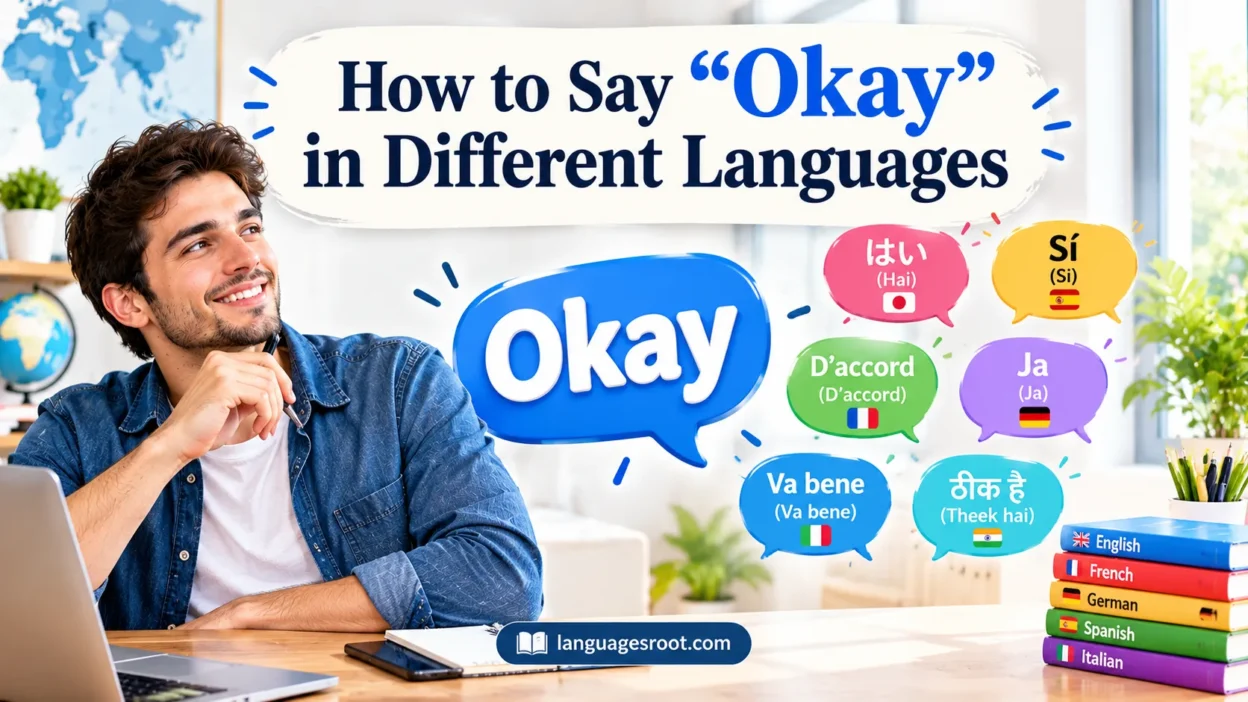
Knowing how to say okay in different languages makes daily communication easier. The word okay expresses agreement, acceptance, confirmation, and understanding in many situations. However, different cultures use unique native expressions and common expressions. Learning these okay translations helps you communicate naturally with people worldwide.
This translation guide explores over 100 languages, including European languages, Asian languages, African languages, and Middle Eastern languages. You will discover local equivalents, English meanings, pronunciation guidance, and example sentences for everyday use. Additionally, these multilingual phrases can help during international travel, language learning, and professional conversations. Explore natural ways to express agreement while respecting cultural differences.
Interesting Facts About Okay
- “Okay” has several meanings. Depending on the situation, it can communicate agreement, acceptance, understanding, reassurance, or an assessment that something is satisfactory.
- “OK” and “okay” are common written forms. Both are widely used in English, although individual style guides and contexts may prefer one spelling.
- Some languages borrow the English expression. In certain settings, speakers use a form of “OK” alongside expressions from their own language.
- Agreement is not always the same as understanding. A person may understand a message without agreeing with it, so the most suitable translation depends on the intended meaning.
- Tone can change the message. A warm “okay” may sound reassuring, while a short or flat response can sometimes seem reluctant or dismissive.
- Formal situations may call for different wording. A native expression meaning “understood,” “certainly,” or “that is acceptable” may sound more appropriate than a casual borrowed word.
- Writing systems affect pronunciation guides. Languages using Arabic, Cyrillic, Devanagari, or other scripts may need transliteration to help English readers pronounce their expressions.
What Does Okay Mean?
Global Word Explorer
Discover everyday English words and explore how people express them in languages around the world.
Translations in 8 Global Languages
Okay is an everyday expression that indicates that something is acceptable, understood, agreed upon, or satisfactory. Its precise meaning depends on the conversation.
Here are some common uses:
- Agreement: “Okay, let’s meet tomorrow.”
- Understanding: “Okay, I understand the instructions.”
- Acceptance: “Okay, I can work with that plan.”
- Reassurance: “Are you okay?” asks whether someone is well or safe.
- Satisfactory condition: “The food is okay” means it is acceptable, although it may not be excellent.
- Permission or confirmation: “Is it okay if I leave early?” asks whether an action is acceptable.
These meanings are related, but they are not interchangeable in every language. For instance, the expression used to agree to a meeting may not be the same one used to tell someone that you are feeling well.
In this article, the primary focus is “okay” as an everyday response expressing agreement, acknowledgment, or acceptance. Where a language uses different wording for these meanings, the table provides a practical expression and the example shows how it is used.
Why Can Okay Have Different Translations?
The word “okay” does not have one universal translation because it serves several conversational purposes. A direct equivalent may work when accepting a suggestion but sound unnatural when confirming that you understand instructions.
Several factors influence the most suitable expression:
- Context: Agreeing to a plan, acknowledging a message, and describing your health may require different words.
- Formality: Casual conversations often permit short expressions, while professional situations may call for a more explicit acknowledgment.
- Relationship: Friends may use borrowed words or informal expressions that are less suitable when speaking to a teacher, customer, or unfamiliar person.
- Regional variation: Speakers of the same language may prefer different expressions across countries and communities.
- Grammar and gender: Some languages change parts of an expression according to the speaker, listener, or grammatical structure.
- Literal versus natural translation: The best translation communicates the intended message rather than copying the English word mechanically.
- Spoken versus written language: A short response used in a text message may not be the best choice for a formal letter.
For the tables below, translations generally represent everyday agreement, acknowledgment, or acceptance. They are not intended as universal replacements for every meaning of “okay.”
European Languages
Europe has many languages with distinct ways of expressing agreement and acknowledgment. Some use a familiar form of “OK,” while others prefer native expressions meaning “all right,” “yes,” or “understood.” The examples below focus on practical, everyday conversation rather than formal dictionary equivalents.
| 🌍 Language | Country/Region | Translation | Pronunciation | Example sentence |
| 🇬🇧 English | UK and other English-speaking regions | Okay | oh-KAY | “Okay, I’ll see you tomorrow.” |
| 🇺🇸 American English | United States | Okay | oh-KAY | “Okay, that sounds good.” |
| 🇬🇧 British English | United Kingdom | All right / Okay | awl-RIGHT / oh-KAY | “All right, I’ll meet you there.” |
| 🇦🇺 Australian English | Australia | No worries / Okay | noh WUR-eez / oh-KAY | “No worries, I’ll take care of it.” |
| 🇪🇸 Spanish | Spain and Latin America | Está bien | es-TAH byen | “Está bien, nos vemos mañana.” (Okay, see you tomorrow.) |
| 🇫🇷 French | France and other French-speaking regions | D’accord | dah-KOR | “D’accord, je comprends.” (Okay, I understand.) |
| 🇩🇪 German | Germany, Austria, Switzerland | In Ordnung / Okay | in OR-doong / oh-KAY | “In Ordnung, ich komme mit.” (All right, I’ll come along.) |
| 🇮🇹 Italian | Italy and Italian-speaking regions | Va bene | vah BEH-neh | “Va bene, ci vediamo dopo.” (Okay, see you later.) |
| 🇵🇹 Portuguese | Portugal and Portuguese-speaking regions | Está bem | esh-TAH bayng | “Está bem, eu espero.” (Okay, I’ll wait.) |
| 🇳🇱 Dutch | Netherlands and Flanders | Oké / In orde | oh-KAY / in OR-duh | “Oké, ik begrijp het.” (Okay, I understand.) |
| 🇸🇪 Swedish | Sweden | Okej | oh-KAY | “Okej, vi ses senare.” (Okay, see you later.) |
| 🇳🇴 Norwegian | Norway | Greit | grite | “Greit, jeg blir med.” (Okay, I’ll come along.) |
| 🇩🇰 Danish | Denmark | Okay / I orden | oh-KAY / ee OR-den | “Okay, det gør vi.” (Okay, we’ll do that.) |
| 🇫🇮 Finnish | Finland | Selvä / Okei | SEL-vah / OH-kay | “Selvä, nähdään huomenna.” (Okay, see you tomorrow.) |
| 🇮🇸 Icelandic | Iceland | Allt í lagi | alt ee LAH-yee | “Allt í lagi, ég kem.” (Okay, I’ll come.) |
| 🇮🇪 Irish | Ireland | Ceart go leor | kyart guh lyor | “Ceart go leor, tuigim.” (Okay, I understand.) |
| 🏴 Welsh | Wales | Iawn | yown | “Iawn, gwela i ti yfory.” (Okay, I’ll see you tomorrow.) |
| 🇵🇱 Polish | Poland | Dobrze | DOB-zheh | “Dobrze, do zobaczenia.” (Okay, see you.) |
| 🇨🇿 Czech | Czechia | Dobře | DOH-bzheh | “Dobře, přijdu zítra.” (Okay, I’ll come tomorrow.) |
| 🇸🇰 Slovak | Slovakia | Dobre | DOH-breh | “Dobre, rozumiem.” (Okay, I understand.) |
| 🇺🇦 Ukrainian | Ukraine | Гаразд | hah-RAHZD | “Гаразд, побачимося завтра.” (Okay, see you tomorrow.) |
| 🇷🇺 Russian | Russia and Russian-speaking communities | Хорошо | khuh-rah-SHOH | “Хорошо, я согласен.” (Okay, I agree.) |
| 🇷🇴 Romanian | Romania and Moldova | Bine | BEE-neh | “Bine, ne vedem mâine.” (Okay, see you tomorrow.) |
| 🇭🇺 Hungarian | Hungary | Rendben | REND-ben | “Rendben, ott találkozunk.” (Okay, we’ll meet there.) |
| 🇬🇷 Greek | Greece and Cyprus | Εντάξει | en-DAH-ksee | “Εντάξει, θα έρθω.” (Okay, I’ll come.) |
| 🇧🇬 Bulgarian | Bulgaria | Добре | doh-BREH | “Добре, ще дойда.” (Okay, I’ll come.) |
| 🇭🇷 Croatian | Croatia | U redu | oo REH-doo | “U redu, vidimo se sutra.” (Okay, see you tomorrow.) |
| 🇷🇸 Serbian | Serbia and Serbian-speaking communities | У реду | oo REH-doo | “У реду, разумем.” (Okay, I understand.) |
| 🇸🇮 Slovenian | Slovenia | V redu | vuh REH-doo | “V redu, pridem jutri.” (Okay, I’ll come tomorrow.) |
| 🇱🇹 Lithuanian | Lithuania | Gerai | geh-RYE | “Gerai, susitiksime rytoj.” (Okay, we’ll meet tomorrow.) |
| 🇱🇻 Latvian | Latvia | Labi | LAH-bee | “Labi, aizejam.” (Okay, let’s go.) |
| 🇪🇪 Estonian | Estonia | Hästi / Olgu | HES-tee / OHL-goo | “Olgu, es tulen.” (Okay, I’ll come.) |
English varieties: what changes?
American, British, and Australian English share the word “okay.” There is no need to learn a different translation for each variety. Differences are more noticeable in accent, conversational habits, and alternative expressions. For example, “no worries” is a familiar casual response in Australia and is also used elsewhere, but it does not replace “okay” in every situation.
Cultural notes
In several European languages, a native expression such as va bene, d’accord, in Ordnung, or está bien can sound more natural than a literal translation. The appropriate choice depends on what the speaker is accepting or acknowledging. Some expressions also carry a stronger sense of confirmation than a neutral “okay.”
Asian Languages
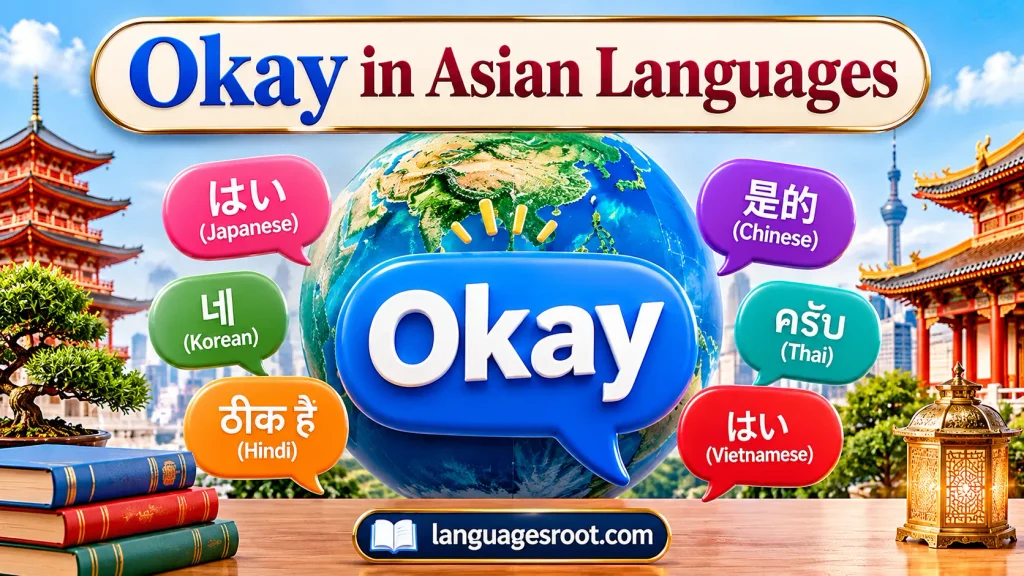
Asia contains many language families and writing systems, from tonal languages to languages with complex systems of honorifics. Everyday expressions of agreement can vary according to age, formality, and the relationship between speakers. The following translations offer useful starting points for common conversations.
| 🌍 Language | Country/Region | Translation | Pronunciation | Example sentence |
| 🇨🇳 Mandarin Chinese | China, Taiwan, Singapore | 好的 | hǎo de | “好的,我们明天见。” (Okay, see you tomorrow.) |
| 🇭🇰 Cantonese | Hong Kong and Guangdong | 好啊 | hou2 aa3 | “好啊,我哋聽日見。” (Okay, see you tomorrow.) |
| 🇯🇵 Japanese | Japan | わかりました | wa-ka-ri-ma-shi-ta | “わかりました。あとで連絡します。” (Okay, I’ll contact you later.) |
| 🇰🇷 Korean | South Korea and Korean-speaking communities | 알겠어요 | al-ge-sseo-yo | “알겠어요. 내일 만나요.” (Okay, see you tomorrow.) |
| 🇮🇳 Hindi | India | ठीक है | ṭhīk hai | “ठीक है, मैं आ जाऊँगा।” (Okay, I’ll come.) |
| 🇵🇰 Urdu | Pakistan and Urdu-speaking communities | ٹھیک ہے | ṭhīk hai | “ٹھیک ہے، میں کل آؤں گا۔” (Okay, I’ll come tomorrow.) |
| 🇧🇩 Bengali | Bangladesh and eastern India | ঠিক আছে | ṭhik achhe | “ঠিক আছে, কাল দেখা হবে।” (Okay, see you tomorrow.) |
| 🇮🇳 Punjabi | Punjab in India and Pakistan | ਠੀਕ ਹੈ / ٹھیک اے | ṭhīk hai / ṭhīk ae | “ਠੀਕ ਹੈ, ਫਿਰ ਮਿਲਦੇ ਹਾਂ।” (Okay, see you later.) |
| 🇮🇳 Gujarati | Gujarat, India | ઠીક છે | ṭhīk chhe | “ઠીક છે, હું આવીશ.” (Okay, I’ll come.) |
| 🇮🇳 Marathi | Maharashtra, India | ठीक आहे | ṭhīk āhe | “ठीक आहे, आपण उद्या भेटू.” (Okay, we’ll meet tomorrow.) |
| 🇮🇳 Tamil | Tamil Nadu, India and Sri Lanka | சரி | sa-ri | “சரி, நாளை சந்திப்போம்.” (Okay, let’s meet tomorrow.) |
| 🇮🇳 Telugu | Andhra Pradesh and Telangana, India | సరే | sa-rē | “సరే, రేపు కలుద్దాం.” (Okay, let’s meet tomorrow.) |
| 🇮🇳 Kannada | Karnataka, India | ಸರಿ | sa-ri | “ಸರಿ, ನಾಳೆ ಭೇಟಿಯಾಗೋಣ.” (Okay, let’s meet tomorrow.) |
| 🇮🇳 Malayalam | Kerala, India | ശരി | sha-ri | “ശരി, നാളെ കാണാം.” (Okay, see you tomorrow.) |
| 🇳🇵 Nepali | Nepal | ठीक छ | ṭhīk chha | “ठीक छ, भोलि भेटौँला।” (Okay, see you tomorrow.) |
| 🇱🇰 Sinhala | Sri Lanka | හරි | ha-ri | “හරි, හෙට හමුවෙමු.” (Okay, let’s meet tomorrow.) |
| 🇹🇭 Thai | Thailand | ได้ / โอเค | dâi / oh-kay | “โอเค แล้วเจอกันพรุ่งนี้” (Okay, see you tomorrow.) |
| 🇻🇳 Vietnamese | Vietnam | Được / Được rồi | dược / dược zồi | “Được rồi, mai gặp nhé.” (Okay, see you tomorrow.) |
| 🇮🇩 Indonesian | Indonesia | Oke / Baik | oh-keh / bye-eek | “Oke, sampai besok.” (Okay, see you tomorrow.) |
| 🇲🇾 Malay | Malaysia and Brunei | Baik / Okey | bye-eek / oh-kay | “Baik, kita jumpa esok.” (Okay, see you tomorrow.) |
| 🇵🇭 Filipino/Tagalog | Philippines | Sige / Okay | SEE-geh / oh-KAY | “Sige, magkita tayo bukas.” (Okay, let’s meet tomorrow.) |
| 🇲🇲 Burmese | Myanmar | ဟုတ်ကဲ့ | hoʊʔ kɛ̰ | “ဟုတ်ကဲ့၊ နားလည်ပါပြီ။” (Okay, I understand.) |
| 🇰🇭 Khmer | Cambodia | បាន / ចាស | baan / chaas | “បាន ខ្ញុំនឹងလာ។” (Okay, I’ll come.) |
| 🇱🇦 Lao | Laos | ໂອເຄ / ໄດ້ | oh-kay / dai | “ໂອເຄ, ພົບກັນມື້ອື່ນ.” (Okay, see you tomorrow.) |
| 🇲🇳 Mongolian | Mongolia | За | zah | “За, маргааш уулзъя.” (Okay, let’s meet tomorrow.) |
| 🇰🇿 Kazakh | Kazakhstan | Жарайды | zhah-RAI-dih | “Жарайды, ертең кездесеміз.” (Okay, see you tomorrow.) |
| 🇺🇿 Uzbek | Uzbekistan | Mayli | my-LEE | “Mayli, ertaga ko‘rishamiz.” (Okay, see you tomorrow.) |
| 🇹🇷 Turkish | Türkiye and Turkish-speaking communities | Tamam | tah-MAHM | “Tamam, yarın görüşürüz.” (Okay, see you tomorrow.) |
Cultural notes
In Japanese and Korean, the choice of expression can reflect politeness and social relationships. For example, Japanese わかりました and Korean 알겠어요 can acknowledge that a message has been understood, not simply that the speaker agrees with it. In Mandarin, 好的 is a common acknowledgment, while 可以 may be more appropriate when granting permission or saying something is possible.
In South and Southeast Asian languages, expressions such as Hindi and Urdu ठीक है / ٹھیک ہے, Tamil சரி, and Filipino sige are useful in everyday settings. However, pronunciation, honorifics, and local speech habits still matter. When speaking with someone you do not know well, listen to how they respond and follow the appropriate level of politeness.
African Languages
Africa is home to a remarkable range of languages, including Bantu, Semitic, Cushitic, and Niger-Congo languages. Expressions used to agree or acknowledge information differ across communities, even within the same country. These examples represent selected languages and regions rather than the continent as a whole.
| 🌍 Language | Country/Region | Translation | Pronunciation | Example sentence |
| 🇰🇪 Swahili | Tanzania, Kenya, and East Africa | Sawa | SAH-wah | “Sawa, tutaonana kesho.” (Okay, see you tomorrow.) |
| 🇿🇦 Afrikaans | South Africa and Namibia | Goed / Reg so | khoot / rekh soh | “Goed, ek verstaan.” (Okay, I understand.) |
| 🇿🇦 Zulu | South Africa | Kulungile | koo-loo-NGEE-leh | “Kulungile, ngizofika kusasa.” (Okay, I’ll arrive tomorrow.) |
| 🇿🇦 Xhosa | South Africa | Kulungile | koo-loo-NGEE-leh | “Kulungile, ndiza kubuya.” (Okay, I’ll return.) |
| 🇪🇹 Amharic | Ethiopia | እሺ | ə-shə | “እሺ፣ እንገናኝ ነገ።” (Okay, let’s meet tomorrow.) |
| 🇳🇬 Yoruba | Nigeria and Yoruba-speaking communities | Ó dáa | aw DAH | “Ó dáa, màá wá lọ́la.” (Okay, I’ll come tomorrow.) |
| 🇳🇬 Igbo | Nigeria | Ọ dị mma | aw dee mah | “Ọ dị mma, aga m abịa echi.” (Okay, I’ll come tomorrow.) |
| 🇳🇬 Hausa | Nigeria, Niger, and West Africa | To | toh | “To, sai gobe.” (Okay, see you tomorrow.) |
| 🇸🇴 Somali | Somalia and the Horn of Africa | Hagaag | hah-GAHG | “Hagaag, berri ayaan is arki doonnaa.” (Okay, we’ll see each other tomorrow.) |
| 🇿🇼 Shona | Zimbabwe | Zvakanaka | zvah-kah-NAH-kah | “Zvakanaka, tichaonana mangwana.” (Okay, see you tomorrow.) |
| 🇱🇸 Sesotho | Lesotho and South Africa | Ho lokile | hoh loh-KEE-leh | “Ho lokile, ke tla tla hosane.” (Okay, I’ll come tomorrow.) |
| 🇧🇼 Setswana | Botswana and South Africa | Go siame | go see-AH-meh | “Go siame, re tla bonana kamoso.” (Okay, see you tomorrow.) |
| 🇷🇼 Kinyarwanda | Rwanda | Ni byiza | nee BYEE-zah | “Ni byiza, tuzabonana ejo.” (Okay, we’ll see each other tomorrow.) |
| 🇲🇬 Malagasy | Madagascar | Eny ary | EH-nee AH-ree | “Eny ary, hihaona rahampitso.” (Okay, see you tomorrow.) |
Cultural notes
Expressions such as Swahili sawa, Yoruba ó dáa, and Amharic እሺ can be useful in ordinary conversation, but their precise meanings depend on context. For example, an expression that means “fine” or “good” may also serve as a response of agreement.
Pronunciation note: Some African languages use sounds that do not have exact English equivalents. The pronunciation guides above are approximate aids, not substitutes for listening to fluent speakers.
Middle Eastern Languages
The Middle East includes several distinct language traditions, with Arabic, Persian, Kurdish, and Turkish among the languages spoken across the region. The best expression for “okay” may differ between formal writing, everyday conversation, and local dialects. The Arabic example below uses Modern Standard Arabic, while the notes explain why regional speech may differ.
| 🌍 Language | Country/Region | Translation | Pronunciation | Example sentence |
| 🇵🇸 Arabic (Modern Standard Arabic) | Palestine and Arabic-speaking regions | حسنًا | ḥasanan | “حسنًا، سأراك غدًا.” (Okay, I’ll see you tomorrow.) |
| 🇮🇷 Persian (Farsi) | Iran and Persian-speaking communities | باشه | bâshe | “باشه، فردا میبینمت.” (Okay, I’ll see you tomorrow.) |
| 🇮🇶 Kurdish (Sorani) | Iraqi Kurdistan and Kurdish-speaking communities | باشە | bâsha | “باشە، سبەینێ دەبینمت.” (Okay, I’ll see you tomorrow.) |
| 🇹🇷 Turkish | Türkiye and Turkish-speaking communities | Tamam | tah-MAHM | “Tamam, seni sonra ararım.” (Okay, I’ll call you later.) |
| 🇦🇲 Armenian | Armenia and Armenian-speaking communities | Լավ | lav | “Լավ, վաղը կհանդիպենք։” (Okay, we’ll meet tomorrow.) |
Cultural notes
Arabic varies considerably by region. Modern Standard Arabic is useful in formal writing and broadly understood contexts, while colloquial expressions differ among Palestinian, Levantine, Egyptian, Gulf, and other varieties. In Palestinian Arabic, تمام (tamām, roughly “fine” or “all right”) and ماشي (māshi, roughly “okay” or “all right” in many contexts) are common conversational options, although their suitability depends on the situation.
Persian باشه (bâshe) is conversational and informal. Kurdish also has regional varieties, so the Sorani example should not be assumed to represent every Kurdish-speaking community. Turkish tamam is widely used in everyday speech, while Armenian լավ means “good” and can function as “okay” in context.
Keep Reading: How to Say Peace in Different Languages
Other World Languages

Several useful expressions come from languages spoken across Oceania, the Americas, and international language communities. These examples extend the list beyond the major regional groups while preserving the focus on everyday agreement and acknowledgment.
| 🌍 Language | Country/Region | Translation | Pronunciation | Example sentence |
| 🇳🇿 Māori | New Zealand | Ka pai | kah PYE | “Ka pai, ka kite āpōpō.” (Okay, see you tomorrow.) |
| 🇼🇸 Samoan | Samoa and Samoan-speaking communities | Ua lelei | oo-ah leh-LEH-ee | “Ua lelei, tatou feiloaʻi taeao.” (Okay, let’s meet tomorrow.) |
| 🇹🇴 Tongan | Tonga | Sai pē | sigh peh | “Sai pē, te tau feʻiloaki ʻapongipongi.” (Okay, we’ll meet tomorrow.) |
| 🇺🇸 Hawaiian | Hawaiʻi | ʻAe / Maikaʻi | eye / my-KAH-ee | “ʻAe, e ʻike kāua i ka lā ʻapōpō.” (Okay, we’ll see each other tomorrow.) |
| 🇵🇪 Quechua | Andean regions of Peru and neighboring countries | Arí | ah-REE | “Arí, paqarin tinkusun.” (Okay, let’s meet tomorrow.) |
| 🇵🇾 Guarani | Paraguay and neighboring regions | Toĩ | toh-EE | “Toĩ, ko’ẽrõ jajotopáta.” (Okay, we’ll meet tomorrow.) |
| 🇭🇹 Haitian Creole | Haiti and Haitian communities | Dakò | dah-KOH | “Dakò, n a wè demen.” (Okay, see you tomorrow.) |
| 🌐 Esperanto | International constructed language | Bone / En ordo | BOH-neh / en OR-doh | “Bone, ni renkontiĝos morgaŭ.” (Okay, we’ll meet tomorrow.) |
Cultural notes
In Māori, ka pai often means “good” or “well done,” and its appropriateness as “okay” depends on context. In Hawaiian, ʻae means “yes,” while maikaʻi means “good”; neither replaces every use of English “okay.” Quechua has multiple regional varieties, so vocabulary and spelling may vary. These distinctions are important when using expressions in real conversations.
Quick Reference: Okay in Different Languages
Use this compact table to find a common expression quickly. The translations are practical equivalents for acknowledgment or acceptance, not universal substitutes for every meaning of “okay.”
| Language | Translation |
| English | Okay |
| American English | Okay |
| British English | All right / Okay |
| Australian English | No worries / Okay |
| Spanish | Está bien |
| French | D’accord |
| German | In Ordnung |
| Italian | Va bene |
| Portuguese | Está bem |
| Dutch | Oké |
| Swedish | Okej |
| Norwegian | Greit |
| Danish | Okay |
| Finnish | Selvä |
| Icelandic | Allt í lagi |
| Irish | Ceart go leor |
| Welsh | Iawn |
| Polish | Dobrze |
| Czech | Dobře |
| Slovak | Dobre |
| Ukrainian | Гаразд |
| Russian | Хорошо |
| Romanian | Bine |
| Hungarian | Rendben |
| Greek | Εντάξει |
| Bulgarian | Добре |
| Croatian | U redu |
| Serbian | У реду |
| Slovenian | V redu |
| Lithuanian | Gerai |
| Latvian | Labi |
| Estonian | Olgu |
| Mandarin Chinese | 好的 |
| Cantonese | 好啊 |
| Japanese | わかりました |
| Korean | 알겠어요 |
| Hindi | ठीक है |
| Urdu | ٹھیک ہے |
| Bengali | ঠিক আছে |
| Punjabi | ਠੀਕ ਹੈ |
| Gujarati | ઠીક છે |
| Marathi | ठीक आहे |
| Tamil | சரி |
| Telugu | సరే |
| Kannada | ಸರಿ |
| Malayalam | ശരി |
| Nepali | ठीक छ |
| Sinhala | හරි |
| Thai | โอเค |
| Vietnamese | Được rồi |
| Indonesian | Oke |
| Malay | Baik |
| Filipino/Tagalog | Sige |
| Burmese | ဟုတ်ကဲ့ |
| Khmer | បាន |
| Lao | ໂອເຄ |
| Mongolian | За |
| Kazakh | Жарайды |
| Uzbek | Mayli |
| Turkish | Tamam |
| Swahili | Sawa |
| Afrikaans | Goed |
| Zulu | Kulungile |
| Xhosa | Kulungile |
| Amharic | እሺ |
| Yoruba | Ó dáa |
| Igbo | Ọ dị mma |
| Hausa | To |
| Somali | Hagaag |
| Shona | Zvakanaka |
| Sesotho | Ho lokile |
| Setswana | Go siame |
| Kinyarwanda | Ni byiza |
| Malagasy | Eny ary |
| Arabic (Modern Standard Arabic) | حسنًا |
| Persian | باشه |
| Kurdish (Sorani) | باشە |
| Armenian | Լավ |
| Māori | Ka pai |
| Samoan | Ua lelei |
| Tongan | Sai pē |
| Hawaiian | ʻAe |
| Quechua | Arí |
| Guarani | Toĩ |
| Haitian Creole | Dakò |
| Esperanto | Bone |
How to Choose the Right Translation
The best translation of “okay” depends on what you want to communicate, whom you are speaking to, and the situation. Before choosing an expression, consider these practical points:
- Identify your meaning. If you are agreeing to a suggestion, choose a natural expression of agreement. If you are confirming instructions, use a phrase that communicates understanding.
- Consider formality. A casual borrowed word may work with friends, while a more polite expression may be preferable in professional conversations.
- Check regional usage. Spanish, Arabic, Portuguese, and other widely spoken languages have regional variations. A phrase familiar in one community may be less natural in another.
- Pay attention to pronunciation. Learn the sounds and stress patterns instead of relying entirely on English spelling.
- Observe the conversation. Notice whether speakers use short responses, complete phrases, or polite acknowledgments.
- Use the right writing system. When possible, learn the original script alongside the romanized pronunciation.
For important conversations, verify unfamiliar expressions with a reliable dictionary, language teacher, or fluent speaker familiar with your intended region.
Keep Reading:Big Sister in 100+ Global Languages: Translations & Pronunciation
Common Mistakes When Translating Okay
Even a short word can create misunderstandings when translated without context. These are some common mistakes to avoid.
- Translating every meaning identically: “Okay” can mean agreement, acknowledgment, or satisfactory condition. One expression may not cover all three.
- Relying only on word-for-word translation: A phrase that looks correct in a dictionary may sound unnatural in everyday speech.
- Ignoring formality: Some expressions are casual, while others communicate respect or a more formal acknowledgment.
- Mixing regional varieties: A phrase from one dialect may not be the most natural choice in another community.
- Overlooking grammatical details: Gender, honorifics, and sentence structure can affect how an expression is formed in certain languages.
- Using misleading pronunciation guides: English approximations cannot always represent sounds accurately, particularly in tonal languages.
- Confusing agreement with understanding: Saying “I understand” does not necessarily mean “I agree.”
- Assuming borrowed words work everywhere: Although “OK” is recognized in many places, local expressions may sound more natural in particular situations.
The safest approach is to learn the expression together with a short, realistic example sentence.
Why Learn Okay in Different Languages?
Learning how to say “okay” in different languages is a practical way to develop conversational confidence. Because the expression appears in everyday exchanges, it offers a useful opportunity to practice vocabulary, pronunciation, listening, and cultural awareness.
For travelers, knowing a local equivalent can make simple interactions easier, from confirming arrangements to acknowledging directions. Language learners can use these expressions to understand how different languages communicate agreement and acceptance. They can also compare sentence structure, writing systems, and pronunciation across language families.
These expressions are useful in messages, classroom discussions, international friendships, and professional communication. However, knowing the word alone is not enough. Understanding its tone and context helps you avoid accidental misunderstandings.
Learning short expressions also encourages curiosity about how other people communicate. Rather than assuming every language follows English conventions, you begin to notice the different ways people express the same idea. That awareness can make conversations more thoughtful and respectful.
Frequently Asked Questions
How do you say okay in different languages?
Common translations include Spanish está bien, French d’accord, German in Ordnung, Italian va bene, and Urdu ٹھیک ہے. Each expression helps communicate agreement, acceptance, or understanding in everyday conversations.
Does okay mean the same thing in every language?
No. The meaning depends on context, cultural differences, and regional expressions. Some translations express agreement, while others communicate acknowledgment or confirmation.
Is okay used as a borrowed word in other languages?
Yes. Many languages use OK or adapted forms like okey and oké. However, native expressions may sound more natural in certain situations.
Conclusion
Learning how to say okay in different languages helps you express agreement, acceptance, and understanding across cultures. Explore these okay translations, practice their pronunciation, and use the example sentences to communicate more naturally. However, always consider context, regional variations, and cultural differences to choose the right expression for every conversation.
How Did You Like This Article?
Share your feedback with a simple reaction.

Mafia Mukhtar is a passionate language enthusiast and experienced writer with multiple years of experience exploring global languages, vocabulary, and communication. Through her work at LanguagesRoot.com, she makes language learning more approachable, enjoyable, and meaningful for readers from different backgrounds. She enjoys sharing practical language insights that help people communicate with confidence. Explore LanguagesRoot.com for more language inspiration, helpful resources, and engaging learning content.