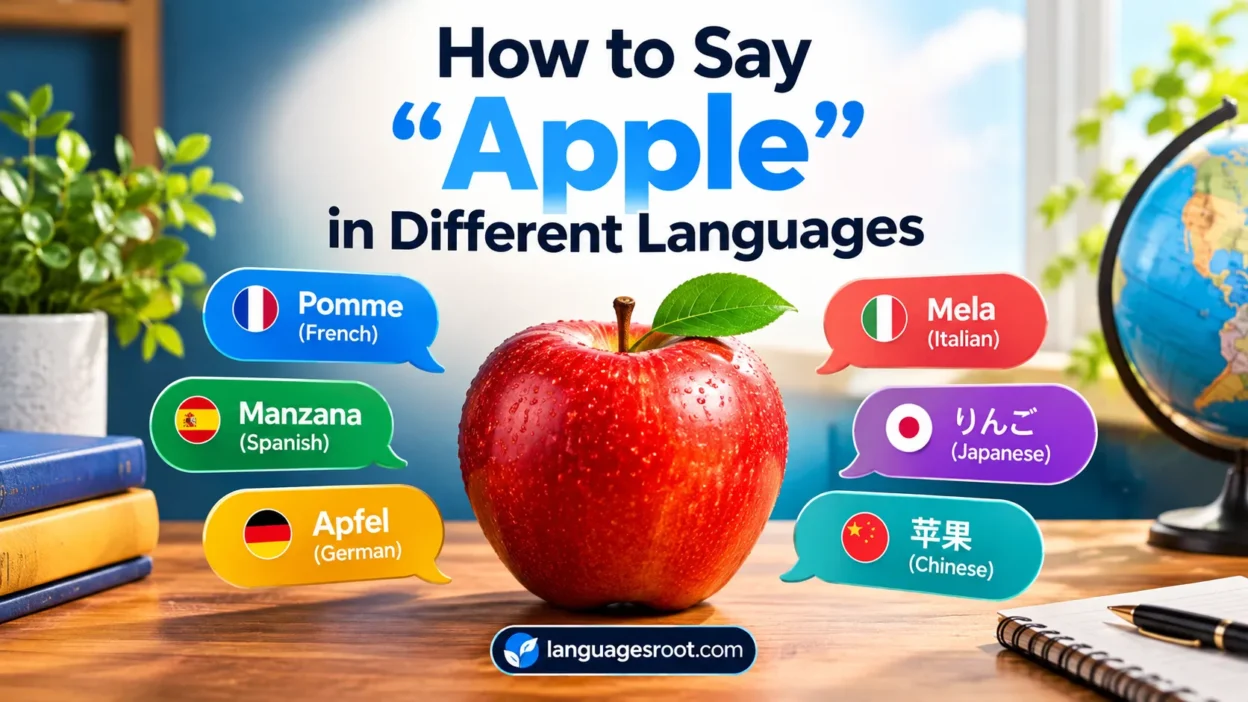
Learning the word apple in different languages can expand your everyday vocabulary. This simple fruit has a rich culture and language history across the world. For example, apple in English is apple, while French uses pomme and Spanish uses manzana. German says Apfel, while Japanese uses ringo in everyday speech.
Exploring the local word for apple also helps you understand language, pronunciation, and cultural use. Moreover, these translations can support learning any language, especially through example sentences and simplified pronunciations. Whether you are traveling, studying a language, or teaching children, familiar words build confidence. This guide explores apple vocabulary across world languages with clear meanings and practical usage.
Interesting Facts About Apple
- The scientific name of the commonly cultivated apple is Malus domestica.
- Apples can have red, green, yellow, or combinations of these skin colors.
- The English word “apple” comes through Middle English appel from Old English æppel.
- Old English æppel could refer to fruit more generally, not only the modern apple.
- The word “apple” has related forms in several Germanic languages, including German Apfel and Dutch appel.
- French uses pomme for an apple.
- Spanish uses manzana.
- Italian uses mela.
- Portuguese uses maçã.
- German uses Apfel.
- Dutch uses appel.
- Finnish uses omena.
- Swedish uses äpple.
- Danish uses æble.
- Norwegian uses eple.
- Mandarin Chinese uses 苹果 (píngguǒ).
- Japanese commonly uses りんご (ringo).
- Korean uses 사과 (sagwa).
- Hindi uses सेब (seb).
- Urdu uses سیب (seb).
- Arabic commonly uses تُفَّاحَة (tuffāḥa) for a single apple and تُفَّاح (tuffāḥ) collectively.
- Apples are often associated with teachers and education in English-speaking cultures.
- “Big Apple” is a well-known nickname for New York City.
- The expression “an apple a day keeps the doctor away” is a famous English proverb.
- Apple vocabulary differs considerably between languages, while some languages use words that are historically related.
- In some languages, the same word may have dialectal or regional alternatives.
- Pronunciation can vary between regions even when the written word remains the same.
- Some languages borrow or adapt the English word “apple,” especially in contexts involving modern products or technology.
- The fruit should not be confused with Apple, the name of the technology company.
European Languages
Europe contains hundreds of languages and many distinct language families. The word for apple shows interesting historical relationships across Germanic, Romance, Slavic, Baltic, and other languages. Some European forms look similar, such as German Apfel and Dutch appel, while others, such as Finnish omena, look completely different. The translations below focus on commonly recognized forms used for the fruit.
| Language | Country/Region | Translation | Pronunciation | Synonyms or Related Words | Example Sentence |
| 🇬🇧 English | United Kingdom, USA, Australia | apple | AP-uhl | fruit | I ate an apple. |
| 🇫🇷 French | France, Belgium, Canada | pomme | pom | fruit | Je mange une pomme. |
| 🇪🇸 Spanish | Spain, Latin America | manzana | man-SAH-nah | fruta | Como una manzana. |
| 🇩🇪 German | Germany, Austria | Apfel | AP-fel | Obst | Ich esse einen Apfel. |
| 🇮🇹 Italian | Italy | mela | MEH-lah | frutto | Mangio una mela. |
| 🇵🇹 Portuguese | Portugal, Brazil | maçã | mah-SAH | fruta | Eu como uma maçã. |
| 🇳🇱 Dutch | Netherlands, Belgium | appel | AH-pel | fruit | Ik eet een appel. |
| 🇸🇪 Swedish | Sweden | äpple | EP-pleh | frukt | Jag äter ett äpple. |
| 🇩🇰 Danish | Denmark | æble | EH-bleh | frugt | Jeg spiser et æble. |
| 🇳🇴 Norwegian | Norway | eple | EH-pleh | frukt | Jeg spiser et eple. |
| 🇫🇮 Finnish | Finland | omena | OH-meh-nah | hedelmä | Syön omenan. |
| 🇮🇸 Icelandic | Iceland | epli | EP-li | ávöxtur | Ég borða epli. |
| 🇮🇪 Irish | Ireland | úll | ool | torthaí | Ithim úll. |
| 🏴 Welsh | Wales | afal | AH-val | ffrwyth | Rwy’n bwyta afal. |
| 🇵🇱 Polish | Poland | jabłko | YAB-koh | owoc | Jem jabłko. |
| 🇨🇿 Czech | Czech Republic | jablko | YABLK-oh | ovoce | Jím jablko. |
| 🇸🇰 Slovak | Slovakia | jablko | YABLK-oh | ovocie | Jem jablko. |
| 🇺🇦 Ukrainian | Ukraine | яблуко | YAB-loo-koh | фрукт | Я їм яблуко. |
| 🇷🇺 Russian | Russia | яблоко | YAB-luh-kuh | фрукт | Я ем яблоко. |
| 🇧🇾 Belarusian | Belarus | яблык | YAB-lik | fruit | Я ем яблык. |
| 🇧🇬 Bulgarian | Bulgaria | ябълка | YAB-ul-kah | плод | Ям ябълка. |
| 🇷🇸 Serbian | Serbia | jabuka / јабука | YAH-boo-kah | voće | Једем јабуку. |
| 🇭🇷 Croatian | Croatia | jabuka | YAH-boo-kah | voće | Jedem jabuku. |
| 🇸🇮 Slovenian | Slovenia | jabolko | YAH-bol-koh | sadje | Jem jabolko. |
| 🇧🇦 Bosnian | Bosnia and Herzegovina | jabuka | YAH-boo-kah | voće | Jedem jabuku. |
| 🇷🇴 Romanian | Romania | măr | muhr | fruct | Mănânc un măr. |
| 🇬🇷 Greek | Greece | μήλο | MEE-lo | φρούτο | Τρώω ένα μήλο. |
| 🇭🇺 Hungarian | Hungary | alma | AHL-mah | gyümölcs | Eszem egy almát. |
| 🇪🇪 Estonian | Estonia | õun | oon | puuvili | Ma söön õuna. |
| 🇱🇹 Lithuanian | Lithuania | obuolys | oh-boo-OH-lis | vaisius | Aš valgau obuolį. |
| 🇱🇻 Latvian | Latvia | ābols | AH-bols | auglis | Es ēdu ābolu. |
| 🇦🇱 Albanian | Albania, Kosovo | mollë | MOL-uh | frut | Unë ha një mollë. |
| 🇦🇲 Armenian | Armenia | խնձոր | KHUN-dzor | միրգ | Ես խնձոր եմ ուտում։ |
| 🇬🇪 Georgian | Georgia | ვაშლი | VASH-li | ხილი | მე ვაშლს ვჭამ. |
| 🇪🇸 Catalan | Catalonia, Spain | poma | POH-mah | fruita | Menjo una poma. |
| 🇬🇦 Galician | Galicia, Spain | mazá | mah-SAH | froita | Como unha mazá. |
| 🇪🇺 Basque | Basque Country | sagar | sah-GAR | fruta | Sagar bat jaten dut. |
| 🇪🇸 Esperanto | International | pomo | POH-mo | frukto | Mi manĝas pomon. |
Many of these forms are supported by established dictionary and multilingual references. For example, Cambridge lists pomme, manzana, maçã, Apfel, mela, 苹果, りんご, सेब, سیب, яблуко, and other common forms.
American English
In American English, the standard word is apple, pronounced approximately AP-uhl. The plural is apples. Americans may also use expressions such as “apple pie,” “apple tree,” “green apple,” and “red apple.”
Example: I bought a fresh apple from the market.
British English
British English also uses apple, with a pronunciation very similar to American English, although vowel sounds can vary by regional accent.
Example: She packed an apple for lunch.
Australian English
Australian English also uses apple. Antipodean pronunciation generally follows English varieties used in Australia, although individual regional accents can differ.
Example: I grabbed an apple before heading to work.
Asian Languages
Asia is home to thousands of languages, including major language families such as Indo-European, Sino-Tibetan, Japonic, Koreanic, Dravidian, Turkic, and Austronesian languages. Apple vocabulary is especially interesting here because some languages use native words while others have adapted forms influenced by foreign languages. Chinese, Japanese, Korean, Hindi, Bengali, Tamil, Thai, and Indonesian all have distinct ways of naming this familiar fruit.
Also Read: How to Say “Autumn” in Different Languages
| Language | Country/Region | Translation | Pronunciation | Synonyms or Related Words | Example Sentence |
| 🇨🇳 Mandarin Chinese | China, Taiwan | 苹果 | píngguǒ | 水果 | 我吃一个苹果。 |
| 🇭🇰 Cantonese | Hong Kong, Guangdong | 蘋果 | ping-gwoh | fruit | 我食一個蘋果。 |
| 🇯🇵 Japanese | Japan | りんご / 林檎 | RING-oh | 果物 | りんごを食べます。 |
| 🇰🇷 Korean | South Korea | 사과 | sah-gwah | 과일 | 사과를 먹어요. |
| 🇮🇳 Hindi | India | सेब | seb | फल | मैं सेब खाता हूँ। |
| 🇵🇰 Urdu | Pakistan, India | سیب | seb | پھل | میں سیب کھاتا ہوں۔ |
| 🇮🇳 Bengali | Bangladesh, India | আপেল | AH-pel | ফল | আমি আপেল খাই। |
| 🇮🇳 Punjabi | India, Pakistan | ਸੇਬ / سیب | seb | fruit | ਮੈਂ ਸੇਬ ਖਾਂਦਾ ਹਾਂ۔ |
| 🇮🇳 Gujarati | India | સફરજન | sa-far-jan | ફળ | હું સફરજન ખાઉં છું. |
| 🇮🇳 Marathi | India | सफरचंद | sa-far-chand | फळ | मी सफरचंद खातो. |
| 🇮🇳 Nepali | Nepal | स्याउ | syau | फल | म स्याउ खान्छु। |
| 🇮🇳 Assamese | India | আপেল | AH-pel | ফল | মই আপেল খাওঁ। |
| 🇮🇳 Tamil | India, Sri Lanka | ஆப்பிள் | AAP-pil | பழம் | நான் ஆப்பிள் சாப்பிடுகிறேன். |
| 🇮🇳 Telugu | India | ఆపిల్ | AA-pil | పండు | నేను ఆపిల్ తింటాను. |
| 🇮🇳 Kannada | India | ಸೇಬು | SAY-boo | ಹಣ್ಣು | ನಾನು ಸೇಬು ತಿನ್ನುತ್ತೇನೆ. |
| 🇮🇳 Malayalam | India | ആപ്പിൾ | AAP-pil | പഴം | ഞാൻ ആപ്പിൾ കഴിക്കുന്നു. |
| 🇹🇭 Thai | Thailand | แอปเปิล | ep-pə̂n | ผลไม้ | ฉันกินแอปเปิล |
| 🇻🇳 Vietnamese | Vietnam | quả táo | kwah TAOW | trái cây | Tôi ăn một quả táo. |
| 🇮🇩 Indonesian | Indonesia | apel | AH-pel | buah | Saya makan apel. |
| 🇲🇾 Malay | Malaysia, Brunei | epal | EH-pal | buah | Saya makan epal. |
| 🇵🇭 Filipino | Philippines | mansanas | man-SAH-nas | prutas | Kumakain ako ng mansanas. |
| 🇱🇰 Sinhala | Sri Lanka | ඇපල් | EP-al | fruit | මම ඇපල් කනවා. |
| 🇲🇳 Mongolian | Mongolia | алим | AH-lim | жимс | Би алим иддэг. |
| 🇰🇿 Kazakh | Kazakhstan | алма | AL-mah | жеміс | Мен алма жеймін. |
| 🇺🇿 Uzbek | Uzbekistan | olma | OL-mah | meva | Men olma yeyman. |
| 🇦🇿 Azerbaijani | Azerbaijan | alma | AL-mah | meyvə | Mən alma yeyirəm. |
| 🇹🇷 Turkish | Turkey | elma | EL-mah | meyve | Bir elma yiyorum. |
| 🇦🇫 Pashto | Afghanistan | مڼه | MAN-ah | fruit | زه یوه مڼه خورم. |
| 🇹🇯 Tajik | Tajikistan | себ | seb | мева | Ман себ мехӯрам. |
| 🇰🇬 Kyrgyz | Kyrgyzstan | алма | al-MAH | жемиш | Мен алма жейм. |
| 🇦🇲 Armenian | Armenia | խնձոր | KHUN-dzor | միրգ | Ես խնձոր եմ ուտում։ |
Reference sources confirm, among others, Mandarin 苹果, Japanese りんご, Thai แอปเปิ้ล, Tamil ஆப்பிள், Telugu ఆపిల్, Hindi सेब, and Urdu سیب as forms used for apple.
One interesting pattern is that several South Asian languages use words that sound like adaptations of “apple,” while others have their own traditional vocabulary. Tamil, Telugu, and Malayalam, for example, commonly use adapted forms written in their respective scripts.
African Languages
Africa has enormous linguistic diversity, with thousands of languages spoken across the continent. Apple vocabulary can vary significantly because apples are not equally traditional or common in every region. Some languages have established native terms, while others use adapted forms borrowed through neighboring languages or international trade.
| Language | Country/Region | Translation | Pronunciation | Synonyms or Related Words | Example Sentence |
| 🇿🇦 Afrikaans | South Africa, Namibia | appel | AH-pel | vrug | Ek eet ‘n appel. |
| 🇪🇹 Amharic | Ethiopia | ፖም | pom | ፍራፍሬ | ፖም እበላለሁ። |
| 🇸🇴 Somali | Somalia | tufaax | too-FAH-akh | miro | Waxaan cunayaa tufaax. |
| 🇸🇩 Sudanese Arabic | Sudan | تفاحة | tuffāḥa | fruit | أنا آكل تفاحة. |
| 🇩🇿 Algerian Arabic | Algeria | تفاحة | tef-FA-ha | fruit | آكل تفاحة. |
| 🇪🇬 Egyptian Arabic | Egypt | تفاحة | tof-FA-ha | fruit | أنا باكل تفاحة. |
| 🇲🇦 Moroccan Arabic | Morocco | تفاحة | tef-FA-ha | fruit | كنأكل تفاحة. |
| 🇲🇬 Malagasy | Madagascar | paoma | PAW-mah | voankazo | Mihinana paoma aho. |
| 🇸🇳 Wolof | Senegal | pomme | pom | fruit | Dama lekk pomme. |
| 🇳🇬 Hausa | Nigeria, Niger | tuffa | TOOF-fah | ‘ya’yan itace | Ina cin tuffa. |
| 🇳🇬 Yoruba | Nigeria | àpùlù | ah-poo-loo | èso | Mo ń jẹ àpùlù. |
| 🇳🇬 Igbo | Nigeria | apụl | AH-pool | mkpụrụ osisi | Ana m eri apụl. |
| 🇰🇪 Swahili | East Africa | tufaha | too-FA-ha | tunda | Ninakula tufaha. |
| 🇿🇦 Zulu | South Africa | i-apula | ee-AH-poo-lah | isithelo | Ngidla i-apula. |
| 🇿🇦 Xhosa | South Africa | iapile | ee-AH-pee-leh | isiqhamo | Nditya iapile. |
| 🇱🇸 Sesotho | Lesotho | apole | ah-POH-leh | tholoana | Ke ja apole. |
| 🇧🇼 Tswana | Botswana | apole | ah-POH-leh | leungo | Ke ja apole. |
| 🇿🇼 Shona | Zimbabwe | apuro | ah-POO-roh | muchero | Ndinodya apuro. |
Wiktionary records appel in Afrikaans and ፖም (pom) in Amharic, while its multilingual entries also show numerous additional regional forms.
When using African language translations, regional variation is especially important. A word may be understood differently across neighboring countries, and some languages have multiple dialects. For practical communication, it is always useful to check the preferred local variety before using a less common translation.
Middle Eastern Languages
The Middle East includes Arabic-speaking countries as well as languages such as Persian, Hebrew, Kurdish, and Turkish. Some languages in this region have ancient vocabulary connected to fruit and agriculture, while others have developed or borrowed modern terms. Arabic itself has several regional pronunciations and forms for apple.
| Language | Country/Region | Translation | Pronunciation | Synonyms or Related Words | Example Sentence |
| 🇸🇦 Arabic | Saudi Arabia, Gulf | تُفَّاحَة | too-FA-ha | تُفَّاح | أنا آكل تفاحة. |
| 🇪🇬 Egyptian Arabic | Egypt | تفاحة | tof-FA-ha | تفاح | أنا باكل تفاحة. |
| 🇱🇧 Lebanese Arabic | Lebanon | تفاحة | tef-FA-ha | تفاح | أنا عم باكل تفاحة. |
| 🇮🇱 Hebrew | Israel | תפוח | ta-POO-akh | פרי | אני אוכל תפוח. |
| 🇮🇷 Persian | Iran | سیب | seeb | میوه | من یک سیب میخورم. |
| 🇦🇫 Dari | Afghanistan | سیب | seeb | میوه | من یک سیب میخورم. |
| 🇮🇶 Kurdish Kurmanji | Iraq, Turkey, Syria | sêv | sayv | fêkî | Ez sêvek dixwim. |
| 🇮🇶 Kurdish Sorani | Iraq | سێو | sêw | میوە | من سێو دەخۆم. |
| 🇹🇷 Turkish | Turkey | elma | EL-mah | meyve | Bir elma yiyorum. |
| 🇦🇲 Armenian | Armenia | խնձոր | KHUN-dzor | միրգ | Ես խնձոր եմ ուտում։ |
| 🇦🇿 Azerbaijani | Azerbaijan | alma | AL-mah | meyvə | Mən alma yeyirəm. |
| 🇬🇪 Georgian | Georgia | ვაშლი | VASH-li | ხილი | მე ვაშლს ვჭამ. |
Arabic dictionaries distinguish between the collective تُفَّاح (tuffāḥ) and the singular تُفَّاحَة (tuffāḥa). Regional Arabic varieties can also use different pronunciations.
Persian uses سیب, pronounced approximately “seeb,” while Turkish uses elma. Hebrew uses תפוח, commonly pronounced approximately “ta-POO-akh.” These differences show how neighboring languages can have completely different words for the same everyday object.
Additional Languages Around the World
The word “apple” becomes even more interesting when we look beyond the major European, Asian, African, and Middle Eastern language groups. Indigenous, constructed, Pacific, and other regional languages can have their own terms. Some forms are historically related to local vocabulary, while others reflect contact with English and neighboring languages.
| Language | Country/Region | Translation | Pronunciation | Synonyms or Related Words | Example Sentence |
| 🌐 Esperanto | International | pomo | POH-mo | frukto | Mi manĝas pomon. |
| 🇫🇯 Fijian | Fiji | yapolo | yah-POH-loh | vuata | Au kana yapolo. |
| 🇵🇭 Cebuano | Philippines | mansanas | man-SAH-nas | prutas | Nagkaon ko og mansanas. |
| 🇼🇸 Samoan | Samoa | apu | AH-poo | fua | Ou te ‘ai se apu. |
| 🇹🇴 Tongan | Tonga | ‘apele | ah-PEH-leh | fua | ‘Oku ou kai ‘apele. |
| 🇹🇴 Tokelauan | Tokelau | apu | AH-poo | fua | E kai au i te apu. |
| 🇵🇫 Tahitian | French Polynesia | ‘āpela | AH-peh-lah | ‘hotu | E ‘amu vau i te ‘āpela. |
| 🇵🇼 Palauan | Palau | aple | AH-pleh | fruit | Ak mo aple. |
| 🇭🇹 Haitian Creole | Haiti | pòm | pom | fwi | Mwen manje yon pòm. |
| 🇨🇻 Cape Verdean Creole | Cape Verde | maçã | mah-SAH | fruta | N ta kome un maçã. |
| 🇲🇹 Maltese | Malta | tuffieħa | too-fee-eh-hah | frotta | Jien niekol tuffieħa. |
| 🇮🇱 Yiddish | Central/Eastern Europe | עפּל | EP-el | פרוכט | איך עס אַן עפּל. |
| 🇳🇱 Frisian | Netherlands | apel | AH-pel | fruit | Ik yt in apel. |
| 🇪🇸 Aragonese | Aragon, Spain | mazana | mah-ZAH-nah | fruta | Como una mazana. |
| 🇮🇹 Corsican | Corsica | mela | MEH-lah | fruttu | Manghju una mela. |
| 🇮🇹 Friulian | Italy | miluç | mee-LOOCH | fruit | O mangji un miluç. |
| 🇷🇴 Aromanian | Balkans | mar | mar | fruit | Mang un mar. |
Wiktionary also records less widespread forms such as Fijian yapolo, Tokelauan apu, and several regional European forms.
How to Pronounce “Apple” in Different Languages
Pronunciation is one of the most useful parts of learning vocabulary. You do not always need a perfect accent to communicate successfully. Start by listening carefully, then repeat the word slowly.
Here are some especially common examples:
- English: apple, approximately “AP-uhl”
- French: pomme, approximately “pom”
- Spanish: manzana, approximately “man-SAH-nah”
- German: Apfel, approximately “AP-fel”
- Italian: mela, approximately “MEH-lah”
- Portuguese: maçã, approximately “mah-SAH”
- Dutch: appel, approximately “AH-pel”
- Polish: jabłko, approximately “YAB-koh”
- Russian: яблоко, approximately “YAB-luh-kuh”
- Greek: μήλο, approximately “MEE-lo”
- Finnish: omena, approximately “OH-meh-nah”
- Turkish: elma, approximately “EL-mah”
- Arabic: tuffāḥa, approximately “too-FA-ha”
- Persian: سیب, approximately “seeb”
- Hindi: सेब, approximately “seb”
- Urdu: سیب, approximately “seb”
- Mandarin: 苹果, approximately “píng-guǒ”
- Japanese: りんご, approximately “RING-oh”
- Korean: 사과, approximately “sah-gwah”
- Vietnamese: quả táo, approximately “kwah TAOW”
The pronunciations above are simplified learning aids rather than replacements for native pronunciation or IPA. Pronunciation can also change according to accent and region.
How to Use “Apple” in Everyday Sentences
Knowing an isolated word is useful, but using it in a sentence makes it much easier to remember. Here are several simple English examples:
I ate an apple for breakfast.
She packed an apple in her lunchbox.
The apple is red and sweet.
There are three apples on the table.
He planted an apple tree in his garden.
Would you like an apple?
I bought some fresh apples from the market.
You can create similar sentences in another language by learning a few basic sentence patterns. For example, once you know the word for apple and the verb “eat,” you can practice sentences such as “I eat an apple,” “I bought an apple,” or “This apple is sweet.”
Apple Vocabulary for Travelers and Language Learners
The word “apple” can be useful when shopping at a market, ordering food, talking about meals, or teaching children. If you are traveling, learning the local word can also make simple interactions more natural.
For example, in France you might hear pomme, while in Spain you will commonly hear manzana. In Germany, the word is Apfel, and in Italy it is mela. In Japan, ringo is the familiar everyday word, while Mandarin Chinese uses píngguǒ.
It is also worth remembering that the word for the fruit is different from the name of the technology company. In many languages, Apple Inc. is referred to with a transliterated form of the brand name, while the fruit has a completely different native word.
Why Does “Apple” Look So Different Across Languages?
Languages develop through centuries of cultural contact, sound changes, borrowing, and independent development. Some words share ancient roots, while others do not.
English apple, German Apfel, and Dutch appel have recognizable similarities. These forms belong to a historical family of related Germanic words. The English word developed through Old English æppel, while related Germanic forms include German Apfel and Dutch appel.
Other languages have words that are much less similar. Finnish uses omena, Spanish uses manzana, and French uses pomme. These differences demonstrate that languages do not simply translate words by changing their sounds. Each language has its own history and vocabulary system.
This is one reason multilingual vocabulary is so interesting. A basic word like “apple” can reveal connections between languages, migration, trade, agriculture, and cultural exchange.
Frequently Asked Questions
What is “apple” in French?
“Apple” in French is pomme, pronounced approximately “pom.” You can use it in simple everyday conversations, such as “Je mange une pomme.”
What is “apple” in Spanish?
The Spanish word for apple is manzana, pronounced approximately “man-SAH-nah.” It is a common vocabulary word for the fruit.
How do you say “apple” in German?
In German, apple is Apfel, pronounced approximately “AP-fel.” The word appears in common sentences about food and daily activities.
What is “apple” in Japanese?
In Japanese, apple is りんご (ringo), commonly pronounced “RING-oh.” It is the familiar everyday word used when talking about this fruit.
How do you say “apple” in Arabic?
In Arabic, a single apple is commonly تُفَّاحَة (tuffāḥa). The collective form تُفَّاح (tuffāḥ) can refer to apples, while pronunciation varies across regions.
Conclusion
Learning apple in different languages offers a simple way to build vocabulary and explore world languages. From pomme, manzana, and Apfel to ringo, píngguǒ, and seb, each translation reflects unique language history and culture. These useful words can support pronunciation, travel, and learning any language through everyday communication.