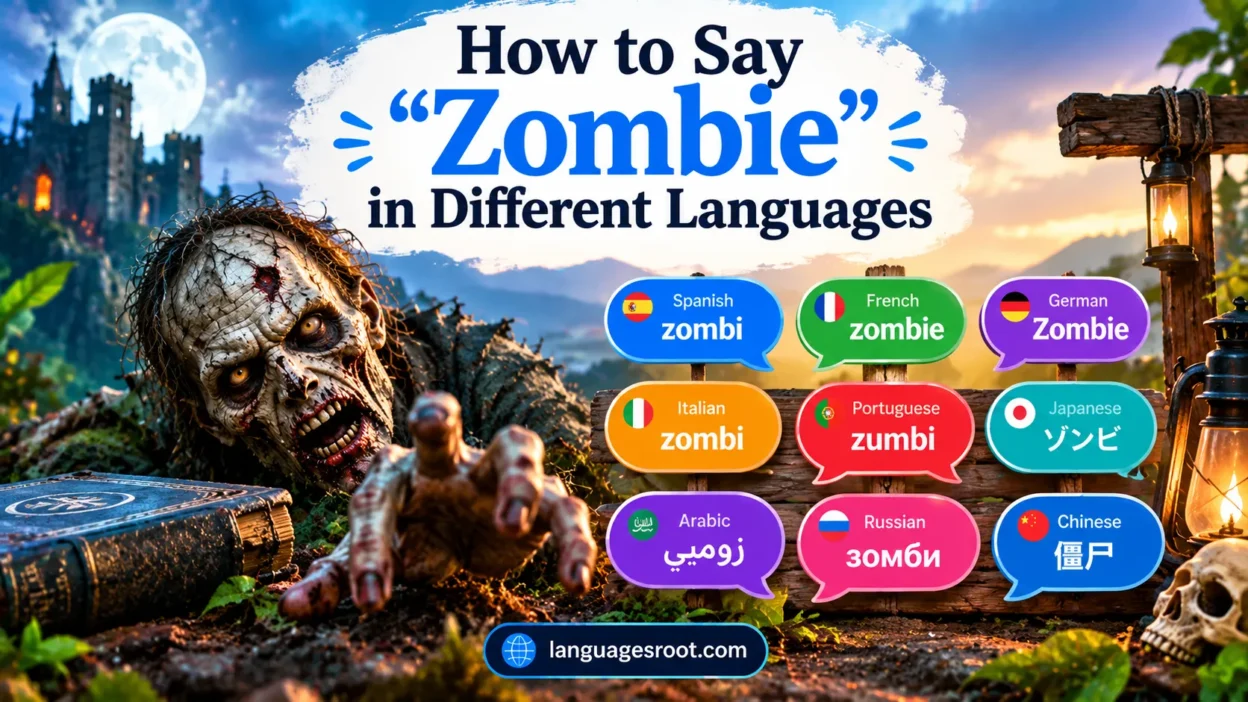
A zombie is a fictional or supernatural creature often portrayed as a dead person who has returned to life. Zombies appear in horror movies, folklore, novels, video games, Halloween celebrations, and popular stories around the world. Although the English word zombie is widely recognized internationally, different languages use their own spellings, pronunciations, and expressions to describe these mysterious creatures.
Learning how to say zombie in different languages is useful for language learners, travelers, writers, students, gamers, and anyone interested in global pop culture. It can also help you understand how languages adapt borrowed words, represent unfamiliar sounds, and describe supernatural beings. Some languages use a form closely resembling the English word, while others have established native expressions or traditional terms with slightly different meanings.
The word also has cultural significance. The modern zombie image, with its association with horror entertainment, is not identical to every traditional belief involving the dead or supernatural beings. For that reason, context matters when translating zombie. A term used in a movie title may differ from one used in folklore or everyday conversation.
In this guide, you will discover translations, pronunciation guides, and original example sentences across a wide range of languages. You will also learn about regional variations, writing systems, and the differences between a literal translation and a natural expression.
Interesting Facts About Zombie
- The word has a complex cultural history. The English word zombie is associated with Haitian Vodou and Caribbean cultural traditions, although its history and interpretation are more complicated than the modern horror stereotype.
- Many languages use borrowed forms. Words resembling zombie appear in numerous languages, sometimes with small changes in spelling or pronunciation.
- Writing systems influence spelling. Japanese, Korean, Chinese, Arabic, and other languages represent the word using their own writing conventions.
- A fictional zombie is not the same as every supernatural being. Terms for ghosts, spirits, animated corpses, and other creatures may overlap in stories, but they are not necessarily interchangeable.
- Popular entertainment spreads vocabulary. International movies, games, comics, and television shows help familiarize audiences with the word zombie.
- Pronunciation varies by language. Even when the spelling resembles English, vowel sounds, stress, and consonants can differ.
- Traditional terminology depends on context. A word associated with local folklore may carry cultural meanings that the international horror term does not fully express.
What Does Zombie Mean?
A zombie is generally understood as a fictional or supernatural dead person who has returned to life, often appearing mindless, moving unnaturally, or seeking living people in horror stories. In modern entertainment, zombies are commonly associated with horror films, survival games, apocalyptic fiction, and Halloween costumes.
The word can also have figurative meanings. Someone might casually describe an exhausted person as a zombie when they feel extremely tired or struggle to concentrate. In some contexts, it can refer to a person who seems to act automatically without paying attention.
The intended meaning matters when translating the word. A horror writer may need a term for an animated corpse, while a friend joking about being tired may need a casual expression. Traditional cultural uses of related words can also differ from the familiar fictional creature.
For this article, zombie refers primarily to the creature found in horror fiction and popular entertainment, unless an example specifically explains another meaning.
Why Can Zombie Have Different Translations?
The word zombie does not require a completely different native word in every language. Many languages have borrowed it directly or adapted it to their own spelling systems. Nevertheless, translations can vary for several reasons.
- Context: A horror movie, a folklore discussion, and a casual joke may call for different wording.
- Writing system: Languages may use Latin letters, Chinese characters, Japanese katakana, Korean Hangul, Arabic script, or another writing system to represent the term.
- Pronunciation: The same borrowed word may have different vowel sounds, consonants, or stress patterns.
- Regional usage: A term commonly understood in one country may be less familiar in another region where the same language is spoken.
- Cultural meaning: Traditional terms for spirits or reanimated bodies may not mean exactly the same thing as a modern fictional zombie.
- Formality: A news report, academic discussion, and informal conversation may use different descriptions.
- Translation purpose: Translating a movie title may require preserving the familiar international term, while explaining a local legend may require a more specific expression.
For the tables below, the main translation is the standard or widely recognizable term for a fictional zombie wherever a suitable equivalent is available. Pronunciation guides are simplified for general readers, and some regional or conventional spellings are noted where useful.
European Languages
European languages belong to several language families, including Romance, Germanic, Slavic, and Uralic languages. Many use a word that resembles zombie, but spelling and pronunciation can differ. The examples below focus on the fictional creature commonly seen in horror stories.
For this article, the translation column gives the word for “zombie,” rather than translating the entire question “How to say zombie.”
| 🌍 Language | Country/Region | Translation | Pronunciation | Example Sentence |
| 🇬🇧 English | United Kingdom and worldwide | Zombie | ZOM-bee | The zombie appeared outside the abandoned house. Meaning: A zombie appeared near an empty house. |
| 🇺🇸 American English | United States | Zombie | ZAHM-bee | That zombie movie frightened everyone. Meaning: The movie about zombies scared everyone. |
| 🇬🇧 British English | United Kingdom | Zombie | ZOM-bee | A zombie wandered through the village in the film. Meaning: A zombie walked through the village in the movie. |
| 🇦🇺 Australian English | Australia | Zombie | ZOM-bee | We dressed as zombies for Halloween. Meaning: We wore zombie costumes for Halloween. |
| 🇪🇸 Spanish | Spain and Latin America | Zombi | SOM-bee | El zombi salió de la casa abandonada. Meaning: The zombie came out of the abandoned house. |
| 🇫🇷 French | France and French-speaking regions | Zombie | zom-BEE | Le zombie avance dans la rue. Meaning: The zombie moves along the street. |
| 🇩🇪 German | Germany, Austria, Switzerland | Zombie | TSOM-bee | Der Zombie steht vor der Tür. Meaning: The zombie is standing in front of the door. |
| 🇮🇹 Italian | Italy and Italian-speaking regions | Zombie | DZOM-bee | Lo zombie cammina lentamente. Meaning: The zombie walks slowly. |
| 🇵🇹 Portuguese | Portugal and Portuguese-speaking regions | Zumbi / zombie | ZOOM-bee | O zumbi apareceu no filme. Meaning: The zombie appeared in the movie. |
| 🇳🇱 Dutch | Netherlands and Belgium | Zombie | ZOM-bee | De zombie loopt door het bos. Meaning: The zombie walks through the forest. |
| 🇸🇪 Swedish | Sweden | Zombie | SOM-bee | Zombien gömmer sig bakom trädet. Meaning: The zombie is hiding behind the tree. |
| 🇳🇴 Norwegian | Norway | Zombie | SOM-bee | Zombien kom ut om natten. Meaning: The zombie came out at night. |
| 🇩🇰 Danish | Denmark | Zombie | SOM-bee | Zombien står ved porten. Meaning: The zombie is standing by the gate. |
| 🇫🇮 Finnish | Finland | Zombi | ZOM-bee | Zombi lähestyi taloa. Meaning: The zombie approached the house. |
| 🇮🇸 Icelandic | Iceland | Uppvakningur | UP-vahk-ning-ur | Uppvakningurinn birtist í sögunni. Meaning: The reanimated dead person appears in the story. |
| 🇮🇪 Irish | Ireland | Zombaí | ZUM-bee | Chonaic mé zombaí sa scannán. Meaning: I saw a zombie in the movie. |
| 🏴 Welsh | Wales | Zombie | ZOM-bee | Gwelais i zombie yn y ffilm. Meaning: I saw a zombie in the film. |
| 🇵🇱 Polish | Poland | Zombie | ZOM-bee | Zombie pojawiły się w filmie. Meaning: Zombies appeared in the movie. |
| 🇨🇿 Czech | Czechia | Zombie | ZOM-bee | Zombie se objevilo ve filmu. Meaning: A zombie appeared in the film. |
| 🇸🇰 Slovak | Slovakia | Zombie | ZOM-bee | Zombie sa objavilo v príbehu. Meaning: A zombie appeared in the story. |
| 🇺🇦 Ukrainian | Ukraine | Зомбі | ZOM-bee | Зомбі вийшло з темного будинку. Meaning: The zombie came out of the dark house. |
| 🇷🇺 Russian | Russia and Russian-speaking regions | Зомби | ZOM-bee | Зомби появился в старом фильме. Meaning: A zombie appeared in an old movie. |
| 🇷🇴 Romanian | Romania and Moldova | Zombi | ZOM-bee | Zombiul a apărut în pădure. Meaning: The zombie appeared in the forest. |
| 🇭🇺 Hungarian | Hungary | Zombi | ZOM-bee | A zombi belépett a házba. Meaning: The zombie entered the house. |
| 🇬🇷 Greek | Greece and Cyprus | Ζόμπι | ZOM-bee | Το ζόμπι βγήκε από το σπίτι. Meaning: The zombie came out of the house. |
| 🇧🇬 Bulgarian | Bulgaria | Зомби | ZOM-bee | Зомбито се появи във филма. Meaning: The zombie appeared in the movie. |
| 🇭🇷 Croatian | Croatia | Zombi | ZOM-bee | Zombi se pojavio u priči. Meaning: A zombie appeared in the story. |
| 🇷🇸 Serbian | Serbia and Serbian-speaking regions | Зомби | ZOM-bee | Зомби се појавио у филму. Meaning: A zombie appeared in the movie. |
| 🇸🇮 Slovenian | Slovenia | Zombi | ZOM-bee | Zombi se je pojavil v filmu. Meaning: A zombie appeared in the movie. |
| 🇱🇹 Lithuanian | Lithuania | Zombis | ZOM-bis | Zombis pasirodė tamsoje. Meaning: The zombie appeared in the darkness. |
| 🇱🇻 Latvian | Latvia | Zombijs | ZOM-biyss | Zombijs parādījās filmā. Meaning: A zombie appeared in the movie. |
| 🇪🇪 Estonian | Estonia | Zombi | ZOM-bee | Zombi ilmus vana maja juures. Meaning: The zombie appeared near the old house. |
European language notes: English, French, German, and several other languages commonly use borrowed forms of zombie. Spanish commonly uses zombi, while Portuguese uses zumbi or zombie, depending on regional usage. Icelandic uppvakningur is a descriptive native term for someone brought back from the dead, rather than a spelling adaptation of the English word.
American English 🇺🇸
In American English, zombie is the familiar spelling, and the vowel in the first syllable is often pronounced differently from the British English vowel. The word is used in horror fiction and informally for someone who feels extremely tired.
British English 🇬🇧
British English also uses zombie. The first vowel generally sounds closer to the vowel in hot than the typical American pronunciation. The meaning remains the same, so there is no need to learn a separate British translation.
Australian English 🇦🇺
Australian English uses zombie as well. Pronunciation follows local Australian English speech patterns, but the spelling and basic meaning are shared with other major English varieties.
Asian Languages
Asia includes languages with many different writing systems and linguistic traditions. Some use borrowed forms of zombie, while others have familiar terms describing an animated corpse or a reanimated dead person.
For Chinese, Japanese, Korean, and other languages that do not use the Latin alphabet as their main writing system, the tables include the native script and a pronunciation guide.
| 🌍 Language | Country/Region | Translation | Pronunciation | Example Sentence |
| 🇨🇳 Mandarin Chinese | China, Taiwan, Singapore | 僵尸 / 殭屍 | Jiāngshī | 那只僵尸出现在电影里。 Meaning: That zombie appears in the movie. |
| 🇭🇰 Cantonese | Hong Kong and Guangdong | 殭屍 | Goeng¹ si¹ | 嗰隻殭屍喺套戲入面出現。 Meaning: That zombie appears in the film. |
| 🇯🇵 Japanese | Japan | ゾンビ | Zonbi | ゾンビが森から出てきた。 Meaning: A zombie came out of the forest. |
| 🇰🇷 Korean | South Korea and North Korea | 좀비 | Jombi | 좀비가 어두운 골목에 나타났어요. Meaning: A zombie appeared in the dark alley. |
| 🇮🇳 Hindi | India | ज़ॉम्बी / ज़ोंबी | Zom-bee | फ़िल्म में एक ज़ॉम्बी दिखाई दिया। Meaning: A zombie appeared in the movie. |
| 🇵🇰 Urdu | Pakistan and Urdu-speaking communities | زومبی | Zoom-bee | فلم میں ایک زومبی نظر آیا۔ Meaning: A zombie appeared in the movie. |
| 🇧🇩 Bengali | Bangladesh and eastern India | জম্বি | Jom-bi | সিনেমায় একটি জম্বি দেখা গেল। Meaning: A zombie appeared in the movie. |
| 🇮🇳 Punjabi | Punjab in India and Pakistan | ਜ਼ੌਂਬੀ / زومبی | Zom-bee | ਫ਼ਿਲਮ ਵਿੱਚ ਇੱਕ ਜ਼ੌਂਬੀ ਦਿਖਾਈ ਦਿੱਤਾ। Meaning: A zombie appeared in the movie. |
| 🇮🇳 Gujarati | Gujarat, India | ઝોમ્બી | Zom-bee | ફિલ્મમાં એક ઝોમ્બી દેખાયો. Meaning: A zombie appeared in the movie. |
| 🇮🇳 Marathi | Maharashtra, India | झॉम्बी | Jhom-bee | चित्रपटात एक झॉम्बी दिसला. Meaning: A zombie appeared in the movie. |
| 🇮🇳 Tamil | Tamil Nadu, India and Sri Lanka | சோம்பி | Soam-bee | படத்தில் ஒரு சோம்பி தோன்றியது. Meaning: A zombie appeared in the movie. |
| 🇮🇳 Telugu | Andhra Pradesh and Telangana, India | జాంబీ | Jaam-bee | సినిమాలో ఒక జాంబీ కనిపించింది. Meaning: A zombie appeared in the movie. |
| 🇮🇳 Kannada | Karnataka, India | ಜಾಂಬಿ | Jaam-bee | ಚಿತ್ರದಲ್ಲಿ ಒಂದು ಜಾಂಬಿ ಕಾಣಿಸಿಕೊಂಡಿತು. Meaning: A zombie appeared in the movie. |
| 🇮🇳 Malayalam | Kerala, India | സോംബി | Soam-bee | സിനിമയിൽ ഒരു സോംബി പ്രത്യക്ഷപ്പെട്ടു. Meaning: A zombie appeared in the movie. |
| 🇳🇵 Nepali | Nepal | जोम्बी | Jom-bee | चलचित्रमा एउटा जोम्बी देखा पर्यो। Meaning: A zombie appeared in the movie. |
| 🇱🇰 Sinhala | Sri Lanka | සොම්බි | Som-bee | චිත්රපටයේ සොම්බියෙක් පෙනී සිටියා. Meaning: A zombie appeared in the movie. |
| 🇹🇭 Thai | Thailand | ซอมบี้ | Som-bii | มีซอมบีตัวหนึ่งอยู่ในหนังเรื่องนี้។ Meaning: There is a zombie in this movie. |
| 🇻🇳 Vietnamese | Vietnam | Xác sống | Sak song | Một xác sống xuất hiện trong bộ phim. Meaning: A living corpse appeared in the movie. |
| 🇮🇩 Indonesian | Indonesia | Zombi / mayat hidup | Zom-bee / mah-yat hee-dup | Zombi itu muncul di tengah hutan. Meaning: The zombie appeared in the middle of the forest. |
| 🇲🇾 Malay | Malaysia and Brunei | Zombi | Zom-bee | Zombi itu muncul dalam filem seram. Meaning: The zombie appeared in the horror film. |
| 🇵🇭 Filipino/Tagalog | Philippines | Zombie | Zom-bee | May zombie sa pelikulang iyon. Meaning: There is a zombie in that movie. |
| 🇲🇲 Burmese | Myanmar | ဖုတ်ကောင် | Phout-kaung | ဒီရုပ်ရှင်ထဲမှာ ဖုတ်ကောင်တစ်ကောင် ပါတယ်။ Meaning: There is a zombie in this movie. |
| 🇰🇭 Khmer | Cambodia | ខ្មោចឆៅ | Khmaoch chhav | ក្នុងរឿងនេះមានខ្មោចឆៅមួយ។ Meaning: There is a zombie in this story. |
| 🇱🇦 Lao | Laos | ຊອມບີ | Som-bii | ມີຊອມບີຢູ່ໃນໜັງເລື່ອງນີ້. Meaning: There is a zombie in this movie. |
| 🇲🇳 Mongolian | Mongolia | Зомби | Zom-bi | Кинонд нэг зомби гарч ирэв. Meaning: A zombie appeared in the movie. |
| 🇰🇿 Kazakh | Kazakhstan | Зомби | Zom-bi | Фильмде зомби пайда болды. Meaning: A zombie appeared in the movie. |
| 🇺🇿 Uzbek | Uzbekistan | Zombi | Zom-bee | Filmda bir zombi paydo bo‘ldi. Meaning: A zombie appeared in the movie. |
| 🇹🇷 Turkish | Türkiye and nearby regions | Zombi | Zom-bee | Filmde bir zombi ortaya çıktı. Meaning: A zombie appeared in the movie. |
| 🇮🇷 Persian | Iran and Persian-speaking communities | زامبی | Zām-bi | یک زامبی در فیلم ظاهر شد. Meaning: A zombie appeared in the movie. |
Asian language notes: Mandarin Chinese uses 僵尸 (jiāngshī) for a reanimated corpse and also uses 丧尸 (sàngshī), particularly in modern horror and survival fiction. The traditional Chinese character forms vary by region. Japanese usually writes the borrowed word as ゾンビ, while Korean uses 좀비. Vietnamese xác sống literally describes a living corpse, and Indonesian mayat hidup has a similar descriptive meaning.
African Languages
Africa is home to a remarkable range of language families, including Niger-Congo, Afroasiatic, and several other traditions. Modern entertainment vocabulary is often borrowed or adapted, but local expressions may also describe supernatural beings in ways that do not exactly match fictional zombies.
The following examples focus on terms that can be used for a zombie in contemporary storytelling. Traditional folklore terms should be interpreted carefully because they may refer to different beings.
| 🌍 Language | Country/Region | Translation | Pronunciation | Example Sentence |
| 🇰🇪 Swahili | Tanzania, Kenya, and East Africa | Zombi | ZOM-bee | Zombi alitokea kwenye filamu ya kutisha. Meaning: A zombie appeared in the horror film. |
| 🇿🇦 Afrikaans | South Africa and Namibia | Zombie | ZOM-bee | Die zombie het uit die donker huis gekom. Meaning: The zombie came out of the dark house. |
| 🇿🇦 Zulu | South Africa | I-zombi | Ee-ZOM-bee | I-zombi yavela efilimini. Meaning: A zombie appeared in the movie. |
| 🇿🇦 Xhosa | South Africa | I-zombi | Ee-ZOM-bee | I-zombi ibonakele kwifilimu. Meaning: A zombie appeared in the movie. |
| 🇪🇹 Amharic | Ethiopia | ዞምቢ | Zom-bee | ዞምቢው በፊልሙ ውስጥ ታየ። Meaning: The zombie appeared in the movie. |
| 🇳🇬 Yoruba | Nigeria and neighboring communities | Zombie | Zom-bee | Zombie náà farahàn nínú fíìmù náà. Meaning: The zombie appeared in the movie. |
| 🇳🇬 Igbo | Nigeria | Zombie | Zom-bee | Zombie ahụ pụtara na fim ahụ. Meaning: The zombie appeared in the movie. |
| 🇳🇬 Hausa | Nigeria, Niger, and West Africa | Zombie | Zom-bee | Wani zombie ya bayyana a fim ɗin. Meaning: A zombie appeared in the movie. |
| 🇸🇴 Somali | Somalia and the Horn of Africa | Zombi | Zom-bee | Zombi ayaa ka muuqday filimka. Meaning: A zombie appeared in the movie. |
| 🇿🇼 Shona | Zimbabwe | Zombie | Zom-bee | Zombie yakaonekwa mufirimu. Meaning: A zombie appeared in the movie. |
| 🇱🇸 Sesotho | Lesotho and South Africa | Zombie | ZOM-bee | Zombie e hlahile filiming. Meaning: A zombie appeared in the movie. |
| 🇧🇼 Setswana | Botswana and South Africa | Zombie | ZOM-bee | Zombie e tlhageletse mo filiming. Meaning: A zombie appeared in the movie. |
| 🇷🇼 Kinyarwanda | Rwanda | Zombie | ZOM-bee | Zombie yagaragaye muri filime. Meaning: A zombie appeared in the movie. |
| 🇲🇬 Malagasy | Madagascar | Zombi | ZOM-bee | Niseho tao amin’ilay sarimihetsika ny zombi. Meaning: The zombie appeared in the movie. |
African language notes: Many of these examples use an internationally recognizable loanword. This is useful for modern movies, games, and informal discussion, but it should not be mistaken for a traditional word shared by all speakers. In particular, local words for spirits, ghosts, or the dead can carry distinct cultural meanings.
Middle Eastern Languages
The Middle East includes Arabic, Persian, Kurdish, Turkish, Armenian, and other languages with distinct writing systems and histories. Modern zombie vocabulary often comes from international entertainment, although descriptive expressions for the living dead are also used.
Arabic is especially diverse in everyday speech. The table uses Modern Standard Arabic as the main reference, while recognizing that pronunciation and colloquial vocabulary may differ between countries.
| 🌍 Language | Country/Region | Translation | Pronunciation | Example Sentence |
| 🇵🇸 Arabic | Palestine and Arabic-speaking regions | زومبي | Zūmbī | ظهر الزومبي في الفيلم. Meaning: The zombie appeared in the movie. |
| 🇮🇷 Persian | Iran and Persian-speaking communities | زامبی | Zām-bi | زامبی در فیلم ظاهر شد. Meaning: The zombie appeared in the movie. |
| 🌍 Kurdish | Kurdish-speaking regions of Iraq, Türkiye, Iran, and Syria | Zombi | Zom-bee | Zombî di fîlmê de xuya bû. Meaning: A zombie appeared in the movie. |
| 🇹🇷 Turkish | Türkiye | Zombi | Zom-bee | Zombi karanlık sokakta göründü. Meaning: The zombie appeared in the dark street. |
| 🇦🇲 Armenian | Armenia and Armenian-speaking communities | Զոմբի | Zom-bee | Զոմբին հայտնվեց ֆիլմում։ Meaning: The zombie appeared in the movie. |
Middle Eastern language notes: In Arabic, زومبي is a recognizable borrowed form. Another expression, الميت الحي (al-mayyit al-ḥayy), means “the living dead” and provides a more descriptive alternative. Persian uses زامبی, while Armenian uses զոմբի. These terms generally work for fictional zombies, but local dialects and particular works of fiction may use other expressions.
Wiktionary, the free dictionary
+1
Other World Languages
Some languages outside the four main regions have their own established adaptations of zombie. These examples are useful for exploring how international vocabulary changes when it enters different writing systems and language communities.
| 🌍 Language | Country/Region | Translation | Pronunciation | Example Sentence |
| 🇳🇿 Māori | New Zealand | Zombie | ZOM-bee | I kitea he zombie i roto i te kiriata. Meaning: A zombie was seen in the movie. |
| 🇼🇸 Samoan | Samoa and Samoan-speaking communities | Zombie | ZOM-bee | Na aliali mai se zombie i le ata tifaga. Meaning: A zombie appeared in the movie. |
| 🇹🇴 Tongan | Tonga | Zombie | ZOM-bee | Naʻe hā mai ha zombie ʻi he faiva. Meaning: A zombie appeared in the film. |
| 🇺🇸 Hawaiian | Hawaiʻi | Zombie | ZOM-bee | Ua ʻike au i kekahi zombie ma ke kiʻiʻoniʻoni. Meaning: I saw a zombie in the movie. |
| 🇵🇪 Quechua | Andean regions of South America | Zombi | ZOM-bee | A zombiqa rikurirqani. Meaning: I saw a zombie. This is a simple illustrative rendering using adapted vocabulary. |
| 🇵🇾 Guarani | Paraguay and neighboring regions | Zombi | ZOM-bee | Ahecha peteĩ zombi. Meaning: I saw a zombie. This is an illustrative rendering using adapted vocabulary. |
| 🇭🇹 Haitian Creole | Haiti and Haitian communities | Zonbi | ZON-bee | Zonbi a parèt nan fim nan. Meaning: The zombie appeared in the movie. |
| 🌐 Esperanto | International constructed language | Zombio | zom-BEE-oh | Zombio aperis en la filmo. Meaning: A zombie appeared in the movie. |
Cultural note: Haitian Creole zonbi is especially relevant to the history of the English word zombie. However, Haitian cultural and religious traditions should not be reduced to the fictional monsters commonly portrayed in modern horror entertainment. The word can carry meanings beyond its familiar cinematic use.
Also Read: How to Say Ice in Different Languages
Quick Reference: Zombie in Different Languages
Use this table to find the written form of zombie quickly. Some entries use a direct loanword, while others use a descriptive term for a reanimated corpse. English varieties are grouped together where the translation is identical.
| Language | Translation |
| English | Zombie |
| American English | Zombie |
| British English | Zombie |
| Australian English | Zombie |
| Spanish | Zombi |
| French | Zombie |
| German | Zombie |
| Italian | Zombie |
| Portuguese | Zumbi / zombie |
| Dutch | Zombie |
| Swedish | Zombie |
| Norwegian | Zombie |
| Danish | Zombie |
| Finnish | Zombi |
| Icelandic | Uppvakningur |
| Irish | Zombaí |
| Welsh | Zombie |
| Polish | Zombie |
| Czech | Zombie |
| Slovak | Zombie |
| Ukrainian | Зомбі |
| Russian | Зомби |
| Romanian | Zombi |
| Hungarian | Zombi |
| Greek | Ζόμπι |
| Bulgarian | Зомби |
| Croatian | Zombi |
| Serbian | Зомби |
| Slovenian | Zombi |
| Lithuanian | Zombis |
| Latvian | Zombijs |
| Estonian | Zombi |
| Mandarin Chinese | 僵尸 / 丧尸 |
| Cantonese | 殭屍 |
| Japanese | ゾンビ |
| Korean | 좀비 |
| Hindi | ज़ॉम्बी |
| Urdu | زومبی |
| Bengali | জম্বি |
| Punjabi | ਜ਼ੌਂਬੀ / زومبی |
| Gujarati | ઝોમ્બી |
| Marathi | झॉम्बी |
| Tamil | சோம்பி |
| Telugu | జాంబీ |
| Kannada | ಜಾಂಬಿ |
| Malayalam | സോംബി |
| Nepali | जोम्बी |
| Sinhala | සොම්බි |
| Thai | ซอมบี้ |
| Vietnamese | Xác sống |
| Indonesian | Zombi / mayat hidup |
| Malay | Zombi |
| Filipino/Tagalog | Zombie |
| Burmese | ဖုတ်ကောင် |
| Khmer | ខ្មោចឆៅ |
| Lao | ຊອມບີ |
| Mongolian | Зомби |
| Kazakh | Зомби |
| Uzbek | Zombi |
| Turkish | Zombi |
| Persian | زامبی |
| Swahili | Zombi |
| Afrikaans | Zombie |
| Zulu | I-zombi |
| Xhosa | I-zombi |
| Amharic | ዞምቢ |
| Yoruba | Zombie |
| Igbo | Zombie |
| Hausa | Zombie |
| Somali | Zombi |
| Shona | Zombie |
| Sesotho | Zombie |
| Setswana | Zombie |
| Kinyarwanda | Zombie |
| Malagasy | Zombi |
| Arabic | زومبي |
| Kurdish | Zombi |
| Armenian | Զոմբի |
| Māori | Zombie |
| Samoan | Zombie |
| Tongan | Zombie |
| Hawaiian | Zombie |
| Quechua | Zombi |
| Guarani | Zombi |
| Haitian Creole | Zonbi |
| Esperanto | Zombio |
How to Choose the Right Translation
The best translation depends on what you want to communicate and who will read or hear it. For a horror movie, game, costume, or fictional character, the familiar borrowed word is often a useful starting point. For a discussion of folklore, a descriptive expression such as “the living dead” may communicate the intended idea more clearly.
Consider these practical tips when choosing a translation:
- Check the context: A supernatural creature in a story may need a different term from a person who looks exhausted.
- Consider your audience: A familiar international word may work well in casual conversation, while a descriptive expression can help readers who do not recognize the loanword.
- Use the right writing system: If you are writing in Japanese, Korean, Chinese, or Arabic, use the appropriate script rather than relying only on English letters.
- Check regional usage: A word can be familiar in one region but less common in another.
- Listen to pronunciation: Romanization is helpful, but listening to a reliable audio example can clarify unfamiliar sounds.
- Respect cultural context: When discussing Haitian traditions or other folklore, distinguish cultural beliefs from fictional horror portrayals.
Key tip: If you are unsure, use the common modern term for a fictional zombie and ask a fluent speaker to check your wording before using it in a formal publication or culturally sensitive context.
Common Mistakes When Translating Zombie
Translating zombie may appear simple because many languages use similar words, but several mistakes can still affect accuracy.
- Assuming every language uses the same spelling: Spanish zombi, Haitian Creole zonbi, and Japanese ゾンビ illustrate how the word can change across languages.
- Confusing a zombie with a ghost: A ghost is generally understood as a spirit, while a zombie is usually portrayed as a reanimated body in modern horror fiction.
- Ignoring cultural meanings: Traditional terms for supernatural beings may have meanings that go beyond the modern horror genre.
- Using misleading pronunciation guides: English-style spelling cannot always reproduce the sounds of another language. Use established romanization systems when appropriate.
- Mixing regional varieties: A word used in one country’s version of a language may not be the most natural choice elsewhere.
- Treating borrowed vocabulary as a native equivalent: A familiar loanword may be useful, but it does not necessarily capture every cultural or literary meaning.
- Assuming literal translation is always best: Descriptive phrases such as “living corpse” can explain the idea but may not be the normal name for a zombie in everyday entertainment.
- Overlooking grammar: Some languages change noun endings, articles, or agreement according to grammatical rules. The form used in a complete sentence may differ from the dictionary form.
Checking the meaning, script, and context together helps you choose a more natural expression.
Why Learn Zombie in Different Languages?
Learning how to say zombie in different languages is a small but enjoyable way to explore vocabulary, popular culture, and the differences between writing systems. The word appears in horror films, books, comics, video games, and Halloween conversations, making it a useful example for language learners who enjoy international entertainment.
Comparing translations can also show how languages borrow words and adapt them to local pronunciation. You might recognize the word immediately in French or German, then discover a descriptive expression such as Vietnamese xác sống or Indonesian mayat hidup. These comparisons help demonstrate that languages do not always describe the same idea in exactly the same way.
For travelers, students, and multilingual readers, learning this vocabulary can make conversations about films and stories more engaging. It can also encourage curiosity about the cultures behind unfamiliar terms. When a word has roots in a particular cultural tradition, understanding that background is just as important as learning its spelling.
Most importantly, learning vocabulary across languages builds an appreciation for linguistic diversity. Even a single word can reveal how communities express shared ideas while preserving their own distinctive language traditions.
Frequently Asked Questions
How to Say Zombie in Different Languages
The word zombie refers to an undead figure or a reanimated corpse in folklore and fiction. Learning how to say zombie in other languages reveals interesting zombie translations and pronunciation differences. Although many languages use borrowed English words, others have unique native expressions. This guide explores zombie in different languages, including Spanish, French, Japanese, Arabic, and Chinese.
You will discover zombie meaning, zombie native spelling, and short example sentences across world languages. Additionally, explore zombie folklore, cultural context, and regional variations to understand how different communities describe these supernatural creatures. Whether you enjoy horror movies, video games, or storytelling, these translations can expand your multilingual vocabulary. Use the English pronunciation guide and English meanings to support accurate, natural language learning.
Conclusion
Learning zombie in different languages reveals fascinating zombie translations, pronunciation differences, and cultural meanings. Although many languages use similar words, others have unique expressions shaped by local traditions. Always consider context, native spelling, and natural expression to choose the right translation. These words also offer a fun way to explore world languages, folklore, and global storytelling.